
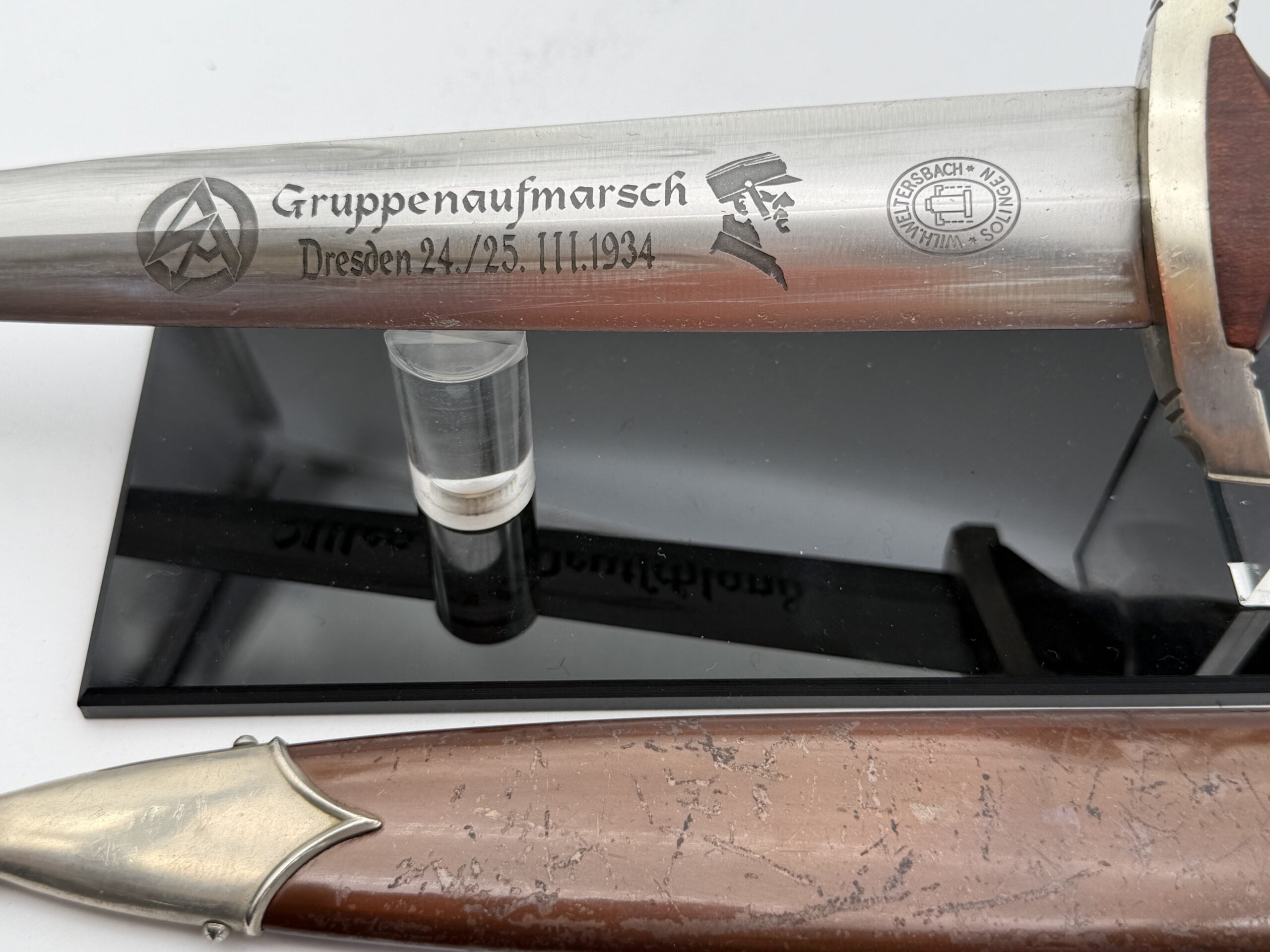
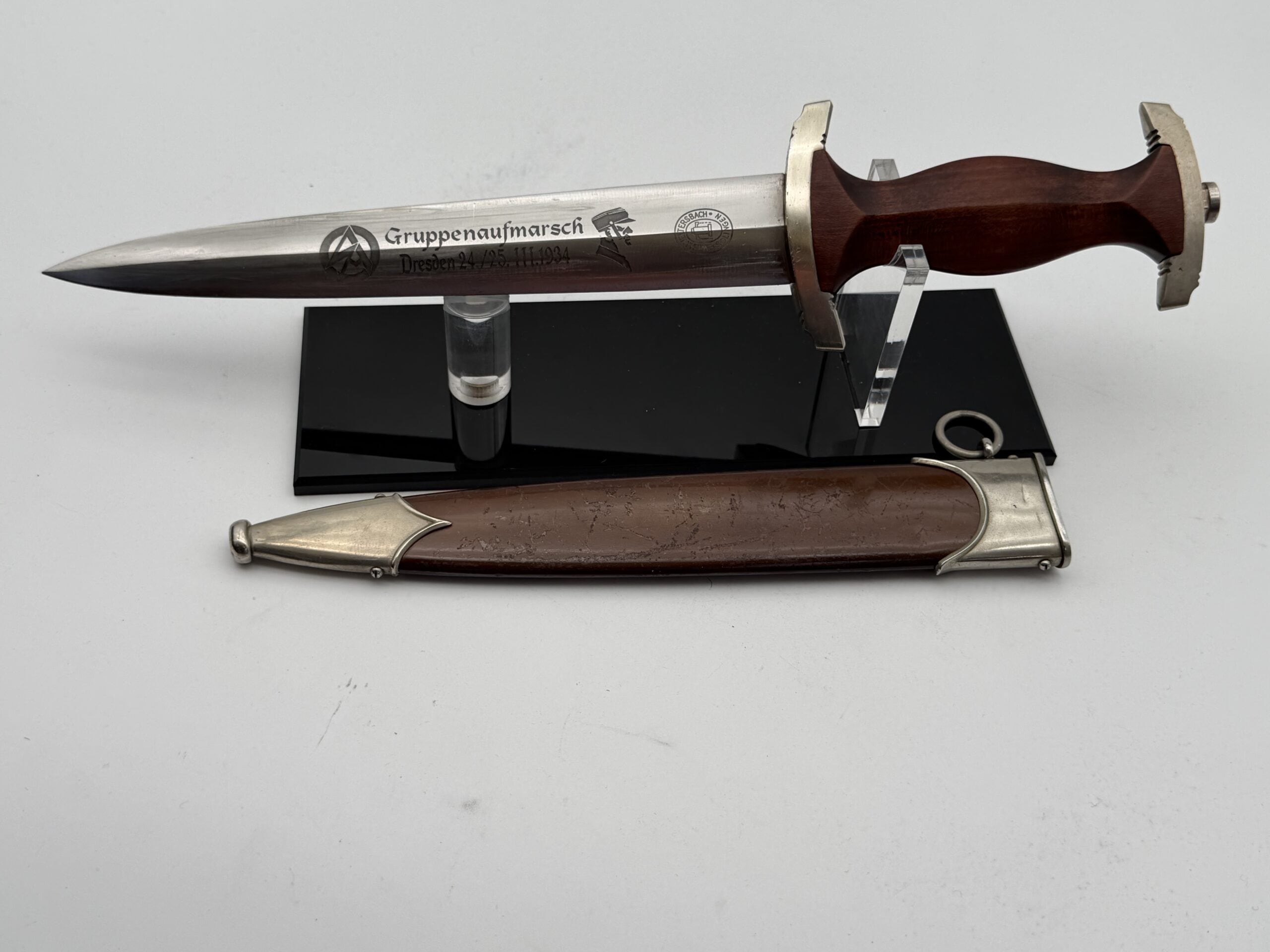
This Dresden SA presentation dagger is an exceptional early Model 1933 SA service dagger made by Wilhelm Weltersbach of Solingen. Its period double-sided blade etching commemorates the SA-Gruppenaufmarsch held in Dresden on 24 and 25 March 1934.
€ 8.000
1 in stock
This Dresden SA presentation dagger is an exceptional early Model 1933 SA service dagger made by Wilhelm Weltersbach of Solingen. Its period double-sided blade etching commemorates the SA-Gruppenaufmarsch held in Dresden on 24 and 25 March 1934.
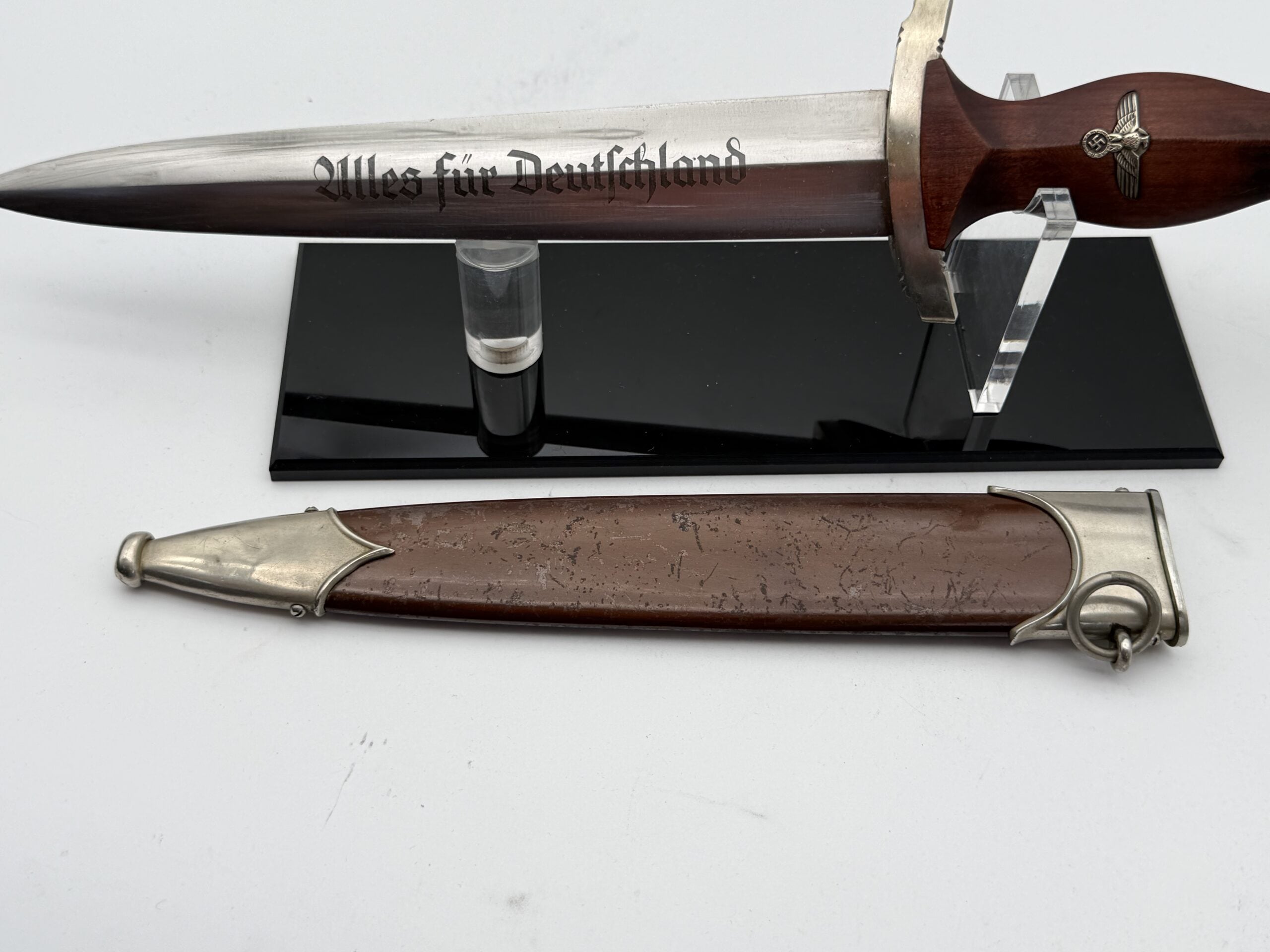
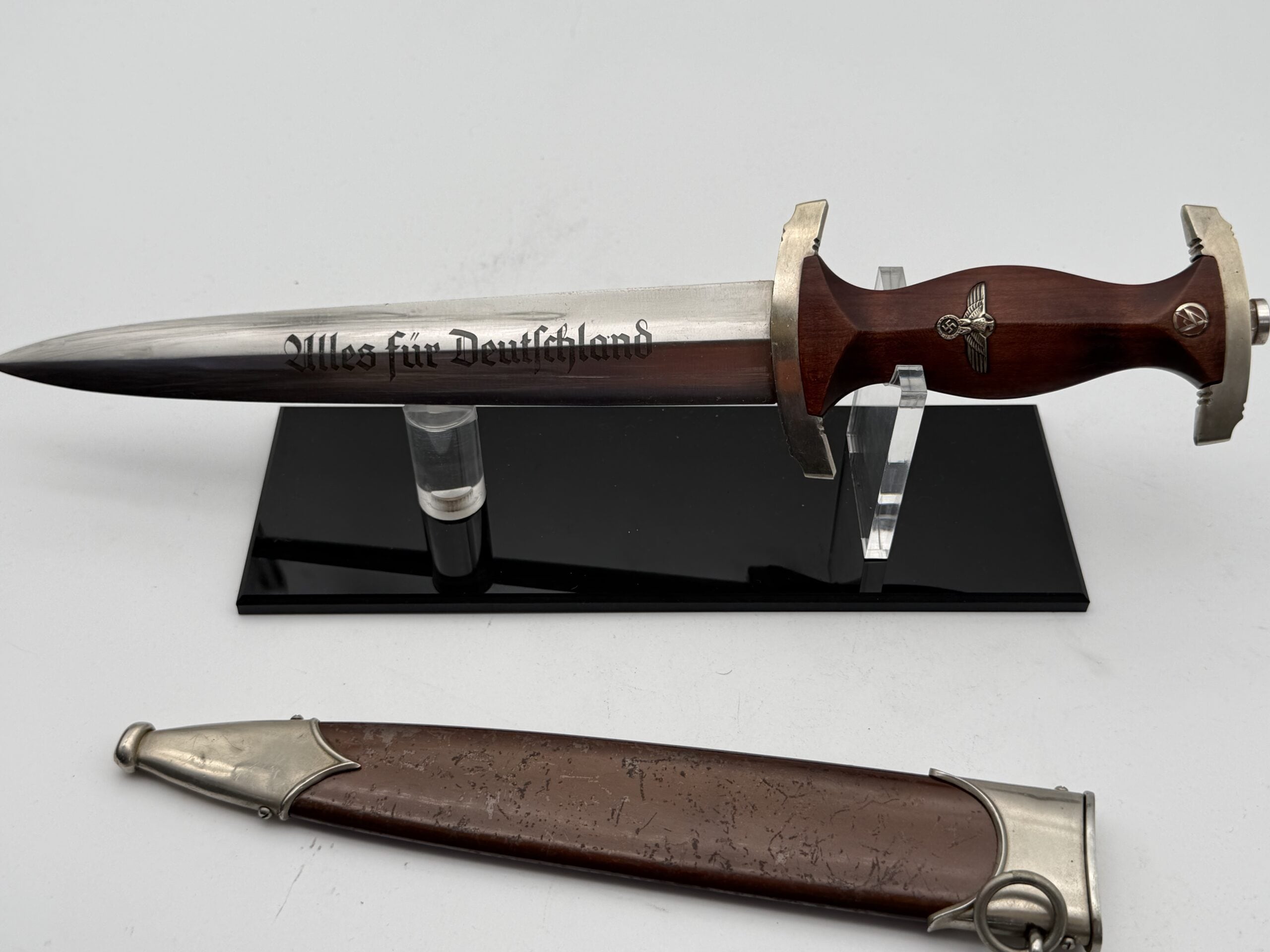
The obverse carries the standard SA motto, Alles für Deutschland. In contrast, the reverse features an elaborate commemorative design. It combines the SA emblem, the event title and dates, a profile portrait and the circular Wilhelm Weltersbach maker’s mark.
The dagger retains its reddish-brown hardwood grip, early nickel-silver fittings and original brown-finished steel scabbard. Moreover, the bright blade preserves strong, dark etching across both sides. Together, these features create a historically important and visually striking SA edged weapon.
Object: Commemorative or presentation SA service dagger
German designation: SA-Dienstdolch Modell 1933
Event: Gruppenaufmarsch Dresden
Event dates: 24–25 March 1934
Organisation: Sturmabteilung
Maker: Wilhelm Weltersbach
Manufacturing location: Solingen, Germany
Approximate production date: 1934
Blade motto: Alles für Deutschland
Commemorative inscription: Gruppenaufmarsch Dresden 24./25. III. 1934
Grip: Reddish-brown hardwood
Fittings: Early nickel silver
Scabbard: Brown-finished steel with nickel-silver mounts
Condition: Very good overall; blade especially well preserved
Named recipient: Not recorded
Provenance: Not supplied
The dagger follows the early Model 1933 SA pattern. Its reddish-brown hardwood grip has the characteristic waisted form, broad shoulders and curved lower section associated with early production.
An enamelled SA roundel sits beneath the upper guard. Below it, a nickel political eagle remains inset into the grip. Both insignia appear correctly positioned and sit naturally within the wood.
The grip retains an attractive grain and a deep reddish tone. Small handling marks remain visible. However, no major crack or serious loss appears in the supplied photographs.
Early solid nickel-silver crossguards enclose the grip. Their subdued grey patina corresponds well with the eagle and scabbard mounts. In addition, the guard surfaces show the minor knocks and contact marks expected from genuine handling.
A threaded pommel nut secures the grip assembly. The nut remains present and displays a similar surface colour to the surrounding fittings.
The blade forms the centrepiece of this Dresden SA presentation dagger.
Its obverse carries the standard acid-etched SA motto:
Alles für Deutschland
The Gothic inscription remains dark, deep and highly legible. The letters show strong outlines and well-defined interior detail.
The blade surface remains bright. Furthermore, the central ridge and full blade profile remain well defined. Fine wiping lines and light longitudinal marks appear under close lighting, although they do not dominate the presentation.
No serious pitting appears around the motto. The point also remains intact. Consequently, the blade can be described as very good, with only moderate evidence of historic cleaning or careful wiping.
The reverse carries a specially commissioned event inscription:
Gruppenaufmarsch
Dresden 24./25. III. 1934
The text translates as:
SA group mass gathering
Dresden, 24–25 March 1934
A large SA emblem appears to the left. Beside the inscription sits the profile of a uniformed SA figure wearing the characteristic kepi. The maker’s circular trademark occupies the area nearest the lower crossguard.
This arrangement differs entirely from ordinary factory-marked SA blades. Instead, the design records a specific event, place and date.
The etching displays a balanced factory-quality layout. Its depth, tone and surface relationship support its period character. Wear also runs naturally through the blade and etched sections rather than stopping around the design.
The profile may depict a senior SA leader. Alternatively, it could represent an idealised SA man. No period programme or matching design record has yet been located that allows a secure identification. Therefore, the portrait should remain officially unidentified.
Wilhelm Weltersbach manufactured the dagger at Solingen, Germany’s principal edged-weapon production centre.
The circular reverse mark reads Wilhelm Weltersbach, Solingen and encloses the firm’s trademark. Documented early Weltersbach SA daggers share the Model 1933 form, solid early fittings and conventional Alles für Deutschland blade inscription seen here.
Weltersbach ranks among the scarcer early SA manufacturers. Specialist references assign the maker a rarity rating of approximately 4.5 out of 5, reflecting the limited number of recognised surviving examples.
However, this example rises above an ordinary Weltersbach dagger. Its dated, event-specific and double-sided period etching gives it a separate level of collecting importance.
The inscription commemorates the large SA gathering held in Dresden over 24 and 25 March 1934.
The Sächsisches Staatsarchiv records the event under the title “Sachsentreffen der SA, 25. März 1934.” Its archival holdings also include records of SA-Gruppe Sachsen covering the period from 1933 to 1945.
Surviving Meissen Böttger stoneware medals carry the same event title and dates. Their existence confirms that organisers produced commemorative material specifically for the Dresden gathering.
The gathering represented a political and paramilitary demonstration rather than a military campaign. Marches, speeches and mass formations displayed the strength of the SA in Saxony.
The event occurred while the SA remained a major force within the National Socialist movement. Only three months later, Hitler’s purge of the SA leadership destroyed much of its independent political influence. Therefore, the Dresden gathering belongs to the final months of the organisation’s pre-purge ascendancy.
This dagger was almost certainly not standard equipment issued to every participant.
A normal SA member attending the gathering might acquire an event badge, postcard or commemorative medal. A specially etched Solingen dagger represented a far more expensive and prestigious object.
The most likely recipient categories include:
The absence of a recipient’s name prevents a more precise attribution. No dedication such as überreicht von, in Anerkennung or für treue Dienste appears on the blade.
Therefore, the safest conclusion identifies it as a small-series commemorative or presentation dagger, rather than a unique named award.
Its design may have served both purposes. Organisers could have presented some examples, while selected officers purchased others through approved channels.
The grip remains one of the dagger’s strongest components.
Its wood has a rich, even colour. Meanwhile, the central contour remains crisp and well balanced. The grip also fits the guards closely, with only slight age-related movement.
The SA roundel retains its enamelled centre and metal border. It appears firmly seated beneath the pommel.
Lower on the grip, the inset eagle retains clear wing and wreath detail. A soft patina covers the metal without obscuring its design.
Neither emblem should be removed for inspection. Attempting to lift them could damage the surrounding wood or loosen an undisturbed fitting.
The upper and lower guards display the weight, colour and finish associated with early nickel-silver construction.
Later SA daggers often used plated base-metal fittings. In contrast, the fittings on this example show a deeper, more uniform grey patina.
The crossguards retain their correct angular ends and decorative incised lines. Minor scratches appear across the exposed surfaces. Nevertheless, no significant bend or major fracture is visible.
The fittings have not been aggressively polished. Their surviving patina contributes to the coherent appearance of the dagger.
The dagger retains its early brown-finished steel scabbard.
Its body remains straight and complete. The brown surface shows age-related scratches, scattered finish loss and areas of oxidation. However, substantial original colour survives across both faces.
Nickel-silver mounts protect the throat and lower end. Their patina closely matches the dagger fittings.
The lower chape terminates in its original rounded ball. Both fittings retain their small attachment screws.
The scabbard displays more wear than the blade. Even so, it remains attractive and historically consistent with an object carried or stored for many years.
No attempt should be made to repaint or refinish it. Such treatment would remove original material and substantially reduce the dagger’s historical integrity.
The Dresden SA presentation dagger remains in very good overall condition.
The blade represents the strongest element. It retains a bright surface, strong motto and remarkably clear commemorative etching. Light wiping marks remain visible, although no major corrosion affects the inscriptions.
Its grip remains solid and well shaped. Both inset insignia survive, while the early fittings retain a matching patina.
The scabbard shows more extensive wear. Scratches, surface losses and oxidation appear throughout the brown finish. Nevertheless, the body remains straight and the nickel mounts remain complete.
Overall, the dagger presents far above the condition of many surviving early SA weapons. More importantly, the unique visual character of the commemorative blade remains fully preserved.
The dagger’s principal components display features consistent with early Model 1933 manufacture.
Positive characteristics include:
The dated Dresden etching displays convincing period application. Its typography, depth, positioning and ageing correspond naturally with the blade.
On the basis of the photographs and the established period nature of the etching, the dagger may be catalogued as:
An original early Model 1933 SA commemorative or presentation dagger by Wilhelm Weltersbach of Solingen, specially etched for the SA-Gruppenaufmarsch held in Dresden on 24 and 25 March 1934, complete with its early brown scabbard.
The individual recipient remains unidentified. That limitation should appear clearly in any museum, auction or sales description.
The most important surviving records lie in Germany.
The Sächsisches Staatsarchiv, Hauptstaatsarchiv Dresden holds collection 11844, Sturmabteilung (SA), Gruppe Sachsen, covering 1933–1945. The Hermann Rahne collection also contains material catalogued specifically under the Dresden SA gathering of 25 March 1934.
Regional NSDAP records survive only in fragments because of wartime destruction, deliberate disposal and post-war seizure. The Sächsisches Staatsarchiv itself recommends consulting the Bundesarchiv, the Political Archive of the German Foreign Office, the Generallandesarchiv Karlsruhe and the Staatsarchiv Bremen alongside its Dresden holdings.
The following material would be especially valuable:
Should evidence of post-war removal or overseas ownership emerge, research should then extend to the United States National Archives and The National Archives in Britain for captured German records.
This dagger survives as evidence of SA political culture during the first years of the National Socialist dictatorship.
The organisation used uniforms, edged weapons, marches and commemorative objects to strengthen internal loyalty. At the same time, such material projected authority and intimidated political opponents.
A museum description should therefore place the object within the history of political violence, dictatorship and persecution. Preservation documents the period; it does not endorse its ideology.
No publicly indexed sale of an identical Dresden Gruppenaufmarsch dagger has been located. Therefore, its value must be judged through its maker, condition, etching and historical specificity.
A more conventional M33 SA presentation dagger with an etched blade appeared through Ratisbon’s in April 2026. It failed to sell at auction and was later offered at US$3,500 plus premium. That example provides a baseline for a generic presentation dagger, but it is not a close comparison for this dated Dresden piece.
The present dagger deserves a substantial premium because it combines:
Specialist auction estimate: £5,500–£7,500
Probable auction hammer price: £6,000–£8,500
Private collector value: £7,500–£10,000
Specialist dealer retail value: £9,500–£12,500
A realistic negotiated sale should fall between approximately £8,750 and £10,000.
For the American collector market, an appropriate asking price would be around US$13,500–US$14,500.
A documented recipient, original presentation photograph or archival manufacturer order could raise the value into the region of £12,500–£15,000. Without that evidence, the dagger should remain valued as an exceptionally rare event-commemorative example rather than a named presentation weapon.
Explore related listings: SA & NSKK Daggers.