
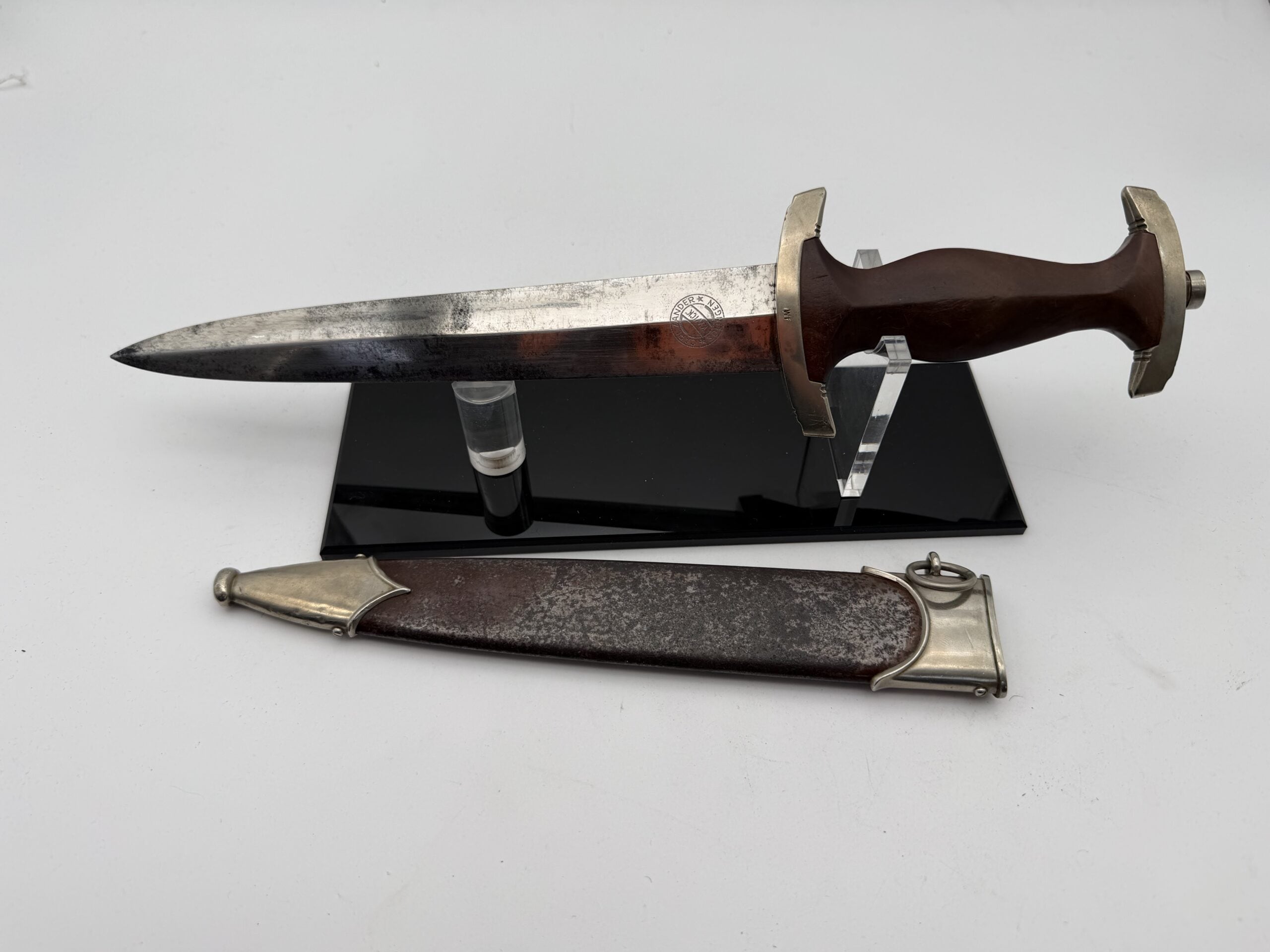
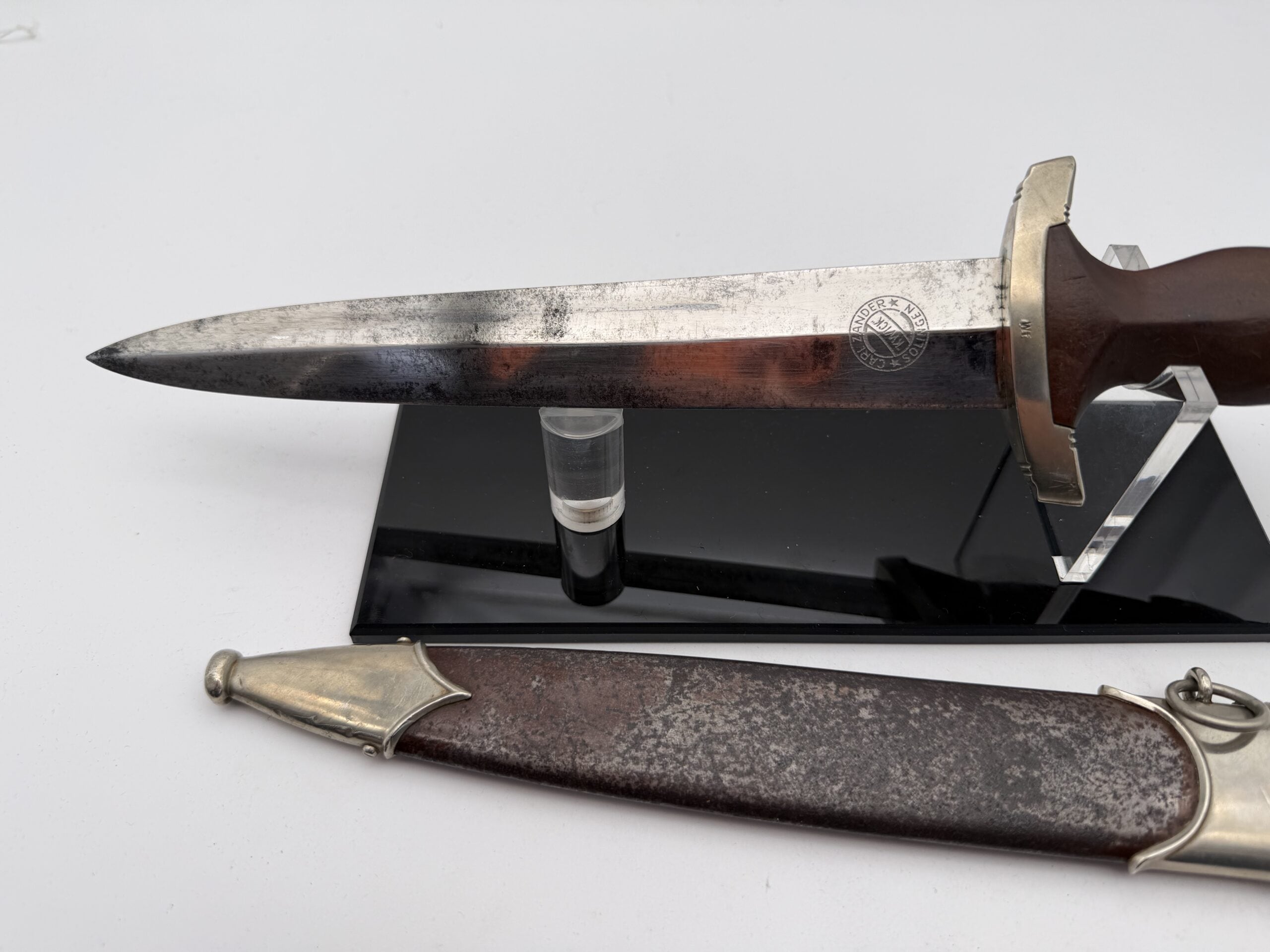
This Carl Zander SA dagger is a rare early Model 1933 SA service dagger. Carl Zander of Solingen manufactured the blade under the distinctive KWICK trademark. In addition, the lower crossguard bears the Wf distribution mark for SA-Gruppe Westfalen.
€ 1.200
1 in stock
This Carl Zander SA dagger is a rare early Model 1933 SA service dagger. Carl Zander of Solingen manufactured the blade under the distinctive KWICK trademark. In addition, the lower crossguard bears the Wf distribution mark for SA-Gruppe Westfalen.
The dagger retains its brown wooden grip, early nickel-silver fittings and brown anodised steel scabbard. Although the blade and scabbard show substantial age wear, the rare maker significantly increases its collector importance.
The visible construction appears consistent with an original early-period dagger. However, the supplied photographs do not show the grip insignia or motto side. Therefore, final authentication remains subject to examination of those areas.
Collectors can compare this dagger with other original SA and NSKK daggers and Third Reich edged weapons in the Nordmenn Militaria collection.
The Nazi Party introduced the Model 1933 SA service dagger shortly after taking power. Its form combined a double-edged blade, shaped wooden grip and brown scabbard. The dagger became one of the principal uniform weapons associated with the Sturmabteilung.
The Imperial War Museums’ Model 1933 SA dagger provides an institutional comparison. The museum identifies the design as the first dagger created for the Nazi Party’s SA militia after the formation of the Nazi government in 1933.
The SA, also known as the Brownshirts or Storm Troopers, operated as the Nazi Party’s paramilitary organisation. It used intimidation and political violence during the Nazi rise to power. Although the 1934 purge weakened its leadership, the organisation continued until Germany’s defeat in 1945. The United States Holocaust Memorial Museum’s history of the SA provides essential historical context.
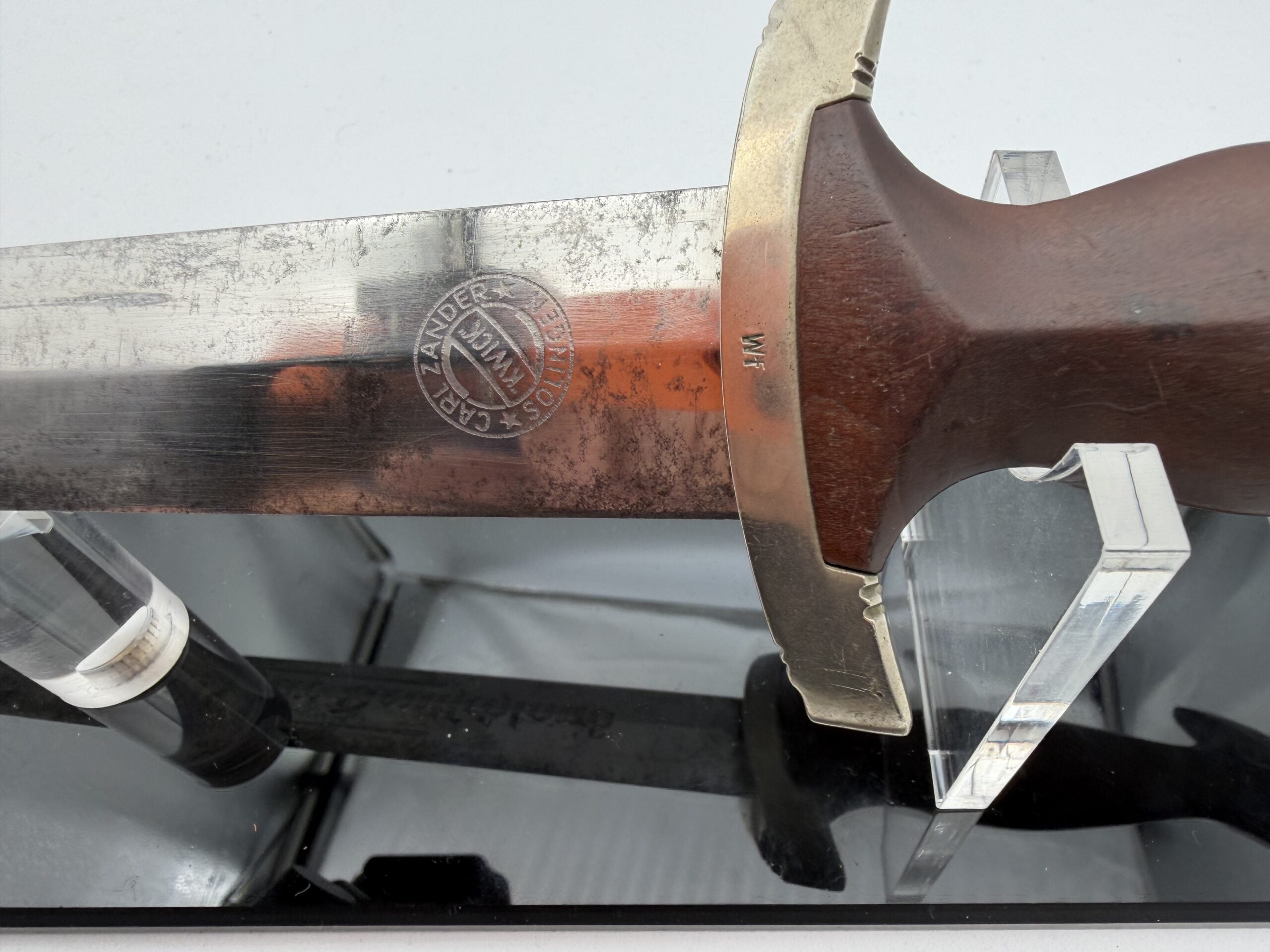
The reverse blade carries the circular Carl Zander KWICK Solingen trademark. The design consists of a circular border, the maker’s name, the Solingen location and the word KWICK across the centre.
Specialist references identify Carl Zander as an exceptionally scarce SA dagger manufacturer. The firm reportedly produced approximately 1,000 SA daggers. Moreover, reference sources associate Zander production with both the Nsand Wf distribution marks.
This low estimated production gives the Carl Zander SA dagger a strong rarity premium. By comparison, many better-known Solingen firms produced considerably larger numbers of early SA daggers.
A documented Carl Zander dagger in the Lakeside Trader archive also carries the Wf Westfalen mark. That example has the same circular KWICK trademark and an early brown anodised scabbard.
The reverse of the lower crossguard carries the stamped letters Wf. This mark identifies distribution through SA-Gruppe Westfalen.
Early SA daggers often received regional group marks during distribution. Workers usually applied these marks to the reverse lower crossguard. Therefore, the group stamp linked the dagger to its original administrative distribution area.
The Wf mark is especially relevant because documented Carl Zander daggers occur with the same Westfalen attribution. A British auction in March 2026 offered another Carl Zander KWICK dagger with a Wf-marked nickel crossguard and brown anodised scabbard.
The stamp on this dagger appears firmly impressed into the guard. It also shows wear consistent with the surrounding metal surface.
The dagger retains early-pattern nickel-coloured crossguards. Their solid appearance, rounded contours and naturally aged surfaces correspond with early Model 1933 production.
The guards have developed a warm, even patina. Small scratches and handling marks remain visible. However, the edges and stepped ends retain clear definition.
The lower guard fits closely against the shaped grip. Likewise, the upper guard follows the grip contours without an obvious modern gap. The exposed tang nut also remains present.
Carl Zander daggers typically appear with nickel-silver fittings rather than the plated fittings associated with later production. Specialist manufacturer records also note this construction characteristic.
The fittings should remain unpolished. Cleaning would remove historic patina and could reduce the dagger’s value.
The shaped brown grip follows the waisted profile of an early SA service dagger. Its surface shows natural grain, light pressure marks and darker age toning.
The grip-to-guard fit appears good. Furthermore, no large structural crack appears on the photographed reverse side.
However, the supplied images do not show the front face. Therefore, the condition and originality of the following components still require confirmation:
Assuming both insignia remain original and undamaged, the grip should contribute positively to the dagger’s value.
The double-edged steel blade retains its original spear-point profile. The reverse ricasso displays the circular Carl Zander trademark clearly.
The maker’s mark remains complete and legible. Its lettering reads:
CARL ZANDER – KWICK – SOLINGEN
The trademark has survived despite considerable blade wear. This feature remains the dagger’s most important identifying characteristic.
The photographed blade surface shows heavy grey spotting, cleaning marks and scattered oxidation. In addition, shallow pitting affects the upper blade and ricasso. Much of the original fine transverse factory grain has disappeared through earlier polishing.
Nevertheless, the blade retains a full-looking profile and an intact point. No major edge sharpening appears obvious from these photographs.
The motto side should carry the etched inscription:
Alles für Deutschland
That side has not been photographed. Consequently, the strength, originality and condition of the motto must be confirmed before the dagger receives an unconditional description.
The dagger includes an early brown steel scabbard with nickel-silver upper and lower mounts. The upper mount retains its suspension ring, while the lower chape retains its rounded ball.
The Imperial War Museums’ SA dagger scabbard records the recognised combination of a brown metal body, bright metal mounts and a suspension ring.
This scabbard shows extensive surface deterioration. Large areas of the original brown finish have thinned or disappeared. Grey oxidation and surface spotting cover much of the body.
Even so, the underlying brown tone remains visible, particularly around the edges and beneath protected areas. The scabbard body also appears reasonably straight. No major crushing or severe folding appears in the photographs.
The mounts have developed a patina that broadly corresponds with the crossguards. Their screws remain important authentication points. Therefore, each screw should receive close examination before sale.
No attempt should be made to repaint, oil or aggressively clean the scabbard. Its worn finish forms part of the object’s documented condition.
This Carl Zander SA dagger survives in fair to good collector condition. Its scarcity provides its principal strength. However, the blade and scabbard show substantial wear.
Blade: Fair to good. The maker mark remains clear, but cleaning, oxidation and pitting affect the surface.
Grip: Provisionally good. The photographed side appears sound, although the front and insignia remain unseen.
Crossguards: Good. The early fittings remain complete and display natural patina.
Group mark: Very good. The Wf Westfalen stamp remains clear.
Scabbard: Fair. It remains structurally complete, but extensive finish loss and oxidation affect both faces.
Scabbard fittings: Good. Both mounts and the suspension ring remain present.
Overall, the dagger has an honest, age-worn appearance. It does not present as a mint example. Instead, it represents a scarce maker in visibly used and stored condition.
The visible trademark, Wf group mark, early fittings, grip profile and scabbard construction support identification as an original early Model 1933 SA dagger.
Moreover, the maker-and-group combination matches other documented Carl Zander Westfalen examples. Nevertheless, photographic assessment cannot confirm every component.
The recommended catalogue wording is:
Catalogued as an original early Model 1933 SA service dagger by Carl Zander “KWICK”, Solingen, with Wf Westfalen group mark and early brown anodised scabbard. Final guarantee remains subject to inspection of the motto, grip insignia, scabbard screws and internal fit.
Before publication, add photographs of the motto, SA roundel, grip eagle, scabbard throat and all four scabbard screws.
This dagger provides material evidence of the SA uniform system and the Solingen edged-weapons industry during the early Nazi period.
Its rarity also makes it useful for studying smaller SA dagger manufacturers. The Carl Zander trademark, regional distribution mark and early nickel construction allow researchers to compare production and distribution practices across surviving examples.
However, the dagger must remain within its correct historical context. The SA helped the Nazi Party undermine democratic government through intimidation and violence. Therefore, museums and responsible collectors should interpret the object as evidence of dictatorship and political extremism rather than as an endorsement of its ideology.
The Bundesarchiv guide to Nazi-era records confirms that its holdings include personal documentation relating to members of the SA and SS. Such records may assist future research when an owner’s name or provenance becomes available.
Explore related listings: SA & NSKK Daggers; WWII German SA Dagger by F. Ed. Ohliger, Solingen; Original WW2 German SA Dagger by Gebr. Heller; Original WWII German SA Dagger by Adolf Völker, Schmalkalden.
Object: Early SA service dagger
Model: Model 1933
Maker: Carl Zander
Trademark: KWICK
Manufacturing location: Solingen
Group mark: Wf
SA group: Westfalen
Blade: Double-edged steel
Expected motto: Alles für Deutschland
Grip: Shaped brown wood
Fittings: Early nickel-silver type
Scabbard: Brown anodised steel
Scabbard mounts: Nickel-silver type
Period: Circa 1933–1935
Condition: Fair to good, with blade pitting and heavy scabbard wear
Rarity: Extremely scarce maker