
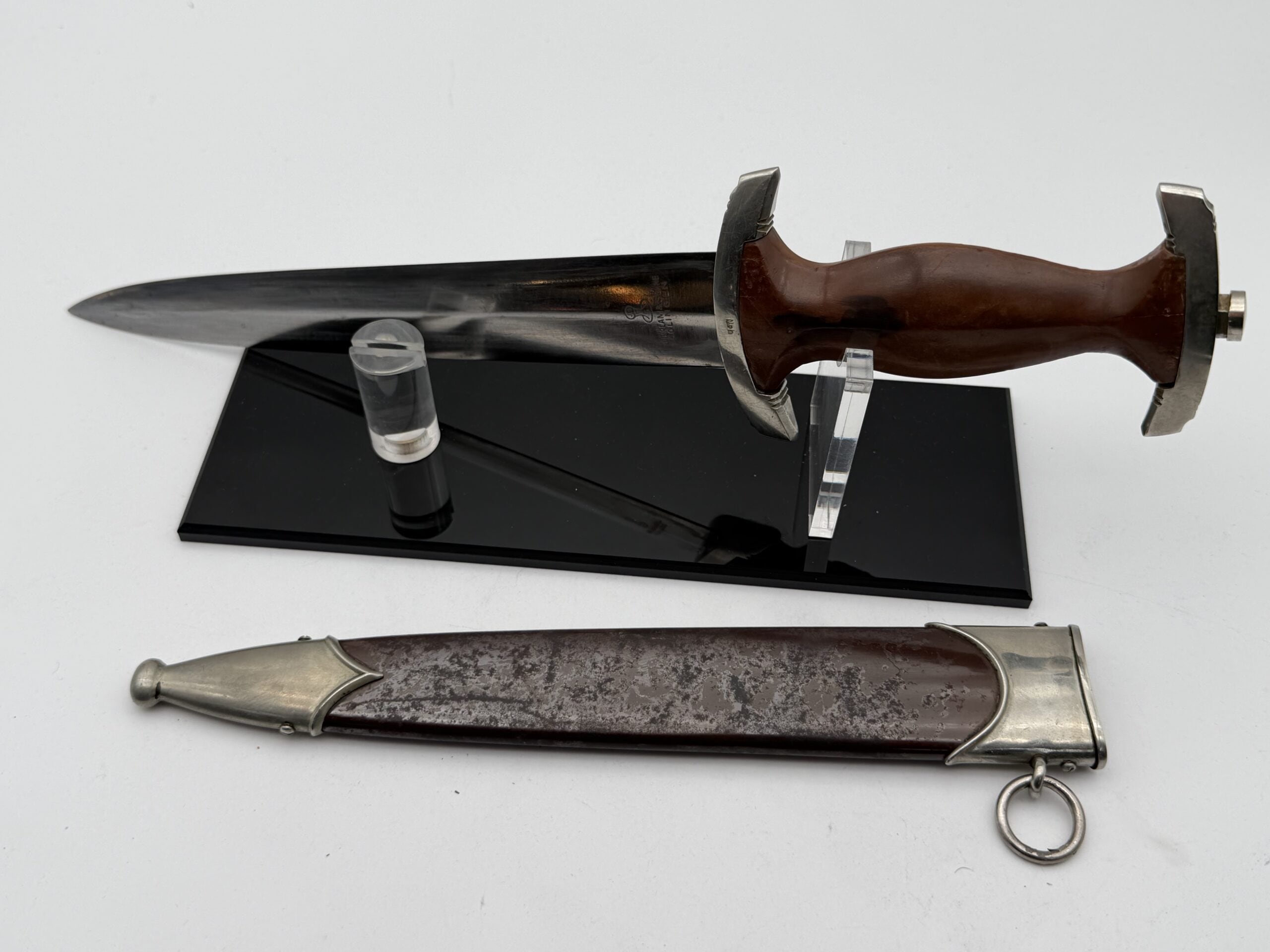
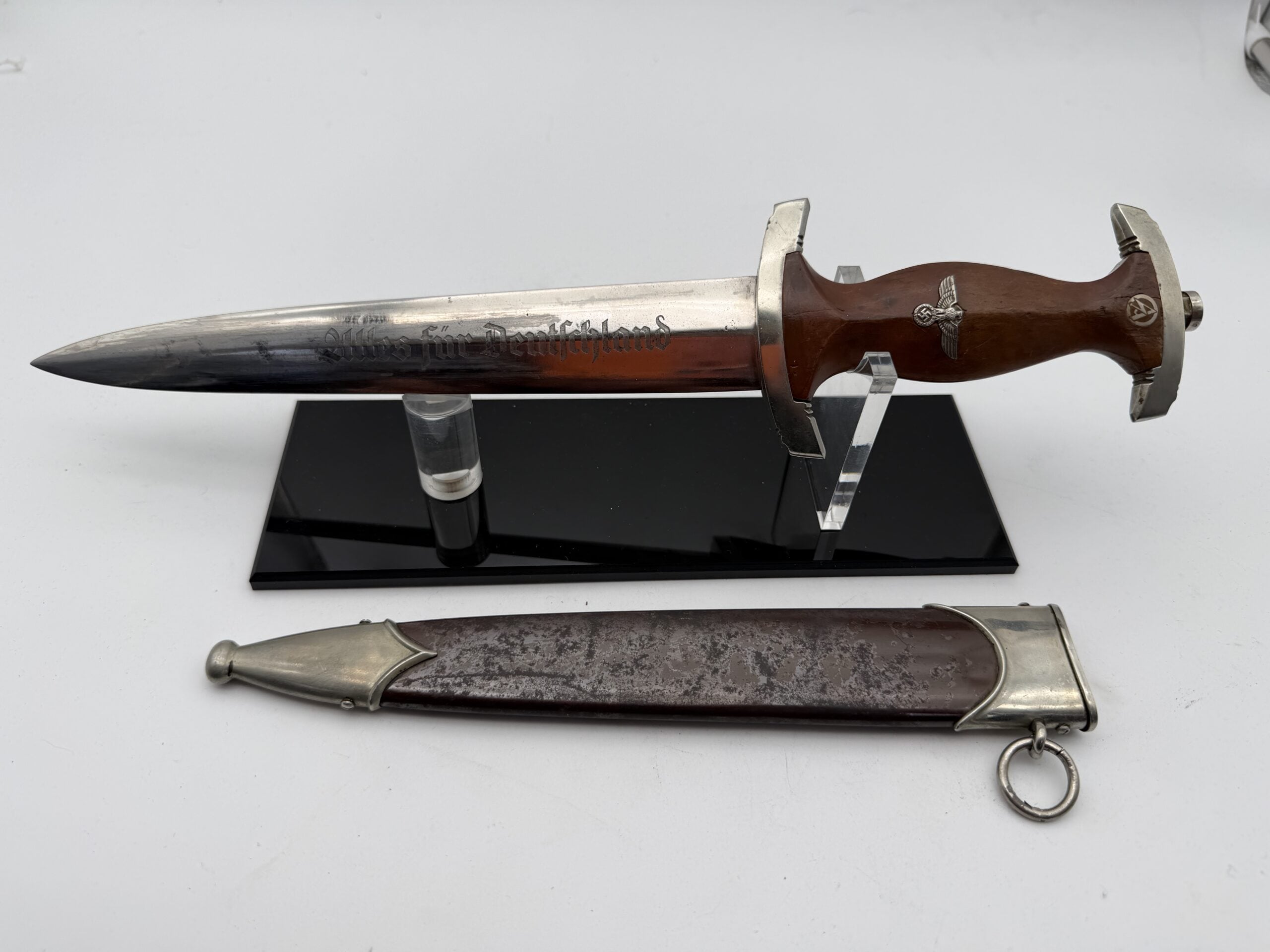
This J. Dirlam SA Dagger is a scarce early-production Model 1933 SA-Dienstdolch. The Solingen firm of J. Dirlam & Söhne manufactured the dagger during the opening years of National Socialist rule, probably between 1933 and 1935. It retains its brown wooden grip, inset SA insignia, early nickel fittings, etched motto blade and brown metal scabbard.
€ 1.300
1 in stock
This J. Dirlam SA Dagger is a scarce early-production Model 1933 SA-Dienstdolch. The Solingen firm of J. Dirlam & Söhne manufactured the dagger during the opening years of National Socialist rule, probably between 1933 and 1935. It retains its brown wooden grip, inset SA insignia, early nickel fittings, etched motto blade and brown metal scabbard.
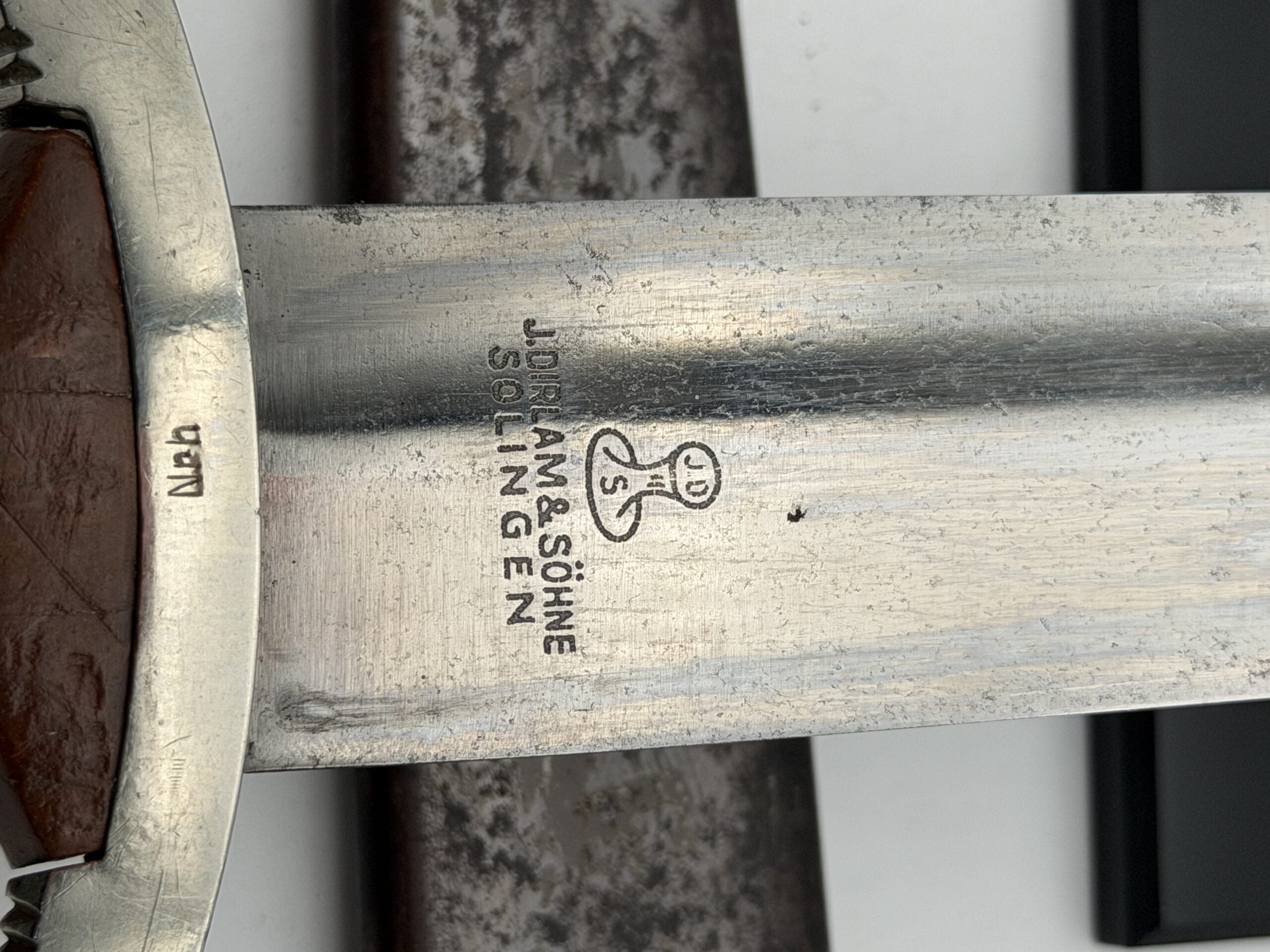
Most importantly, the reverse ricasso carries the distinctive three-lobed J.D/S trademark above the inscription:
J. DIRLAM & SÖHNE
SOLINGEN
The reverse lower crossguard bears the regional abbreviation “Nrh”, identifying allocation to SA-Gruppe Niederrhein. This maker-to-group combination appears on other documented J. Dirlam daggers. Therefore, the group mark supports the internal consistency of the dagger. Specialist sources regard J. Dirlam as one of the scarcer early SA dagger manufacturers.
The SA service dagger was introduced shortly after the establishment of the Nazi government in 1933. It became an official dress weapon of the Sturmabteilung, commonly known as the SA or Brownshirts. Its broad double-edged blade, waisted grip and curved guards drew inspiration from the traditional Holbein dagger form. The Imperial War Museums preserve comparable Model 1933 examples in their edged-weapons collection.
The SA served as the Nazi Party’s principal paramilitary organisation during its rise to power. Its members intimidated political opponents, disrupted meetings and helped enforce Nazi authority through organised violence. After the 1934 Röhm purge, the organisation lost much of its influence to the SS. Nevertheless, the SA continued to exist until the collapse of the Nazi regime in 1945.
Consequently, this J. Dirlam SA Dagger should be understood as material evidence of political extremism, dictatorship and organised violence. Its preservation and study do not imply approval of the ideology represented by its insignia.
J. Dirlam & Söhne operated in Solingen, Germany’s historic centre of edged-weapons manufacture. The firm produced only a limited number of SA service daggers when compared with major contractors such as Eickhorn, Hörster, Pack and WKC.
Collector references consistently place J. Dirlam within the scarce or rare category. One specialist reference rates the maker at approximately 8 out of 10 for rarity. Another estimates production at around 1,000 SA daggers. However, these figures represent collector research rather than surviving audited factory records. They should therefore be treated as informed estimates.
The maker’s unusual trademark is particularly desirable. It consists of a compact three-lobed device containing the letters J.D/S, followed by the company name and Solingen location. The mark remains clearly visible on the photographed blade.
The obverse blade carries the standard SA motto:
Alles für Deutschland
“Everything for Germany”
The motto remains complete, dark and clearly legible. Its Gothic lettering follows the conventional Model 1933 layout and occupies the central portion of the blade.
The blade retains its original double-edged form, central ridge and spear point. However, the surface shows considerable age and previous cleaning. Longitudinal scratches, grey spotting, oxidation and areas of polishing are visible on both sides. Some transverse grain remains apparent near the ricasso, although much of the original factory finish has been reduced.
The blade has not been shortened, and the point appears substantially intact. In addition, the motto and maker mark have survived without destructive grinding. These features preserve the dagger’s historical identity despite its condition.
The reverse ricasso displays the principal collector feature of this J. Dirlam SA Dagger. The etched trademark remains strong and consists of:
The trademark displays appropriate age within the surrounding blade surface. It does not appear freshly applied in the photographs. Moreover, the style corresponds with documented J. Dirlam examples.
A recent C&T Auctioneers example carried the same maker attribution and an identical Nrh group mark. That dagger was described as a rare-maker example and sold for £600 hammer in October 2025.
The fitted hardwood grip has the characteristic brown colour and waisted profile associated with the Model 1933 SA dagger. It retains both of its principal insignia.
Near the pommel sits the circular enamelled SA roundel. The device remains firmly installed and shows the expected brown-and-silver visual contrast. Below it, the national eagle and wreath emblem occupies the centre of the grip.
The wood shows dents, scratches, compressed areas and uneven colour. Furthermore, the surface has a relatively glossy appearance. This may result from historic handling, wax, oil or an older protective coating. A hands-on examination would be required to establish whether any later varnish has been applied.
Minor gaps are visible where the grip meets the guards. Natural shrinkage can cause this effect. However, the proud tang nut and general grip fit suggest that the hilt may have been dismantled at some point during its history.
No major section of the wooden grip appears missing. Therefore, despite the wear, the grip remains complete and presents the dagger’s original form effectively.
The upper and lower guards have the sweeping form associated with early SA daggers. Their appearance is consistent with solid nickel or nickel-silver fittings rather than the plated base metal used on many later examples.
Both guards show scratches, patination and small impact marks. Nevertheless, their edges and decorative stepped details remain well defined.
The reverse of the lower guard carries the stamped abbreviation:
Nrh
This marking is conventionally associated with SA-Gruppe Niederrhein. The same abbreviation appears on other recorded J. Dirlam daggers, making it a credible and desirable maker-to-group association.
The tang nut remains present, although it stands slightly proud of the upper guard. This may reflect wood shrinkage, earlier tightening or historic disassembly. It should not be adjusted without specialist examination.
The steel scabbard retains portions of its original brown surface treatment. Early SA scabbards commonly used a chemically browned or anodised finish, sometimes protected by a clear lacquer coating. Museum examples demonstrate the standard combination of a brown metal body, bright throat mount, lower chape and suspension ring.
The photographed scabbard remains complete with:
However, the scabbard has suffered extensive surface deterioration. One face displays widespread finish loss, oxidation and pitting. Large irregular patches now expose the underlying steel. The surviving brown finish is most visible around the edges and on the reverse.
The nickel mounts show age-related dulling, scratches and small contact marks. The lower ball remains present and has not been crushed flat. No leather suspension hanger accompanies the dagger.
Although the corrosion lowers the commercial grade, it also shows that the scabbard has not received an aggressive modern refinishing treatment. The surviving surface should remain untreated. Abrasive cleaning would remove additional original material and reduce the historical value.
The visible features of this J. Dirlam SA Dagger are consistent with an original early Model 1933 example:
The J. Dirlam maker mark and Nrh group stamp also correspond with documented examples offered through established specialist and auction sources.
Nevertheless, photographic examination cannot confirm the tang, internal guard markings, grip emblem pins or scabbard throat construction. Therefore, the most responsible catalogue conclusion is:
An apparently original early J. Dirlam & Söhne Model 1933 SA service dagger with Nrh group mark, retaining its period scabbard, subject to final hands-on authentication.
Blade: Complete, with a clear motto and scarce maker mark. Considerable polishing, scratching, grey spotting and oxidation are present. Much of the factory grain has been reduced.
Grip: Complete and fitted with both insignia. It shows dents, scratches, colour variation and a glossy surface. Minor shrinkage is visible around the guards.
SA roundel: Present and securely fitted. It shows age but remains clearly recognisable.
Grip eagle: Complete, with visible feather and wreath detail.
Crossguards: Early nickel-style construction with age-related scratches and patination. The lower guard carries the clear Nrh mark.
Tang nut: Present but slightly proud. Previous dismantling cannot be excluded.
Scabbard: Complete but heavily affected by finish loss, oxidation and pitting. Both mounts and the suspension ring remain present.
Hanger: Not included.
Overall condition: Fair to good, with scarcity and completeness offset by substantial blade cleaning and scabbard corrosion.
No individual ownership number or documentary provenance is visible in the supplied photographs. Therefore, the dagger cannot currently be attributed to a named SA member.
The Nrh stamp connects the dagger administratively with the Niederrhein regional SA structure. However, it does not identify an individual owner. Further research would require surviving purchase documentation, family history or a separately recorded membership number.
The German Federal Archives provide the principal institutional starting point for research into surviving Nazi Party and paramilitary records. However, wartime destruction and post-war dispersal mean that many personnel files remain incomplete.
This J. Dirlam SA Dagger represents a scarce and distinctive variation of the early Model 1933 SA service dagger. Its principal strengths include the clearly preserved maker trademark, the Nrh group stamp, complete wooden grip, original-style insignia and period brown scabbard.
Condition remains the principal limitation. The blade has undergone noticeable cleaning, while the scabbard has extensive corrosion and finish loss. Nevertheless, the dagger remains historically complete and retains the important features that identify its uncommon manufacturer.
For an advanced collection arranged by manufacturer, regional group or Solingen production, this is a worthwhile representative example of a rarely encountered maker.
Explore related listings: SA & NSKK Daggers; Original WWII German SA Dagger by Gl. Koller Nachf., Solingen; WWII German SA Dagger by F. Ed. Ohliger, Solingen.