
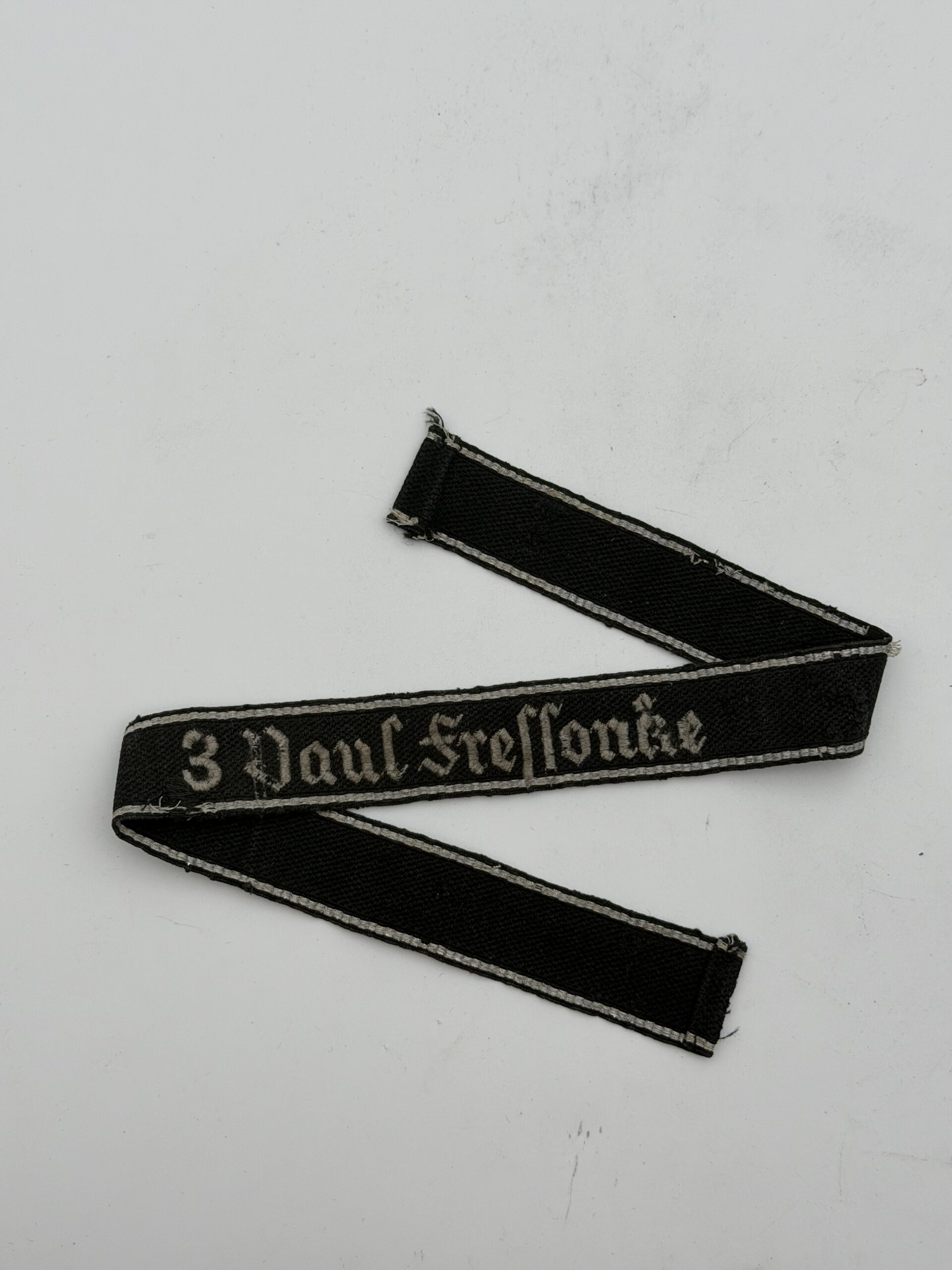
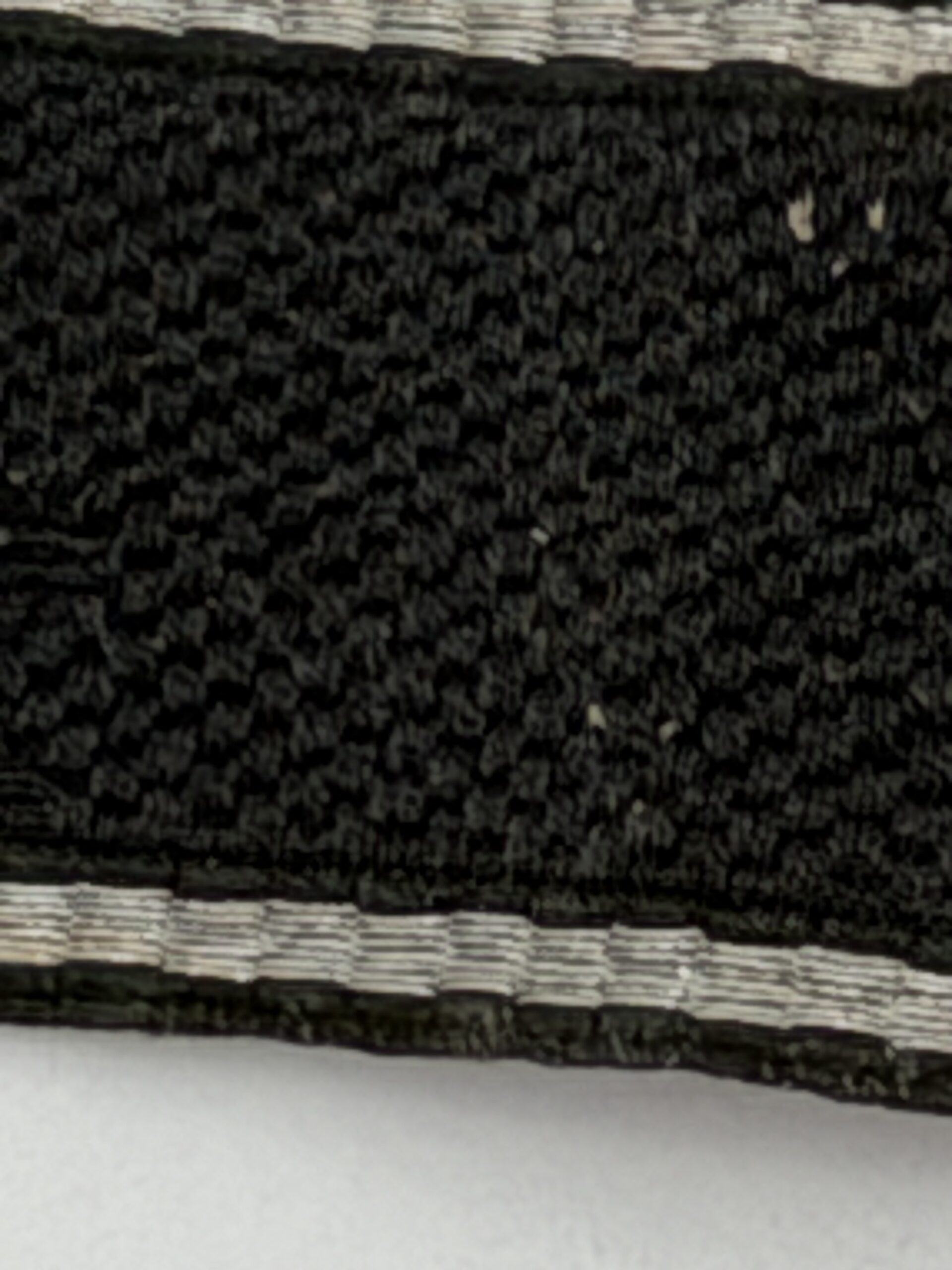
Rare original Paul Fressonke SS cuff title for the Danzig-based 3rd platoon of the 7th SS transport formation. Machine embroidered in silver-grey Gothic lettering on black woven RZM-pattern band material, with seven-thread silver-aluminium borders and finished ends. Approximately 46.5 cm long, with visible period wear and losses. Photographically matched to Hermann Historica lot 4175 from the Dave Delich Collection.
€ 4.250
1 in stock
This original Paul Fressonke SS cuff title is a rare, full-length Allgemeine-SS honour title associated with the Danzig transport formation 3/7 SS-Kraftfahrsturm. The black woven band carries the numeral “3” and the name “Paul Fressonke” in silver-grey Gothic machine embroidery.
Seven horizontally woven silver-aluminium threads border the upper and lower edges. Moreover, both ends retain their original folded finish. The title measures approximately 46.5 cm, according to its archived Hermann Historica catalogue entry.
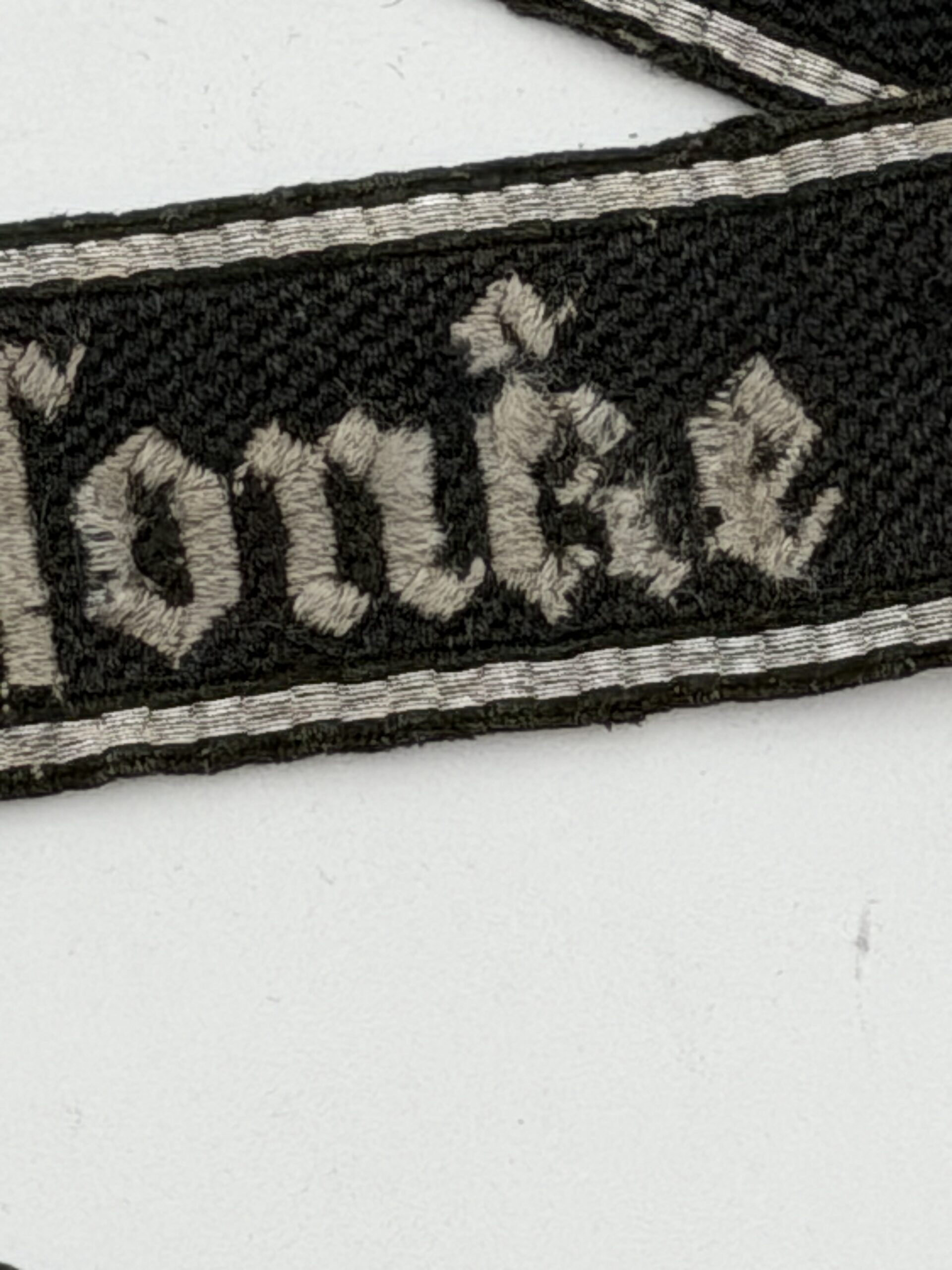
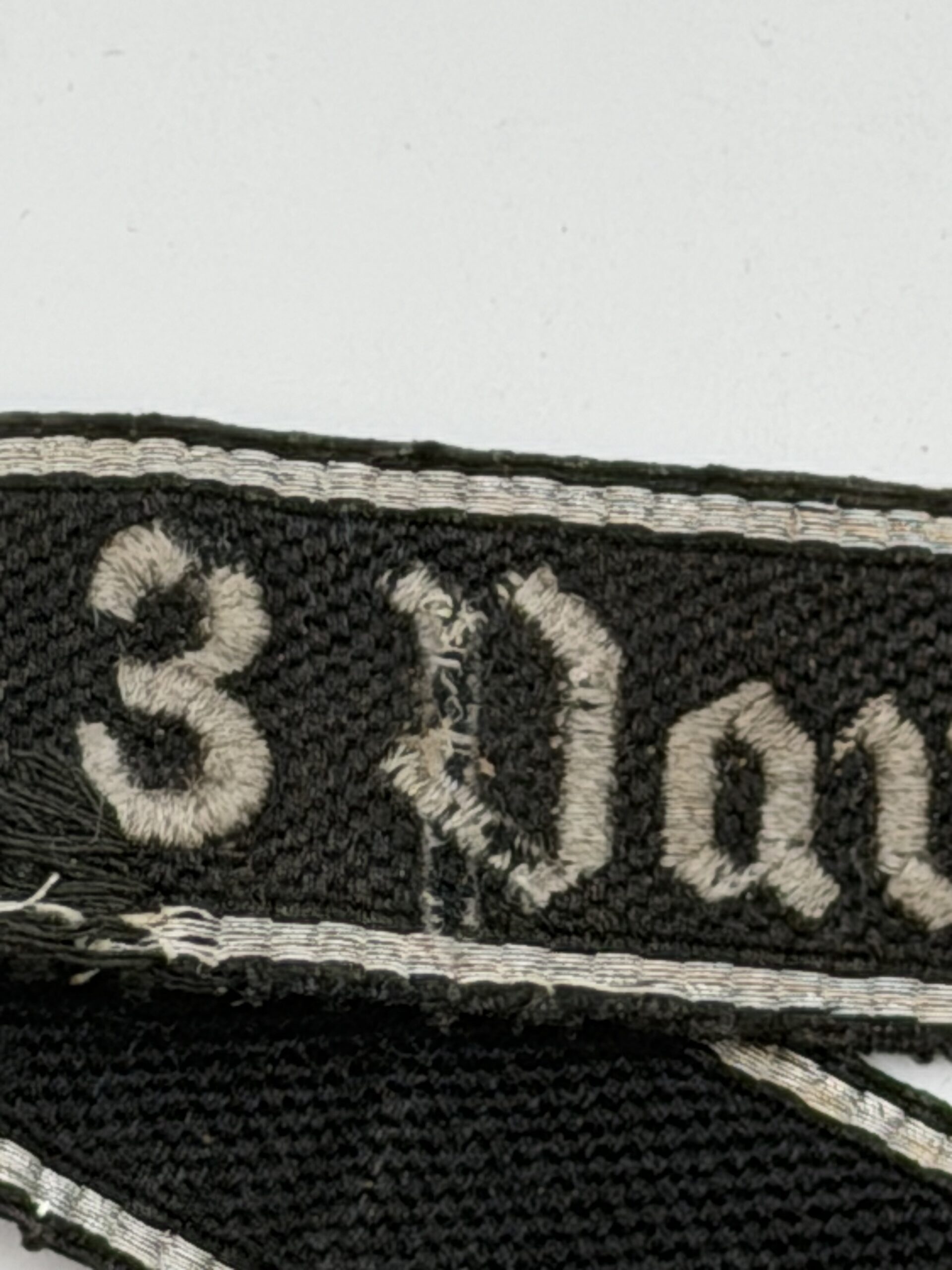
The cuff title displays genuine age and service wear. Several sections of the lettering have suffered thread loss, particularly around the capital P and within the surname. Small pulls also affect the metallic borders. Nevertheless, the complete designation remains clearly recognisable.
The title has traditionally been identified as the honour cuff title of the 3rd Sturm of the 7. SS-Standarte “Friedrich Schlegel”, based in Plauen. That interpretation appears in older specialist references and continues to circulate in the collector market.
More recent archive-based research has corrected this attribution.
Historian Jan Daniluk examined an April 1939 list of SS formations stationed in Danzig. The document records the 3rd platoon of the 7th SS transport company, designated 7. SS-Kraftfahrsturm “Paul Fressonke,” at Heiligenbrunnerweg 30 in Danzig-Langfuhr.
Daniluk specifically describes the supposed connection with the Plauen-based 7. SS-Standarte as a mistake. The presence of a Danzig transport unit bearing Fressonke’s name also makes greater geographical and organisational sense. Fressonke himself belonged to the Danzig SS.
Consequently, the numeral 3 should be interpreted as identifying the Danzig subunit or third platoon. It does not represent the 3rd company of the unrelated Plauen foot Standarte.
The correct catalogue designation is therefore:
Allgemeine-SS cuff title for 3/7 SS-Kraftfahrsturm “Paul Fressonke,” Danzig-Langfuhr.
This archive-supported identification significantly improves the historical importance of the cuff title. It connects the insignia with a documented local SS transport formation rather than with the previously assumed Saxon unit.
The Danzig motorised SS organisation underwent several changes during the 1930s. Initially, the local unit formed part of the 26. SS-Motor-Standarte.
Around 1935 or 1936, the 26th motor Standarte was dissolved. Its reduced motorised formations joined a regional unit known as the 7. SS-Motor-Standarte, headquartered in Königsberg. By 1938, this formation had become the 7. SS-Kraftfahrsturm.
Its subunits operated in Königsberg, Elbing and Danzig. The Danzig component formed the third platoon and occupied its own headquarters at Heiligenbrunnerweg 30. Members of the unit had constructed this building for their use.
The specialist transport formation provided trained drivers, vehicle personnel and motorised support within the Allgemeine-SS structure. Therefore, it should not be confused with a Waffen-SS combat regiment or division.
Research published by the Stutthof Museum also lists Sturm 3/K/7 “Paul Fressonke” among the specialist SS formations associated with the Danzig area. This independently supports the transport-unit interpretation.
Paul Fressonke held the rank of SS-Unterscharführer in the Danzig SS.
In June 1936, Fressonke and SS-Rottenführer Ernst Ludwig were shot during an incident near Wiesenthal in the Danzig region. Both men died after they were taken to the municipal hospital in Danzig.
Nazi newspapers claimed that the two men had been attacked while seeking assistance for a broken-down motorcycle. However, opposition newspapers presented a different account. The surviving evidence does not allow the precise circumstances to be reconstructed with certainty.
The Nazi authorities quickly transformed their deaths into political propaganda. Heinrich Himmler, Karl Wolff and Werner Lorenz attended the funeral ceremonies. Subsequently, SS formations received the names of Fressonke and Ludwig as supposed National Socialist “martyrs.” Streets and youth institutions in Danzig were also named after them.
The term “martyr” should therefore appear only in quotation marks or as a description of contemporary Nazi propaganda. It should not be repeated as an objective historical judgement.
The cuff title uses a dense black woven foundation. Its surface shows the fine diagonal texture commonly associated with RZM-pattern cuff-title band material.
The complete inscription reads:
3 Paul Fressonke
The maker applied the wording by machine in silver-grey textile thread. The Gothic-style letters stand above the black foundation and display the slightly irregular density expected from period machine embroidery.
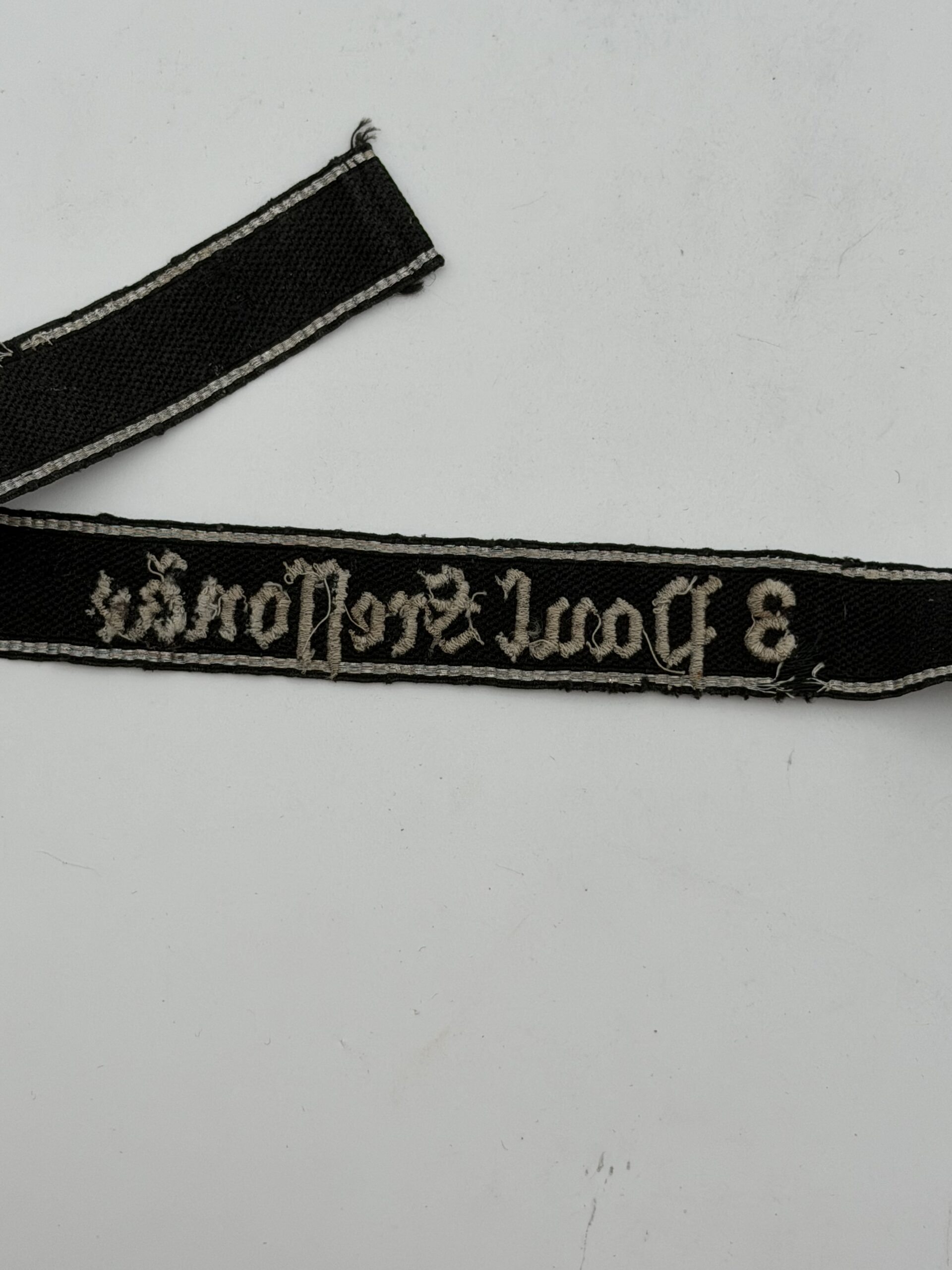
This is not a BeVo flatwoven cuff title. Instead, the letters were embroidered onto previously manufactured bordered band material. The reverse confirms this method, as it shows the travelling and securing threads associated with the embroidered inscription.
Both long edges incorporate seven horizontal silver-aluminium threads. These borders form part of the original band construction rather than separate strips applied later.
The silver-grey borders now display age-related dulling and localised wear. Small sections have also become pulled or displaced. However, the borders remain substantially complete along the full surviving length.
The title begins with a large embroidered Arabic numeral 3. A clear space separates the numeral from the personal name.
The name appears in traditional Gothic lettering. The tall initial P originally featured a broad curved upper section and a long vertical stem. Unfortunately, part of this letter has suffered noticeable thread loss.
The surname remains readable as Fressonke, although scattered sections of embroidery are missing. These losses appear through several individual letters rather than across one newly damaged area.
Importantly, the damaged portions reveal the underlying black foundation. They do not show signs that the original inscription was removed and subsequently replaced.
The colour, thickness and ageing of the numeral and name remain consistent. Therefore, the numeral and inscription appear to have formed one original manufacturing stage.
The reverse shows the black woven foundation and the underside of the machine embroidery. There is no modern synthetic covering or newly applied backing panel.
The travelling threads correspond with the letters visible on the obverse. In addition, the thread colour remains consistent across the inscription.
The exposed reverse also shows natural compression and irregularity. These features reflect manufacture, folding and long-term storage rather than recent artificial ageing.
No RZM label remains visible. However, the absence of a label is not unusual on a worn or handled machine-embroidered cuff title. Labels could detach during service, removal from a tunic or subsequent storage.
Both ends retain folded black terminations. One end shows loose fibres and displaced metallic border threads. The opposite end also displays old stitching and surface disturbance.
These details support genuine period use. They also agree with the Hermann Historica description, which recorded “finished ends” and damage to the lettering and border threads.
The full length of approximately 46.5 cm falls within the normal range for machine-embroidered Allgemeine-SS cuff titles. Specialist references record examples between approximately 41 and 50 cm.
The ends should remain untouched. They preserve important evidence concerning the title’s original construction and use. Therefore, loose fibres should not be trimmed or secured with adhesive.
Photographic comparison identifies this cuff title as Hermann Historica lot 4175, offered on 18 October 2023 as part of the Dave Delich Collection.
Several unique features establish the match:
Hermann Historica catalogued the title as a black cloth band with seven-thread silver-aluminium borders. It recorded the inscription as machine embroidered in silver-grey thread. The auction house also measured the title at approximately 46.5 cm and assigned Condition II. It sold for €520 hammer.
The provenance should appear in the published listing as:
Provenance: The Dave Delich Collection; Hermann Historica, lot 4175, 18 October 2023.
The original invoice, lot card, catalogue page and any earlier collection documentation should remain permanently with the cuff title.
The visible construction supports an original pre-1945 assessment.
Positive characteristics include:
The wear pattern also appears coherent. The damaged lettering, borders, foundation and finished ends have aged together. No isolated component looks newly introduced.
Most importantly, the title can be photographically traced to a recognised specialist collection and an established German auction house. This provenance provides considerably stronger support than an anonymous dealer attribution.
The most accurate authentication conclusion is:
Original period Allgemeine-SS machine-embroidered honour cuff title for 3/7 SS-Kraftfahrsturm “Paul Fressonke,” Danzig, approximately 46.5 cm long and formerly in the Dave Delich Collection.
Black foundation: The woven black band remains complete and structurally stable. It shows light surface wear and small localised pulls.
Lettering: The inscription remains legible. However, the capital P and several letters within “Fressonke” have sustained visible losses.
Numeral: The embroidered numeral 3 remains substantially complete, with minor surface wear.
Metallic borders: Both seven-thread borders remain present. Several sections show pulls, displaced strands and age-related dulling.
Reverse: The machine-embroidered construction remains clearly visible. No modern backing or major repair appears in the photographs.
Ends: Both ends retain their old folded finish. Loose threads and minor fraying remain visible.
Repairs: No obvious modern reconstruction appears. The damaged embroidery should not be restored.
Overall condition: Good historic, service-worn condition. The title has visible losses, but it remains full length, legible and highly collectable.
Named Allgemeine-SS honour titles were limited to particular formations. Consequently, their production numbers were much smaller than those of ordinary numbered Standarte cuff titles.
This example has several desirable features:
The archive-based reassessment also adds research value. It corrects a long-standing error in collector literature and places the title within the documented Danzig SS transport structure.
Therefore, this Paul Fressonke SS cuff title would suit an advanced Allgemeine-SS collection, a specialist Danzig historical display or a study collection devoted to SS unit insignia.
| Feature | Description |
|---|---|
| Organisation | Allgemeine-SS |
| Formation | 7. SS-Kraftfahrsturm |
| Subunit | 3rd platoon, commonly expressed as 3/7 |
| Honour name | Paul Fressonke |
| Location | Danzig-Langfuhr, now Gdańsk-Wrzeszcz |
| Period | Circa 1936–1939 |
| Inscription | 3 Paul Fressonke |
| Construction | Machine-embroidered lettering on black woven band |
| Script | Gothic |
| Lettering colour | Silver-grey |
| Borders | Seven-thread silver-aluminium upper and lower borders |
| Ends | Period folded and finished |
| Length | Approximately 46.5 cm, according to the auction record |
| RZM label | Not present |
| Condition | Service worn, with losses to lettering and border threads |
| Provenance | Dave Delich Collection; Hermann Historica lot 4175 |
Explore related listings: Cuff Titles & Armbands; Nordmenn Militaria SS Items collection; Uniforms and Cloth Insignia collection; Original SS-Hauptamt Officer Cuff Title with Original RZM Label.
Detailed archive-based research appears in Jan Daniluk’s study of the SS in Danzig. His work corrects the older Plauen attribution and identifies the Danzig 3/7 transport unit.
The Stutthof Museum research journal provides further scholarly material concerning SS formations operating in the Danzig region.
The original auction appearance can be viewed in the Hermann Historica lot 4175 archive.
Further primary research can be undertaken through the Bundesarchiv guide to surviving SS records, including records relating to Allgemeine-SS formations and regional commands.
No. It is an Allgemeine-SS specialist transport-unit cuff title. It predates or belongs outside the familiar Waffen-SS divisional cuff-title system.
Archive research indicates that the numeral identifies the 3rd platoon of the 7th SS transport formation stationed in Danzig.
Older collector references say so. However, surviving Danzig archival records show that this attribution resulted from a historical misreading. The correct formation was the Danzig 3/7 SS transport unit.
Paul Fressonke was an SS-Unterscharführer in Danzig. He died after a shooting incident in June 1936. The Nazi authorities later used his death for propaganda and named an SS transport subunit after him.
Yes. The archived measurement is approximately 46.5 cm, which represents a substantially full-length example.
No modern repair is visible in the supplied photographs. The losses to the lettering and borders should remain untouched.
The unique damage pattern, folded ends, proportions and embroidery losses match Hermann Historica lot 4175. Therefore, the photographed cuff title can be identified as the Dave Delich Collection example.