
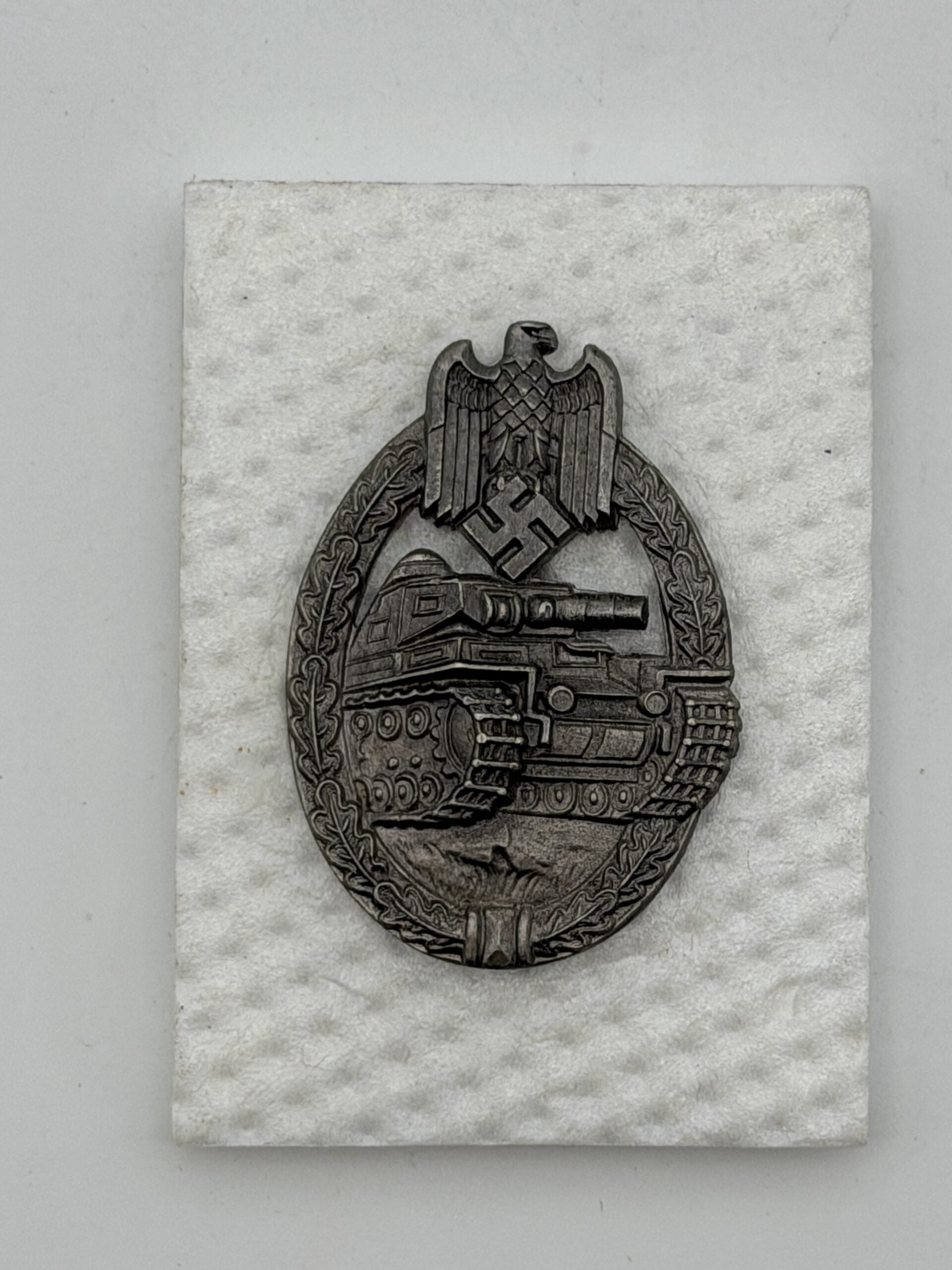
This Juncker Panzer Assault Badge is an exceptionally desirable early example of the German Army Panzerkampfabzeichen in Silber. C.E. Juncker of Berlin produced this distinctive hollow nickel-silver pattern during the early period of the award. Collectors commonly refer to the design as the Juncker “Porsche” pattern.
€ 1.400
This Juncker Panzer Assault Badge is an exceptionally desirable early example of the German Army Panzerkampfabzeichen in Silber. C.E. Juncker of Berlin produced this distinctive hollow nickel-silver pattern during the early period of the award. Collectors commonly refer to the design as the Juncker “Porsche” pattern.
The badge displays the exceptional die work associated with early Juncker production. Moreover, its hollow construction, detailed Panzer, distinctive eagle and characteristic reverse fittings place it firmly within one of the most desirable families of early Panzer Assault Badges.
Specialist references attribute this pattern to C.E. Juncker, Berlin, despite the absence of a maker mark. The construction corresponds particularly closely with the variant catalogued by Philippe De Bock as Type 1.1.2b.
The Panzerkampfabzeichen was introduced shortly after the beginning of the Second World War. Generaloberst Walther von Brauchitsch approved the silver class on 20 December 1939. It recognised soldiers who served directly with German armoured formations.
For the original grade, qualifying tank personnel generally had to participate in three armoured assaults on three separate days. Eligible crewmen included tank commanders, drivers, gunners and radio operators. The regulations subsequently expanded eligibility to certain supporting personnel connected with armoured operations.
The silver Panzer Assault Badge therefore became one of the defining combat awards of the German Panzertruppe.
Researchers studying German Army formations and wartime personnel can also consult the Bundesarchiv military collections. The Bundesarchiv retains extensive surviving documentation relating to Wehrmacht personnel and formations.
This Juncker Panzer Assault Badge represents the superior early manufacturing period.
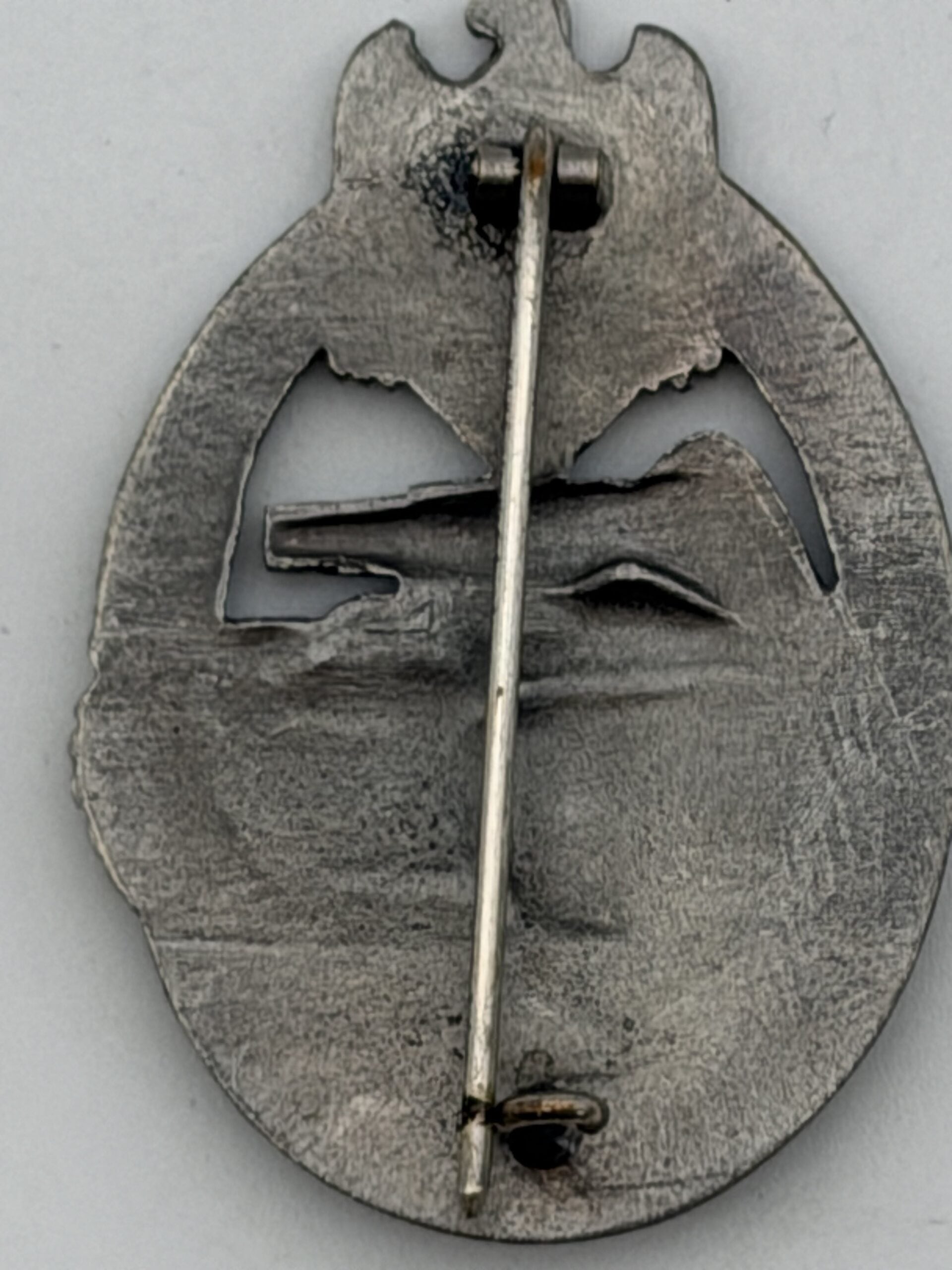
The maker produced the badge from die-struck nickel silver rather than the lower-grade zinc used extensively later in the war. Its hollow reverse clearly records the negative form of the deeply struck obverse design.
The obverse features a Panzer viewed in three-quarter profile. Detailed tracks, road wheels, turret and gun barrel dominate the centre. An oval oak-leaf wreath surrounds the vehicle, while the Wehrmacht eagle and swastika complete the upper section.
The relief remains notably crisp. In addition, the sculpting of the tank, wreath and eagle retains the sharp character expected from early Juncker dies.
Early badges used nickel silver and tombak before manufacturers increasingly adopted zinc as wartime material restrictions developed. Ratisbon’s specialist reference material similarly records early hollow nickel-silver Juncker Panzer badges before the transition towards zinc production.
Collectors have long referred to this particular Juncker design as the “Porsche” variant or “Porsche Design.”
Several features support the attribution. These include the shape of the tank, turret configuration, long gun barrel, track arrangement, eagle design and characteristic open areas around the vehicle.
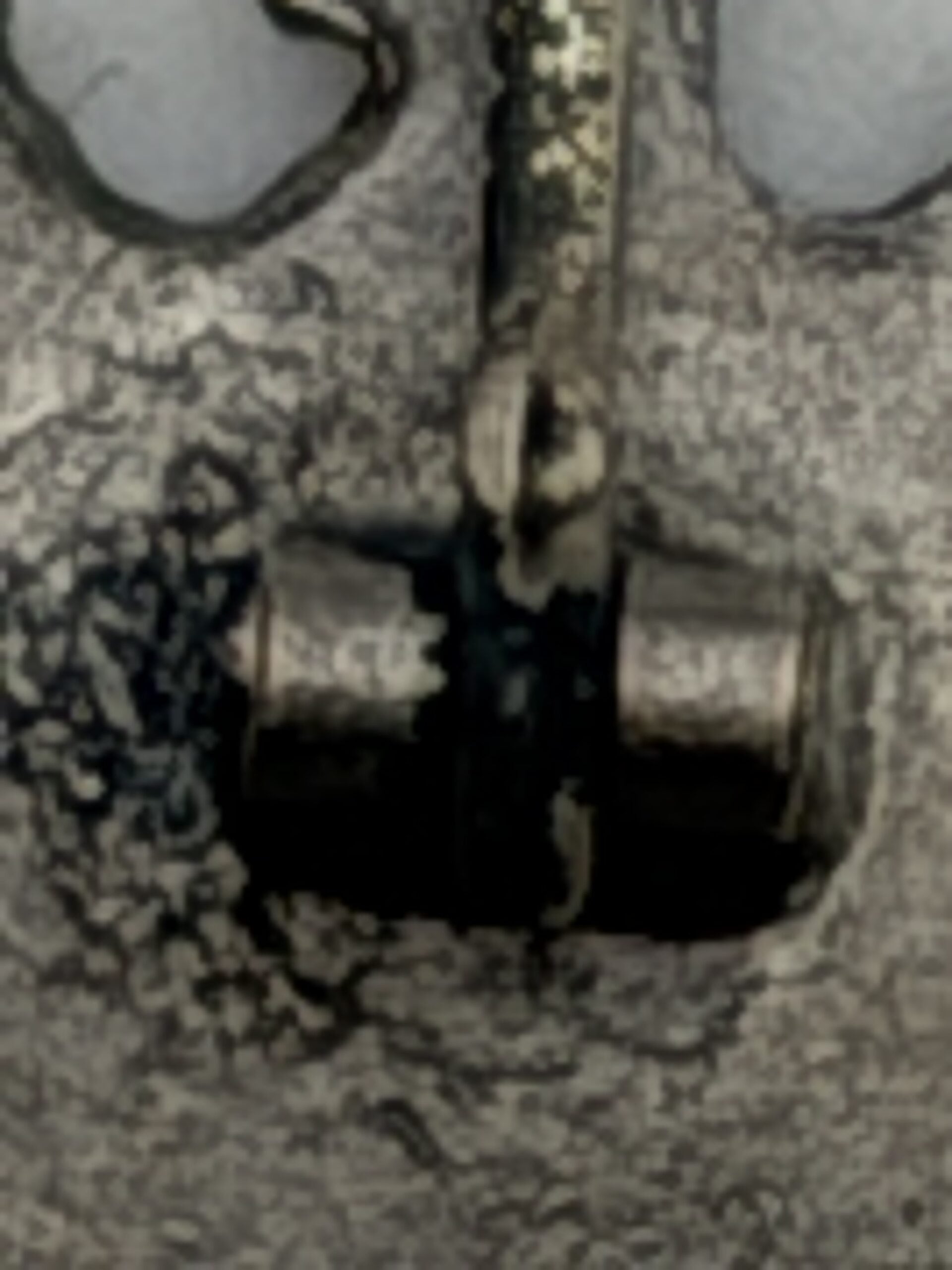
The reverse construction provides further evidence. Most importantly, this badge has the characteristic small-footed horizontal hinge associated with early Juncker examples.
A specialist comparison published by Panzertruppe identifies a hollow nickel-silver Juncker badge as De Bock Type 1.1.2b and specifically records the small footed hinge as typical construction.
The badge is correctly unmarked. Therefore, attribution rests on die characteristics and construction rather than a stamped maker’s name.
For collectors wishing to compare further wartime awards, see our Medals, Badges and Awards section.
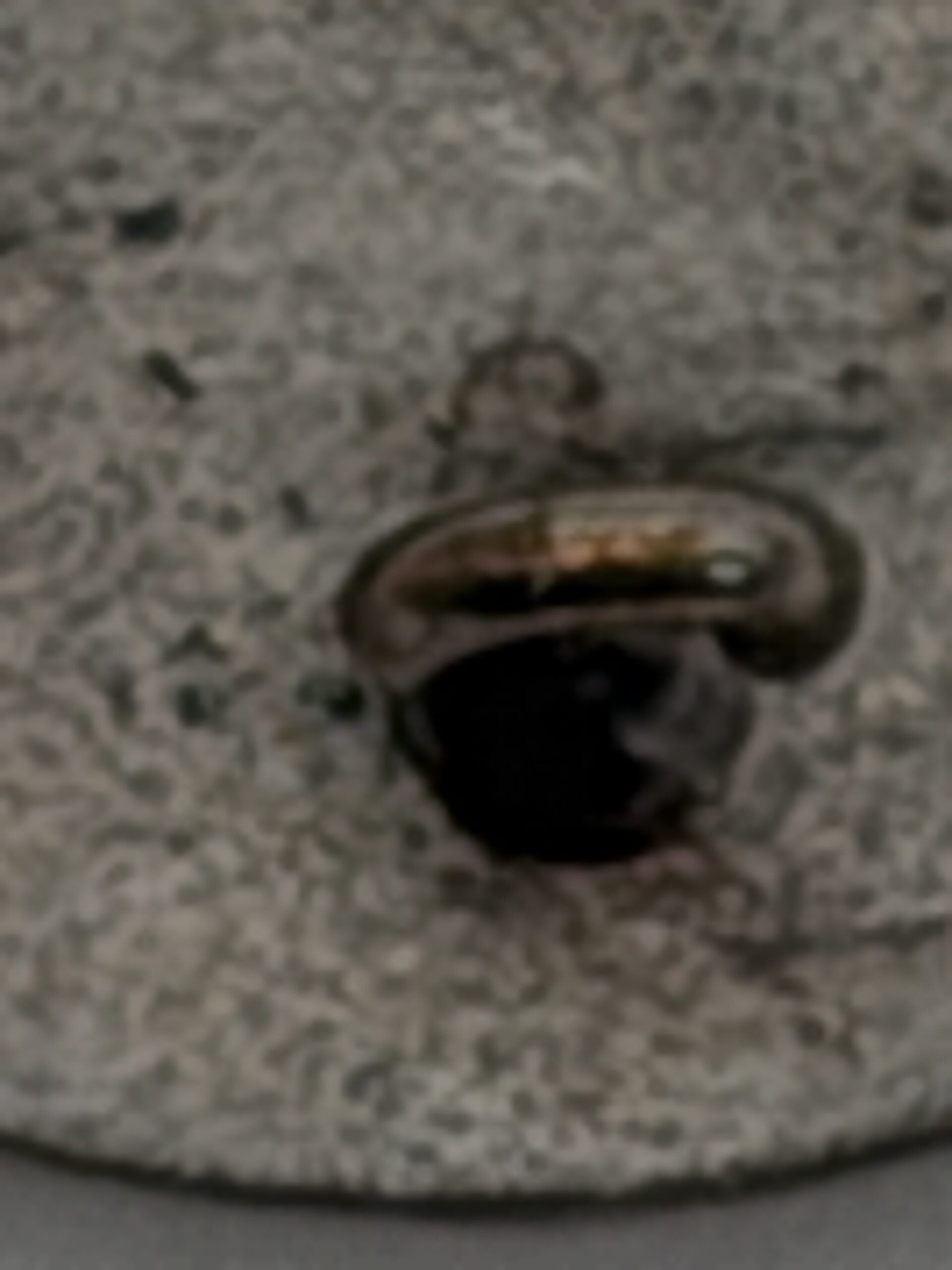
The reverse displays a long round pin mounted through the horizontal barrel-type hinge. At the lower end sits the corresponding wire catch.
Both fittings show natural age and oxidation. Furthermore, the solder around the attachment areas has darkened naturally.
The enlarged photographs show no obvious evidence of modern casting. Likewise, the hollow reverse, sharp die-struck edges and negative impression of the obverse design are consistent with genuine period manufacture.
The hinge configuration is particularly significant. Juncker used a distinctive small supporting foot beneath the hinge on examples of this pattern. The hardware seen here closely follows that construction.
No obvious replacement of the hinge or pin can be identified from the photographs. Nevertheless, as with every valuable wartime badge, final authentication should include physical examination under magnification.
Comparable original Juncker badges can be studied in the Ratisbon’s Panzer Assault Badge archive. Ratisbon’s likewise identifies early hollow nickel-silver examples as unmarked but attributable to C.E. Juncker.
The badge survives in very good original condition.
The obverse retains strong detail throughout the eagle, wreath, tank and tracks. Attractive age toning remains within the recessed areas. Meanwhile, lighter high points emphasise the original relief.
The reverse shows expected oxidation and age around the fittings. Importantly, these traces contribute to the untouched appearance of the badge rather than detracting from it.
The pin remains present and functional in appearance. The badge has not suffered the severe corrosion or loss of detail frequently encountered on later zinc Panzer badges.
It should not be polished or chemically cleaned. The existing surface, toning and oxidation form part of both its historical character and its authentication evidence.
Early hollow nickel-silver Juncker Panzer badges rank considerably above ordinary later zinc examples in both desirability and value.
Their combination of early manufacture, superior material, deep die striking and distinctive Juncker design has made them highly sought after among specialist Panzer badge collectors.
The Type 1.1.2b Porsche-pattern family is specifically described by specialist references as rare.
A closely comparable hollow nickel-silver Juncker Porsche variant sold through Richter in May 2026 for €1,200 before the 15% buyer’s premium. The auction house described it as a rare silver-plated nickel-silver Juncker Porsche variant.
Ratisbon’s records another early hollow nickel-silver Juncker example selling for €1,470 in September 2023.
Therefore, examples with attractive surfaces and convincing original hardware occupy the premium end of the standard Panzerkampfabzeichen market.
Based on the supplied photographs, this badge displays the principal characteristics expected from an original early C.E. Juncker Panzerkampfabzeichen in Silber.
Key positive characteristics include:
Taken together, these characteristics provide a strong photographic attribution to C.E. Juncker’s early Porsche-pattern production, most closely corresponding with the De Bock Type 1.1.2b family.
For further specialist research, see the Panzer Assault Badge reference section at Panzertruppe, which illustrates comparable Juncker nickel-silver Porsche-pattern examples.
Collectors researching Third Reich awards may also find relevant specialist literature in our Militaria Reference Books & Literature
This is significantly more desirable than a standard wartime zinc Panzer Assault Badge.
Its early Juncker manufacture, hollow nickel-silver construction, Porsche-pattern design and convincing original hardware make it a particularly strong representative example of the silver Panzerkampfabzeichen.
For a collection focused on German combat awards, Panzer insignia or early C.E. Juncker production, it represents an important and increasingly difficult badge to obtain.
Philippe De Bock, The German Panzer Assault Badge of WWII, revised edition – early C.E. Juncker variants.
Ratisbon’s – Early Juncker Panzer Assault Badge reference and sales archive
Panzertruppe – Panzer Assault Badge reference collection
Bundesarchiv – German military personnel and archival research
Richter Auctions – Hollow nickel-silver Juncker Porsche variant