
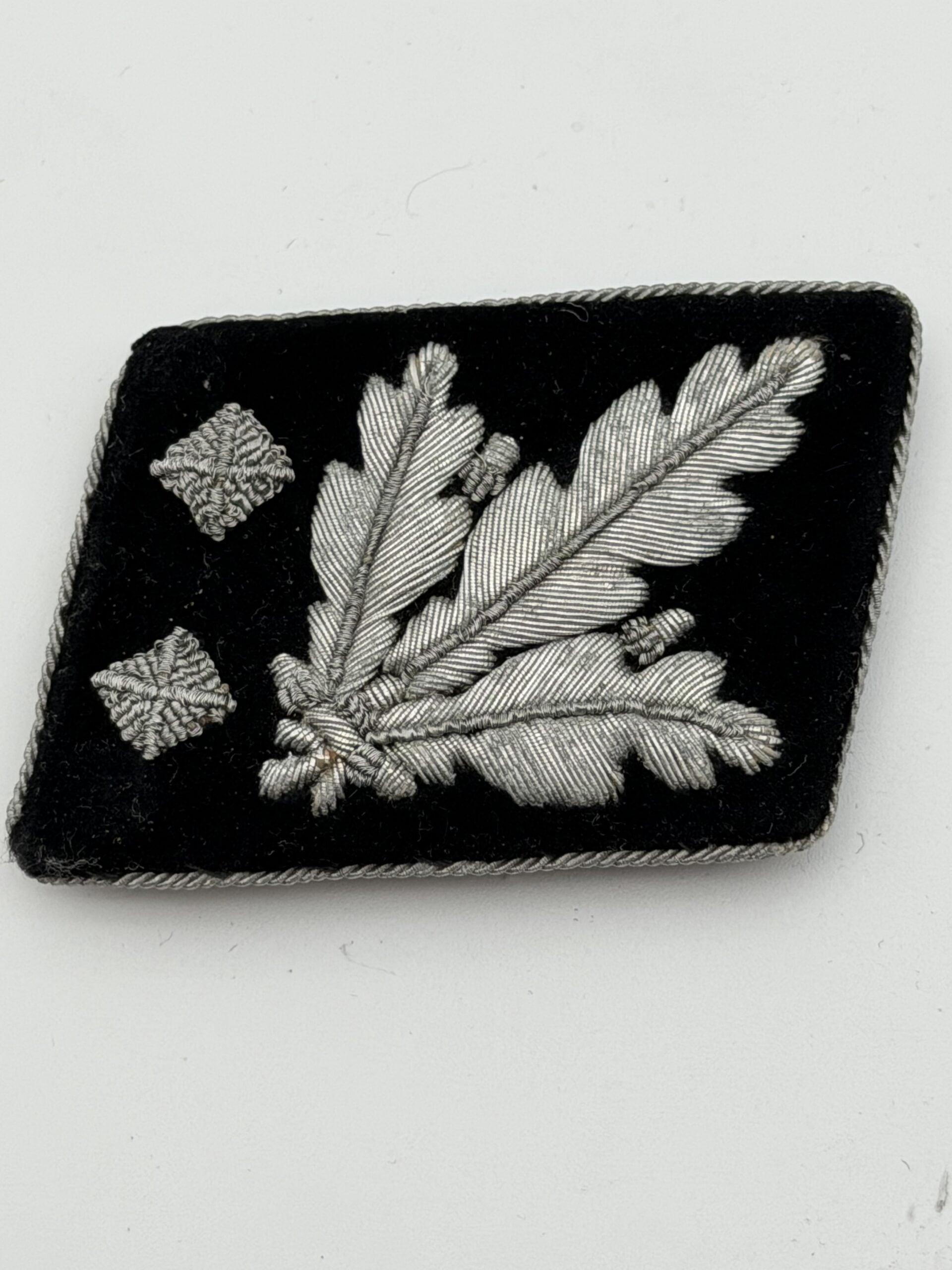
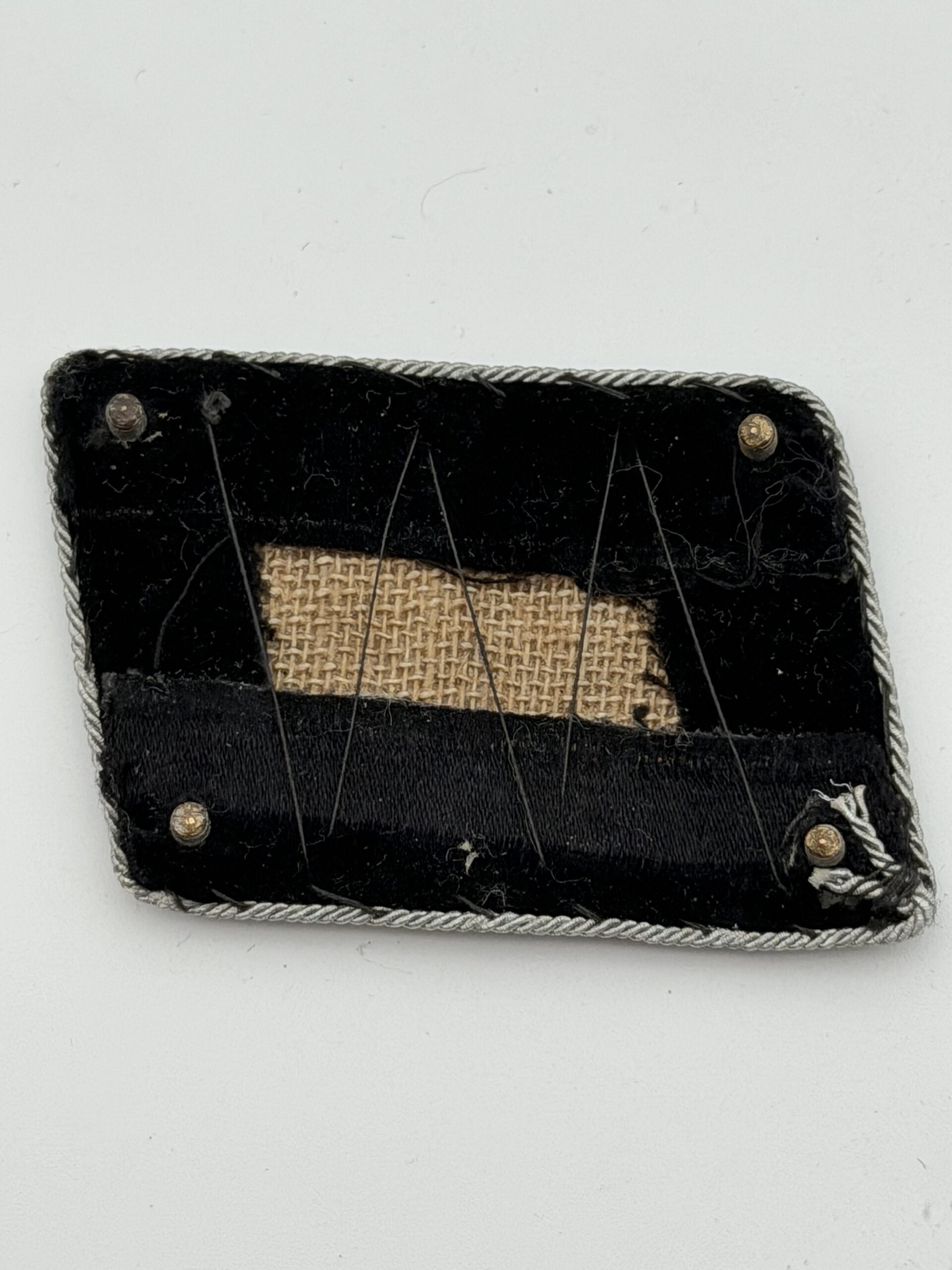
Rare original post-1942 SS-Obergruppenführer collar tab with superb hand-embroidered metal-thread oak leaves and two rank pips on black velvet. The reverse retains its unusual four-post removable mounting system, closely matching documented SS general-officer insignia used with the white summer service uniform. Very fine original condition and an exceptionally scarce senior-rank uniform insignia.
€ 3.500
1 in stock
This exceptionally rare SS-Obergruppenführer collar tab is a post-April 1942 general-officer rank insignia produced in hand-embroidered metal thread on black velvet. Most importantly, the reverse retains a four-post removable mounting system associated with SS white summer service uniforms.
The face carries the distinctive three-leaf oak spray together with two square rank pips, identifying the rank of SS-Obergruppenführer. Fine silver-coloured metal embroidery, raised leaf veins and twisted officer-grade perimeter cord demonstrate the quality expected of insignia intended for one of the most senior ranks within the SS hierarchy.
The reverse construction is equally significant. Four metal attachment posts pass through the reinforced foundation. This arrangement allowed the collar tab to be removed from a washable summer tunic rather than permanently sewn in place.
Consequently, this is considerably scarcer than a conventional sew-on SS general-officer collar tab.
The SS-Obergruppenführer collar tab belongs to the revised SS general-officer insignia system introduced in April 1942.
Under this system, a spray of three oak leaves formed the principal general-officer device. Additional rank pips distinguished the successive grades. The present tab displays:
Three oak leaves + two rank pips = SS-Obergruppenführer.
The Imperial War Museums preserves a facing pair of SS-Obergruppenführer collar patches and describes them as black collar insignia with silver edging and oak-leaf devices, providing an important institutional comparison.
View the Imperial War Museums SS-Obergruppenführer collar insignia.
The tab identifies rank rather than division. Therefore, it cannot by itself be assigned to a particular Waffen-SS division, SS Main Office, police command or named individual.
An SS-Obergruppenführer could hold a variety of senior appointments. Some also held corresponding military or police ranks, including titles such as General der Waffen-SS or General der Polizei.
SS-Obergruppenführer ranked among the highest grades in the SS hierarchy. Men holding this rank frequently occupied major administrative, police, security or military commands.
The SS began as Adolf Hitler’s personal bodyguard organisation. However, under Heinrich Himmler it developed into a vast political, security, police and military apparatus. The SS controlled the German police and concentration-camp system and played a central role in implementing Nazi racial policy and the Holocaust. The United States Holocaust Memorial Museum describes the SS as both an elite guard of the Nazi state and an executive instrument that operated without normal legal restraint.
For historical context, see the United States Holocaust Memorial Museum – The SS.
This context remains essential when cataloguing original SS material. Such objects survive as evidence of the hierarchy, symbolism and material culture of an organisation centrally involved in persecution, war crimes and genocide.
In April 1942, the SS revised its general-officer collar insignia.
The later design used a straighter three-oak-leaf arrangement accompanied by between zero and three rank pips to distinguish senior grades. A documented Helmut Weitze post-1942 general-officer example confirms this pattern and its use of hand-embroidered metal thread on black velvet.
A current Weitze pair specifically identified as SS-Obergruppenführer is likewise described as a pattern used from 1942 onwards, hand embroidered in metal thread on black velvet. The pair is presently offered at €6,500.
View the Weitze SS-Obergruppenführer reference pair.
The most important constructional feature of this SS-Obergruppenführer collar tab is its removable attachment system.
The SS introduced a white summer service tunic in 1939. Surviving period examples show that senior insignia could employ detachable fittings, allowing expensive embroidered insignia to be removed from the washable white garment.
A particularly significant comparative example is currently offered by Helmut Weitze. It consists of a pair of post-1942 SS-Gruppenführer collar tabs still mounted on the cut-away collar of a white summer service tunic.
Each of those tabs has four attachment screws with nuts and washers on the reverse. Weitze records dimensions of approximately 55 × 40 mm and describes them as hand-embroidered metal-thread insignia on black velvet.
View the Weitze white summer service collar-tab reference.
The construction of the present example closely follows that documented principle.
The front uses a fine black velvet ground over a rigid internal foundation.
The three oak leaves have been produced using dense, hand-laid silver-coloured metal thread. Significantly, the direction of the thread changes across individual sections of the leaves. This creates depth and defines their natural contours.
Raised metal-thread stems run along the centres of the leaves. The embroiderer separately constructed the smaller stems, acorns and binding details. Therefore, the design achieves a pronounced three-dimensional quality rather than the flat appearance associated with inexpensive machine-made reproductions.
The two square rank pips are also hand worked.
Their dense textured surfaces differ naturally from one another at microscopic level, which is consistent with individual hand embroidery rather than modern identical machine production.
A narrow twisted silver-coloured cord surrounds the outer perimeter. It remains closely fitted to the edge and gives the tab the formal finish associated with officer-quality SS collar insignia.
The oak spray displays particularly accomplished craftsmanship.
Each principal leaf consists of many parallel metal threads laid diagonally across its surface. The thread direction then changes where the leaf geometry changes. As a result, reflected light creates the characteristic tonal variation visible across authentic high-grade metal embroidery.
The prominent centre veins sit above the underlying leaf embroidery.
Furthermore, the stems and acorns were assembled from separate groups of metal thread rather than simply worked as one continuous flat design.
Minor tonal variation and natural darkening around several exposed thread areas are consistent with age and handling.
The reverse provides perhaps the strongest distinguishing feature.
Four metal mounting posts are positioned close to the corners of the tab. The arrangement corresponds with known removable SS general-officer collar insignia intended for white summer uniforms.
Unlike conventional collar tabs, which were sewn directly onto the uniform, removable tabs could be detached when the white tunic required cleaning.
The posts therefore served a practical purpose.
On complete surviving examples, nuts and washers secured the threaded attachments from inside the collar. The present tab retains the four posts, although the corresponding nuts and washers are no longer present.
Their absence is entirely compatible with a tab removed from its uniform. However, replacement modern hardware should not be added because the untouched reverse construction has greater historical and authentication value.
An exposed rectangular area reveals the coarse tan woven internal foundation.
This stiff material provided structural support for the substantial bullion embroidery on the face. Furthermore, it helped prevent the tab from distorting when attached to the collar.
A broad black textile strip crosses the reverse horizontally. Several old black securing threads also remain visible.
The combination of velvet, coarse stiffening material, folded edges and supplementary textile reinforcement creates the substantial multi-layer construction expected from high-grade period insignia.
Based on the photographs supplied, this SS-Obergruppenführer collar tab displays strong characteristics consistent with original period manufacture.
Several features support that conclusion.
First, the metal-thread embroidery demonstrates genuine hand workmanship. The leaves are similar, but they are not mechanically identical.
Secondly, the directional thread construction changes naturally throughout the oak spray. Raised veins, separately worked stems and individually constructed acorns further support traditional hand embroidery.
Thirdly, the velvet ground shows an appropriate dense pile and surface character.
Furthermore, the narrow twisted silver perimeter cord appears naturally incorporated into the original assembly.
The reverse provides additional evidence. The coarse tan foundation, folded velvet, old securing threads, black retaining strip and four-post attachment system form a coherent method of construction.
Most significantly, the four-post system has a close documented parallel in surviving SS general-officer insignia from a white summer service tunic. Weitze’s current Gruppenführer comparison retains four screws, nuts and washers on each tab.
Taken together, the constructional evidence is highly encouraging.
Catalogue assessment: consistent with an original period post-1942 SS-Obergruppenführer removable white summer service collar tab.
As with all high-value textile insignia, final authentication should ideally include an in-hand examination under magnification together with fibre, UV and metal-thread inspection.
The posts should not be interpreted as later repairs.
Instead, they form part of a specialised removable mounting system.
This substantially changes the collecting significance of the object because ordinary sew-on SS general-officer tabs survive more frequently.
Weitze currently documents not only a complete four-screw Gruppenführer summer-uniform pair but also other post-1942 SS rank tabs employing four reverse attachment screws. For example, a single SS-Oberführer tab with four screws is currently listed at €1,750.
Therefore, the mounting method fits within an established period pattern rather than representing an anomalous alteration.
The SS-Obergruppenführer collar tab remains in very fine original condition.
The black velvet retains a strong colour and dense pile. Meanwhile, the metal-thread oak leaves remain exceptionally well defined.
The two rank pips are complete. Likewise, almost all of the perimeter cord remains firmly attached.
Minor age toning appears within several areas of the metal embroidery. There is also light surface debris and evidence of normal handling. These characteristics are preferable to aggressive cleaning and contribute to the untouched appearance.
On the reverse, the foundation remains intact. All four mounting posts survive.
The original retaining nuts and washers are absent.
Overall condition can therefore be described as very good to excellent for a removable uniform-used example.
No restoration is recommended.
Original SS general-officer collar insignia is scarce because comparatively few individuals attained these ranks.
SS-Obergruppenführer insignia is especially desirable because it represents one of the highest levels within the organisation.
However, this example has an additional level of rarity.
Its four-post removable summer-uniform construction survives far less frequently than ordinary sew-on insignia. White service uniforms also suffered particularly high attrition because they required regular cleaning and were often discarded or separated from their removable insignia.
Consequently, a surviving post-1942 Obergruppenführer tab retaining its original mounting system represents a specialised and very difficult general-officer insignia variant.
The present market provides several useful reference points.
Helmut Weitze currently offers a matching pair of conventional post-1942 SS-Obergruppenführer collar tabs for €6,500. They are described as hand-embroidered metal-thread examples on black velvet in lightly worn condition.
More importantly, Weitze currently offers a pair of SS-Gruppenführer removable collar tabs on their original white summer-service collar for €6,500. Both retain four screws, nuts and washers.
Finally, Weitze lists a single post-1942 SS-Oberführer four-screw collar tab at €1,750, providing a lower-rank comparison for the removable construction.
These references demonstrate both the premium associated with SS general-officer rank and the recognised rarity of four-post removable insignia.
This valuation assumes that an in-hand examination confirms the period materials and mounting construction visible in the photographs.
Should the matching opposite-facing tab subsequently be reunited with this example, the value would increase significantly. A genuine matching Obergruppenführer summer-service pair could reasonably justify a specialist retail valuation in the region of €8,000–€10,000, depending on matching construction, condition and provenance. This is an appraisal inference based on current €6,500 Weitze comparisons for both a conventional Obergruppenführer pair and the lower Gruppenführer four-screw summer pair.
Object: SS general-officer collar tab
Rank: SS-Obergruppenführer
Pattern: Post-April 1942
Date: Circa 1942–1945
Organisation: Schutzstaffel (SS)
Branch: Not determinable from collar tab alone
Uniform application: Removable insignia consistent with white summer service uniform use
Face material: Black velvet
Embroidery: Hand-embroidered silver-coloured metal thread
Design: Three oak leaves and two rank pips
Edge: Twisted silver-coloured officer cord
Foundation: Coarse woven stiffening material
Attachment: Four metal mounting posts
Retaining hardware: Nuts and washers absent
Condition: Very good to excellent
Rarity: Very rare
Recommended retail value: €4,250
This SS-Obergruppenführer collar tab represents an unusually specialised piece of senior SS uniform insignia.
Although the rank itself makes the object scarce, the removable construction is the feature that elevates it beyond a conventional general-officer collar patch.
The embroidery demonstrates the quality expected from senior-officer metal-thread insignia. Moreover, the exposed reverse provides an unusually useful opportunity to examine the internal foundation and mounting method.
For an advanced collection, the tab therefore has value at several levels: as an example of SS general-officer rank insignia, as a study piece for hand-embroidered metal-thread construction and, most importantly, as evidence of removable insignia produced for white summer uniform wear.
Its survival in largely untouched condition makes preservation preferable to restoration.
The object should be interpreted within the wider history of the organisation whose rank it represented.
The SS became one of the principal instruments of Nazi dictatorship. It controlled police and concentration-camp systems and assumed major responsibility for racial persecution, mass murder and the Holocaust.
Accordingly, preservation and study of original SS material should document not merely uniform design but also the political and criminal system represented by the insignia.
Explore related listings: SS Collar Tabs; SS Items; Original Pre-1942 SS-Gruppenführer Collar Tab; RZM labelled SS collar tab.
For historical and comparative research: