
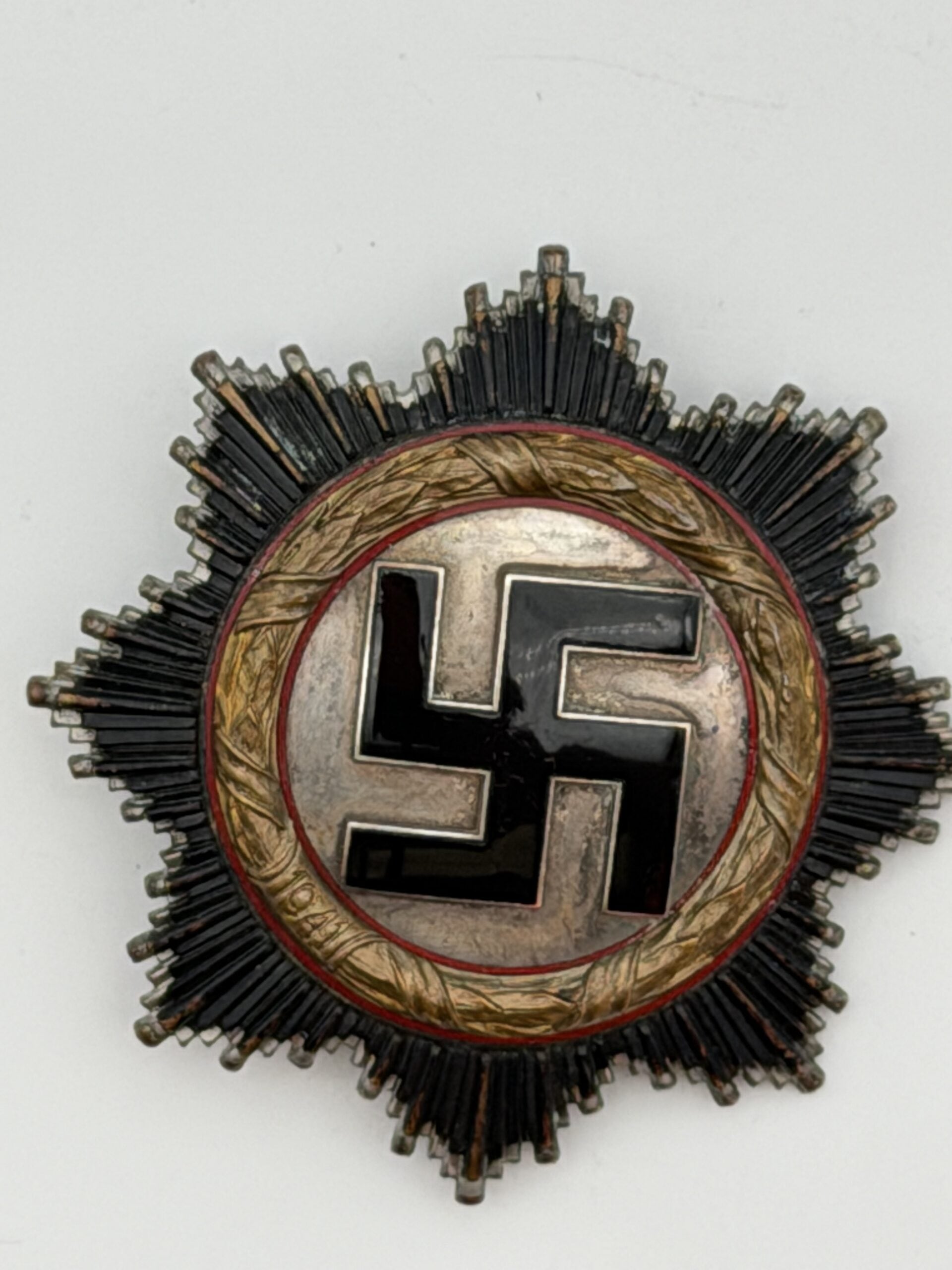
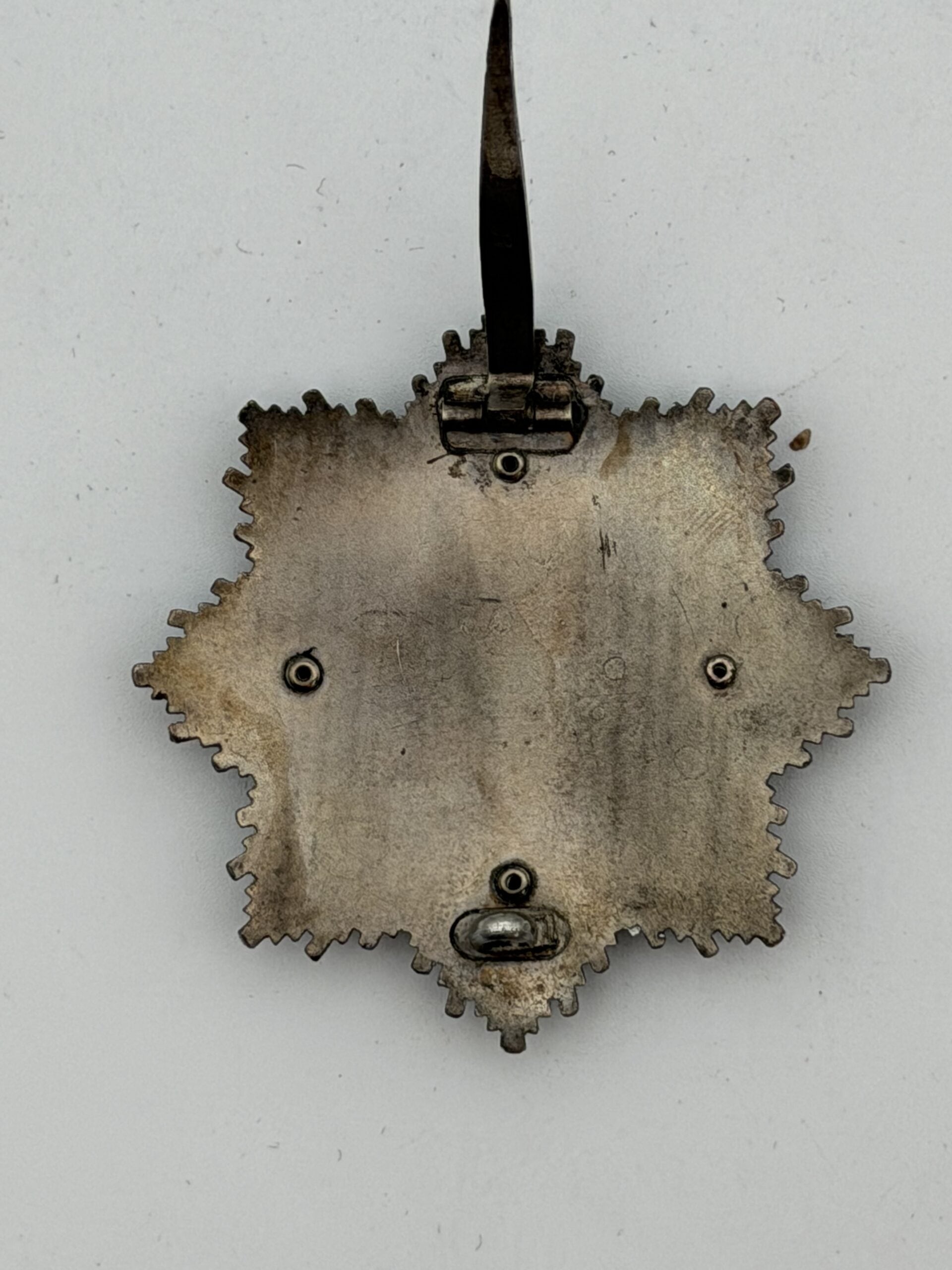
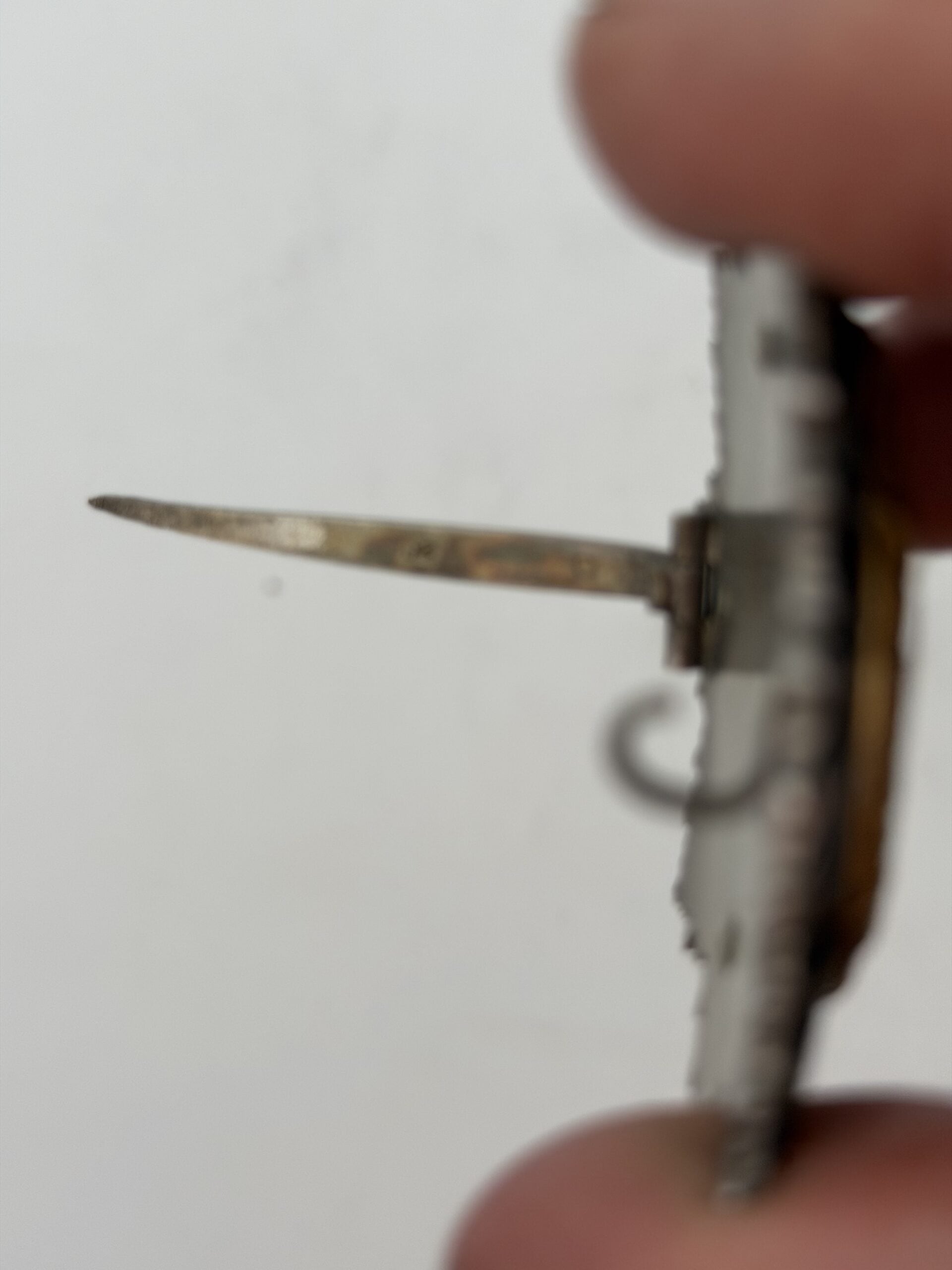
Original German Cross in Gold by C. F. Zimmermann, Pforzheim, maker marked “20” on the reverse pin. Classic four-rivet multi-piece construction with black radiating starburst, gilded laurel wreath, red enamel border and central black enamel swastika. Attractive naturally worn example with strong original character.
€ 3.500
1 in stock
This German Cross in Gold Zimmermann 20 is a highly desirable maker-marked example of the Deutsches Kreuz in Gold. C. F. Zimmermann of Pforzheim manufactured this distinctive four-rivet version, while the underside of the pin carries the recognised “20” maker code.
Across the obverse, a black radiating starburst surrounds the silver-coloured central field. A gilded laurel wreath and red enamel border frame the large black enamel swastika. Natural wear, age toning and surviving gilding give the decoration excellent historical character.
No presentation case accompanies this example.
Germany instituted the German Cross in Gold on 28 September 1941.
The decoration recognised repeated acts of bravery or exceptional military achievement. In the German award hierarchy, it occupied an important position above the Iron Cross 1st Class while remaining separate from the Knight’s Cross.
A German Cross in Silver also existed for distinguished non-combat military service.
Further historical and construction information can be found through the Wehrmacht-Awards German Cross reference.
Collectors can also browse our German Medals and Awards Collection.
One of the strongest features of this German Cross in Gold Zimmermann 20 is its clearly stamped pin.
The number reads:
20
Specialist maker references identify code 20 as:
C. F. Zimmermann, Pforzheim
Zimmermann produced several recognised German Cross variants. Both heavy and lightweight examples are known, while the four-rivet reverse construction remained a characteristic feature.
See the detailed Wehrmacht-Awards Zimmermann study for direct comparison.
The reverse displays the classic Zimmermann assembly.
Four hollow rivets secure the multi-part badge together. Above them sits a substantial block hinge supporting the broad vertical pin. At the lower edge, the original retaining catch remains present.
Important construction features include:
This arrangement corresponds closely with documented C. F. Zimmermann examples.
The German Cross was a complicated award rather than a simple one-piece badge.
Its construction combines several visual layers:
Together, these separate elements produce the dramatic three-dimensional appearance associated with the German Cross in Gold.
A large radiating star forms the outer body.
Numerous narrow rays remain well defined around the perimeter. Dark finish survives between many of them, whereas exposed high points show natural wear.
That contrast gives the award substantial visual depth.
Rather than appearing freshly finished, the surface displays the irregular ageing expected from a wartime decoration.
A broad gilded wreath surrounds the central silver field.
Individual laurel leaves remain clearly visible. Protected recesses retain stronger gold tones, while exposed areas have naturally softened with age.
A narrow red enamel ring borders the wreath.
Its surviving colour creates the distinctive red, gold, silver and black combination that makes the German Cross immediately recognisable.
The black enamel centre remains visually strong.
A large swastika dominates the central field, surrounded by its raised silver-coloured border. Light surface wear can be seen under close examination, although no major enamel loss is apparent in the supplied photographs.
Strong contrast remains between the polished black centre and the surrounding metalwork.
Authentication of a German Cross depends heavily on the reverse.
Here, the four securing rivets are correctly positioned around the backing plate. A broad pin extends vertically between the upper hinge and lower catch.
Age toning appears throughout the reverse.
Scratches and handling marks are also visible, yet they remain consistent with genuine long-term use rather than artificial ageing.
The underside of the pin carries the 20 stamp.
That placement is significant because genuine Zimmermann German Crosses are documented with the maker number in precisely this area.
Comparable examples can be examined through Ratisbon’s German Cross archive.
Another useful retail comparison appears at Helmut Weitze Militaria.
Zimmermann manufactured both heavy and lightweight German Crosses.
Photographs alone cannot reliably establish which production group this example belongs to.
Known lightweight pieces generally fall around the mid-40 gram range. Heavy Zimmermann examples usually weigh approximately 64–68 grams.
Therefore, exact weight remains important.
Approximately 44–47 g: lightweight Zimmermann
Approximately 64–68 g: heavy Zimmermann
The heavier version is scarcer and may justify a higher specialist valuation.
Until an exact weight is recorded, this catalogue correctly identifies the maker without assigning an unsupported weight variant.
Several characteristics strongly support wartime manufacture.
Positive points include:
Construction details correspond closely with established Zimmermann reference examples.
Strongly consistent with an original wartime German Cross in Gold by C. F. Zimmermann, Pforzheim.
Hands-on inspection remains the final standard for any high-value decoration. Even so, the photographs reveal no obvious fatal reproduction characteristic.
Overall condition is very good with honest period wear.
Much of the central black enamel remains intact. Gold colour survives within the laurel wreath, while the red enamel border continues to provide strong contrast.
Outer rays show expected age-related finish loss.
On the reverse, the pin assembly remains complete. General toning and surface wear contribute to the untouched appearance of the piece.
No presentation case is included.
Do not polish this award.
Abrasive cleaning would remove surviving gilding and silver finish. Chemical products could also damage the enamel or dark starburst coating.
Only minimal handling is recommended.
When displaying the badge, support it properly rather than placing unnecessary pressure on the original pin mechanism.
Maker-marked German Crosses are particularly attractive to specialist collectors.
A visible maker number allows the badge to be compared with established manufacturing characteristics. In this instance, the 20 code provides a direct attribution to C. F. Zimmermann.
Furthermore, the surviving four-rivet construction makes the decoration useful as a reference example.
The strong enamel and naturally aged finish also create excellent display appeal.
Current specialist pricing varies considerably according to condition, weight variant and whether a case is present.
Uncased maker-20 examples commonly occupy the lower to middle specialist range. By comparison, complete cased examples can command a substantial premium.
For current comparison, consult:
Helmut Weitze – German Cross in Gold by Zimmermann
Ratisbon’s – German Cross in Gold by Zimmermann
Wehrmacht-Awards – Zimmermann Manufacturing Study
This example benefits from several desirable features:
Because no original presentation case accompanies the award, the valuation remains below comparable complete cased sets.
Explore related listings: Heer, Luftwaffe, Kriegsmarine; German Medals and Awards Collection; Iron Cross and German Military Decorations; Nordmenn Militaria Shop.
For detailed construction analysis, visit Wehrmacht-Awards – C. F. Zimmermann German Cross.
Current retail examples can be compared through Helmut Weitze Militaria.
Historic and current auction comparisons are available through Ratisbon’s.
For broader archival research into German wartime award documentation, consult the Bundesarchiv.
This German Cross in Gold Zimmermann 20 is a strong maker-attributed example of one of the most distinctive German military decorations of the Second World War.
A correct four-rivet reverse supports the Zimmermann attribution. Equally important, the underside of the broad pin carries the documented maker code 20.
Excellent black enamel remains at the centre. Around it, surviving gilding, red enamel and naturally aged starburst surfaces create impressive visual depth.
No case accompanies the award.
Once the exact weight is known, the piece can be classified more precisely as either the lightweight or scarcer heavy Zimmermann variant.