
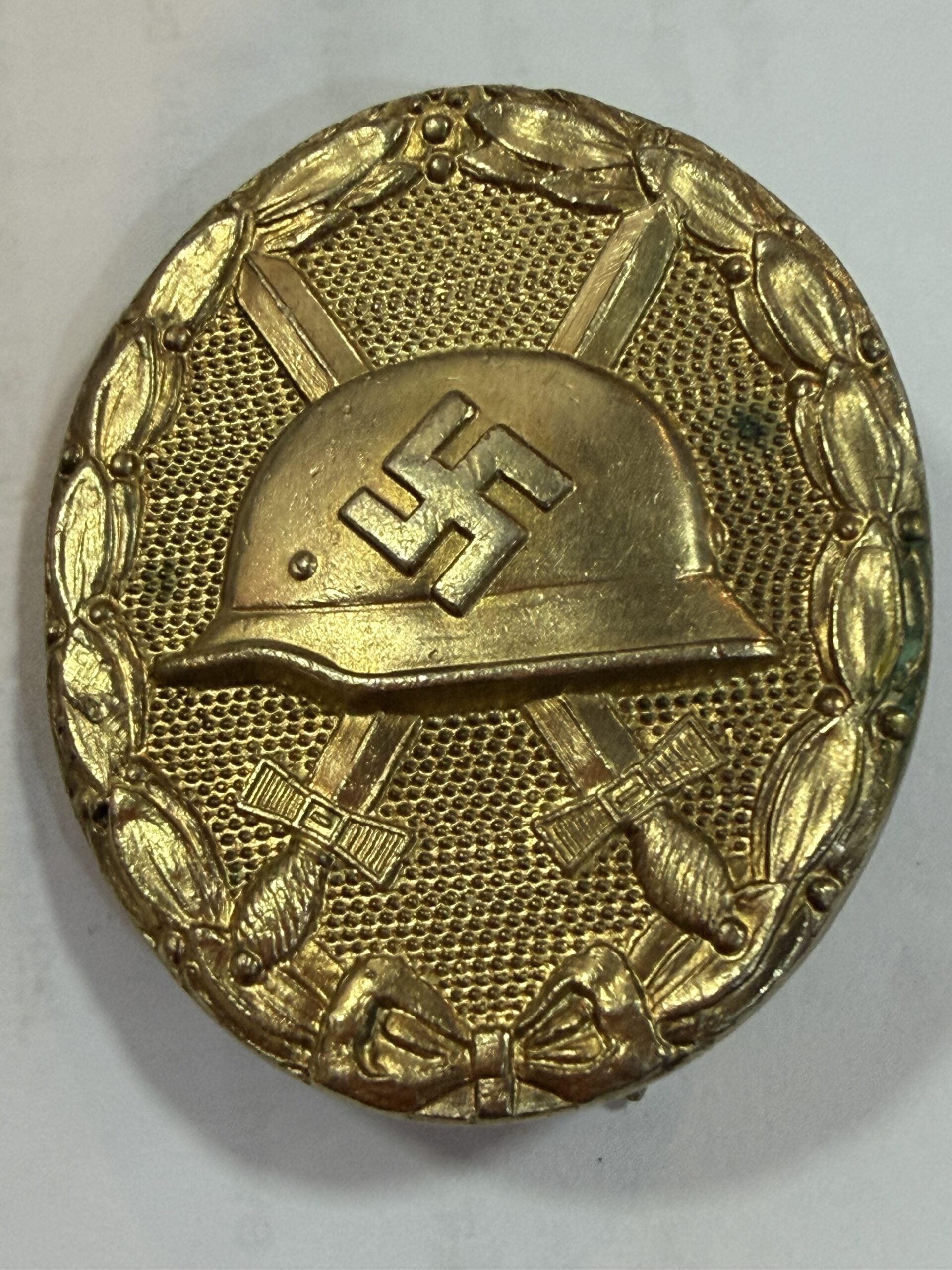
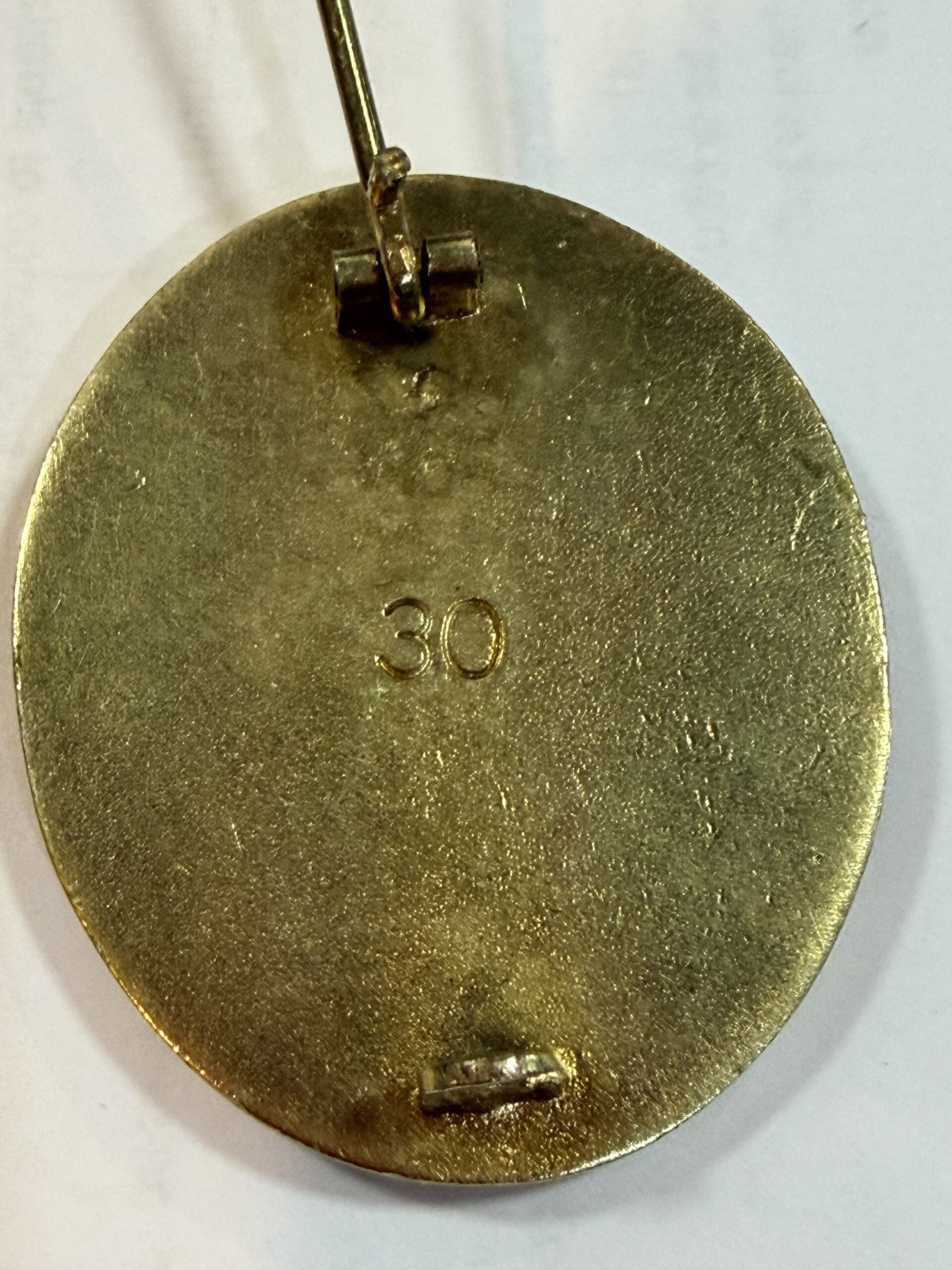
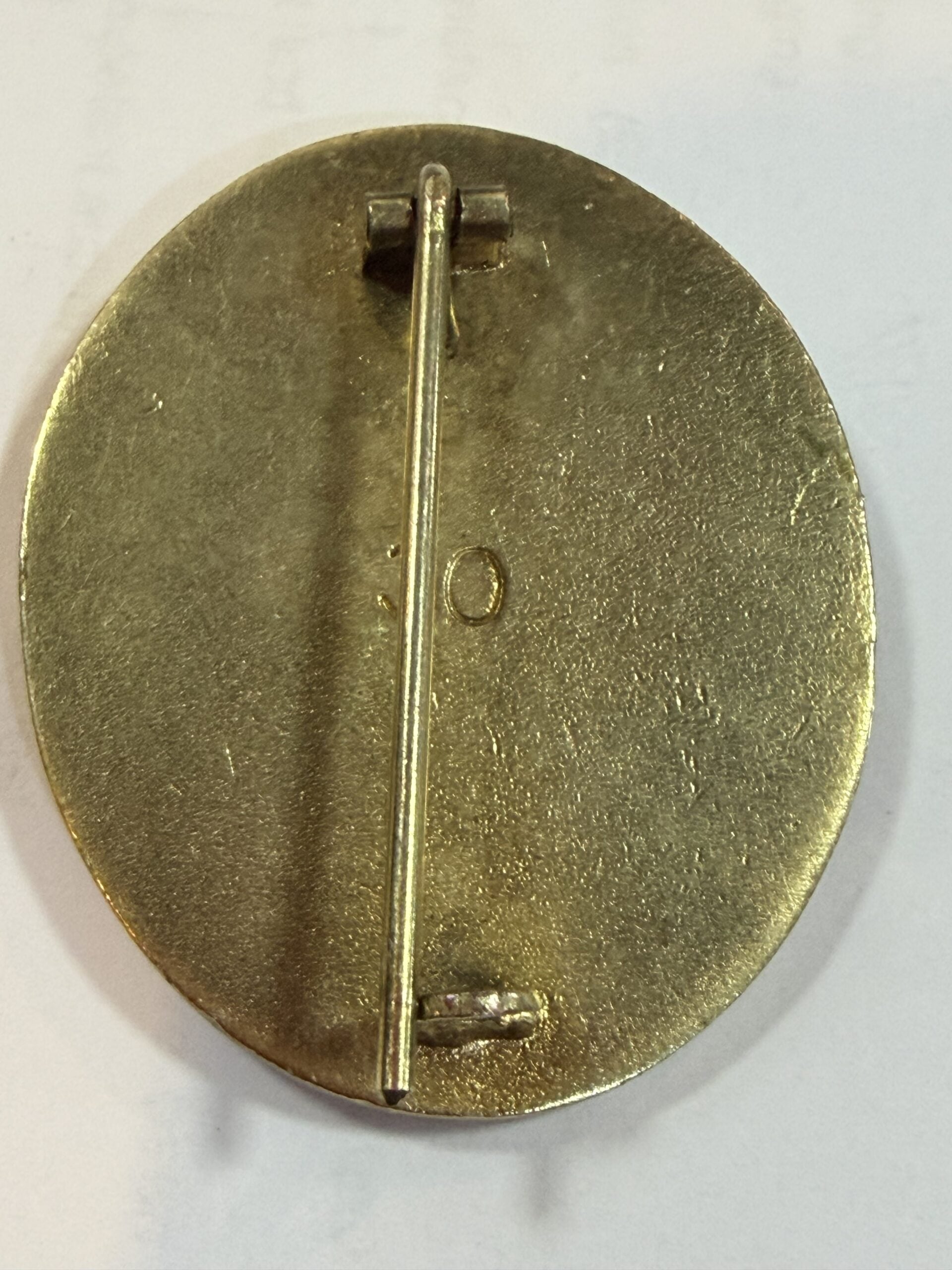
Excellent original 1939 Wound Badge in Gold maker 30 by Hauptmünzamt Wien, Vienna. This solid gilt Buntmetall example weighs 35.18 grams and retains substantial original gold finish. The reverse carries the clearly impressed maker number “30”, together with the characteristic round vertical pin, hinge and catch. Strong detail throughout the helmet, crossed swords and wreath makes this a particularly attractive maker-marked Gold Wound Badge.
€ 495
1 in stock
Maker: Hauptmünzamt Wien, Vienna
Maker Code: 30
Grade: Gold
Material: Gilt Buntmetall / tombak-type non-ferrous metal
Construction: Solid
Weight: 35.18 grams
Period: Second World War
Country: Germany
Condition: Very good original condition
This 1939 Wound Badge in Gold maker 30 is a particularly attractive example attributed to the Hauptmünzamt Wien, or Vienna State Mint.
Its reverse carries the clearly impressed number:
That manufacturer code identifies Hauptmünzamt Wien on documented examples of this decoration.
Furthermore, the badge weighs 35.18 grams. Its substantial weight agrees well with the solid Buntmetall construction expected from this desirable type.
A large proportion of the original gold-coloured finish also survives. Consequently, the badge presents considerably better than many heavily worn examples found today.
The 1939 Wound Badge, or Verwundetenabzeichen 1939, was instituted on 1 September 1939.
It continued an award tradition established during the First World War. However, the Second World War version incorporated a contemporary German steel helmet and the political state emblem of the period.
Three principal grades existed.
Black normally recognised one or two wounds.
Silver generally represented three or four wounds.
Gold represented more than four wounds. Nevertheless, regulations also allowed higher grades for particularly severe injuries.
The Gold grade therefore represented the highest class of the standard 1939 Wound Badge.
German federal legislation still specifically references the original 1 September 1939 regulations when discussing entitlement to the Second World War Wound Badge.
Authoritative historical reference:
German Federal Ministry of Justice – Wound Badge legislation
The badge has the familiar tall oval form.
At its centre appears a German steel helmet carrying the state emblem used during the period. Two crossed swords extend diagonally behind the helmet.
A finely textured field surrounds these elements.
Around the perimeter runs a raised wreath composed of detailed leaves and berries. A tied ribbon appears prominently at the bottom.
The present badge displays particularly crisp definition.
Fine surface detail remains visible throughout the wreath. Likewise, the granular background retains good definition.
The helmet and crossed swords remain sharply formed. Although minor high-point wear is present, the overall appearance remains impressive.
The most important identifying feature appears on the reverse.
A clearly impressed:
sits prominently within the otherwise plain reverse field.
Hauptmünzamt Wien used this manufacturer number on documented examples of the 1939 Wound Badge.
The Vienna State Mint had a long-established tradition of medal and coin production. During the Third Reich period, it also manufactured military decorations.
Documented maker-30 Gold Wound Badges survive with more than one pin configuration.
Some examples have broad flat pins. Others feature the round vertical pin seen on this badge.
That distinction is important because the presence of a round pin should not automatically cause concern.
Helmut Weitze currently lists a maker-marked “30” Gold Wound Badge with round pin and attributes it directly to Hauptmünzamt Wien.
Direct comparison:
Helmut Weitze – Hauptmünzamt Wien maker 30 Gold Wound Badge
This example has a solid rather than hollow reverse.
The substantial 35.18 gram measured weight further supports the identification as a heavy Buntmetall example.
Earlier-quality Gold Wound Badges frequently employed a copper-rich non-ferrous base material finished in gold.
Later wartime production could use zinc instead. Zinc examples often lose their finish considerably more readily, sometimes leaving a dull grey appearance.
In contrast, the present badge retains a rich gold appearance across substantial areas.
Its weight, construction and finish therefore form an internally consistent group.
A precise weight is particularly valuable when studying German badges.
This example weighs:
That figure should remain permanently recorded with the catalogue entry.
Weight alone cannot prove authenticity. However, it becomes useful when combined with construction, die characteristics, maker marking and hardware.
In this case, the substantial weight agrees with the badge’s solid construction.
More importantly, it does not conflict with the expected characteristics of a heavy Hauptmünzamt Wien Gold Wound Badge.
The 35.18 g weight, solid body, original-style gilding, maker number and period-type pin system therefore reinforce one another.
The reverse remains remarkably clean.
A long round-section vertical pin extends almost the entire height of the badge.
At the top sits the original hinge assembly. Meanwhile, the corresponding catch remains positioned towards the bottom.
The pin remains complete.
Age-related marks and light scratches are visible across the reverse. Nevertheless, nothing appears inconsistent with normal handling and use.
The hardware also displays ageing compatible with the surrounding metal.
Importantly, the fittings do not appear newly replaced.
The number “30” remains clearly visible near the centre of the reverse.
Its position provides an immediate identification point for collectors.
Published specialist examples confirm the use of 30 for Hauptmünzamt Wien.
Helmut Weitze currently records both broad-pin and round-pin maker-30 examples.
Another documented example carries the same manufacturer’s number with a broad pin.
Additional comparison:
Helmut Weitze – maker 30 broad-pin Gold Wound Badge
The surviving finish is one of the strongest features of this badge.
Large areas of the wreath remain bright gold. Substantial finish also survives across the helmet, crossed swords and textured background.
Normal rubbing appears on exposed high points.
Such wear gives the badge character without severely affecting its appearance.
Small areas of darker toning are also present.
Additionally, a small greenish area appears close to the outer edge. This probably represents oxidation associated with the copper content of the underlying non-ferrous alloy.
That area should not be polished or chemically cleaned.
Preserving original patina is preferable to creating an unnaturally bright surface.
Based on the supplied photographs and recorded 35.18 gram weight, this badge displays a convincing collection of characteristics associated with original Hauptmünzamt Wien production.
Important positive features include:
Most importantly, published Hauptmünzamt Wien examples demonstrate that round pins as well as broad pins are known.
Therefore, the round pin seen here fits documented period production.
No obvious feature visible in the supplied photographs presently causes significant concern.
For catalogue purposes, I would describe it as an:
Naturally, a photographic examination cannot replace microscopic or metallurgical examination. Nevertheless, the available evidence strongly supports the identification.
The badge remains in very good original condition.
Its gold finish survives extensively across the obverse.
Detail remains crisp within the wreath, helmet, swords and textured field. In addition, the edges retain their original profile without obvious major distortion.
Minor scratches and contact marks are present.
Small areas of oxidation can also be seen.
These characteristics are entirely acceptable for an original wartime decoration.
The reverse retains its complete pin system. Moreover, the maker marking remains clearly legible.
Overall presentation is considerably above many worn Gold Wound Badges encountered on today’s market.
Maker-marked German decorations generally attract greater collector interest than unidentified examples.
Here, the clearly visible “30” gives the badge a definite manufacturer attribution.
Hauptmünzamt Wien pieces have a strong following because their distinctive production characteristics can be studied against surviving examples.
The Gold grade adds another level of desirability.
Unlike the considerably more common Black grade, Gold Wound Badges represented the highest standard class.
A solid example retaining substantial gilding is therefore an attractive addition to an advanced German medal collection.
Current specialist-market evidence supports a value considerably above ordinary Wound Badges.
Helmut Weitze presently lists a Hauptmünzamt Wien maker 30 Gold Wound Badge with round pin for €550.
That comparison is especially relevant because the pin configuration closely resembles this badge.
Another maker-30 example with a broad pin is listed at approximately €480.
Ratisbon’s auction archive also records comparable Gold Wound Badges. Recent archive results include uncased examples around €530, while cased maker-30 pieces have achieved higher figures.
Specialist price reference:
Ratisbon’s – Wound Badge in Gold price archive
Taken together, these comparisons provide a useful market benchmark.
Explore related listings: Wound Badges.
For authoritative historical and specialist comparisons:
German Federal Ministry of Justice:
German legislation referring to the 1939 Wound Badge regulations
Helmut Weitze Militaria:
Maker 30 Hauptmünzamt Wien Gold Wound Badge with round pin
Ratisbon’s Militaria Archive:
Gold Wound Badge auction and price references
This 1939 Wound Badge in Gold maker 30 is an excellent example attributable to Hauptmünzamt Wien, Vienna.
The clearly stamped manufacturer’s number provides positive identification. Furthermore, the solid construction and measured 35.18 gram weight are entirely compatible with the heavy non-ferrous type.
Its round pin is also supported by documented Hauptmünzamt Wien comparisons.
Perhaps most importantly for collectors, substantial original gold finish remains visible. Combined with strong detail and complete hardware, this produces a particularly attractive badge.
For an advanced collection of German military decorations, maker-marked awards or Wound Badges, this is a desirable and well-preserved example.