
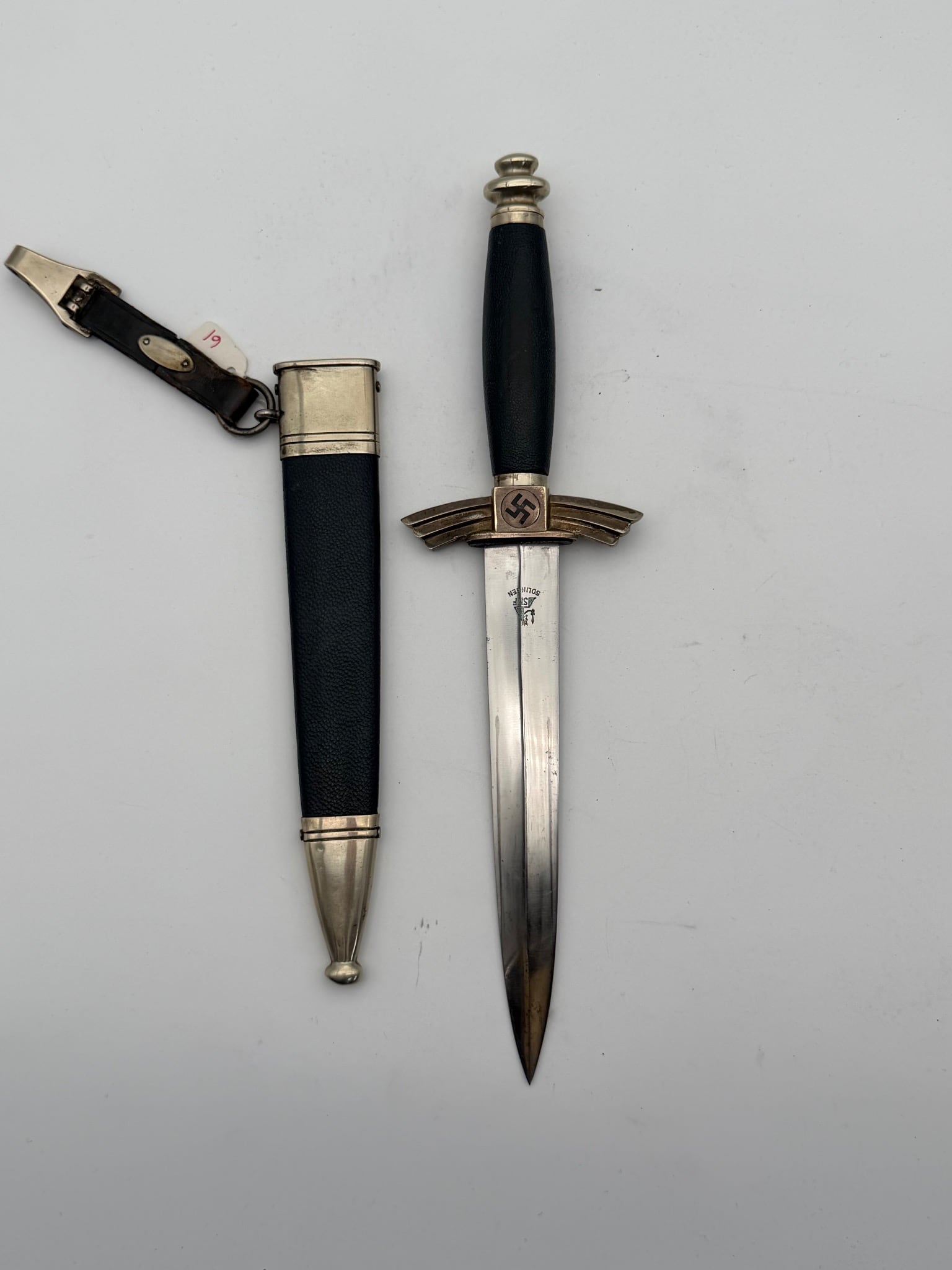
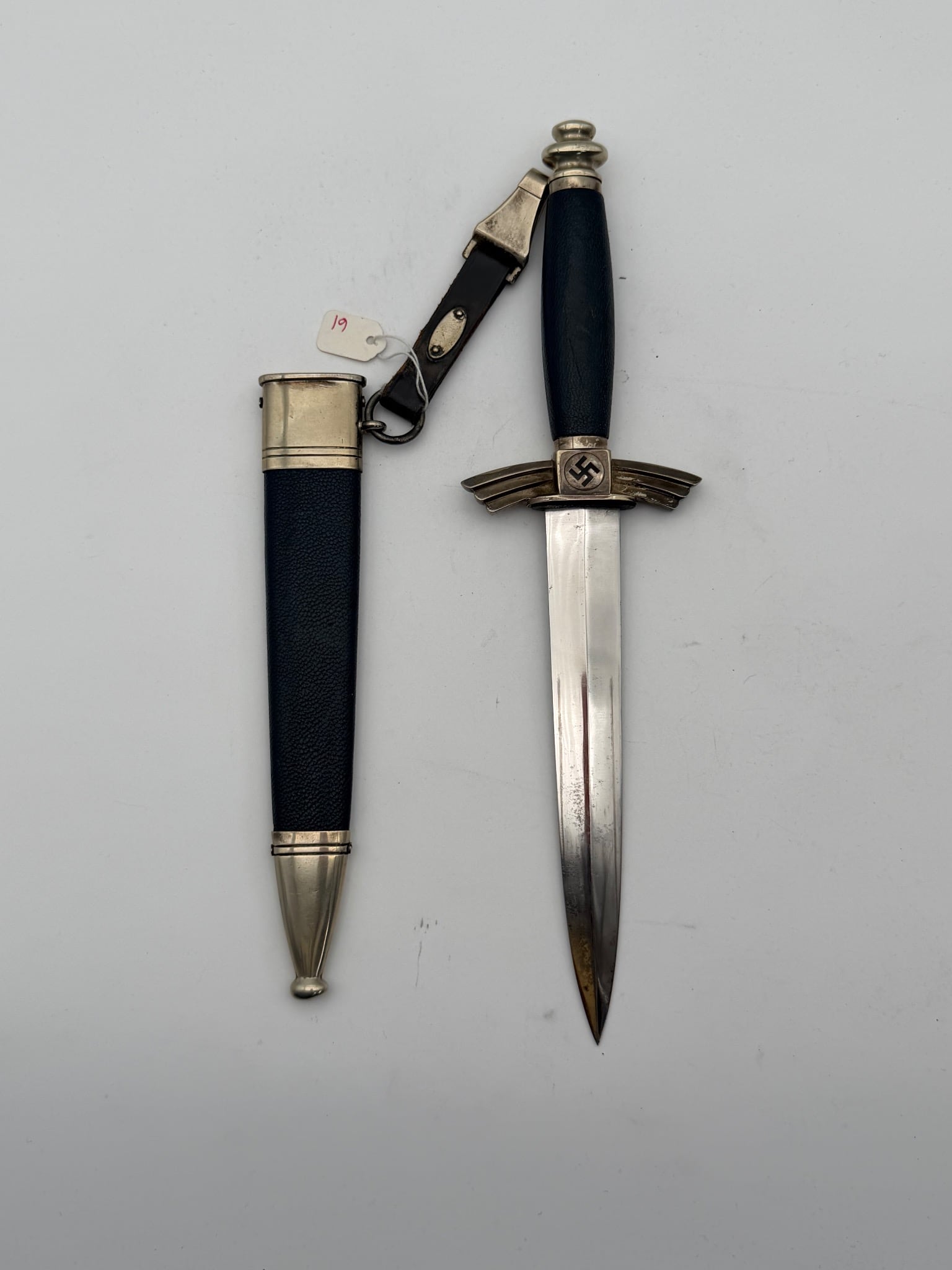
Original DLV / NSFK Fliegermesser by SMF Solingen, dating from the Third Reich German aviation period. Features a dark blue-black leather-covered grip and matching scabbard, nickel-coloured fittings, winged crossguard with black enamel swastika, SMF Solingen maker-marked double-edged blade and surviving short suspension hanger. An attractive and increasingly collectible example with pleasing age patina.
€ 1.795
1 in stock
This original DLV / NSFK Fliegermesser by SMF Solingen is an attractive example of one of the distinctive edged weapons associated with German aviation organisations during the Third Reich period. Manufactured by SMF of Solingen, the knife retains its characteristic leather-covered grip and scabbard, nickel-coloured fittings, enamelled swastika crossguard and original-style suspension hanger.
The photographs show the well-known SMF SOLINGEN maker’s trademark at the base of the blade. SMF was closely associated with the manufacture of German aviation edged weapons and produced DLV/NSFK Fliegermesser as well as later Luftwaffe daggers.
The Deutscher Luftsportverband, generally abbreviated to DLV, was established in 1933 as Germany’s national aviation-sports organisation. Although presented publicly as a civilian flying organisation, it played an important role in the development of German aviation training during the period preceding the open establishment of the Luftwaffe.
The characteristic short Fliegermesser appeared during this early period. Its compact dimensions distinguish it immediately from the much longer First Model Luftwaffe officer’s dagger.
During 1937 the DLV was superseded by the Nationalsozialistisches Fliegerkorps, or NSFK. Existing equipment patterns continued to be used, which explains why collectors normally classify this type as a DLV/NSFK Fliegermesserunless the acceptance marking on the scabbard throat allows a more precise attribution.
The German Federal Archives discusses the NSFK’s role in pre-military aviation and communications training in its published material on the Wehrmacht and associated organisations. Bundesarchiv – Nationalsozialistisches Fliegerkorps research reference
A particularly desirable feature is the clearly visible SMF Solingen trademark on the blade.
SMF is generally associated with Stöcker & Co. / Solinger Metallwaffenfabrik, Solingen, one of the recognised manufacturers of German edged weapons during the period. Aviation-related edged weapons formed an important part of the firm’s production.
The trademark visible on this blade incorporates the characteristic figure above the SMF initials together with the SOLINGEN designation. Its position close to the crossguard corresponds with documented examples from this manufacturer.
Comparable SMF-manufactured DLV/NSFK Fliegermesser can also be examined through established German militaria dealer Helmut Weitze. Helmut Weitze – comparable SMF DLV/NSFK Fliegermesser
The grip has the characteristic elongated oval profile of the Fliegermesser and remains covered with finely textured leather.
Its colouring presently appears extremely dark blue to blue-black. Period DLV and NSFK examples were normally covered with blue leather, although ageing, handling, oils and environmental exposure can make surviving leather appear almost black.
Importantly, the covering displays natural surface texture rather than the artificial uniformity often encountered on later reproductions.
Above the grip sits the distinctive multi-stage urn-shaped pommel assembly. The nickel-coloured surface has developed appropriate age toning and minor wear, complementing the finish seen elsewhere on the dagger.
One of the most recognisable features of the SMF DLV NSFK Fliegermesser is its broad wing-form crossguard.
Raised ribs run along each wing, producing the unmistakable aerodynamic design associated with Germany’s early aviation organisations.
At the centre sits a square boss containing the black swastika device. The dark enamel remains particularly prominent against the naturally aged metal surrounding it.
Surface patination is visible inside the recessed areas of the guard. Rather than detracting from the piece, this gives the fittings an attractive untouched appearance.
The short double-edged blade retains a strong overall profile with its pronounced central ridge running towards the point.
Most importantly, the maker’s trademark remains clearly legible:
SMF
SOLINGEN
The blade retains considerable brightness. Light runner marks, small surface marks and scattered age spotting are visible, particularly towards the lower portion and point.
These characteristics are consistent with an edged weapon that has experienced genuine period use, storage and repeated insertion into its scabbard.
No attempt should be made to polish the blade aggressively. The surviving surface, maker mark and accumulated age characteristics are important elements of the item’s historical integrity.
The original dark leather blade buffer remains visible immediately beneath the crossguard.
The matching scabbard follows the characteristic compact Fliegermesser construction.
A textured leather covering surrounds the central body, while substantial nickel-coloured fittings protect the throat and lower end.
The leather displays an attractive aged surface with no obvious major areas of loss visible in the supplied photographs. Its colour closely corresponds with the grip covering, helping give the ensemble a harmonious appearance.
The lower fitting terminates in the characteristic rounded ball finial.
Age toning, handling marks and minor surface wear remain visible across the metal components. These should be preserved rather than polished away.
Another important feature is the retained short leather suspension hanger.
The strap connects directly with the suspension ring fitted near the scabbard throat and terminates in its substantial metal belt attachment.
Complete Fliegermesser with their suspension equipment are more desirable to collectors than isolated knives and scabbards. Consequently, the presence of the hanger adds both display appeal and collector value.
The fundamental knife pattern continued across the transition from the DLV to the NSFK, making the scabbard-throat acceptance mark particularly important.
DLV examples can carry the earlier aviation acceptance emblem, whereas NSFK pieces may display the later NSFK/Icarus-style marking. Transitional examples are also documented.
Because the relevant face of the scabbard throat cannot be clearly examined in the supplied photographs, the academically safest description for this piece is:
DLV / NSFK Fliegermesser by SMF Solingen
A close photograph of every stamp on the scabbard throat could potentially allow the attribution to be narrowed further.
Several features visible in the photographs correspond closely with documented period examples.
The overall proportions are correct for the short Fliegermesser pattern. Additionally, the SMF maker trademark appears in the expected blade location, while the wing-form crossguard, enamelled centre device, urn pommel and leather-covered scabbard all correspond with established examples.
Natural age toning appears reasonably consistent between the hilt and scabbard fittings. Meanwhile, the leather shows genuine-looking surface texture and age rather than an obviously modern appearance.
The blade exhibits believable scabbard runner wear and age spotting.
Final authentication should nevertheless include examination of the scabbard-throat markings, crossguard stamps, hanger construction, internal tang and fittings whenever possible.
Overall condition is very good for an early DLV/NSFK Fliegermesser.
The leather grip covering remains complete and displays attractive age. Likewise, the scabbard covering survives well, while its fittings retain a pleasing toned finish.
Some wear and oxidation are present on the blade, particularly towards the point. Minor marks occur elsewhere from handling and storage.
The black central crossguard device remains visually strong.
Most importantly, the dagger has not acquired the unnaturally bright appearance caused by excessive modern polishing. Its surviving patina contributes significantly to its character.
DLV and NSFK Fliegermesser occupy an interesting position in the development of Third Reich German aviation edged weapons.
They pre-date or overlap the more familiar Luftwaffe officer’s dagger patterns and represent the organisations through which a substantial element of German flying and gliding training was organised.
An SMF Solingen DLV/NSFK Fliegermesser retaining its scabbard and suspension hanger therefore represents a desirable addition to a serious German aviation, Luftwaffe or Third Reich edged-weapons collection.
For related pieces, see our German Military Daggers & SwordsLuftwaffe Daggers