
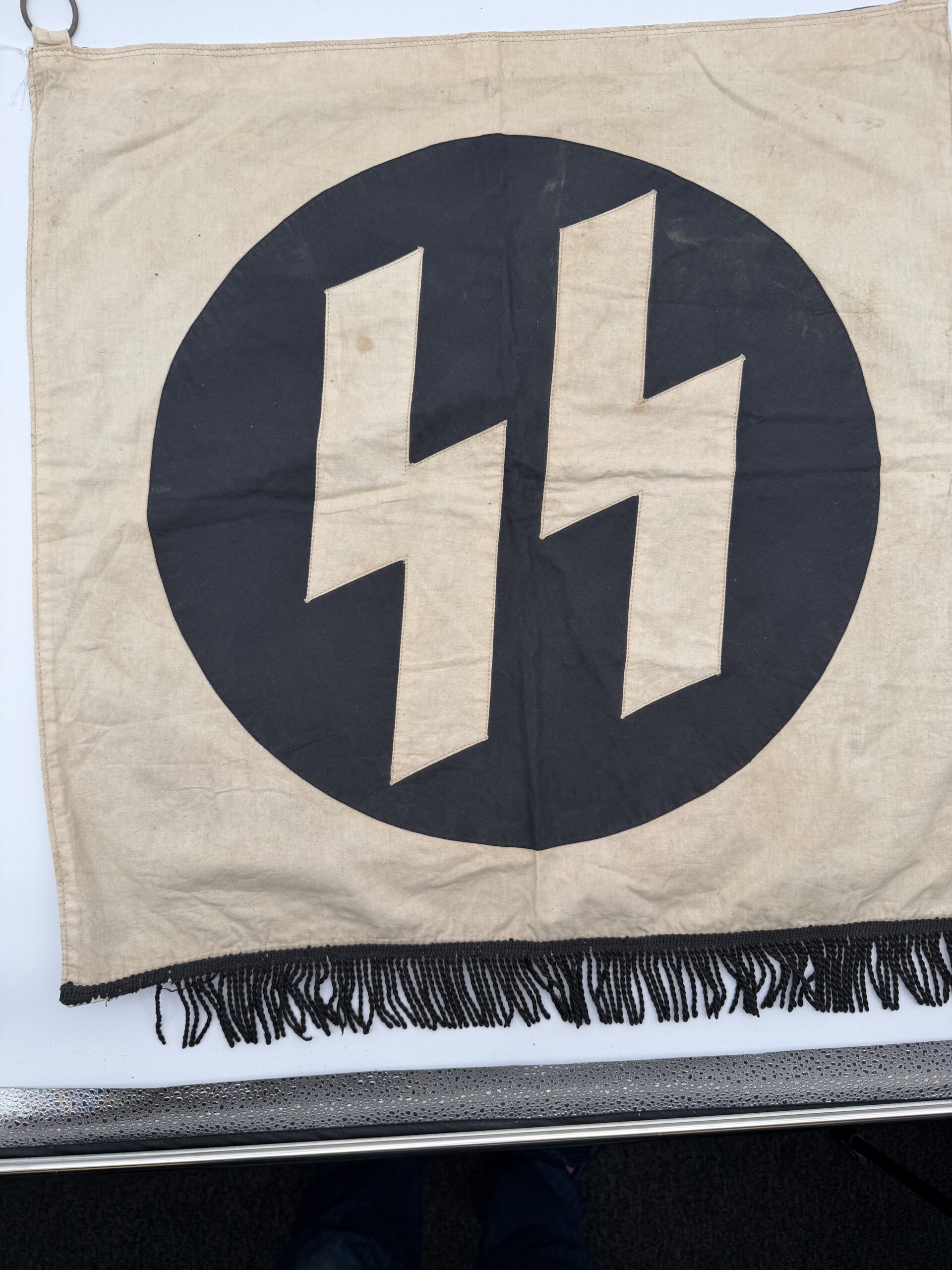
Rare Third Reich SS runic ceremonial hanging / podium banner featuring a large separately applied black roundel with sewn ivory SS runes. Constructed with a black cloth reverse, two original suspension rings and long black twisted lower fringe. Attractive period ageing, staining and wear remain throughout. A striking and highly collectible SS textile display piece.
€ 1.595
1 in stock
This original Third Reich SS runic hanging banner is a particularly striking piece of period textile insignia associated with the Schutzstaffel. Constructed from substantial woven cloth, the banner features a large black circular field with separately applied light-coloured SS runes. A black cloth reverse, original suspension rings and long black twisted fringe complete the construction.
Unlike the much more frequently encountered red NSDAP banners, this example employs the stark black, ivory and white colour combination closely associated with SS symbolism. Its substantial multi-piece construction and large central runic emblem give the piece considerable visual presence.
The surviving ageing, stitching, suspension fittings and natural textile wear make this an especially interesting example for an advanced Third Reich textile, Allgemeine-SS or historical flag collection.
The front is manufactured from an ivory or cream-coloured woven textile which has naturally toned with age.
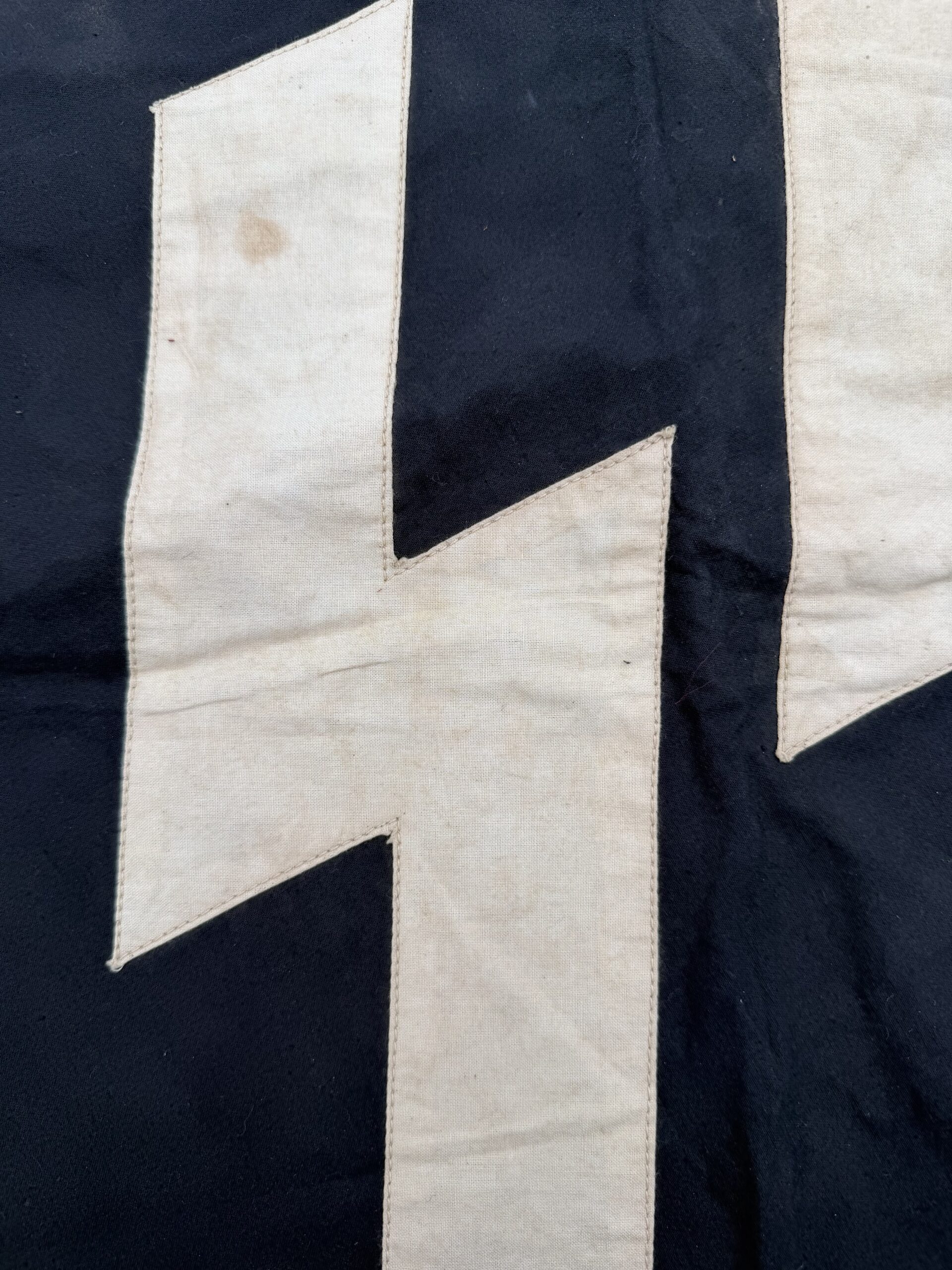
A large separately applied black circular roundel dominates the centre. Two substantial SS runes have then been individually cut from light-coloured cloth and machine sewn onto the black field.
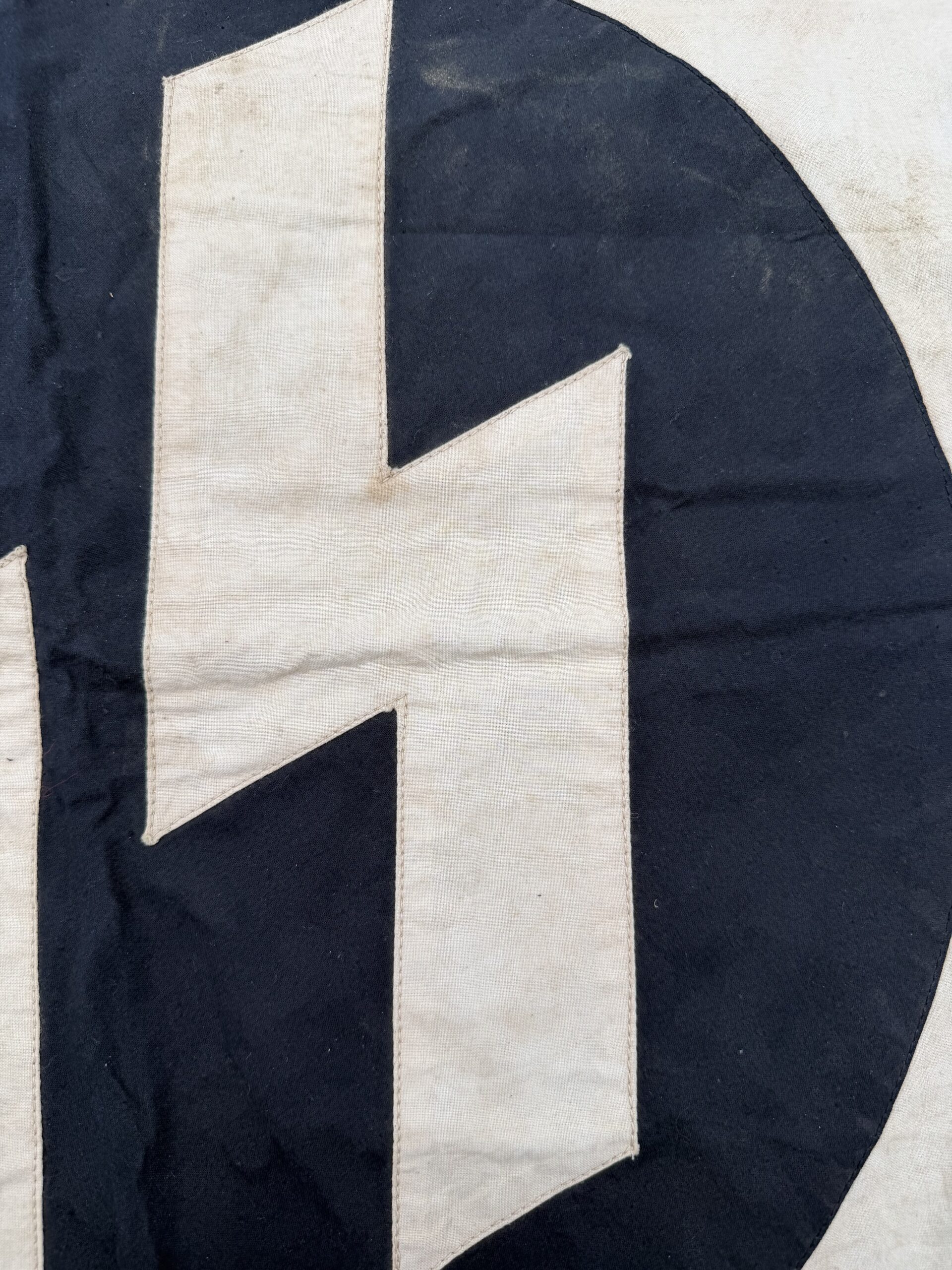
Close examination of the photographs shows conventional period-style stitching around the outlines of the runes. Small variations in the stitch path remain visible, particularly around the internal corners and angled sections.
This is important because the emblem has not simply been printed onto the banner. Instead, the design is assembled from individual pieces of cloth.
Such multi-piece construction creates considerably greater depth and character than later printed reproductions.
The central feature is the pair of large SS Sig runes.
Both devices have been separately cut and sewn directly onto the black circular field. Age toning is visible across their surfaces, while the edges exhibit minor irregularities consistent with textile cutting and period sewing rather than modern computer-controlled manufacture.
Light staining and natural discolouration can also be seen.
These imperfections should not be cleaned away. They form part of the textile’s surviving historical surface and contribute significantly to its character.
The runic emblem became one of the principal visual identifiers of the SS. For historical background on the organisation and its development, see the United States Holocaust Memorial Museum’s detailed reference on the SS.
United States Holocaust Memorial Museum – The SS
Behind the runes is a large black cloth disc.
The roundel is itself separately cut and sewn onto the lighter main body of the banner. Its edge stitching remains clearly visible in the close photographs.
The black textile has retained strong colour despite minor surface dust, creasing and age-related marks.
Careful comparison between the roundel, runes and main body shows ageing across the different textile components rather than one artificially uniform surface.
That distinction is useful when assessing period ceremonial textiles.
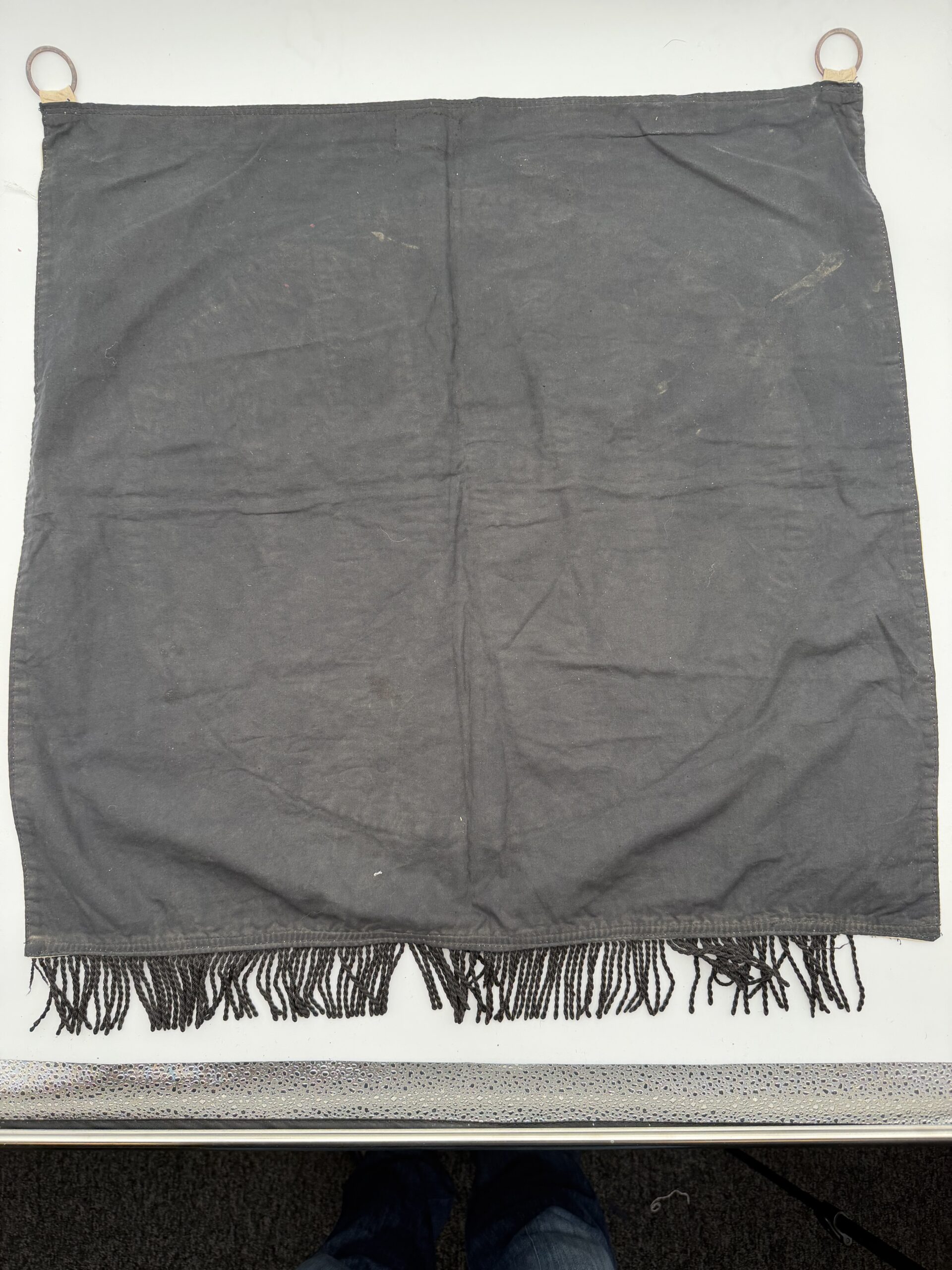
The reverse is entirely different from the presentation face.
A plain black cloth backing covers the rear of the banner. Consequently, the construction appears deliberately intended for viewing primarily from the decorated front.
The backing exhibits general surface wear, creasing, scattered marks and accumulated age. None of this appears excessive.
Importantly, the rear construction separates this banner from the conventional double-sided SS field flag.
For that reason, the most accurate description is SS ceremonial hanging banner or podium banner, rather than simply calling it an SS flag.
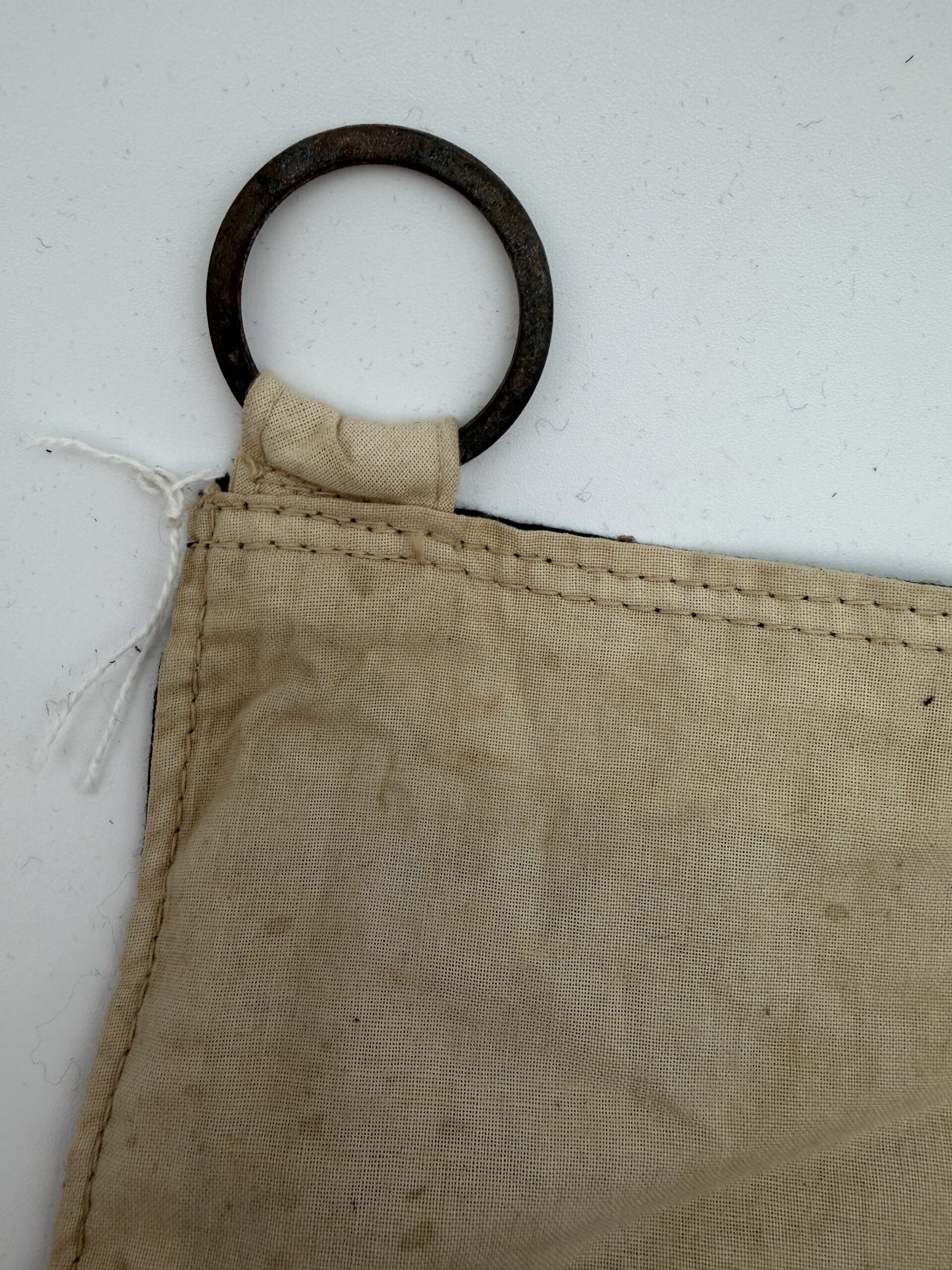
Two substantial metal suspension rings survive at the upper corners.
Each ring is secured through a folded textile tab incorporated into the top construction. The close photograph shows the stitching, folded cloth and naturally aged metal surface particularly well.
Both rings display dark oxidation and surface patination.
Their positioning indicates that the banner was intended to hang vertically from a horizontal support, rail, hooks or similar fixture.
Period German ceremonial and display banners were produced with several suspension arrangements according to their intended function. Comparable trumpet banners could use rings, clips, loops or straps, while podium and wall banners frequently employed suspension loops or rings.
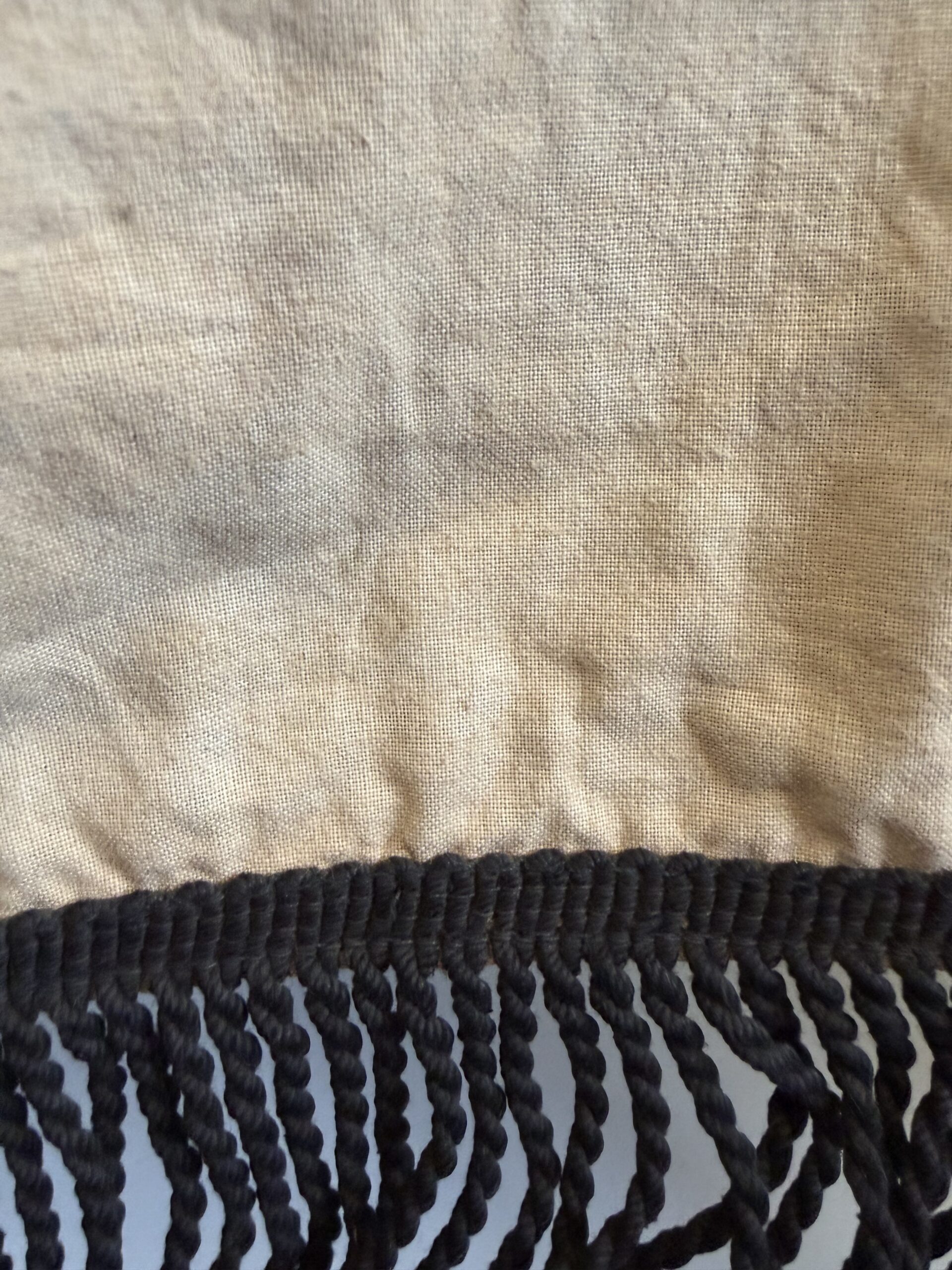
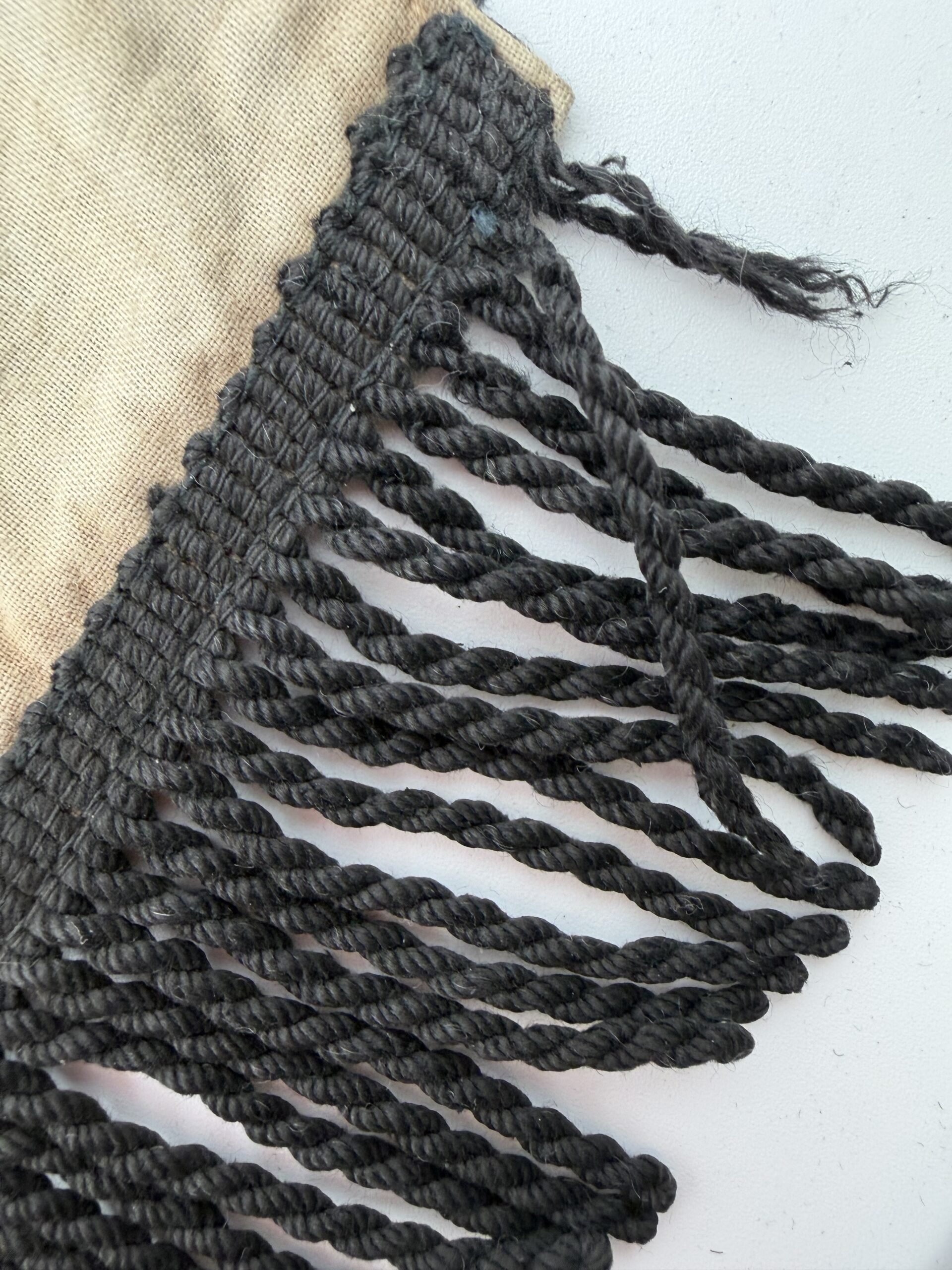
The lower edge retains its original-style black twisted textile fringe.
This is one of the most attractive features of the banner.
Numerous individual twisted cords remain present, while several areas show natural displacement, fraying and minor loss.
The detailed photographs reveal the woven header into which the individual cords are secured. Age, slight distortion and localised wear are visible throughout the fringe.
No attempt should be made to straighten, replace or restore missing tassels. The surviving untouched appearance is considerably more desirable from a collector and conservation perspective.
The combination of features is significant:
Taken together, these characteristics suggest an interior ceremonial, meeting, recruiting, podium or wall-display function.
I would therefore avoid describing the piece definitively as an SS trumpet banner without first establishing its exact dimensions.
Trumpet banners, or Fanfarentücher, were normally relatively compact and frequently carried fringe on three free edges. Many also employed several straps, clips or loops across their upper edge.
Nevertheless, there are clear stylistic similarities.
A currently documented comparison from Strachan Militaria consists of a square white SS banner with separately sewn white runes on a black circular field. That example is identified as an SS trumpet banner and retains black fringe and suspension clips.
View the closely comparable SS banner at Strachan Militaria
The SS, or Schutzstaffel, developed from a small personal protection organisation established for Adolf Hitler into one of the principal organisations of the National Socialist regime.
Heinrich Himmler became Reichsführer-SS in 1929. Thereafter the organisation expanded enormously and eventually controlled major elements of the German police, intelligence structure and concentration-camp system.
The SS also played a central role in Nazi persecution, mass murder and the Holocaust. Consequently, surviving SS banners and insignia should be viewed as historical evidence of the organisation rather than simply as decorative military objects.
The United States Holocaust Memorial Museum provides extensive historical documentation concerning the SS, its structure and its crimes.
USHMM historical reference – SS and Police
The photographs show several encouraging characteristics.
First, the banner is of multi-piece textile construction rather than modern printed manufacture.
Additionally, the SS runes are individually applied and stitched to a separately applied circular field.
Natural variation occurs around the stitching.
The light-coloured fabric displays widespread age toning and embedded staining rather than artificial spot ageing.
Likewise, the black reverse shows believable handling marks and storage wear.
Dark oxidation is present on the two suspension rings.
Finally, the fringe displays irregular wear, broken cords and natural fibre distortion.
These observations are compatible with genuine period use. However, photographs alone cannot provide absolute authentication.
For a definitive catalogue attribution I would additionally record:
UV examination: no modern optical-brightener fluorescence should be present in the principal fabrics or original sewing thread.
Thread inspection: close magnification should determine whether the sewing threads are period natural fibres.
Ring inspection: examine beneath the textile suspension loops for long-established compression, oxidation transfer and consistent wear.
Seam examination: internal stitching should correspond with the visible exterior assembly.
Measurements: exact width and height are important for determining whether the banner was intended as a podium/wall hanging or instrument banner.
Overall condition is very good for a period ceremonial textile.
The main ivory-coloured field has developed considerable natural toning, scattered staining and minor surface marks.
The black roundel remains strong and clearly defined.
Both applied SS runes survive complete, although age-related staining and slight edge irregularity are visible.
The black reverse displays honest wear, folding and surface marks.
Most of the lower twisted fringe remains intact. Several cords have become displaced or partially lost, which is entirely acceptable on an object of this age.
Both upper suspension rings remain present.
The banner should be preserved exactly as found and should not be washed, chemically cleaned or heavily pressed.
Original SS ceremonial textiles are substantially scarcer than ordinary NSDAP flags.
Furthermore, unusual banner formats are especially interesting because many were produced for specific interior, musical, recruiting or ceremonial functions.
This example has particularly strong display appeal because of its enormous central runic emblem and contrasting black-and-ivory construction.
Its surviving fringe and suspension rings enhance the completeness of the piece.
For a specialist collection of Allgemeine-SS memorabilia, SS flags and banners, Third Reich textiles or museum-standard political material, it represents a visually impressive historical artefact.
For related pieces, see our MiscellaneousSS ItemsInsignia, Shoulder Boards and Breast Eagles