
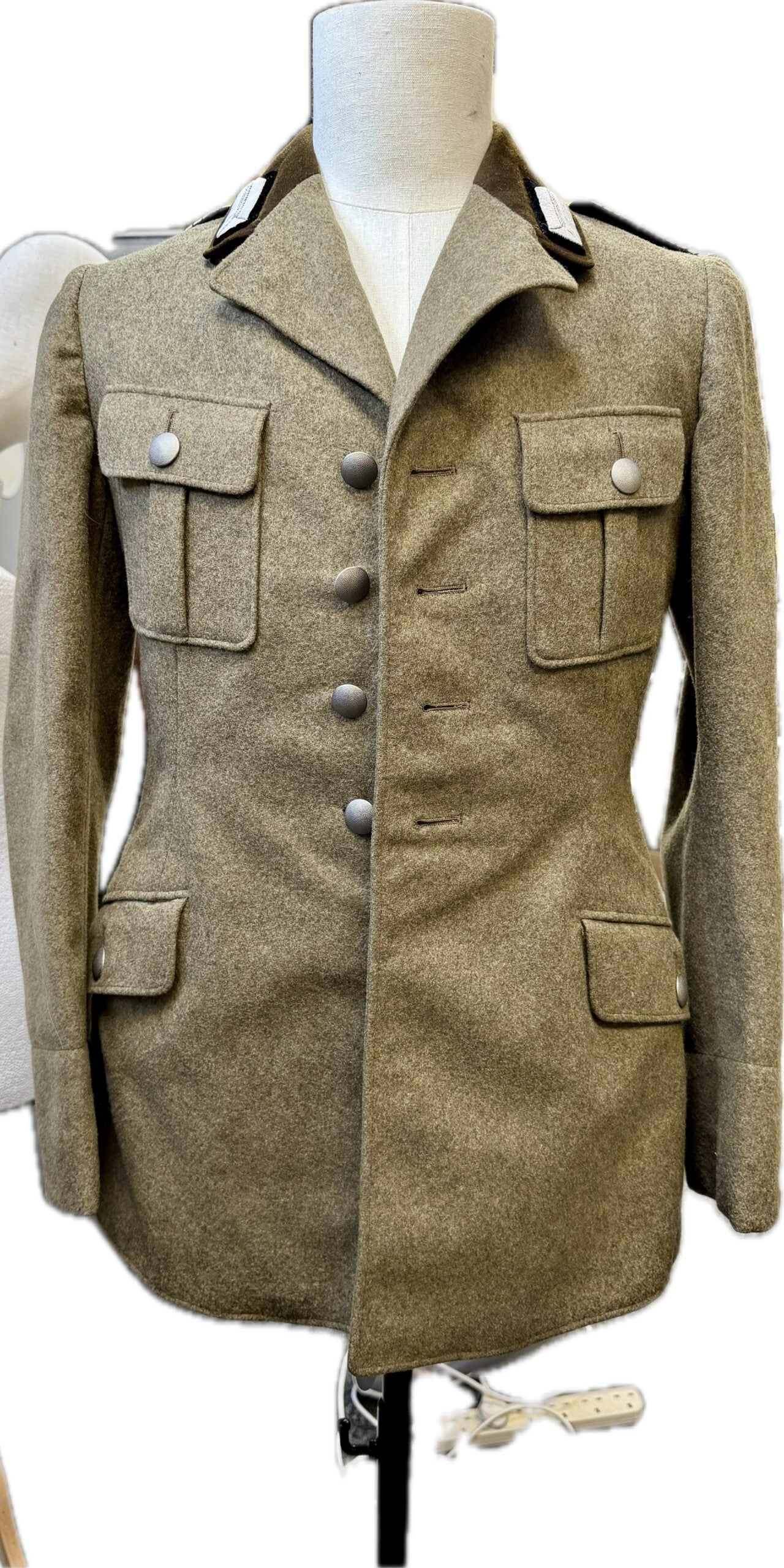
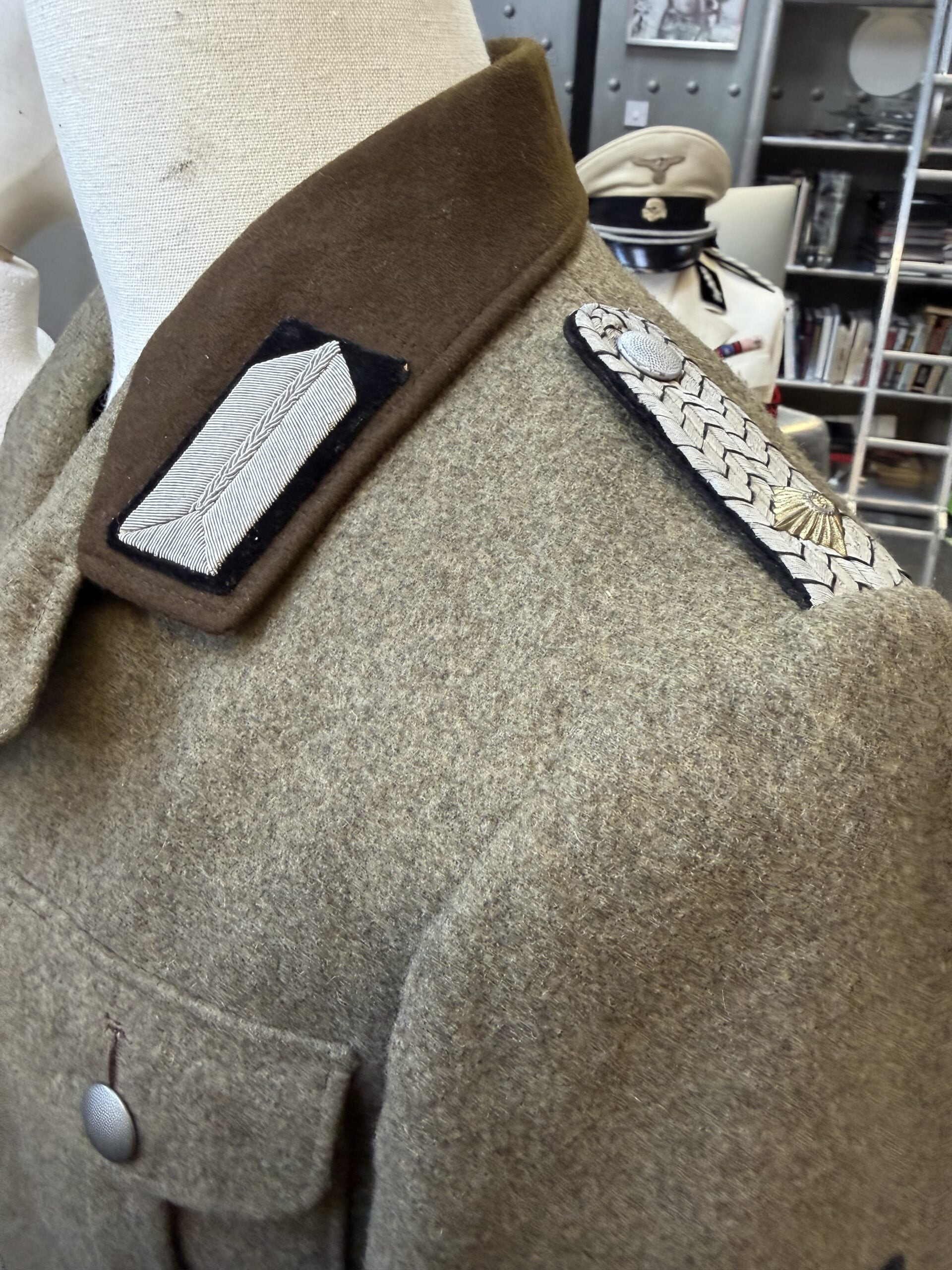
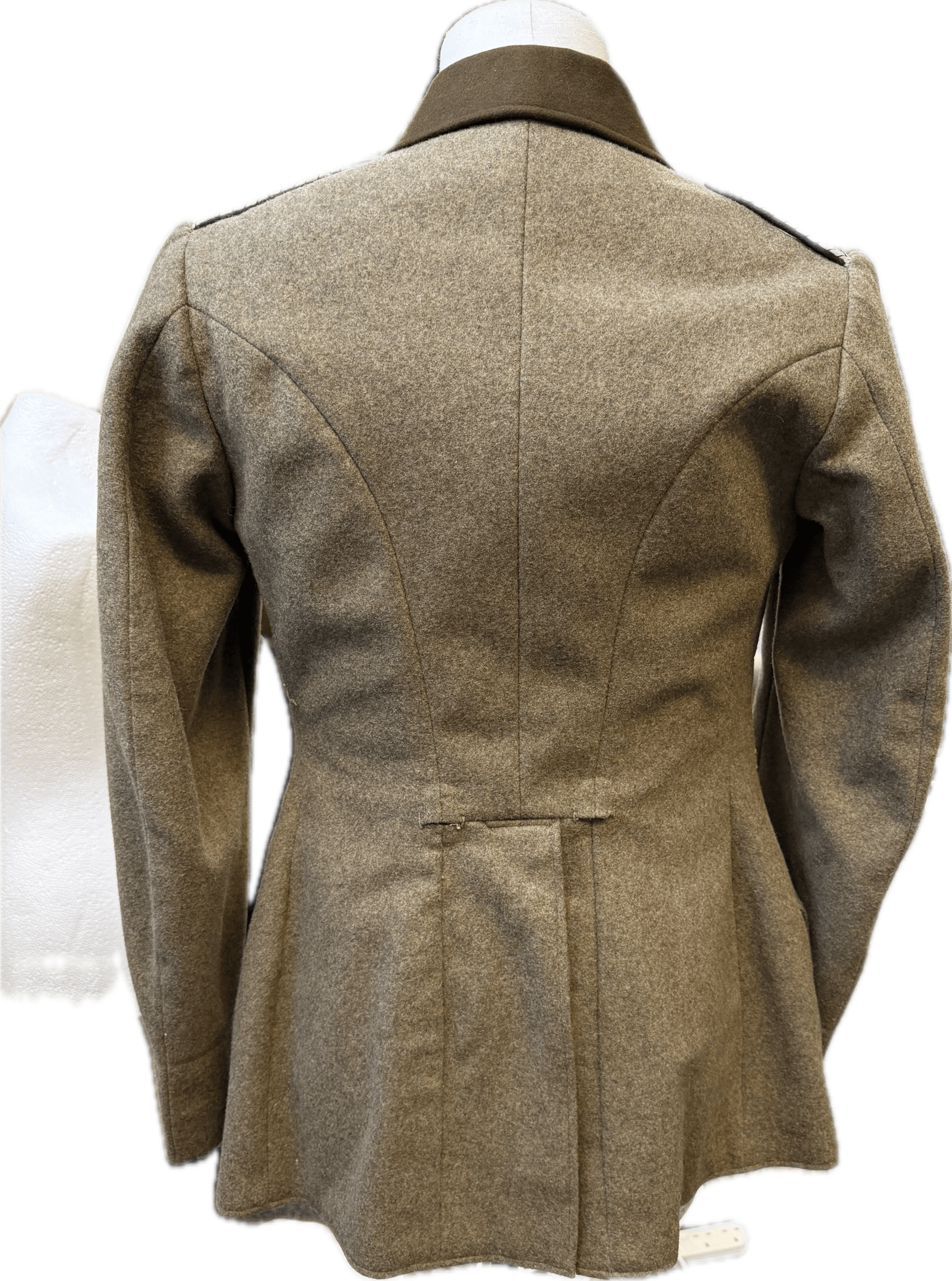
Exceptional original RAD Oberfeldmeister tunic dating from approximately 1938 and retaining its regulation officer-grade collar tabs, braided shoulder boards and complete pebbled buttons.
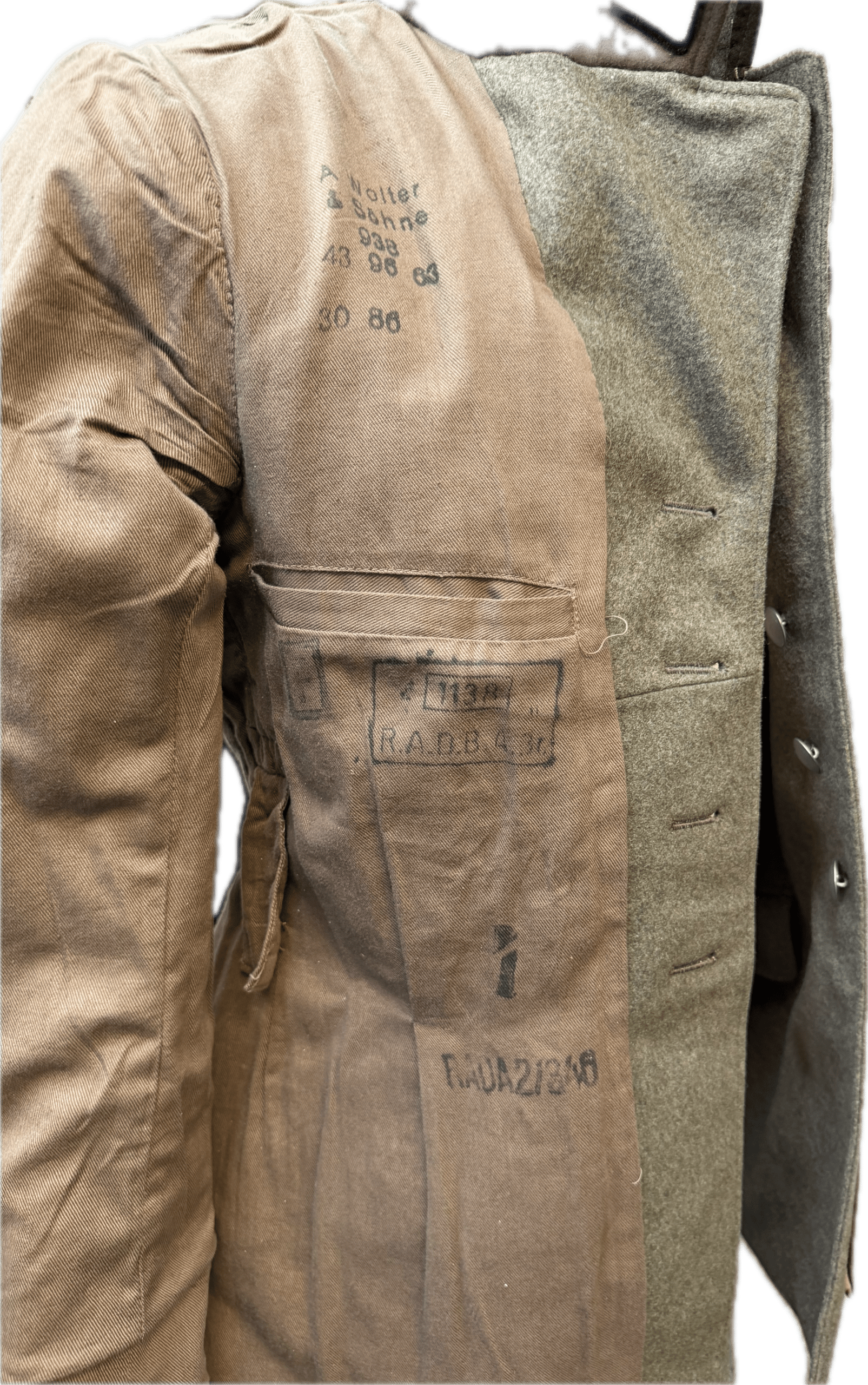
The earth-brown wool body carries the characteristic dark chocolate-brown collar associated with the Reichsarbeitsdienst. Furthermore, extensive interior issue, sizing and manufacturer markings survive beneath the brown cotton lining.
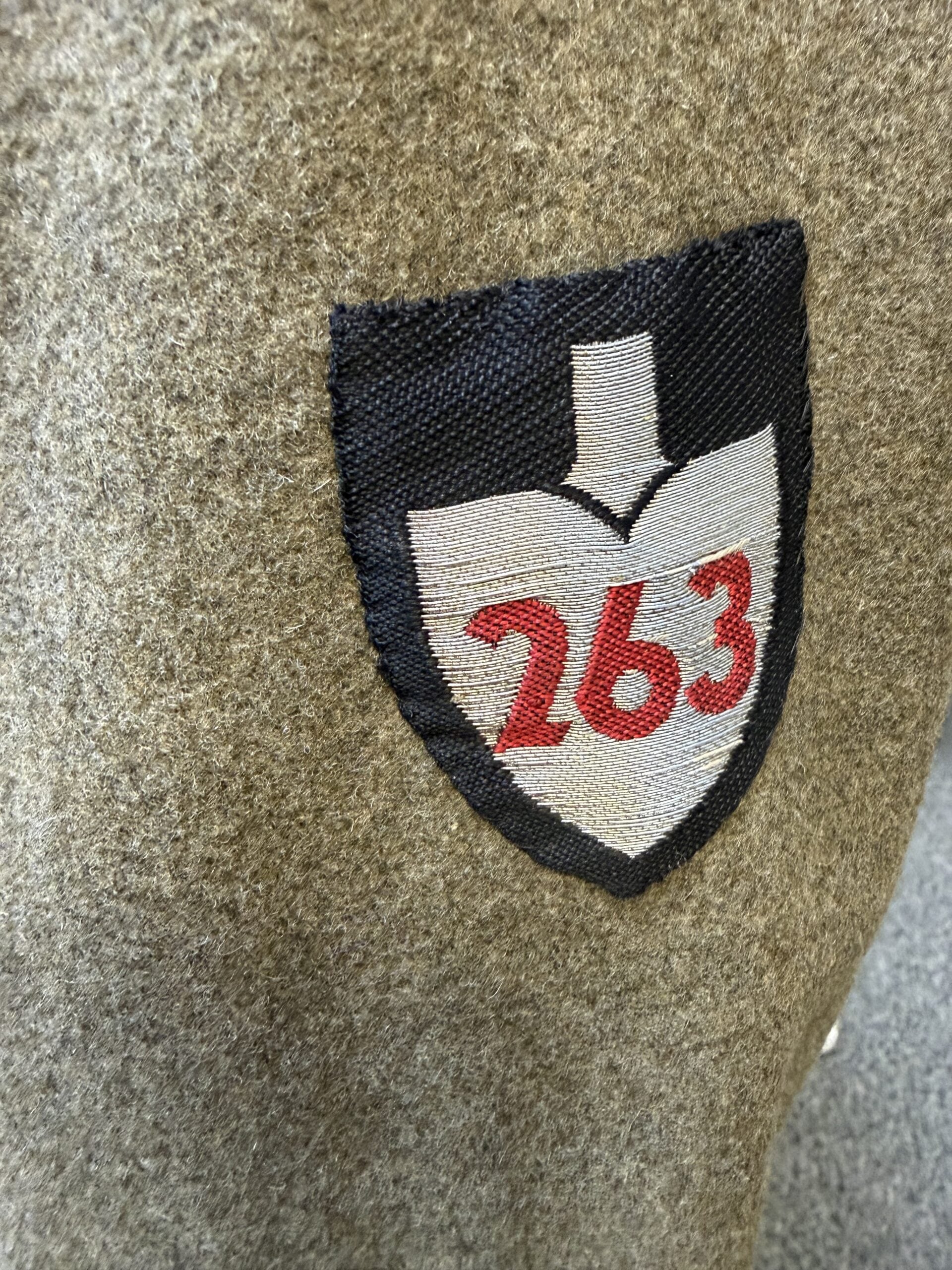
A separate original-style 263 Gruppenstab sleeve spade accompanies the tunic. Historical records identify RAD-Gruppe 263 with Villingen in Württemberg during 1938 and 1939.
Catalogue price: €2,750
€ 2.750
1 in stock
This original RAD Oberfeldmeister tunic represents a particularly attractive pre-war Reichsarbeitsdienst officer uniform.
Fine earth-brown wool forms the four-pocket body. Meanwhile, a contrasting dark chocolate-brown collar creates the distinctive appearance associated with RAD service dress.
Four pleated patch pockets remain complete with their original-style flaps and pebbled metal buttons.
The tunic retains an elegant fitted shape. Moreover, curved rear seams and the long central skirt opening demonstrate careful period tailoring.
Condition remains considerably better than many issued RAD uniforms encountered today.
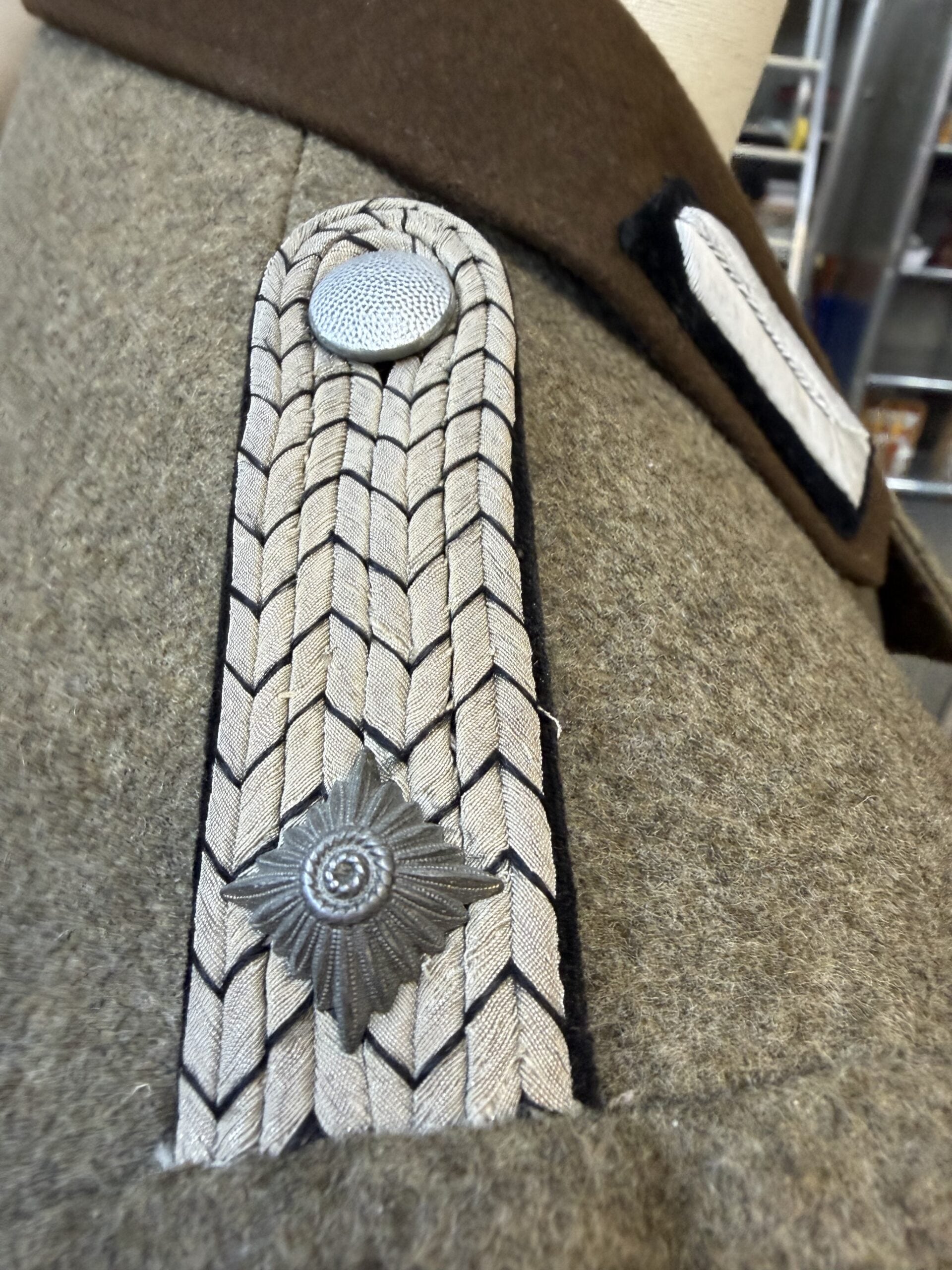
The shoulder boards provide the strongest evidence for the wearer’s rank.
Heavy silver aluminium braid forms each board over a dark backing. Significantly, one rank pip appears on each shoulder board.
That configuration corresponds with the RAD rank of Oberfeldmeister. Specialist examples identify the same one-pip officer board as the Oberfeldmeister pattern.
Oberfeldmeister ranked within the professional RAD leadership corps. In broad military comparison, the grade sat at approximately senior lieutenant level.
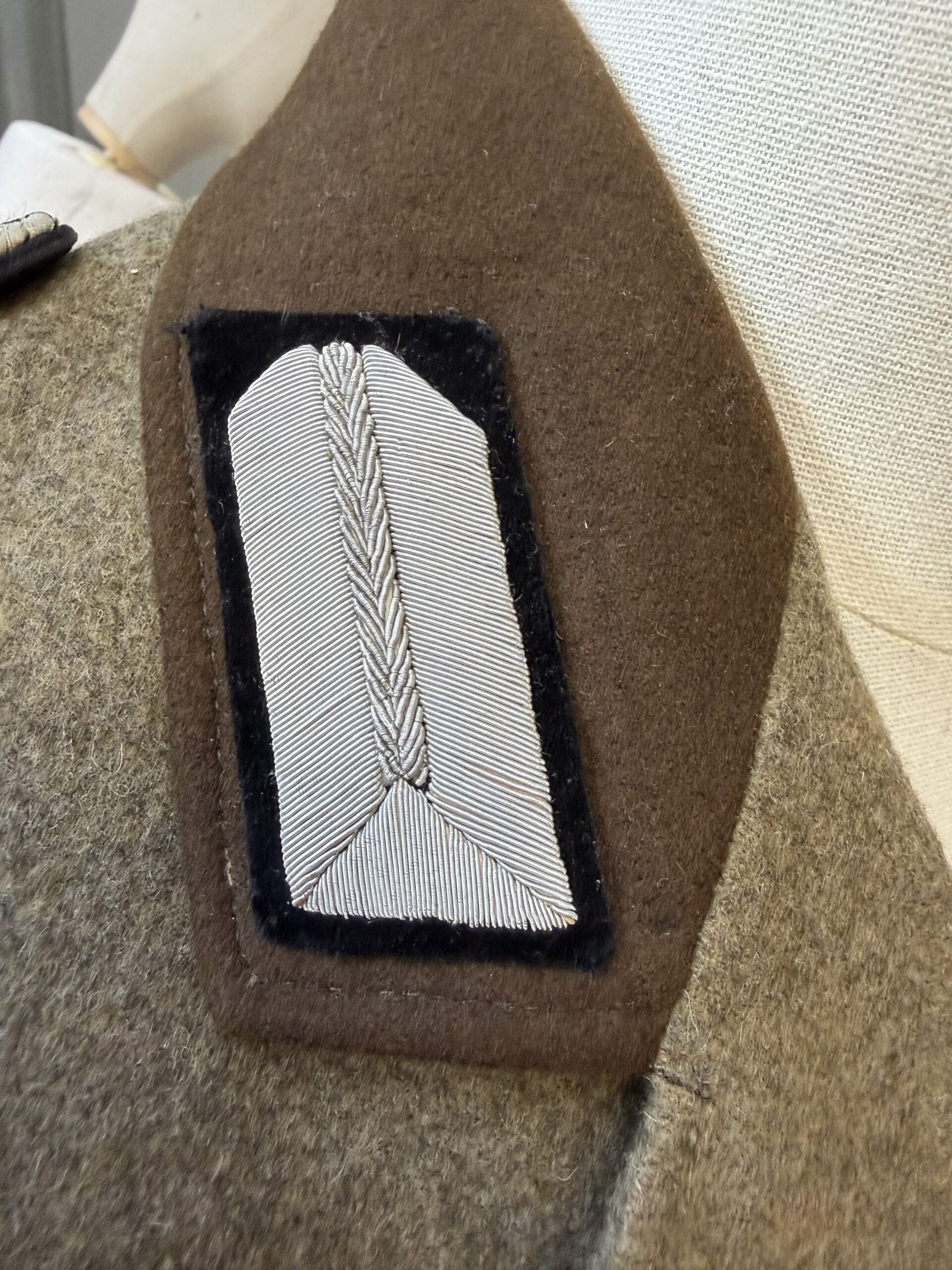
Matching officer-pattern collar tabs complete the rank presentation.
Both collar patches remain fitted to the chocolate-brown collar.
A black velvet foundation supports finely worked silver aluminium insignia. Across the centre, raised silver braid forms the characteristic leader-grade device.
The silver surface displays natural age toning. However, strong definition remains throughout the embroidery.
Period references place this style of officer collar patch within the rank group from Unterfeldmeister through Oberstfeldmeister. Individual rank was then differentiated principally through the shoulder boards.
Consequently, the single shoulder-board pip identifies this uniform specifically as an Oberfeldmeister example.
One of the most interesting features accompanying the uniform is the loose RAD 263 sleeve spade.
Its black textile foundation carries a silver woven shovel-head device. Bright red numerals 263 appear prominently across the centre.
Importantly, no subordinate Abteilung number appears beneath the 263.
Number-only RAD sleeve spades are associated with personnel serving at Gruppenstab, rather than within an individual numbered Abteilung. Period organisational research confirms that RAD-Gruppe 263 was based at Villingen during 1938 and 1939.
The dating corresponds exceptionally well with the internal 1938 markings found inside this tunic.
For that reason, the sleeve spade provides a highly interesting potential organisational association.
Nevertheless, because it is presently detached, the catalogue should describe it as an accompanying Gruppe 263 sleeve badge rather than claim that it has remained permanently sewn to this tunic since issue.
RAD-Gruppe 263 formed part of the organisation operating within the Württemberg region.
Bundesarchiv research identifies Arbeitsgau XXVI Württemberg, headquartered at Stuttgart, as one of the RAD’s established regional commands before the war.
Regional sources place Gruppe 263 at Villingen.
Several subordinate units existed under the group, including 1/263 and 2/263.
A detailed regional historical study records that units belonging to Gruppe 263 later contributed personnel to Bau-Bataillon 62 during mobilisation in August 1939. This development illustrates the increasing military use of RAD formations immediately before the outbreak of war.
The surviving 263 insignia therefore adds considerably more historical interest than an anonymous RAD uniform.
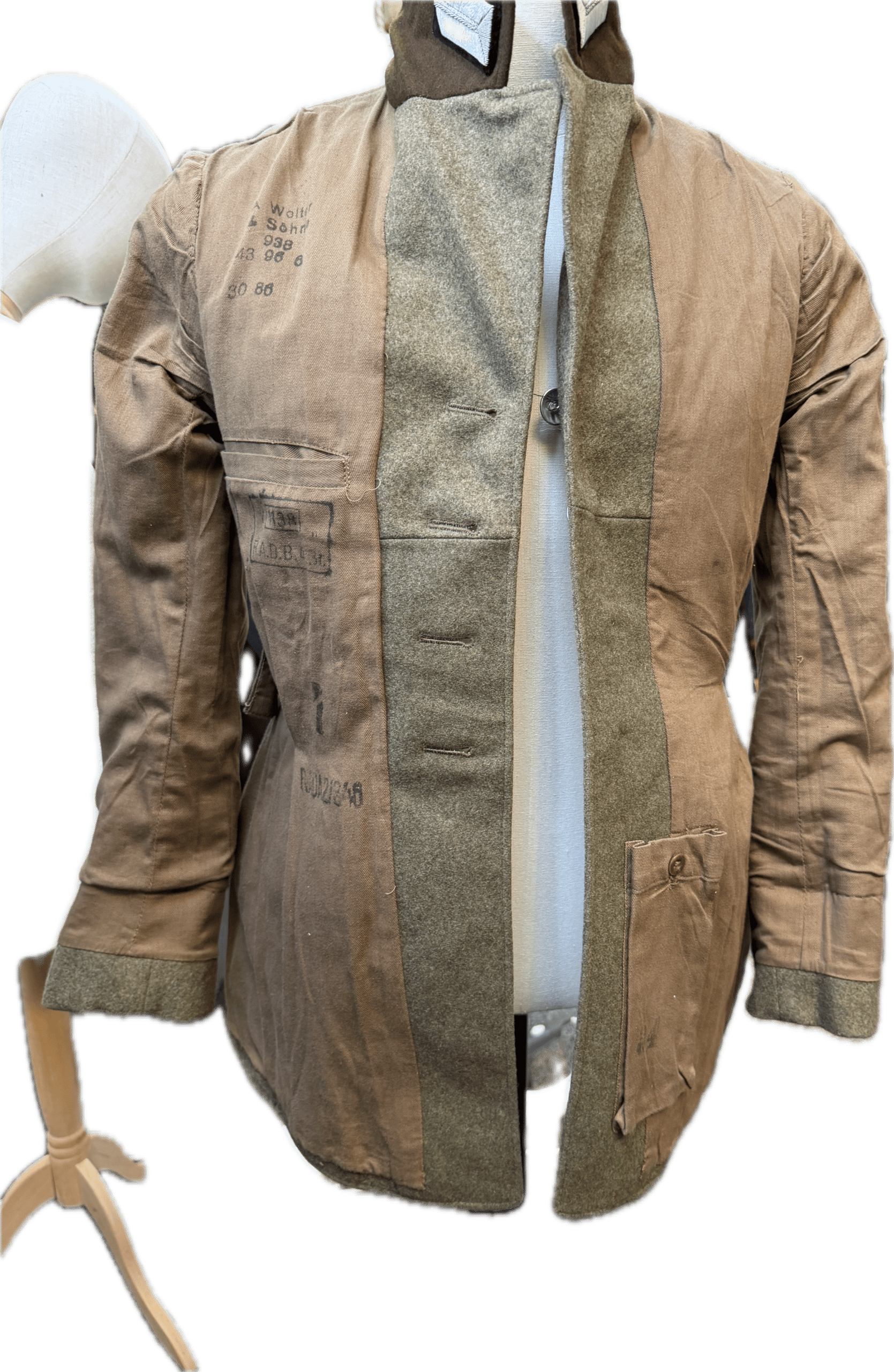
Opening the tunic reveals a remarkably informative brown cotton lining.
Several black ink stamps remain clearly visible.
The upper marking appears to read:
A. Wolf & Söhne
Beneath this appears a date or production marking ending in 938, together with a series of numerical sizing or control stamps.
Visible numbers include:
A further boxed acceptance marking also contains a clearly visible 1938 date.
Because the precise factory or contractor represented by the stamp has not yet been confirmed from a reliable period contractor register, the safest museum-standard approach is to record the marking exactly as it appears.
Accordingly, no unsupported manufacturer location should be added.
Unlike many privately tailored RAD officer uniforms, this tunic displays extensive internal issue markings.
Brown cotton drill covers the interior body and sleeves. In contrast, the exterior uses heavier earth-brown wool.
Internal pockets remain present on both sides.
The lining reveals extensive hand and machine finishing. Furthermore, naturally aged seams, reinforcement stitching and period thread remain clearly visible.
Close photographs show no obvious modern overlocking or synthetic construction.
Wear to the lining also corresponds with long-term use rather than artificial distressing.
The wool body retains an attractive mixture of brown, olive and grey fibres.
Under magnification, individual natural fibres remain clearly visible.
Subtle colour variation appears throughout the surface. Consequently, the cloth has the muted earth-tone appearance expected from original RAD uniform material.
The four-pocket front remains sharply tailored.
Pebbled silver-grey buttons show natural oxidation without excessive polishing.
Likewise, buttonholes display period-type hand finishing and age-consistent wear.
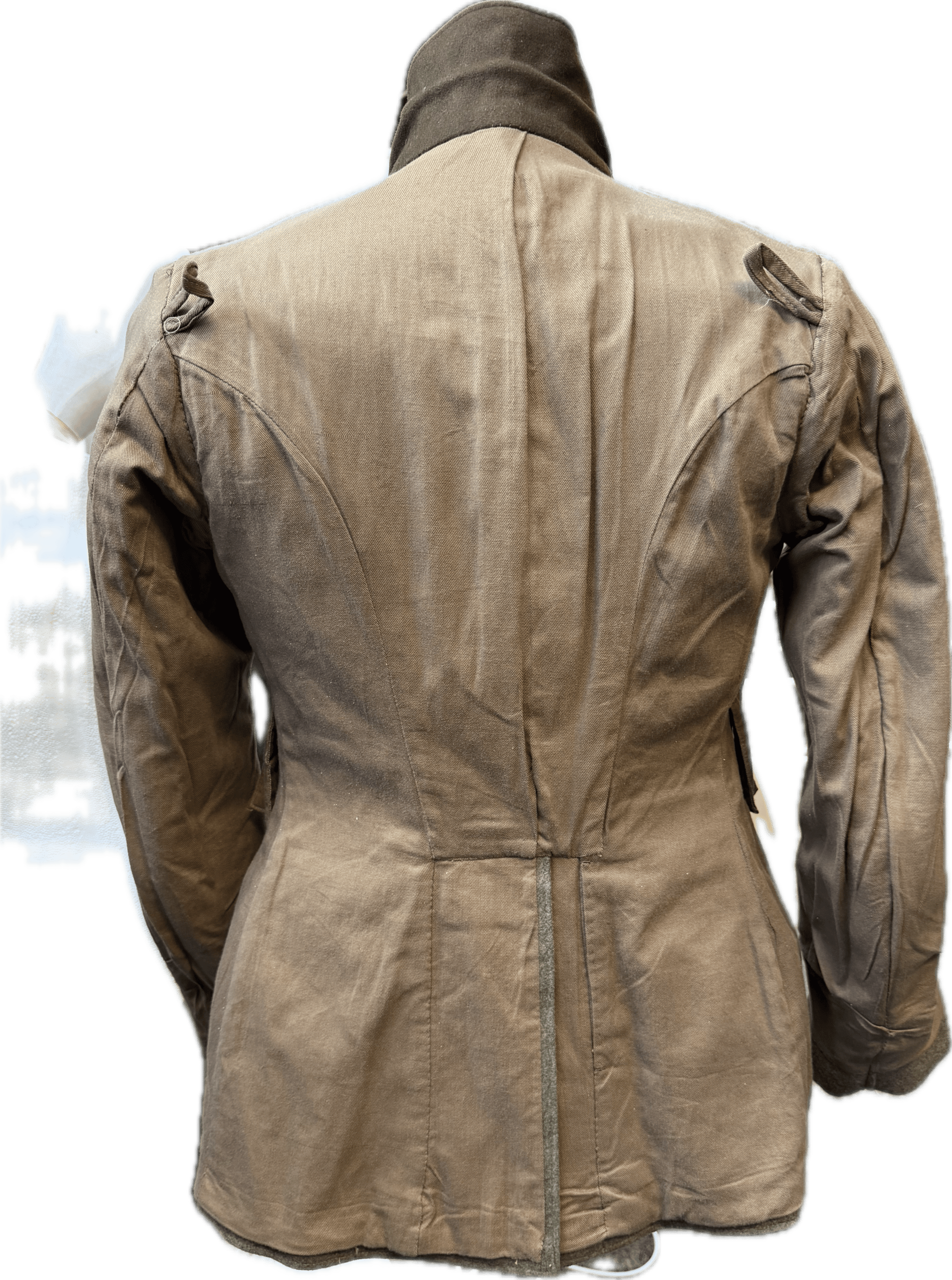
The rear of this RAD Oberfeldmeister tunic is particularly well constructed.
Curving seams extend from beneath the shoulders toward the waist. Therefore, the tunic develops the narrow-waisted silhouette associated with pre-war uniform tailoring.
A long rear vent continues below the waist.
Original cloth reinforcement remains visible internally.
No major structural repairs can be seen in the supplied photographs.
Overall shaping remains excellent despite the age of the garment.
Photographic examination provides several positive indicators of period manufacture.
Firstly, the wool cloth exhibits appropriate natural fibre structure.
Secondly, both the collar insignia and shoulder boards show traditional metallic-thread construction.
Internal stamps provide another strong feature. In addition, the lining shows natural oxidation, handling wear and period-style sewing.
The pebbled buttons also appear visually consistent with the rest of the garment.
No obvious modern synthetic textile appears in the photographs.
Equally important, the rank configuration is internally coherent: officer-pattern collar tabs combined with single-pip Oberfeldmeister shoulder boards.
For those reasons, the tunic presents as a convincing original period RAD garment.
Final authentication of any high-value uniform should still include ultraviolet testing and direct examination of concealed stitching.
Overall condition is very good to excellent for an issued pre-war RAD uniform.
The exterior wool retains strong colour and excellent body.
Minor surface marks remain visible in several areas. Nevertheless, no widespread moth destruction appears in the photographs.
Both collar tabs remain highly presentable.
Metallic shoulder braid retains considerable brightness. Meanwhile, the rank pips show attractive natural ageing.
Interior cotton remains substantially complete.
Several stains and service marks appear within the lining, although these are entirely acceptable on an issued garment.
The surviving issue stamps remain unusually legible.
The Reichsarbeitsdienst became compulsory for young German men following legislation introduced in June 1935.
Although officially presented as a labour service, the organisation also imposed military-style discipline and increasingly provided pre-military training.
By the late 1930s, RAD units became closely involved with construction projects connected to German rearmament.
The Bundesarchiv provides detailed contemporary organisational material concerning the RAD and its relationship with the German military system.
Bundesarchiv:
Bundesarchiv – Reichsarbeitsdienst historical research
Regional history provides further evidence concerning Gruppe 263 and its Villingen-area units.
Baden-Württemberg regional archive/reference:
Regional history – RAD-Gruppe 263 Villingen and Bau-Bataillon 62
Additional documentation survives concerning RAD-Abteilung 2/263 “Heinrich von Fürstenberg” at Hüfingen.
LEO-BW:
LEO-BW – RAD Abteilung 2/263 historical reference
Explore related listings: Uniforms; Nordmenn Militaria – Insignia, Shoulder Boards and Breast Eagles.
Recent specialist auction results demonstrate the wide price range found among RAD Oberfeldmeister tunics.
A standard Oberfeldmeister tunic sold through Ratisbon’s in February 2026 for €435 before buyer’s premium.
Another unit-marked Oberfeldmeister tunic from Abteilung 7/284 achieved €750 at auction in March 2025.
By contrast, an especially complete privately purchased Oberfeldmeister service uniform reached €1,730 hammer, or approximately €2,120 including premium, in an earlier Ratisbon’s sale.
This example offers several features that justify positioning it above an ordinary anonymous tunic.
Those advantages include:
Consequently, a premium specialist retail price is justified.
The €2,750 valuation assumes that the loose original 263 Gruppenstab sleeve spade accompanies the tunic.
Organisation: Reichsarbeitsdienst – RAD
Item: Officer service tunic
Rank: Oberfeldmeister
Period: Third Reich
Approximate date: 1938
Regional command: Arbeitsgau XXVI Württemberg
Associated unit: RAD-Gruppe 263
Location: Villingen
Exterior: Earth-brown wool
Collar: Chocolate-brown wool
Collar tabs: Silver aluminium officer pattern on black velvet
Shoulder boards: Silver braided officer pattern
Rank pips: One per shoulder board
Front: Four-pocket service pattern
Buttons: Pebbled metal
Interior: Brown cotton lining
Maker marking: Appears to read A. Wolf & Söhne
Issue markings: Multiple sizing and acceptance stamps
Accompanying insignia: Loose Gruppe 263 sleeve spade
Condition: Very good to excellent
Catalogue price: €2,750
The single pip on each officer-pattern shoulder board identifies the wearer as an Oberfeldmeister.
The accompanying number-only sleeve spade corresponds with RAD-Gruppe 263, which historical references place at Villingen during 1938 and 1939.
A subordinate Abteilung normally added its own unit number. By contrast, a number-only badge is associated with personnel attached to the Gruppenstab.
Interior markings include a 1938 acceptance or issue date together with several sizing and control stamps.
One internal stamp appears to read A. Wolf & Söhne. Until a reliable period contractor list confirms the exact company, no speculative location should be added.
No. The photographs show the badge separately. Therefore, it should be catalogued as an accompanying original-style Gruppe 263 sleeve spade rather than described as untouched on the sleeve.
The materials, tailoring, insignia, interior markings and ageing visible in the supplied photographs are consistent with period manufacture. Physical examination remains advisable for absolute authentication.
This RAD Oberfeldmeister tunic combines strong pre-war construction, unusually clear issue markings and complete officer-rank insignia.
Its 1938 dating places it immediately before the major expansion and mobilisation of the Reichsarbeitsdienst.
More importantly, the accompanying 263 sleeve spade provides a direct organisational link with RAD-Gruppe 263 at Villingen.
Excellent exterior preservation further enhances its appeal. In addition, the untouched-looking lining gives collectors valuable access to the uniform’s original manufacturing and issue information.
For an advanced collection of Reichsarbeitsdienst uniforms, pre-war German organisational clothing or documented Third Reich textiles, this represents a highly desirable surviving example.