
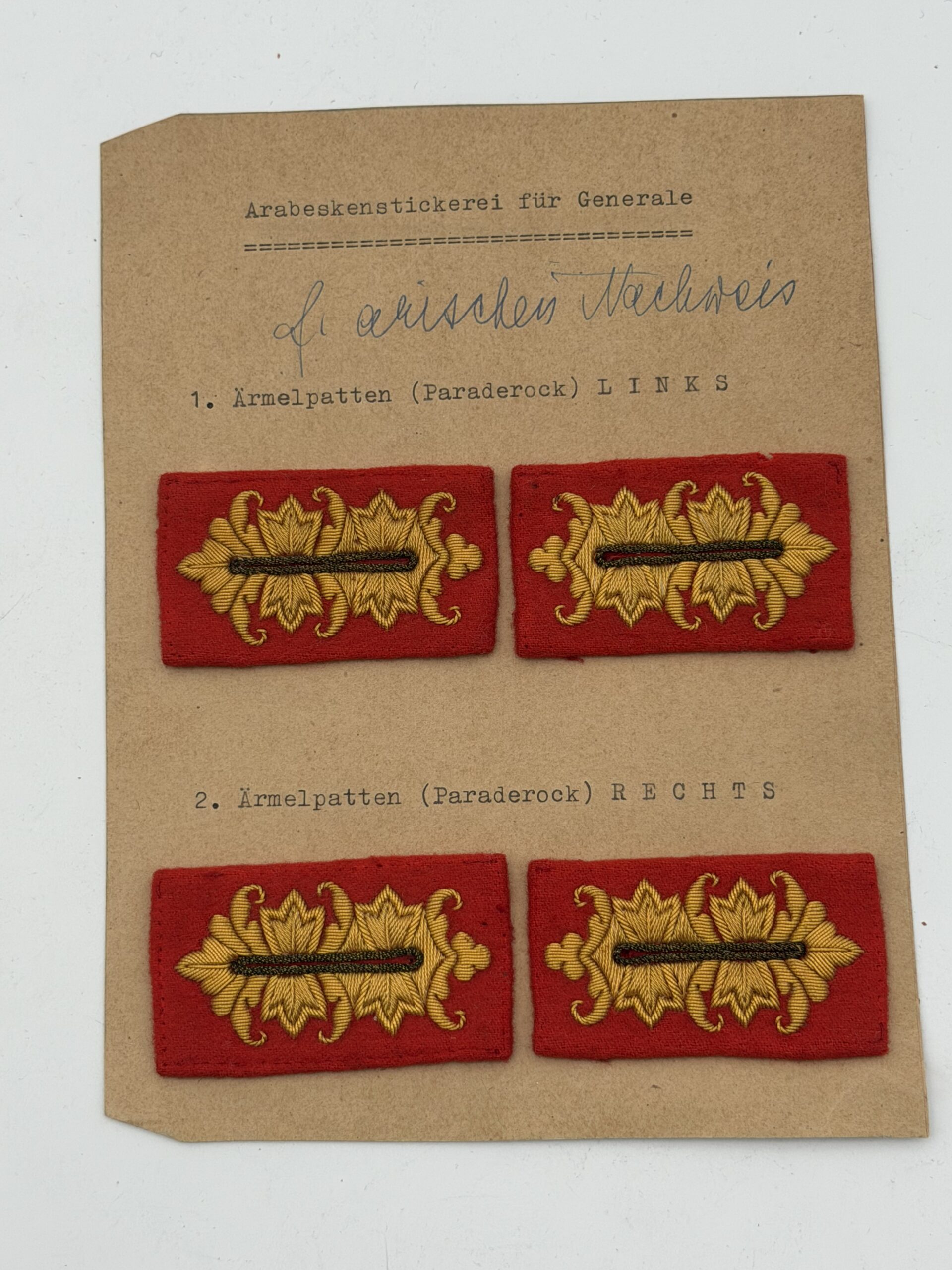
An exceptionally rare Walter von Reichenau parade cuff sample comprising four original gold bullion General’s Arabesken mounted to a period workshop reference card.
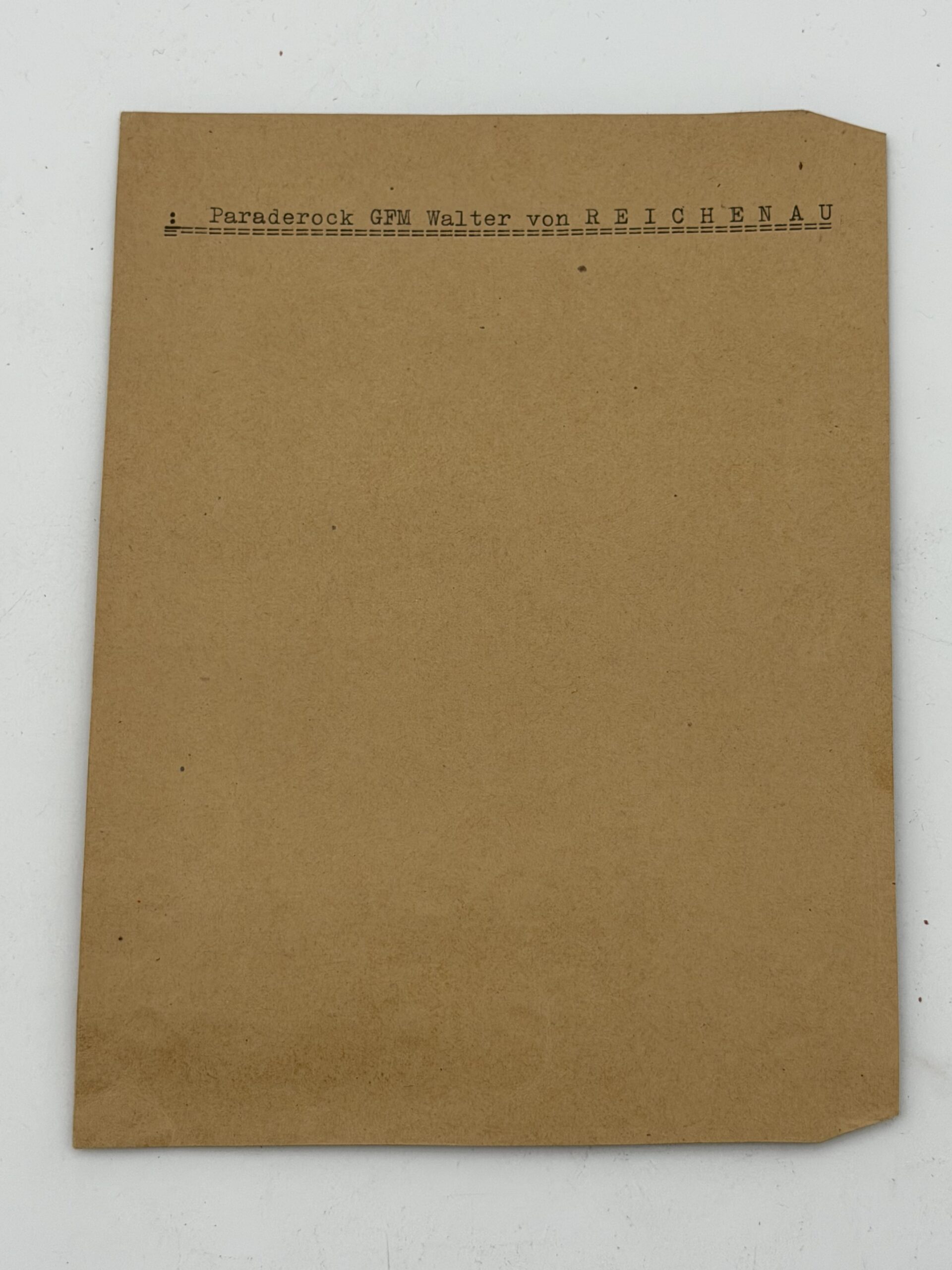
The front is typed “Arabeskenstickerei für Generale” and separates the four pieces into left and right Ärmelpatten for the Paraderock. Most importantly, the reverse is specifically typed:
“Paraderock GFM Walter von REICHENAU”
The four high-quality hand-embroidered gold bullion Arabesken remain mounted on their original card. Their hochrot wool foundations and elaborate metallic embroidery correspond with the sleeve insignia used on the Heer General’s parade Waffenrock.
As a named workshop or tailoring reference connected directly by its period inscription to Generalfeldmarschall Walter von Reichenau, this is considerably more significant than an ordinary loose set of General’s insignia.
€ 4.500
1 in stock
This remarkable Walter von Reichenau parade cuff sample survives as a complete period reference card containing four General’s sleeve Arabesken.
The card provides unusually strong internal identification.
Across the top, the maker or workshop typed:
“Arabeskenstickerei für Generale”
Below this heading appear two clearly defined sections.
The upper group reads:
“1. Ärmelpatten (Paraderock) LINKS”
The lower group reads:
“2. Ärmelpatten (Paraderock) RECHTS”
Two embroidered examples appear beneath each heading.
Therefore, the card preserves four original samples intended to demonstrate the correct left and right sleeve embroidery for a General’s parade tunic.
The four pieces remain attached to the original workshop card.
Each example displays elaborate gold-coloured metallic embroidery on a rich hochrot wool foundation.
Furthermore, the left and right examples mirror the direction of the decorative Arabesken.
This arrangement strongly supports the interpretation of the card as a tailoring or embroidery workshop reference, rather than four unrelated loose insignia later placed together.
The reverse provides the most important evidence.
It is typed:
The abbreviation GFM stands for Generalfeldmarschall.
Consequently, the card does not merely identify the embroidery as a generic General’s pattern. Instead, the workshop record associates it specifically with a Paraderock for Generalfeldmarschall Walter von Reichenau.
That distinction gives the group its exceptional historical importance.
Walter von Reichenau became a Generalfeldmarschall on 19 July 1940 following the campaign in France.
The Deutsches Historisches Museum confirms this promotion date. It also records his subsequent command of the 6th Army and later Heeresgruppe Süd.
Therefore, if the typed “GFM Walter von REICHENAU” notation is contemporary to the production process, the card must date from 19 July 1940 or later.
Reichenau died on 17 January 1942.
That gives the card a highly significant probable working period of approximately:
This relatively narrow window makes the surviving workshop reference particularly interesting.
Walter von Reichenau was born in Karlsruhe on 8 October 1884.
During the inter-war period, he became one of the German Army’s most politically influential senior officers.
Reichenau commanded the 10th Army during the invasion of Poland. Subsequently, he led the 6th Army during the campaign in the West.
After the defeat of France, he received promotion to Generalfeldmarschall on 19 July 1940.
During 1941, Reichenau commanded forces on the Eastern Front. He later assumed command of Heeresgruppe Süd.
His historical record also includes direct involvement in the regime’s criminal war in the Soviet Union. On 10 October 1941, he issued the notorious Reichenau Order, which encouraged participation in the ideological and racial policies of the occupation. The Deutsches Historisches Museum specifically records this episode in its biographical study.
Reichenau died in January 1942 after suffering a severe medical emergency.
The four insignia on this card were intended for the Paraderock or parade Waffenrock.
Generals of the Wehrmacht Heer wore distinctive versions of the Waffenrock.
Their uniforms incorporated:
A surviving Generalmajor Franz Zednicek parade Waffenrock catalogued by Helmut Weitze retains gold hand-embroidered General’s insignia on red cloth and provides an excellent comparison for the quality expected on privately tailored General officer uniforms.
Period uniform references from 1938 also illustrate the special Kragenspiegel and Ärmelpatten for Generale worn with the Waffenrock.
The German term Arabeskenstickerei refers to the traditional elaborate embroidery used for German General officers.
It is also commonly known as:
Larisch-Stickerei
or
Generalsstickerei
The design developed from older Prussian military traditions.
For Heer Generals, gold embroidery appeared on hochrot red cloth. The same decorative family appeared on the collar and, on the Waffenrock, on special sleeve patches.
The present card therefore uses historically correct terminology when it states:
That wording is another significant feature because it identifies the material by its correct contemporary tailoring function.
All four insignia demonstrate high-quality General officer construction.
The embroidery consists of densely worked gold-coloured metallic thread.
Individual leaf formations create the elaborate Arabesque pattern.
Moreover, the metallic elements follow a raised, three-dimensional structure rather than a simple flat machine weave.
The centre of each patch contains the characteristic simulated buttonhole feature.
Around this centre, the embroiderer formed symmetrical leaf and scroll motifs.
The hochrot cloth foundations remain strong.
Likewise, the gold embroidery retains excellent colour and definition.
The arrangement of the card is particularly revealing.
Two pieces sit beneath the heading:
Ärmelpatten – LINKS
Meanwhile, another two appear beneath:
Ärmelpatten – RECHTS
Therefore, this does not appear to be a normal single uniform set of only two sleeve patches.
Instead, the card appears to preserve workshop or production samples for the left and right sides.
There are two examples for each direction.
This arrangement may represent alternative examples, retained production references or embroidery approval samples.
However, no surviving notation presently establishes exactly why two examples of each side were retained.
For that reason, the catalogue should describe them as:
rather than claiming that all four were intended to be fitted simultaneously to one tunic.
The condition also supports a sample-card interpretation.
The red cloth foundations show no obvious evidence of having been cut from a worn uniform.
Similarly, the metallic embroidery remains exceptionally strong.
Their continued attachment to the labelled card is highly important.
Separating the insignia would destroy much of the historical context.
Therefore, the entire card should remain intact.
The value lies not simply in the four Arabesken. Instead, it lies in the combination of:
four original General’s embroidery samples + original reference card + left/right workshop identification + named Walter von Reichenau Paraderock inscription.
Named Generalfeldmarschall material commands a very different level of collector interest from anonymous General officer insignia.
Walter von Reichenau material appears only occasionally on the specialist market.
For comparison, the Wormser auction archive records a pair of silver “800” crossed field-marshal baton shoulder-board devices attributed to Reichenau’s estate. They realised €1,400.
Separately, Reichenau’s original field marshal baton has appeared on the German auction market and was specifically described as having been presented following his 1940 promotion.
These comparisons demonstrate the established collector interest surrounding genuine Reichenau-associated uniform and rank material.
Nevertheless, the present sample card is unusual in another way.
It represents the manufacturing and tailoring process behind a named Generalfeldmarschall’s parade uniform.
That makes it a highly specialised historical object.
The period card itself clearly reads:
“Paraderock GFM Walter von REICHENAU.”
This constitutes strong internal period attribution.
However, the card should not be described as insignia actually worn by Reichenau.
There is presently no evidence that these four examples were sewn onto his completed tunic.
Instead, the most accurate description is:
That wording preserves the exceptional named association without overstating the available evidence.
The complete card remains exceptionally presentable.
All four Arabesken survive.
Gold metallic embroidery retains excellent definition and strong colour.
The hochrot cloth remains vibrant.
Meanwhile, the backing card displays natural age toning, minor surface marks and expected edge wear.
Several corners were originally or historically clipped.
Typed inscriptions remain clearly legible on both sides.
Most importantly, the complete named context remains intact.
No restoration is recommended.
The card should remain exactly as found.
The photographs show a highly convincing period assembly.
Important positive characteristics include the period card stock, typewritten German terminology, correct General’s parade terminology, four directional sleeve samples, high-quality metallic embroidery and historically appropriate red foundation cloth.
Furthermore, the reverse identification uses the correct title:
GFM Walter von Reichenau
The dating also works chronologically.
Reichenau became Generalfeldmarschall on 19 July 1940 and died in January 1942.
Finally, surviving period Wehrmacht references confirm that Heer Generals wore gold embroidered Arabesken on hochrot collar and sleeve patches with the parade Waffenrock.
Taken together, the evidence provides a strong and coherent period attribution.
This piece should not be valued as four ordinary General’s sleeve patches.
The original sample card changes its significance completely.
It documents:
Few surviving militaria objects provide such a direct view into the manufacture of a senior commander’s dress uniform.
Consequently, the complete card has considerable museum and research value.
Item: General officer embroidery workshop sample card
Named officer: Generalfeldmarschall Walter von Reichenau
Card inscription: “Arabeskenstickerei für Generale”
Reverse inscription: “Paraderock GFM Walter von REICHENAU”
Contents: Four embroidered sleeve patches
Left sleeve samples: Two
Right sleeve samples: Two
Uniform: Heer Paraderock / parade Waffenrock
Rank class: General officer / Generalfeldmarschall attribution
Ground cloth: Hochrot wool
Embroidery: Gold-coloured metallic bullion Arabesken
Construction: High-quality embroidered General officer pattern
Probable date: Circa 1940–1942
Condition: Excellent, complete on original reference card
Rarity: Exceptional
Short ID: WVR-GFM-ARAB-04
Explore related listings: Insignia, Shoulder Boards and Breast Eagles; General Crusher Cap | Original Kaschet München Heer General Crusher Cap; Heer General Feldbinde | Original Gilt Parade Belt.
Deutsches Historisches Museum
Use this source for Walter von Reichenau’s biography, commands and promotion to Generalfeldmarschall on 19 July 1940.
Deutsches Historisches Museum – Walter von Reichenau Biography
Period 1938 Heer Uniform Reference
This contemporary Reibert plate illustrates Heer uniforms and specifically identifies General officer collar and sleeve patches.
1938 Reibert Heer Uniform Plate – Generals’ Kragenspiegel and Ärmelpatten
Documented General’s Parade Waffenrock
The named Generalmajor Franz Zednicek Waffenrock provides a useful surviving comparison for gold embroidered General’s insignia on a parade uniform.
Helmut Weitze – Generalmajor Franz Zednicek Parade Waffenrock
Bundesarchiv Walter von Reichenau Images
The Bundesarchiv Bilddatenbank preserves period photographs of Reichenau from the 1930s.
Bundesarchiv – Walter von Reichenau Photographic Records
It is a period workshop or embroidery reference card holding four gold General officer sleeve Arabesken.
The reverse is typewritten “Paraderock GFM Walter von REICHENAU.”
GFM is the standard abbreviation for Generalfeldmarschall.
He received promotion on 19 July 1940.
The card contains two examples marked for the left sleeve and two marked for the right sleeve.
Almost certainly not simultaneously. They appear to be workshop or production samples.
The gold Arabesken and hochrot backing identify the Heer General officer class. The card’s named inscription associates this particular group with Reichenau after he became Generalfeldmarschall.
The card does not prove that these four pieces were sewn onto a finished tunic. Therefore, they should be described as samples associated with the production or preparation of his Paraderock.
Without the card, these would simply be four rare General’s sleeve patches. The surviving typed attribution gives them their specific Walter von Reichenau historical context.
