
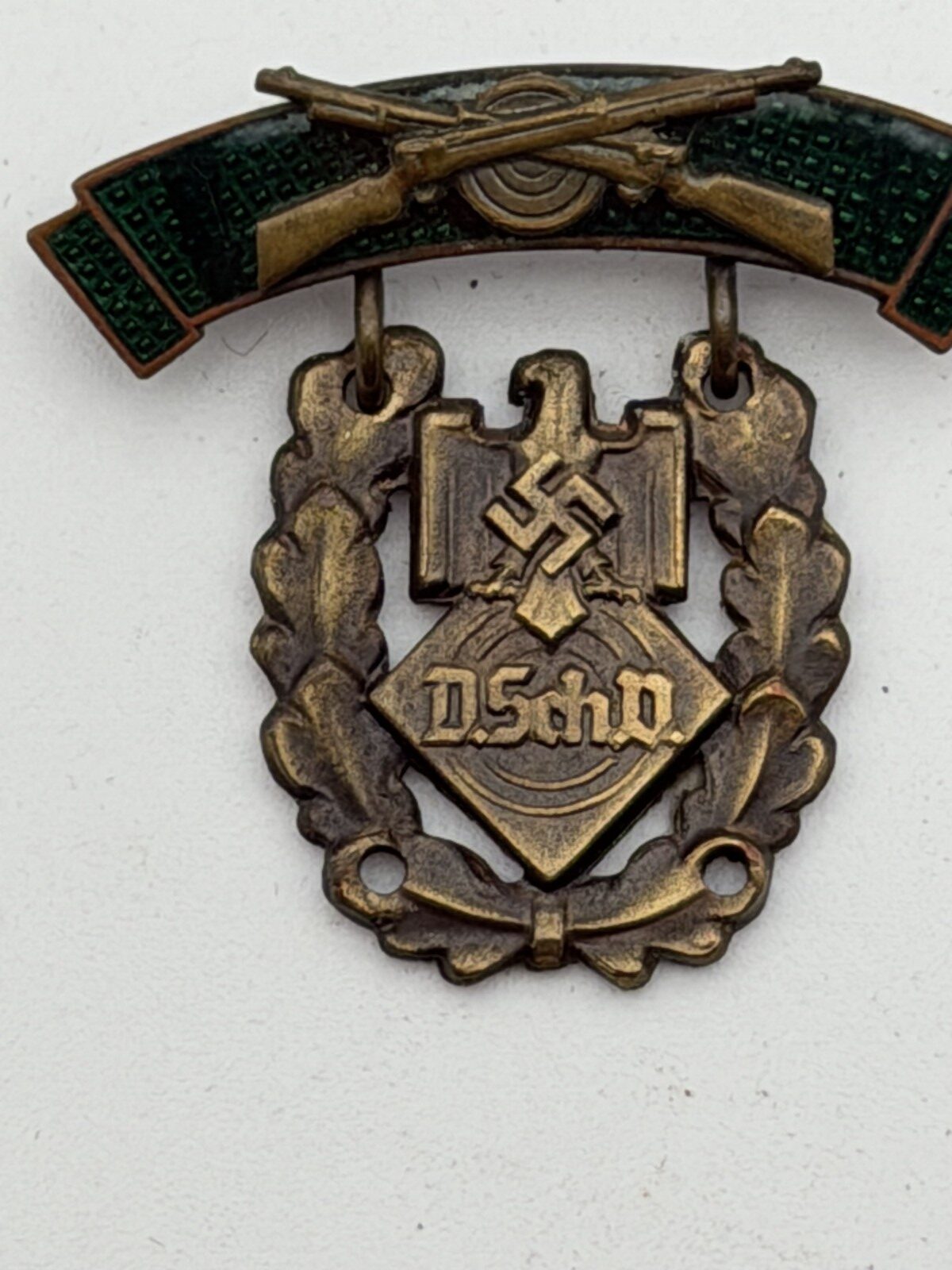
Original 1930s Deutscher Schützenverband large bronze-grade shooting award featuring a green enamel hanger with crossed rifles and target above the suspended D.Sch.V. bronze badge. Complete with original pin and connecting links. Attractive untouched patina and genuine period enamel wear.
€ 125
1 in stock
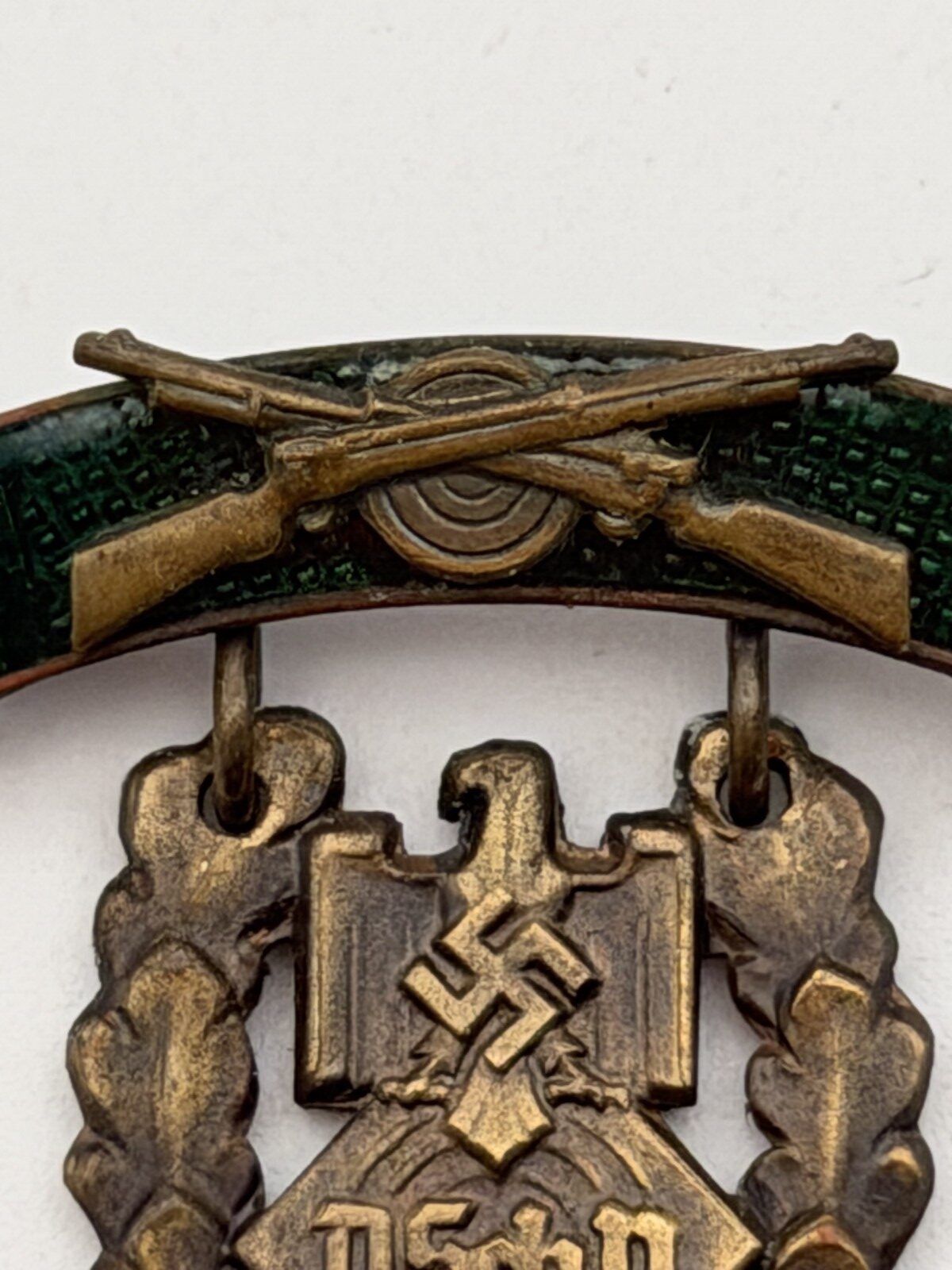
This Deutscher Schützenverband Bronze Shooting Badge is an attractive original shooting proficiency award from 1930s Germany. The distinctive two-part decoration combines a green enamelled suspension bar with crossed rifles and a target above the suspended bronze-grade badge.
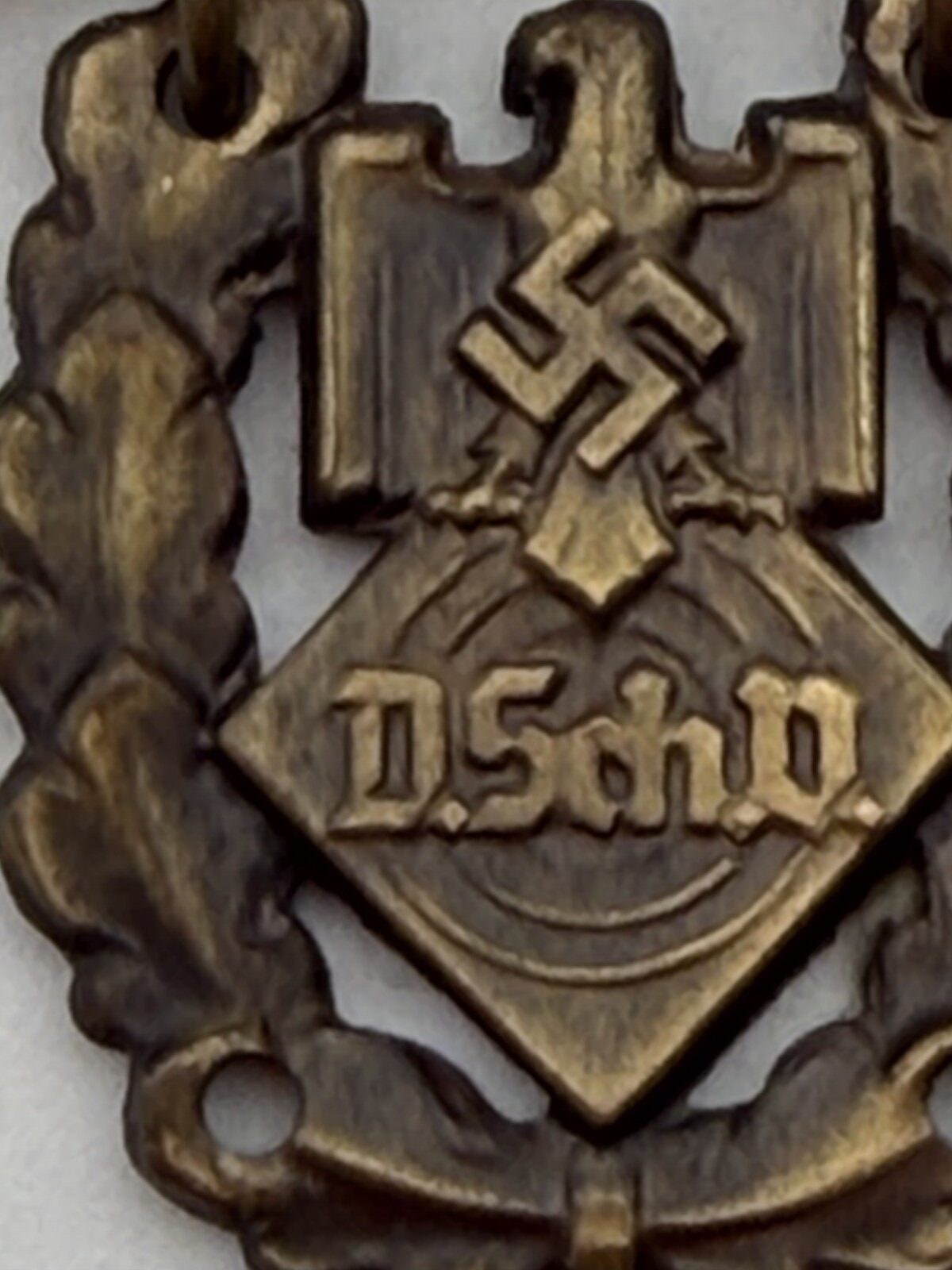
The lower section features an oak-leaf wreath surrounding the central D.Sch.V. emblem. Above it appears the contemporary national emblem. The combination of shooting target, crossed rifles and the abbreviation D.Sch.V. immediately identifies the organisation.
Importantly, comparison with documented examples confirms that this is the large-pattern bronze shooting awardrather than a simple membership pin.
Helmut Weitze records Deutscher Schützen-Verband awards in bronze, silver and gold grades and notes both small and large versions. Large lower badges measure approximately 29.2 × 34.5 mm, while the enamelled hanger is approximately 35.8 mm wide.
The badge uses the characteristic articulated construction associated with this award.
At the top sits a slightly curved suspension bar. Dark green enamel fills the recessed field, while a pair of raised crossed rifles lies across a centrally positioned shooting target.
Two original wire suspension links connect this section to the main award beneath.
The main badge consists of a bronze-coloured oak-leaf wreath surrounding the D.Sch.V. device. The central diamond carries the raised Gothic-style abbreviation:
D.Sch.V.
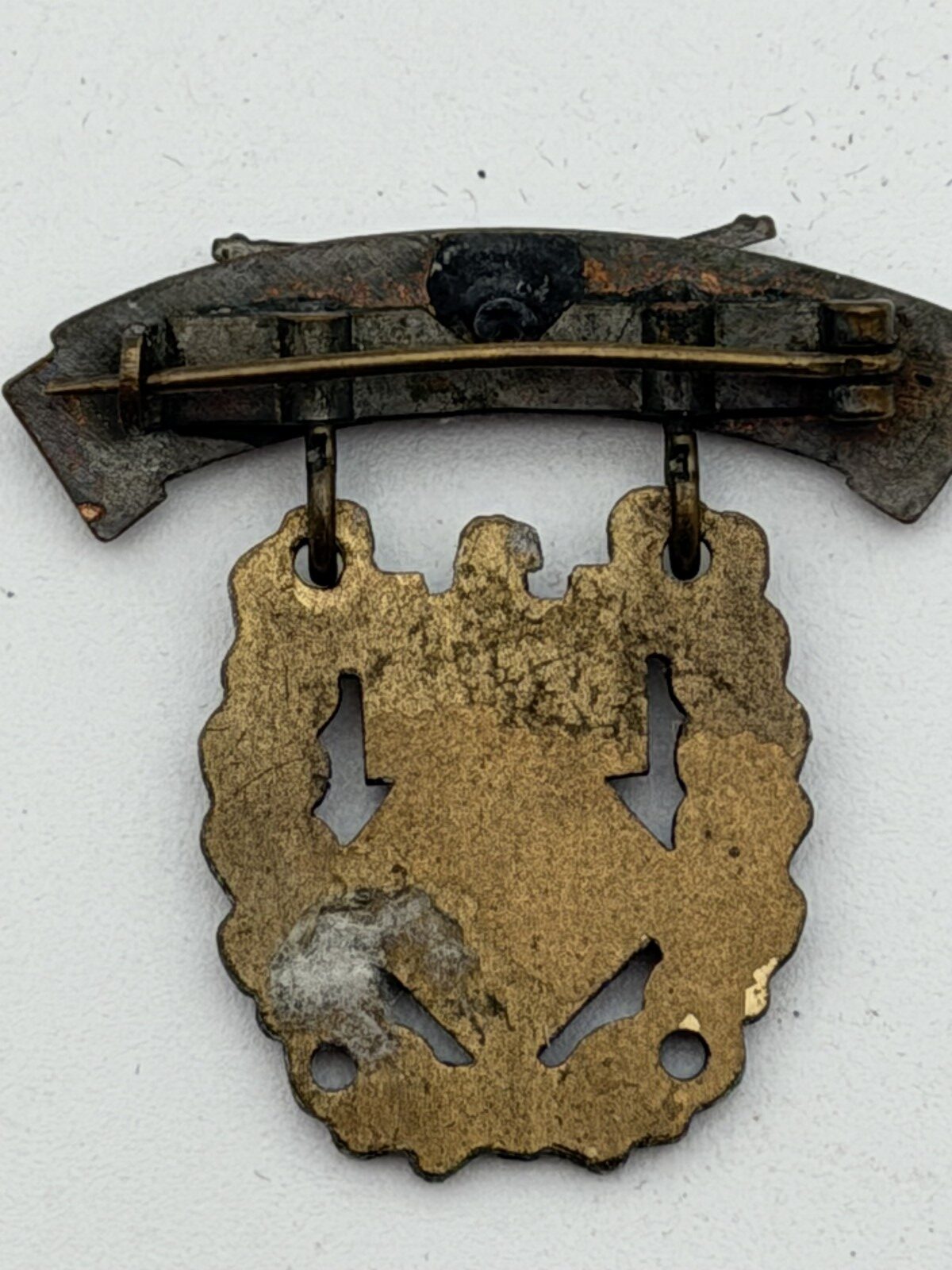
The reverse remains largely plain, which is not problematic. Weitze specifically notes that many examples of these shooting awards were unmarked, although certain regional or manufacturer-produced versions can carry markings.
A horizontal pin fitting remains attached to the reverse of the enamelled upper section.
The construction of this example corresponds exceptionally closely with an example catalogued by eMedals as a:
German Shooting Association (D.Sch.V.) Large Shooting Award – Bronze Grade.
Their example was described as bronze, unmarked, with a 29.2 × 34.5 mm lower badge, green enamelled 35.8 mm hanger, crossed rifles and target, and approximately 45 mm overall height.
That is essentially the same configuration visible here.
Ratisbon’s has likewise catalogued the large bronze version as a second-pattern D.Sch.V. shooting badge, approximately 4.5 cm high.
From the supplied photographs, I see no immediate feature suggesting modern reproduction.
Positive features include the period-style die-struck construction, naturally worn bronze surface, separate articulated lower badge, aged suspension wires, correctly constructed pin system and genuine-looking vitreous enamel.
The reverse is particularly useful. It displays natural oxidation and uneven surface ageing rather than the artificial chemically applied patina frequently found on reproductions.
There is also genuine-looking wear around the suspension holes and connecting wires. That type of concentrated mechanical wear would be expected after decades of movement between the two sections.
Consequently, I would catalogue this example as:
Original Third Reich-period Deutscher Schützenverband Large Shooting Award, Bronze Grade, circa 1930s.
The badge remains complete and presents very well.
Its bronze finish has developed an attractive dark age patina, with surviving highlights on the raised rifles, wreath, lettering and central emblem.
The green enamel remains clearly visible. However, it shows age-related surface deterioration, crazing and small areas of loss. This should be regarded as part of the badge’s genuine period character rather than restored.
The original pin assembly remains present.
No attempt should be made to polish the metal because its untouched patina contributes significantly to the historical appearance and collector desirability.
German shooting associations had existed for generations before the National Socialist period. The Deutscher Schützen-Verband organised civilian competitive shooting and marksmanship events through numerous regional organisations.
During the mid-1930s, German shooting organisations increasingly came under centralised state sporting administration. Weitze notes that the reorganisation beginning in 1935 placed shooting activities increasingly within the wider programme of physical training and pre-military preparation.
Members competed for recognised proficiency distinctions.
The D.Sch.V. awards were issued in Bronze, Silver and Gold, representing different levels of shooting achievement.
Therefore, this was an achievement award rather than simply decorative organisational insignia.
The Deutscher Schützenverband Bronze Shooting Badge is especially attractive because it combines several classic elements of German shooting culture within a relatively compact award: crossed rifles, a shooting target, enamelled detailing and a suspended achievement badge.
Complete examples are considerably more desirable than incomplete badges missing either the lower award or the suspension links.
Moreover, this example retains its original upper fitting and lower bronze-grade badge as a complete assembly.
It would complement a collection of Third Reich sporting awards, German shooting association insignia, civilian decorations or enamel badges particularly well.
Explore related listings: Badges; Nordmenn Militaria – Medals & Awards.
For comparison with documented original Deutscher Schützen-Verband awards:
Helmut Weitze – Deutscher Schützen-Verband Reference Group
Weitze’s reference confirms the bronze, silver and gold grades, green and white enamel hangers and standard dimensions.