
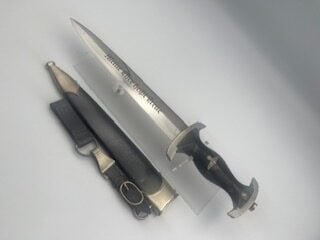
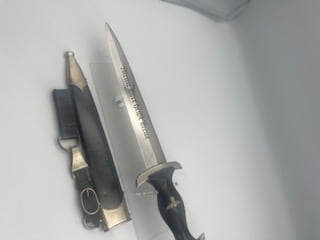
Exceptionally attractive numbered Friedrich Herder SS dagger manufactured by Friedrich Herder Abr. Sohn of Solingen during the early production period of the Model 1933 SS service dagger.
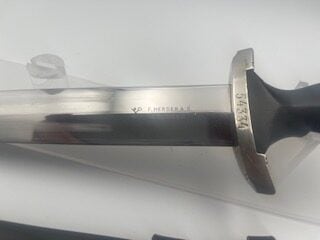
Most importantly, the lower nickel crossguard carries SS membership number 54,334. A surviving SS-number compilation identifies this number with Adalbert Kollewe, whose documented rank is listed as SS-Unterscharführer.
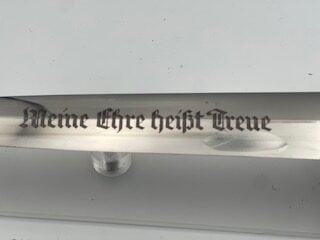
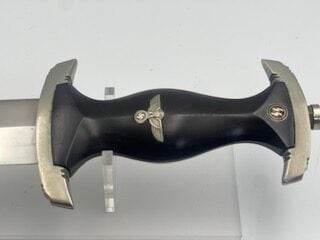
The dagger retains its black wooden grip, inset SS runic roundel, nickel eagle, solid early fittings, bright blade with “Meine Ehre heißt Treue” motto and the distinctive Friedrich Herder maker mark. Furthermore, its original black scabbard with nickel fittings remains with the dagger.
An identifiable SS membership number, respected Solingen maker and particularly attractive condition combine to make this a highly desirable early SS edged weapon.
€ 7.575
1 in stock
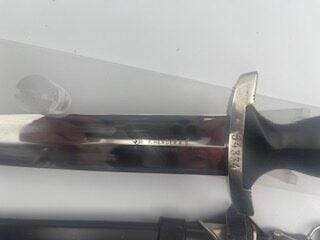
The reverse ricasso carries the clearly visible inscription:
F. HERDER A.S.
Below the lettering appears:
SOLINGEN
Alongside the wording sits the firm’s distinctive crossed-keys trademark.
Friedrich Herder Abr. Sohn represents one of Solingen’s longest-established edged-tool manufacturers. Solingen archival material records the Herder firm’s knife-making history and identifies Friedrich Herder as the later head of the historic family business.
Modern company literature likewise traces Friedrich Herder Abr. Sohn back to 1727, demonstrating the considerable manufacturing tradition behind the maker.
Later RZM references allocated M7/49 to Friedrich Herder A.S., although this dagger belongs to the desirable earlier trademark period rather than carrying the later numerical RZM marking.
The manufacturer’s mark remains one of the strongest visual features on this example.
Clear lettering survives immediately below the lower guard.
Moreover, the crossed-keys device remains easily recognisable despite normal photographic reflections across the polished blade.
Placement of the trademark conforms with the expected early Solingen manufacturing arrangement.
Rather than carrying a later coded RZM inscription, the blade displays the manufacturer’s traditional commercial trademark.
For collectors of early SS edged weapons, that characteristic adds considerably to its appeal.
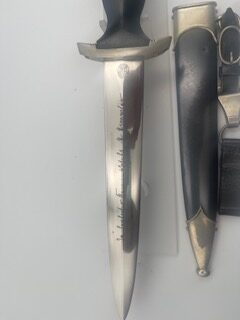
The obverse blade retains the traditional SS motto:
“Meine Ehre heißt Treue”
Its Gothic lettering remains deeply and clearly defined.
Notably, the inscription retains strong contrast against the bright steel surface.
Fine longitudinal finishing remains visible across portions of the blade, while scattered age and handling traces prevent the surface from appearing artificially new.
Equally important, the blade retains its correct central ridge and original overall geometry.
The motto itself appears well positioned in relation to the shoulders, blade edges and central spine.
The most historically significant feature appears on the lower crossguard.
Clearly engraved into the nickel fitting is:
A surviving compilation of SS membership numbers identifies SS-Nr. 54,334 as Adalbert Kollewe and gives his recorded rank as SS-Unterscharführer. The same source places Kollewe directly between documented SS numbers 54,332 and 54,338, making the number-to-name attribution particularly clear.
Unlike many anonymous M1933 daggers, this example can therefore be connected to a specific SS member through its surviving membership number.
That research potential substantially increases the historical interest of the piece.
Current publicly accessible information identifies Adalbert Kollewe but does not provide a verified date of birth or NSDAP membership number.
Therefore, those details should not be invented or inferred.
Instead, the catalogue should presently describe the dagger as:
Attributed through SS-Nr. 54,334 to SS-Unterscharführer Adalbert Kollewe.
Further research has genuine potential.
The Bundesarchiv’s former Berlin Document Center holdings contain approximately 350,000 personnel files relating to SS members, together with extensive additional NSDAP and RuSHA material.
Consequently, an original file may ultimately establish Kollewe’s date of birth, occupation, SS entry details, promotions, unit assignments or other biographical information.
Numbered SS daggers hold special appeal because the physical object can potentially be reconnected with its original recipient.
Here, the membership number remains prominently visible rather than faintly scratched or partially obscured.
Furthermore, the engraving displays age and surface character compatible with the surrounding nickel guard.
Its position also gives the dagger an immediate visual feature that separates it from an otherwise comparable unnumbered M1933 example.
For historical research, the number represents one of the most useful surviving pieces of evidence on the dagger.
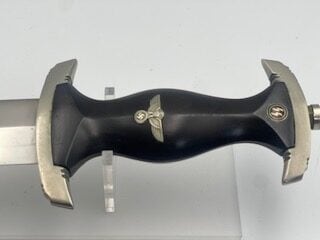
The grip presents exceptionally well.
Deep black timber displays the narrow waist and pronounced upper and lower shoulders expected from early SS dagger construction.
At the top sits the circular SS runic insert.
Lower down, the nickel national eagle remains embedded within the grip.
Neither insignia appears crudely repositioned in the supplied photographs.
Likewise, the wood-to-guard relationship looks tight and convincing.
Minor age and handling marks remain visible, yet the grip avoids the serious cracks and chips frequently encountered on heavily used M1933 daggers.
Overall, this is one of the strongest visual aspects of the piece.
The upper grip retains its original-style circular SS rune button.
Black enamel surrounds the paired silver-coloured runes.
A narrow metal border completes the roundel.
Natural ageing appears around the inset without excessive disturbance to the surrounding wood.
Importantly, the button sits appropriately within the upper section of the grip rather than appearing obviously reinserted.
Its condition complements the remainder of the hilt very well.
Below the centre of the grip sits the national eagle carrying a swastika.
Wing and feather detail remain strong.
Meanwhile, natural dulling across the nickel surface corresponds with the overall age of the dagger.
The insignia follows the early inset arrangement used on M1933 political daggers.
Combined with the SS roundel above, it creates a particularly attractive and balanced hilt.
The upper and lower guards display the heavy construction associated with early-period SS dagger production.
Both surfaces retain an appealing mellow patina.
Small handling traces remain visible, but there is no excessive corrosion.
Moreover, the characteristic decorative grooves near the guard extremities remain sharply defined.
The lower fitting carries the all-important 54334 membership number.
Together, these features strongly enhance the dagger’s early-production character.
The dagger remains accompanied by its black-finished steel scabbard.
Nickel-coloured throat and lower chape fittings contrast attractively with the dark body.
Ageing across the scabbard appears natural and consistent with prolonged storage.
Rather than presenting as a recently refinished component, the surface retains the subtle variation expected from an original period piece.
The upper throat also carries the original suspension ring.
At the bottom, the nickel chape terminates in its characteristic rounded ball.
Preservation of the original scabbard is particularly important on early SS daggers because replaced or mismatched scabbards reduce both collector interest and value.
Another positive feature is the consistency of ageing across the ensemble.
Nickel fittings on both dagger and scabbard display compatible surface character.
Similarly, the grip does not appear dramatically newer or older than the accompanying metal components.
Such visual coherence matters when assessing whether an early dagger has remained together or has been assembled from unrelated parts.
Nothing obvious in the supplied photographs suggests a modern mismatched assembly.
Nevertheless, an in-hand inspection always provides the final confirmation for high-value edged weapons.
Overall condition is very good for an early M1933 SS dagger.
The grip remains particularly impressive, while the nickel fittings retain strong definition and attractive age.
Likewise, both inscriptions on the blade remain easy to read.
Light surface marking and normal age traces remain present across the steel.
Rather than detracting heavily from the dagger, those characteristics provide evidence of genuine historical handling.
The scabbard displays honest wear but remains substantially complete.
For collectors who prefer original appearance over restoration, the ensemble has considerable appeal.
Based on the supplied photographs, this dagger presents a convincing combination of characteristics expected from an original early Friedrich Herder Model 1933 SS dagger.
The maker trademark, blade configuration, motto style, grip construction, insignia, nickel guards and scabbard all form a coherent ensemble.
Additionally, the membership number corresponds with an independently listed SS member.
That number-to-name relationship provides an important external consistency check.
No evidence visible here requires the dagger to be classified as an ex-Röhm example.
Accordingly, the correct catalogue description remains an early numbered M1933 SS service dagger, without Röhm attribution.
Several characteristics elevate this example above a standard anonymous SS dagger.
First, Friedrich Herder represents a recognised historic Solingen manufacturer.
Second, the early trademark blade and nickel fittings belong to the desirable initial manufacturing period.
Third, SS membership number 54,334 identifies a documented recipient.
Moreover, the attractive grip and complete original-style scabbard give the ensemble particularly strong display appeal.
Finally, future archival research could add substantially more history to Adalbert Kollewe’s attribution.
For an advanced collection of SS edged weapons, those qualities make this a particularly worthwhile example.
The present Nordmenn SS dagger category provides useful internal market context. An early Eickhorn M1933 SS dagger is currently listed at €4,950, while an original Henckels M1933 example is listed at €4,250.
Helmut Weitze also currently lists an early Robert Klaas M1933 SS dagger with nickel fittings and a blued scabbard at approximately €4,500.
Those comparisons concern ordinary unnumbered examples.
By contrast, the present dagger combines early Friedrich Herder manufacture with SS-Nr. 54,334 and a presently identifiable recipient.
Archival research represents the final stage needed to elevate this dagger from a named-number example into a fully documented recipient piece.
The Bundesarchiv specifically states that its holdings include personnel records for members of the SS, Waffen-SS and other National Socialist organisations.
However, searches within these personnel holdings generally require sufficient identifying information, particularly a full name and ideally a date of birth.
Finding Kollewe’s birth details through an additional period source would therefore make a formal Bundesarchiv enquiry considerably easier.
Any resulting documents should remain permanently associated with the dagger.
This Numbered Friedrich Herder SS Dagger represents a particularly desirable early M1933 example.
Traditional Friedrich Herder markings establish the Solingen manufacturer, while the excellent black grip and nickel fittings preserve the appearance associated with early SS production.
More significantly, lower crossguard number 54,334 presently identifies the original recipient as SS-Unterscharführer Adalbert Kollewe.
An original black scabbard completes the ensemble.
Combined with its researchable ownership number, attractive condition and respected maker, this dagger deserves a place among the stronger named and numbered examples currently available to collectors.
Original Early M1933 Numbered SS Service Dagger by Friedrich Herder Abr. Sohn, Solingen – SS-Nr. 54,334 – attributed to SS-Unterscharführer Adalbert Kollewe – original black scabbard with nickel fittings.
Explore related listings: SS Daggers; Original SS Items – Nordmenn Militaria; Original German Weapons – Nordmenn Militaria.
Adalbert Kollewe – SS-Nr. 54,334 reference
SS Membership Number 54,334 – Adalbert Kollewe
Bundesarchiv – Berlin Document Center
Bundesarchiv – Berlin Document Center SS Personnel Records
Friedrich Herder manufacturer history
Friedrich Herder Abr. Sohn – Manufacturer History
Helmut Weitze market reference