
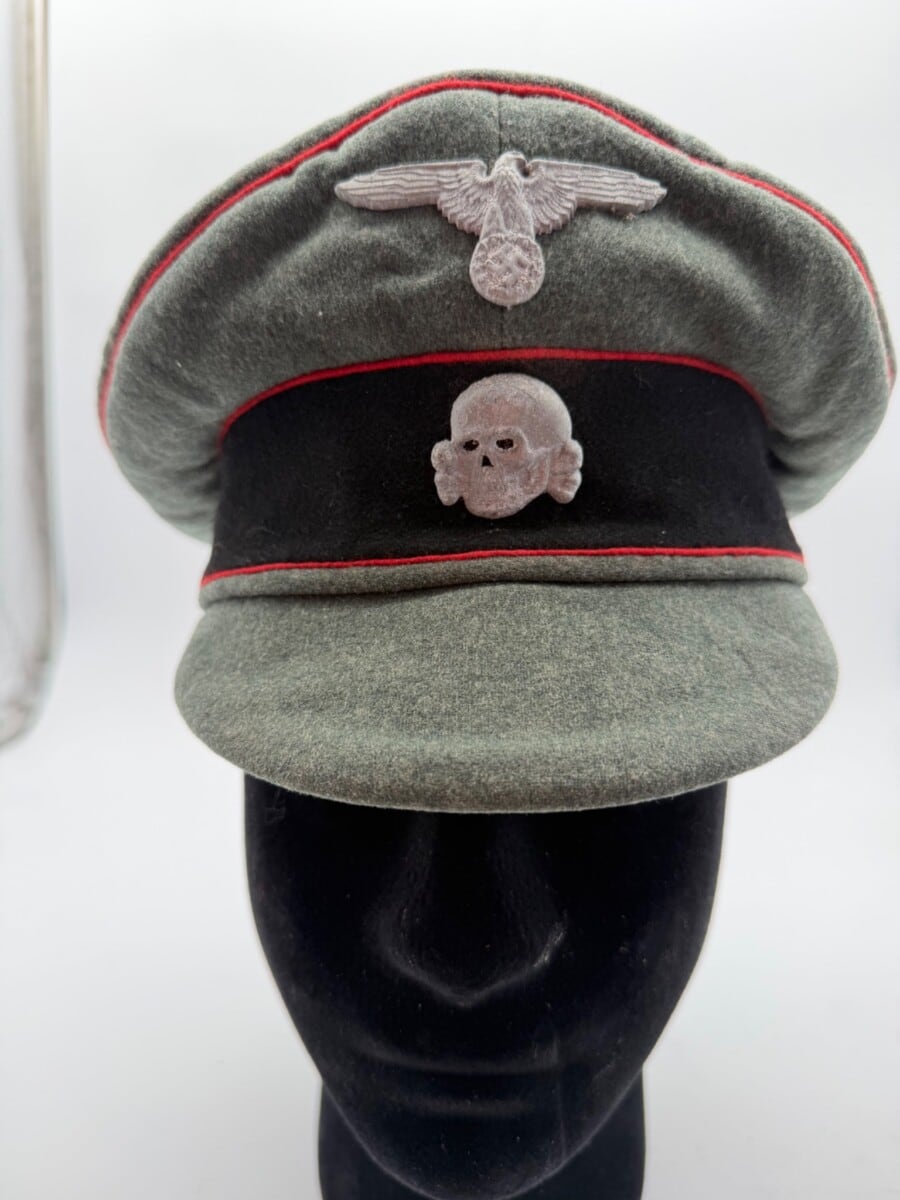
Exceptionally rare Original Waffen-SS Artillery Crusher Cap produced in the distinctive Feldmütze alter Art or soft visor-cap configuration.
The cap combines a field-grey wool body with a black centre band and vivid artillery-red Waffenfarbe piping. Original-style silvered zinc SS eagle and Totenkopf insignia remain fitted to the front, while the heavily oxidised eagle retains a visible RZM marking on its reverse.
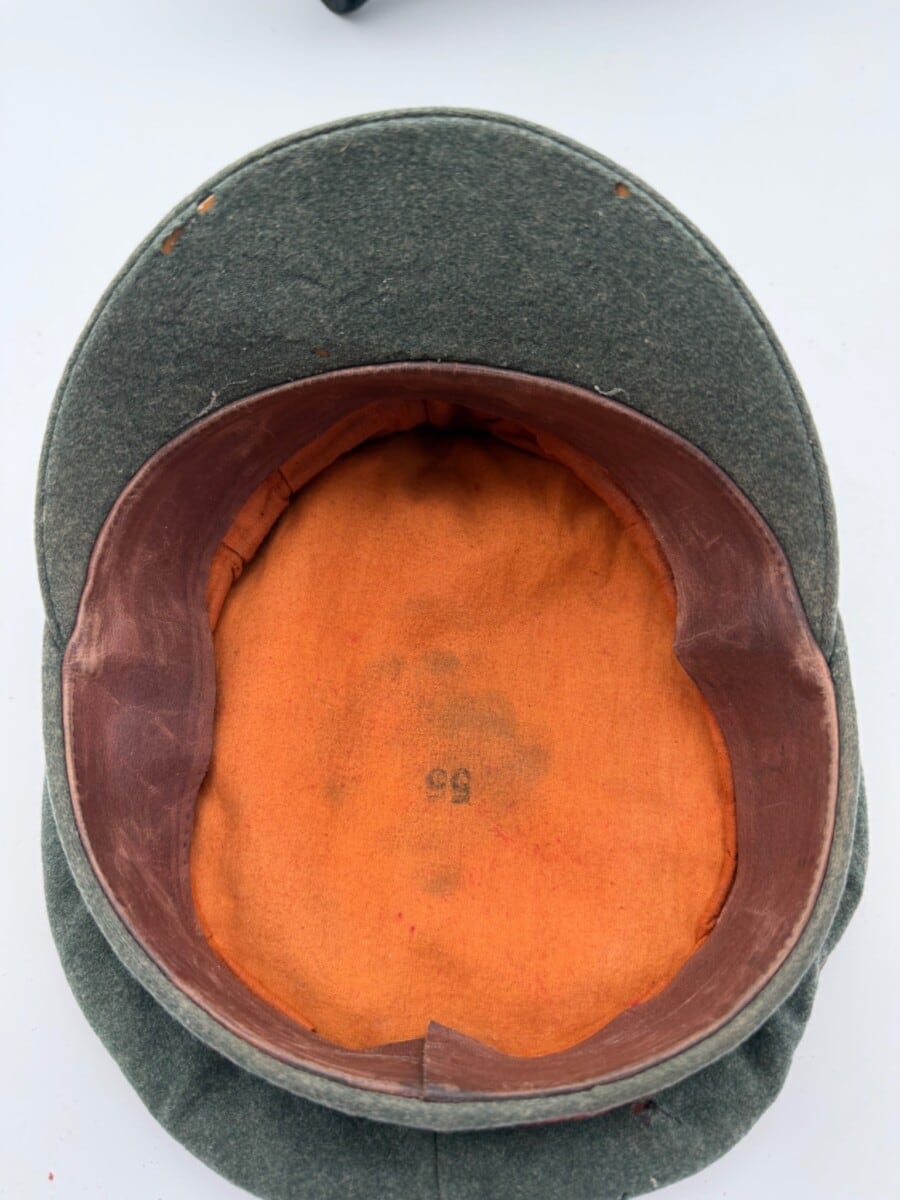
Inside, the cap retains its brown leather sweatband, orange-brown textile lining and clearly stamped size 55 marking. Matching age, wear and oxidation across the principal components give the cap a highly convincing untouched appearance.
€ 7.500
1 in stock
This Original Waffen-SS Artillery Crusher Cap represents an exceptionally scarce example of Waffen-SS branch-coloured headgear.
Collectors commonly refer to this soft style of cap as a “crusher,” although the more historically appropriate German terminology is Feldmütze alter Art or Knautschmütze.
Unlike the more frequently encountered white-piped Waffen-SS headgear, this example carries unmistakable red Waffenfarbe piping. Red identified artillery personnel and creates one of the most desirable colour combinations encountered on Waffen-SS visor caps.
Documented original Waffen-SS artillery visor caps with red piping are extremely uncommon. Militaria Plaza, for example, records an original privately purchased field-grey Waffen-SS artillery visor with red branch piping and original period insignia.
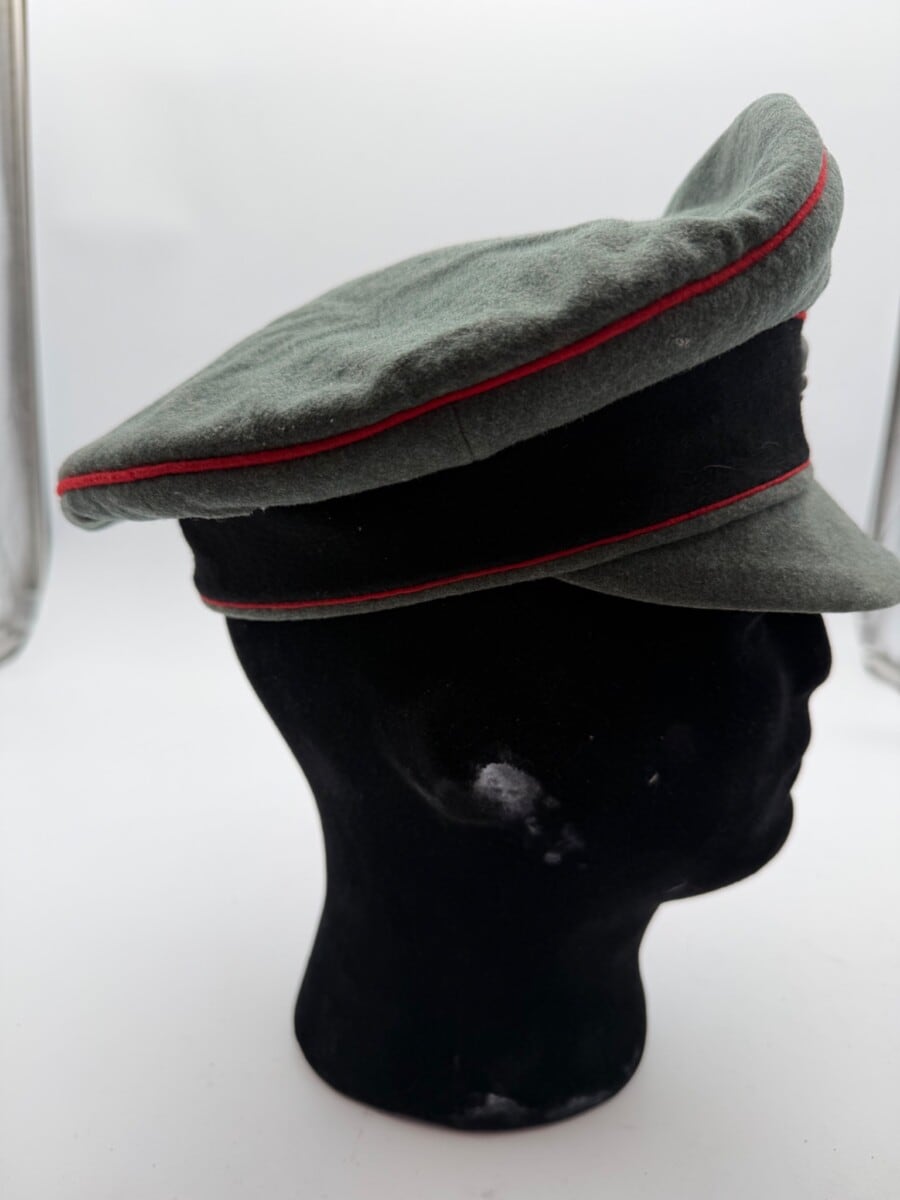
The cap body uses dense field-grey wool with a soft, flexible profile.
Rather than retaining the rigid appearance of a conventional Schirmmütze, the crown collapses naturally when unsupported. This characteristic gave rise to the modern collector term “crusher cap.”
A cloth-covered flexible peak continues the field-grey appearance across the front.
Soft peaks were used on period German Feldmützen alter Art, and documented original crusher caps show comparable deliberately flexible construction. Ratisbon’s records original artillery examples with red Waffenfarbe piping and soft visors.
Perhaps the most important feature of this Original Waffen-SS Artillery Crusher Cap is its red piping.
Fine red piping follows the upper crown seam.
Matching red Waffenfarbe also borders the black cap band.
A further narrow red line separates the lower edge of the black band from the field-grey lower section.
Together, these three lines create the characteristic artillery branch-colour configuration associated with period German military and Waffen-SS headgear.
Surviving Waffen-SS examples retaining coloured Waffenfarbe are considerably scarcer than standard white-piped caps. The documented Militaria Plaza artillery example likewise incorporates red piping around the crown and black band.
The upper front retains a silver-grey SS-pattern national eagle.
Heavy oxidation has consumed much of the original silvered surface. Consequently, the feather detail now appears considerably softer than it would have when manufactured.
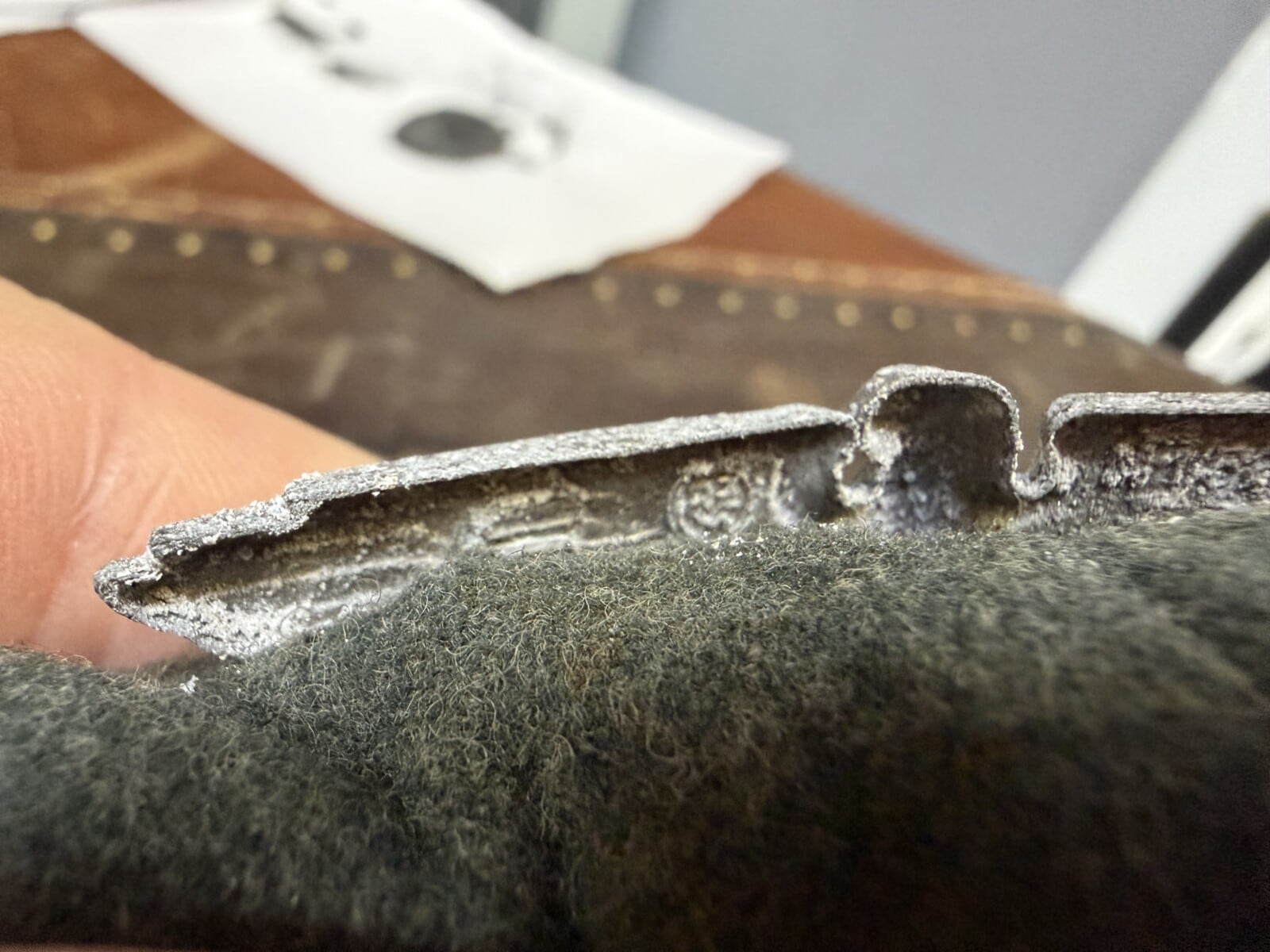
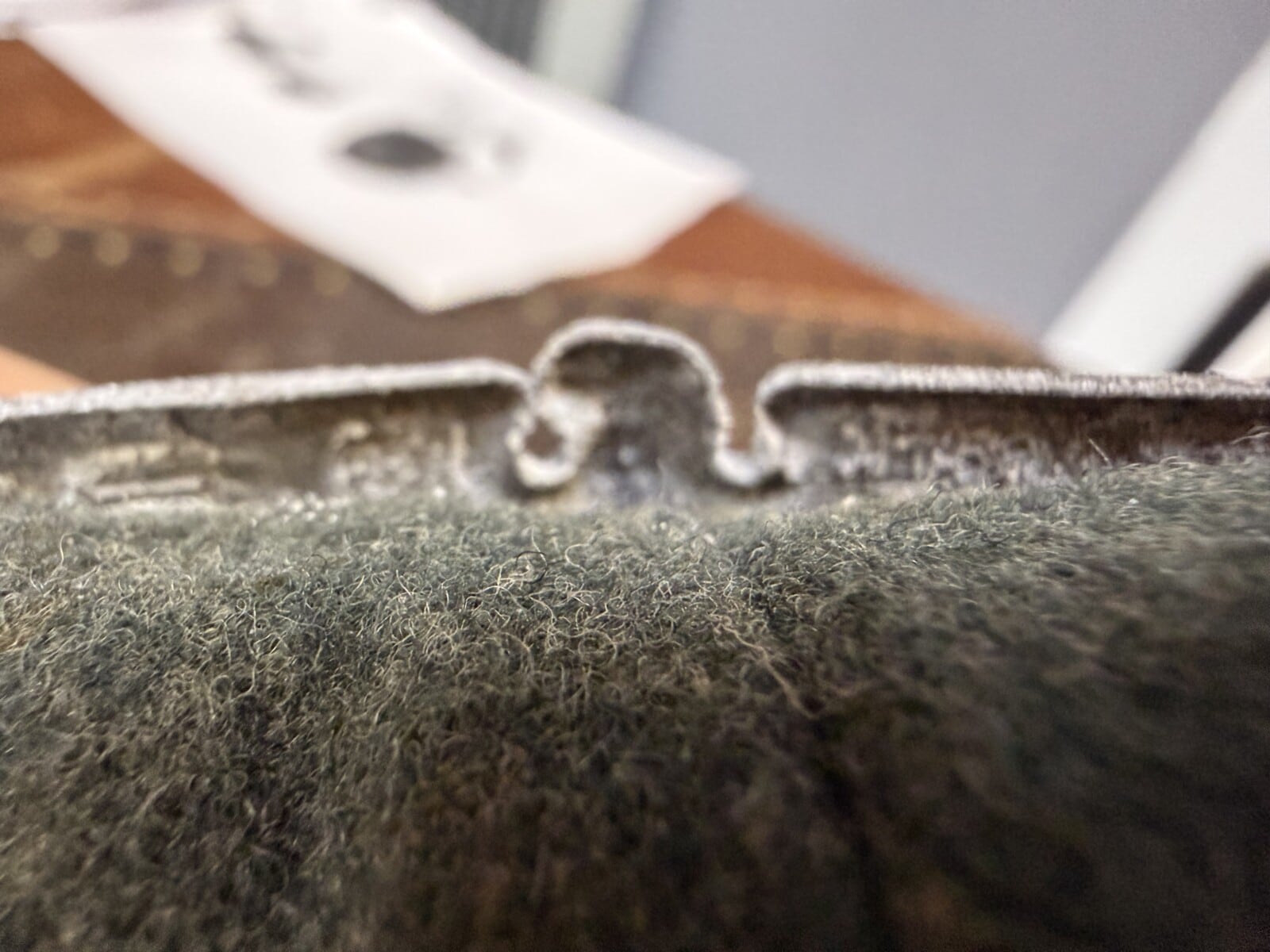
Inspection beneath the eagle reveals thin, hollow or semi-hollow stamped metal construction rather than a thick solid casting.
More importantly, a circular RZM marking remains visible on the reverse.
The surrounding rear construction, perimeter walls and aged zinc surface are consistent with recognised wartime Feinzink SS visor-cap insignia.
Comparable Waffen-SS cap eagles are known in silvered zinc with reverse RZM markings. One documented Augustin Hicke example carries the code M1/167 and shows comparable loss of finish through ageing.
Another eMedals example combines an oxidised zinc Totenkopf with an RZM M1/167 eagle whose silver finish had almost completely disappeared.
The corrosion on the present eagle prevents us from securely reading the complete maker code. Therefore, the catalogue should describe it as an RZM-marked wartime-pattern Feinzink SS eagle rather than assigning a definite manufacturer without further evidence.
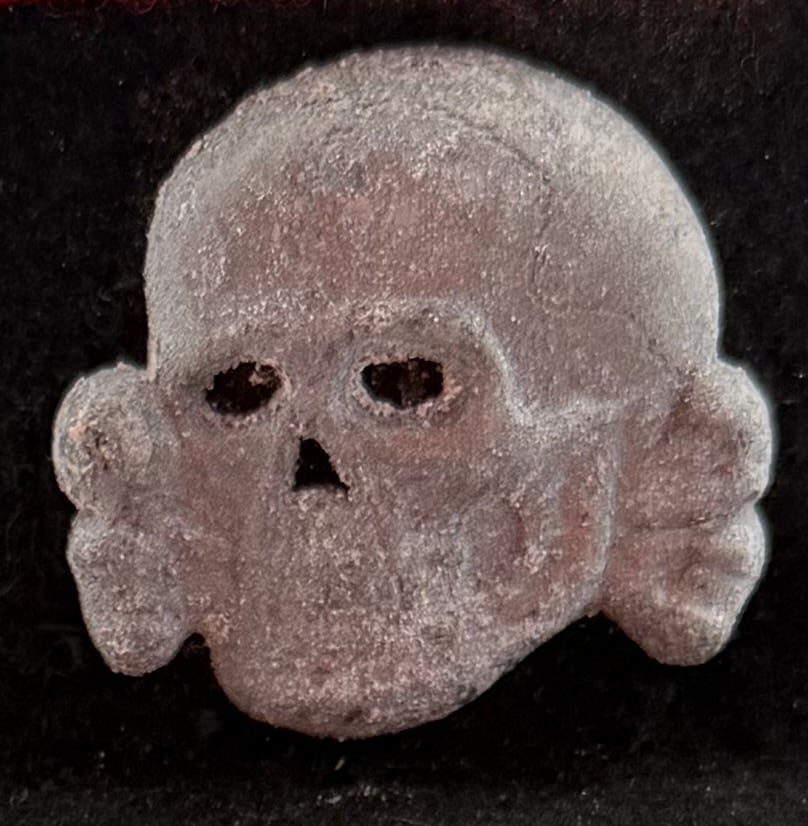
Below the eagle sits the familiar SS Totenkopf.
Its surface exhibits essentially the same grey-white oxidation found on the eagle.
That matching deterioration is significant because both pieces appear to have aged under comparable environmental conditions.
Despite corrosion, the skull retains its principal design features, including the rounded cranium, recessed eye openings, triangular nasal aperture, pronounced cheek structure and horizontal crossbones.
Importantly, the Totenkopf has not been removed for inspection.
The oxidised attachment pins may now be brittle, and disturbing them purely to locate a maker mark could cause permanent damage.
Preserving the original installation is therefore considerably more important than forcing access to the reverse.
Both metal insignia display extensive natural degradation.
Rather than showing isolated artificial ageing, the eagle and skull demonstrate closely comparable oxidation.
The surrounding wool also exhibits genuine compression and long-term contact with the fittings.
Taken together, these features support the possibility that the insignia have remained attached to the cap for a considerable period.
Oxidised original zinc SS insignia are well documented. Ratisbon’s has recorded original Waffen-SS visor insignia made from zinc, including an M1/167 eagle and M1/24 skull combination.
A deep black wool centre band encircles the cap.
Its material contrasts correctly with the field-grey crown.
Age-related wear remains present without excessive modern disturbance.
The red piping frames the band above and below, creating the distinctive artillery appearance.
No chin cord is presently fitted.
That absence does not automatically present a problem on a soft alter Art configuration, since crusher-style headgear was frequently worn without the rigid appearance and accessories associated with conventional parade visor caps.
The interior retains a broad brown leather sweatband.
Natural creasing, colour variation and surface wear are visible throughout the leather.
Behind the sweatband sits an orange-brown textile lining.
A black stamped 55 remains clearly visible inside the crown.
The lining has acquired expected age-related staining and discolouration while retaining an attractive untouched appearance.
No modern manufacturer label or artificial reproduction marking is visible in the supplied photographs.
Marked size: 55
The size stamp remains clearly visible within the lining.
Its understated appearance corresponds well with practical wartime garment marking rather than decorative post-war presentation.
Detailed examination of the available photographs has identified a number of encouraging characteristics.
These include:
Nothing currently visible provides a decisive modern-production indicator.
Nevertheless, responsible cataloguing requires acknowledging that the skull reverse has deliberately not been disturbed because of the risk of breaking the aged pins.
Likewise, corrosion prevents a secure reading of the complete maker code on the eagle.
The cap can therefore be described as an original wartime Waffen-SS artillery-style crusher with highly convincing period construction and RZM-marked insignia, while retaining appropriate caution concerning maker attribution.
The Waffen-SS expanded rapidly during the Second World War and incorporated numerous specialist branches.
Artillery formations used red Waffenfarbe to identify their branch of service.
Within the Waffen-SS, coloured piping appeared on certain visor caps and related headgear, although surviving examples are considerably scarcer than standard configurations.
Privately purchased caps could vary in tailoring and materials, especially among experienced personnel who preferred softer headgear.
The Feldmütze alter Art developed into a particularly practical style because its reduced internal reinforcement allowed it to fold more easily than a rigid visor cap.
Period artillery crusher caps with red piping are independently documented in specialist auction archives. Ratisbon’s records several original German artillery Knautschmützen exhibiting the same red branch colour.
Overall condition can be described as good untouched collector condition with substantial age-related oxidation to the metal insignia.
The field-grey wool remains structurally sound.
Red piping retains excellent visual contrast.
Black band material remains intact.
Interior wear corresponds with genuine use and age.
Both metal insignia show extensive oxidation and considerable loss of their original silver-coloured finish.
No attempt should be made to clean, polish or chemically stabilise the eagle or skull without professional conservation advice.
Equally, the Totenkopf should remain undisturbed because its oxidised prongs may now be fragile.
Original Waffen-SS headgear occupies one of the most heavily collected areas of German militaria.
Within that category, branch-coloured examples are significantly harder to obtain.
An artillery-red configuration adds particular collector interest because comparatively few have survived.
Furthermore, this cap retains both principal metal insignia together with its original interior components.
The combination of a soft crusher profile, red piping, RZM-marked eagle and convincing wartime ageing makes the cap especially suitable for an advanced Waffen-SS headgear collection.
Organisation: Waffen-SS
Branch: Artillery
Period: Second World War
Type: Feldmütze alter Art / crusher-style visor cap
Crown: Field-grey wool
Centre band: Black wool
Waffenfarbe: Red
Visor: Soft cloth-covered construction
Eagle: Silvered Feinzink, heavily oxidised, RZM marked
Totenkopf: Silvered zinc-type construction, heavily oxidised
Interior: Orange-brown textile lining
Sweatband: Brown leather
Size: 55
Condition: Good original age-used condition with heavy insignia oxidation
Explore related listings: Military Visor & Peaked Caps; Original SS Officer White Summer Visor Cap | Allgemeine-SS; Original Allgemeine-SS Officer’s Black Visor Cap.
Militaria Plaza Waffen-SS Artillery EM/NCO Visor Cap
A documented Waffen-SS artillery visor cap with corresponding red Waffenfarbe can be studied in the Militaria Plaza archive.
eMedals Waffen-SS Visor Cap Eagle by Augustin Hicke
Comparable wartime silvered-zinc SS cap eagles with RZM manufacturer markings are documented by eMedals.