
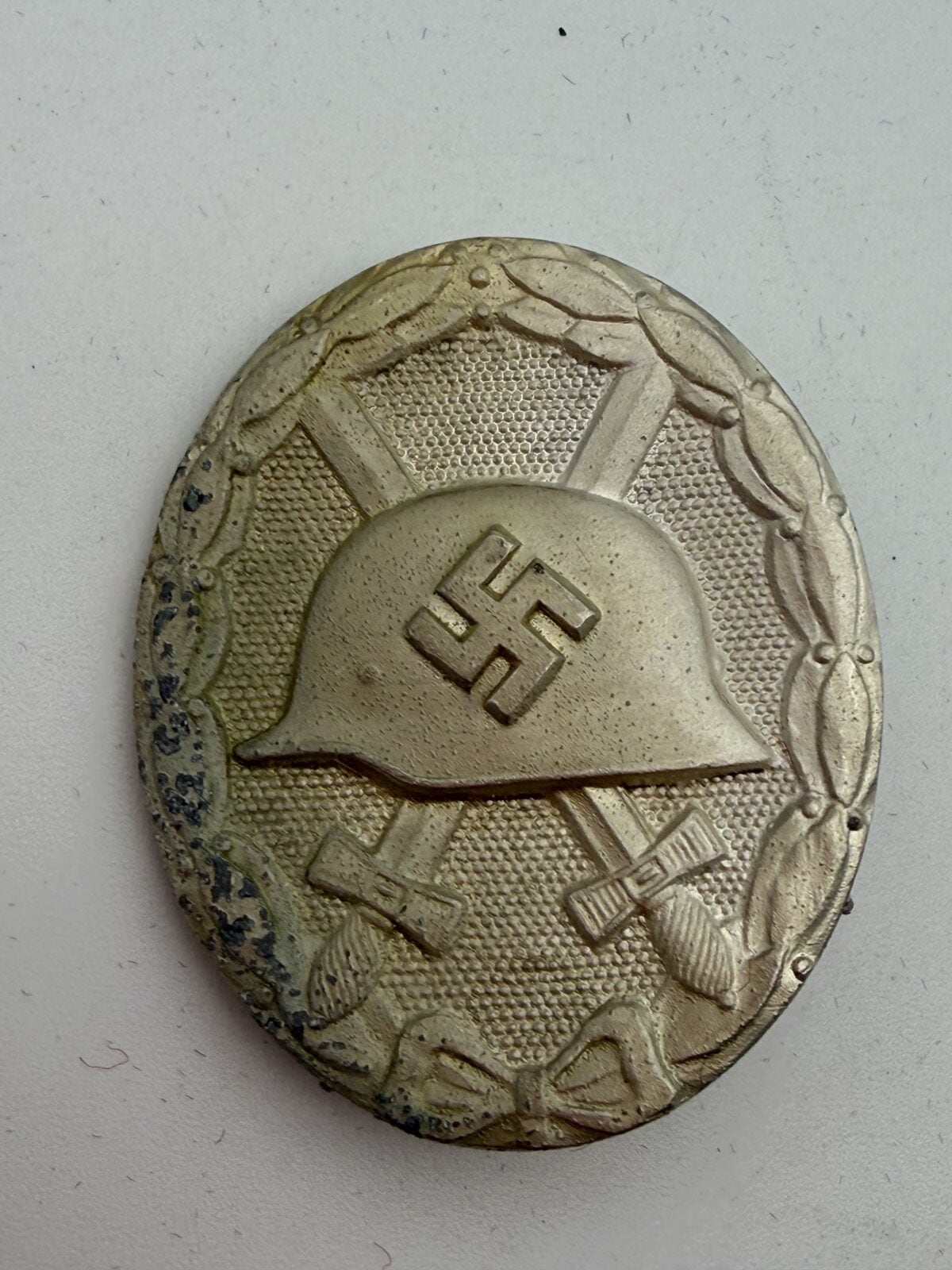
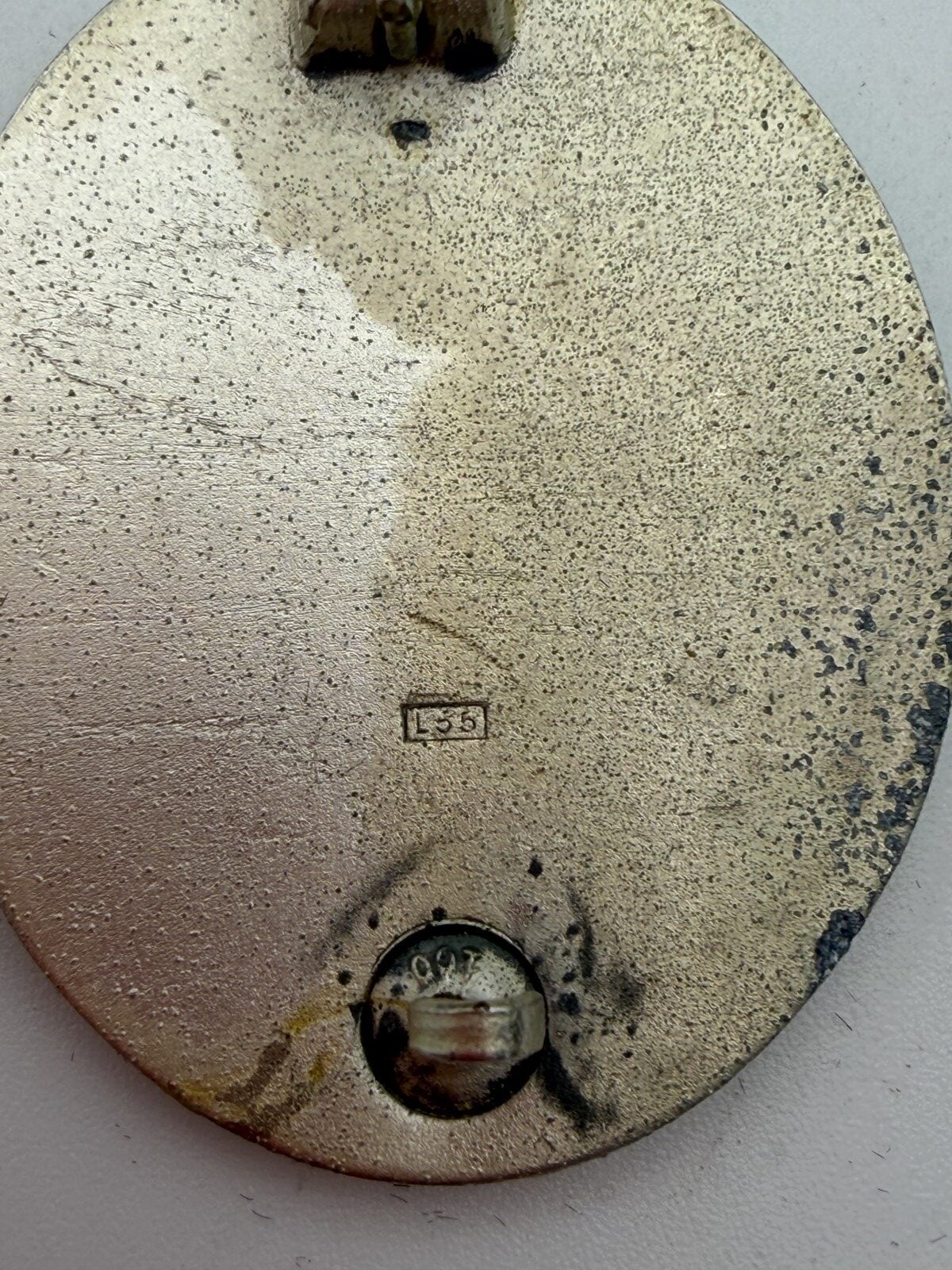
Scarce maker-marked Silver Wound Badge 1939, or Verwundetenabzeichen 1939 in Silber, manufactured by Hymmen & Co. of Lüdenscheid and clearly stamped L/53 on the reverse.
The solid badge retains a substantial amount of its original silver finish, particularly across the reverse and raised obverse details. Its classic design displays an M35 steel helmet over crossed swords within an oval laurel wreath.
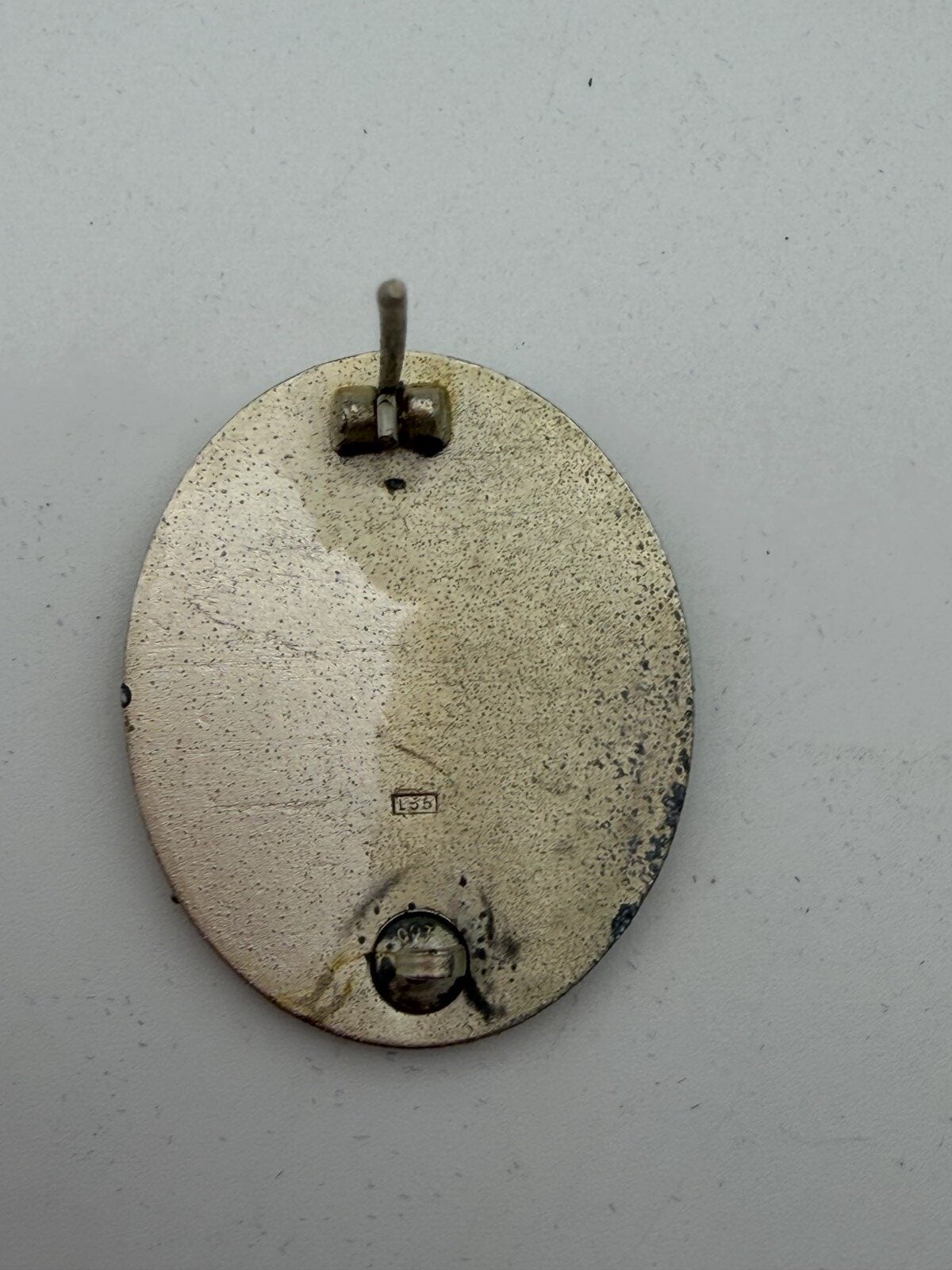
The reverse retains its original vertical pin, hinge and catch assembly. Natural oxidation, spotting and age toning remain untouched throughout.
€ 200
1 in stock
This Silver Wound Badge 1939 is an especially desirable maker-marked example produced by Hymmen & Co., Lüdenscheid.
The reverse carries the firm’s distinctive LDO designation:
Ratisbon’s identifies L/53 as the wartime LDO code used by Hymmen & Co., while surviving Hymmen Iron Crosses, Minesweeper Badges and Wound Badges all carry the same designation.
That maker mark considerably improves the collector appeal because many surviving Silver Wound Badges are completely unmarked.
Hymmen & Co. operated in Lüdenscheid, one of Germany’s principal centres for badge and medal manufacture.
The company participated in the LDO system and used the code L/53 on qualifying privately supplied or replacement decorations.
Ratisbon’s describes original Hymmen awards explicitly as “Hymmen & Co., Lüdenscheid” and identifies L/53 as the firm’s LDO code.
Interestingly, Nordmenn already holds another L/53-marked Hymmen piece: the Original WWII German Iron Cross 1st Class Screwback – L/53 Hymmen & Co., providing an excellent internal maker comparison.
The present badge is unquestionably the Silver grade, not Gold.
Its surviving finish shows a pale silver-grey colour across the obverse and a considerably stronger silver surface on the reverse.
The darker areas visible around the edge are consistent with oxidation and deterioration of the original silvered surface rather than gold finish.
Therefore, the correct catalogue designation is:
or
The badge appears to be manufactured from silvered fine zinc / Feinzink, which is entirely consistent with documented Hymmen L/53 Wound Badges.
eMedals records an L/53 Hymmen Silver Wound Badge measuring approximately 36.6 × 44.1 mm and weighing 25.7 grams, manufactured from silvered zinc. Another documented example measures approximately 36.4 × 44.2 mm and weighs 26.7 grams.
Ratisbon’s likewise records an original Hymmen L/53 example as zinc with silver finish.
Until your badge is weighed or XRF tested, I would phrase the material as:
Silvered zinc / Feinzink construction, consistent with documented L/53 Hymmen examples.
That is stronger than claiming an alloy from photographs alone.
The obverse carries the familiar Second World War Wound Badge design.
A German M35-style steel helmet sits centrally.
The national emblem appears prominently on the helmet, while two crossed swords extend diagonally behind it.
An oval laurel wreath encloses the composition.
The background uses a finely pebbled texture, creating contrast between the raised helmet, swords and wreath.
On your example, much of the detail remains very sharp.
Individual helmet contours, sword grips and wreath leaves are all still clearly defined.
This is the familiar 1939 / second-pattern form.
Later Wound Badges used the M35 helmet rather than the earlier First World War-style helmet seen on the 1918 pattern.
Weitze describes this second form as the wartime design adopted for the 1939 decoration.
For the website I would use:
1939 Silver Wound Badge, 2nd Pattern
as a supporting description.
The reverse photograph is particularly useful.
At its centre is a clearly impressed rectangular maker stamp:
This placement agrees with documented Hymmen Wound Badges.
Ratisbon’s specifically describes an original example as having a central maker mark and identifies the maker as Hymmen & Co.
Your mark is cleanly struck and entirely legible.
That is a major advantage when cataloguing the badge because it removes the uncertainty associated with die-only maker attribution.
The badge retains its original-style vertical fastening system.
At the top is the hinge assembly.
A long pin extends downward toward the catch at the base.
The lower fitting sits within a recessed circular area in the reverse.
Documented L/53 Silver Wound Badges also use a vertical pin system with sheet-metal-type hinge and flat-wire catch arrangements.
The hardware visible in your photographs therefore compares positively with known Hymmen construction.
I see no obvious modern replacement fitting in the images supplied.
The 1939 Wound Badge was instituted on 1 September 1939.
It continued the tradition of the First World War Wound Badge while updating the design for the Wehrmacht period.
Three grades existed:
Black — generally one or two wounds.
Silver — generally three or four wounds.
Gold — generally five or more wounds or the most severe permanent injuries.
Weitze confirms this basic award structure.
The Silver grade therefore represented a considerably higher qualification than the commonly encountered Black badge.
The Silver grade did not always require exactly three or four separate wounds.
Certain particularly serious injuries could justify award of Silver regardless of the simple wound count.
Weitze records qualifying examples including loss of a hand, foot or eye, serious hearing loss, brain injury and significant permanent disfigurement.
Therefore, the Silver badge represented substantial physical sacrifice rather than simply length of service.
From the photographs supplied, I rate this Silver Wound Badge 1939 very positively as a wartime L/53 Hymmen & Co. example.
The strongest features are:
Most importantly, documented L/53 Hymmen Wound Badges exist with extremely similar construction.
I would therefore be considerably more confident with this badge than with the previous mistaken RS attribution.
Overall condition is very good original condition.
A significant percentage of silver finish remains.
The reverse is particularly strong, although numerous small dark oxidation spots have developed across the surface.
The obverse displays some finish thinning, particularly along the left side and outer wreath.
Nevertheless, the principal design remains very sharp.
The maker mark is excellent.
Likewise, the original fastening system remains present.
Do not polish this badge.
Polishing would remove surviving silver finish and could significantly reduce its collector value.
Silver Wound Badges themselves are not exceptionally rare.
However, clearly maker-marked examples are more desirable.
The L/53 Hymmen & Co. variant is substantially less common than many unmarked zinc types.
Past Glories describes its L/53 Hymmen Silver Wound Badge as a difficult maker to find and currently prices an example at £150.
Ratisbon’s has also recorded original Hymmen L/53 examples, confirming the variant as a recognised wartime production type.
Explore related listings: Wound Badges; Original WWII German Iron Cross 1st Class Screwback – L/53 Hymmen & Co.; Original WWII FLL Infantry Assault Badge in Silver; Nordmenn – Medals, Badges & Awards Collection.
For an almost exact L/53 Hymmen comparison:
eMedals – L/53 Hymmen Silver Wound Badge
eMedals records its example as silvered zinc, L/53 marked and manufactured by Hymmen & Co.
For a documented auction comparison:
Ratisbon’s – Hymmen L/53 Silver Wound Badge
Ratisbon’s identifies the piece as zinc, centrally L/53 marked and manufactured by Hymmen & Co.
For a general current Silver Wound Badge reference: