
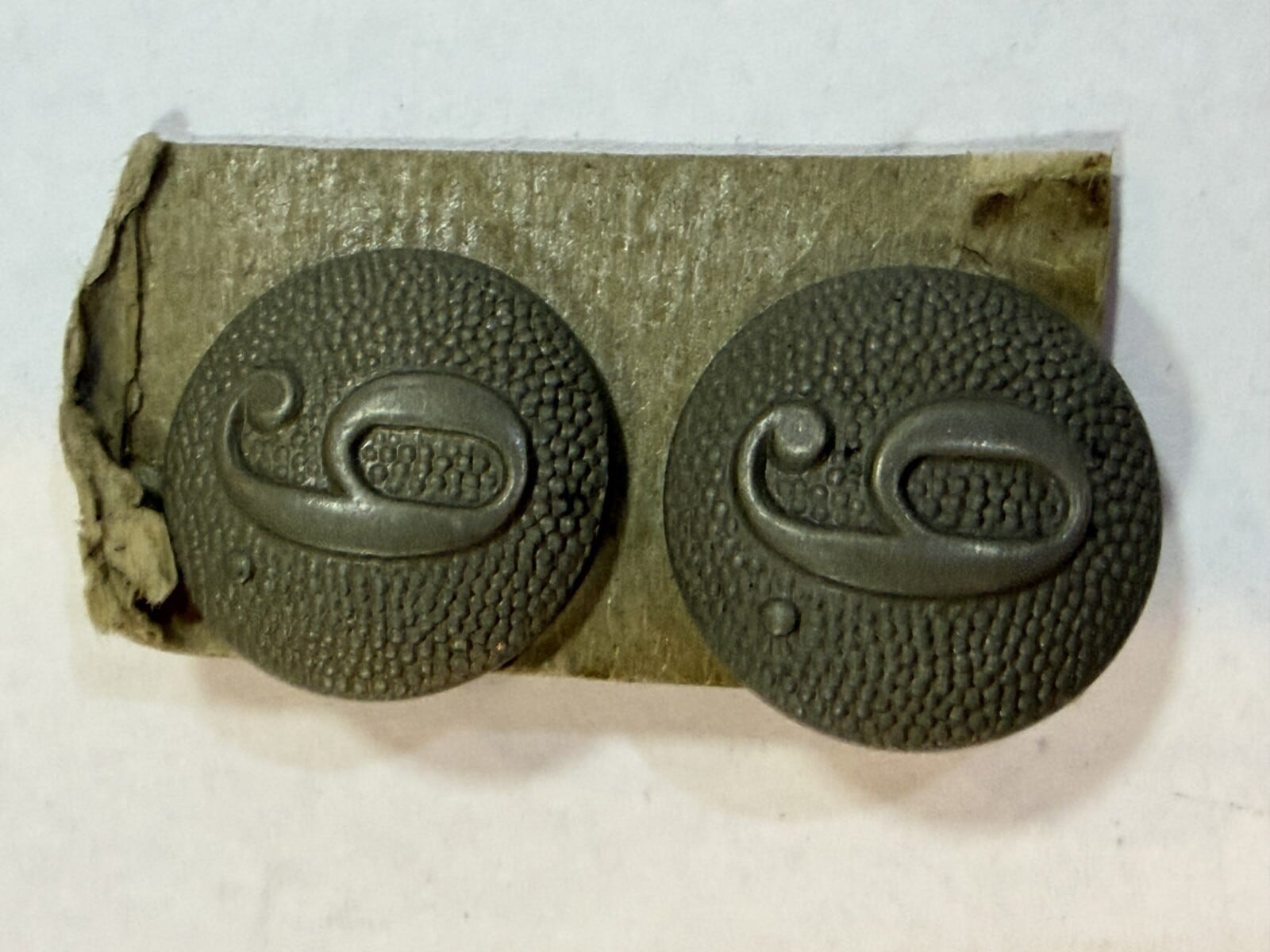
Matching pair of original Wehrmacht 9th Company Shoulder Buttons, each displaying a raised Arabic numeral 9 with orientation dot against a finely pebbled grey field. The numeral identifies a soldier serving with the 9. Kompanie of his regiment and does not by itself identify Infantry Regiment 9. Both buttons retain convincing period construction and remain together on old card backing.
€ 18
1 in stock
This matching pair of original Wehrmacht 9th Company Shoulder Buttons displays the raised Arabic numeral “9”against a finely pebbled field. Both buttons remain together on old card backing and retain an attractive, untouched grey-toned finish.
The numeral is particularly important. It does not indicate Infantry Regiment 9. Instead, the raised 9 identifies the wearer as a soldier of the 9th Company – 9. Kompanie – within his regiment.
A small raised dot beneath the numeral establishes its correct orientation and prevents the figure from being mistaken for a 6.
Helmut Weitze documents directly comparable examples under the description “Reichswehr / Wehrmacht Paar Schulterknöpfe für einen Soldaten der 9. Kompanie.” Its referenced pair is made from aluminium, measures approximately 19 mm and carries the same raised numeral 9.
Compare an original 9th Company pair at Helmut Weitze
Company-numbered shoulder buttons provided an immediate indication of a soldier’s sub-unit.
On these examples, the Arabic 9 signifies 9. Kompanie. In the standard infantry organisation, Companies 1–4 normally formed the I Battalion, Companies 5–8 the II Battalion and Companies 9–12 the III Battalion. Consequently, the 9th Company normally represented the first company of the regiment’s III Battalion.
Importantly, the number does not establish the regiment.
A soldier serving in the 9th Company of any regiment using this system could wear a number 9 shoulder button. Therefore, attributing the pair specifically to Infanterie-Regiment 9 without additional provenance would be incorrect. Weitze makes the same distinction when discussing comparable numbered buttons.
This style spans the transition from the Reichswehr into the early Wehrmacht period.
Numbered shoulder buttons had already been used during the Reichswehr era. Following the creation of the Wehrmacht in 1935, the system continued into the pre-war period and early stages of the Third Reich military uniform system.
The practice was particularly useful because the shoulder straps could simultaneously indicate branch through their Waffenfarbe, while the button supplied the company number.
As a result, a complete shoulder strap containing its original numbered button can sometimes provide considerably more information than the button alone.
The fronts of these Wehrmacht 9th Company Shoulder Buttons show a finely textured or gekörnt surface.
Against this field sits the large raised numeral 9. The design remains clear on both examples, while the little orientation dot beneath the figure is also visible.
Their subdued grey finish is consistent with military uniform fittings rather than decorative civilian buttons.
Period numbered buttons were manufactured in several metals according to date and specification. Reichswehr examples can occur in nickel-silver-type materials, while later Wehrmacht production included aluminium and subsequently zinc or other economy metals. Weitze notes that light-metal uniform buttons were formally introduced into Wehrmacht regulations in November 1935.
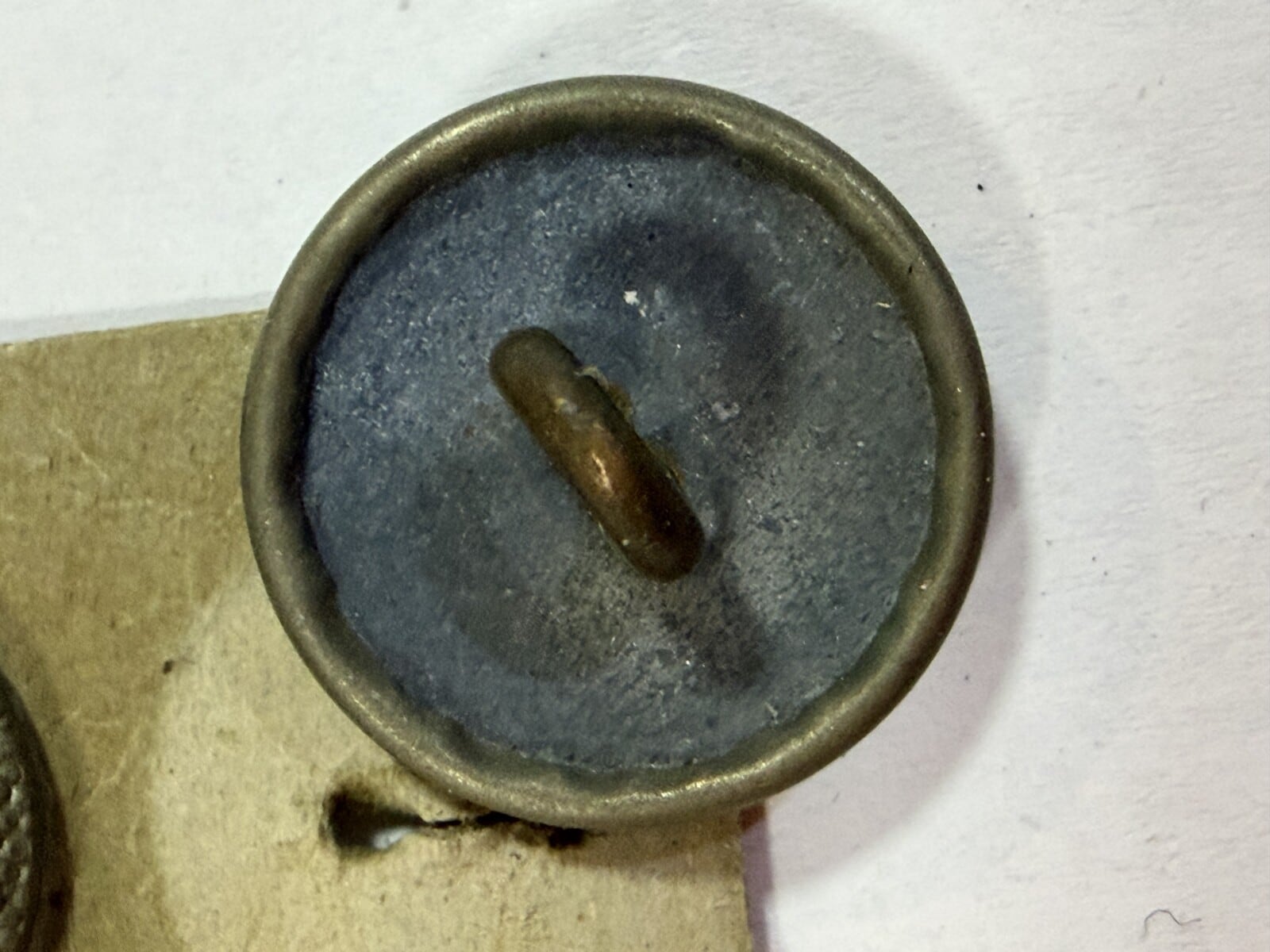
The photographed reverse provides useful authentication evidence.
It displays a separate rear section enclosed by the rolled outer edge together with a substantial metal attachment loop. Natural oxidation surrounds the protected areas without looking artificially applied.
Several details support period manufacture:
I see no obvious reproduction warning signs in the photographs supplied.
Both buttons remain attached to a small section of old card.
The card displays staining, edge deterioration and old mounting openings. Its appearance is entirely compatible with long-term storage.
Nevertheless, unless manufacturer’s printing or original packaging can be established, the safest catalogue terminology is:
“Matching pair retained on old card backing.”
That description preserves the interesting presentation without making an unsupported claim that the card is definitely original factory packaging.
My current catalogue identification is:
Item: Numbered military shoulder buttons
Country: Germany
Period: Reichswehr / early Wehrmacht
Organisation: German Army
Number: 9
Meaning: 9th Company / 9. Kompanie
Quantity: 2 matching buttons
Front: Pebbled field with raised numeral 9 and orientation dot
Reverse: Period attachment loop construction
Finish: Grey / subdued metal finish
Regimental attribution: Not identifiable from the buttons alone
Condition: Very good original condition
Authentication assessment: Original period manufacture
Small numbered uniform components provide particularly useful evidence when studying complete German uniforms.
Unlike an ordinary plain button, a company-numbered shoulder button records the wearer’s position within the organisational structure of his unit. A surviving matched pair is additionally desirable because one button was required for each shoulder strap.
For comparison, Weitze currently lists an approximately 19 mm original single 9th Company button for €10 and a matching pair for €20.
Further original German uniform material can be viewed within the Nordmenn collection:
Original Third Reich Uniforms – Nordmenn Militaria
For the strongest external comparison:
Helmut Weitze – Original Number 9 Wehrmacht Shoulder Button
I19 mm size as the documented Weitze pair,