
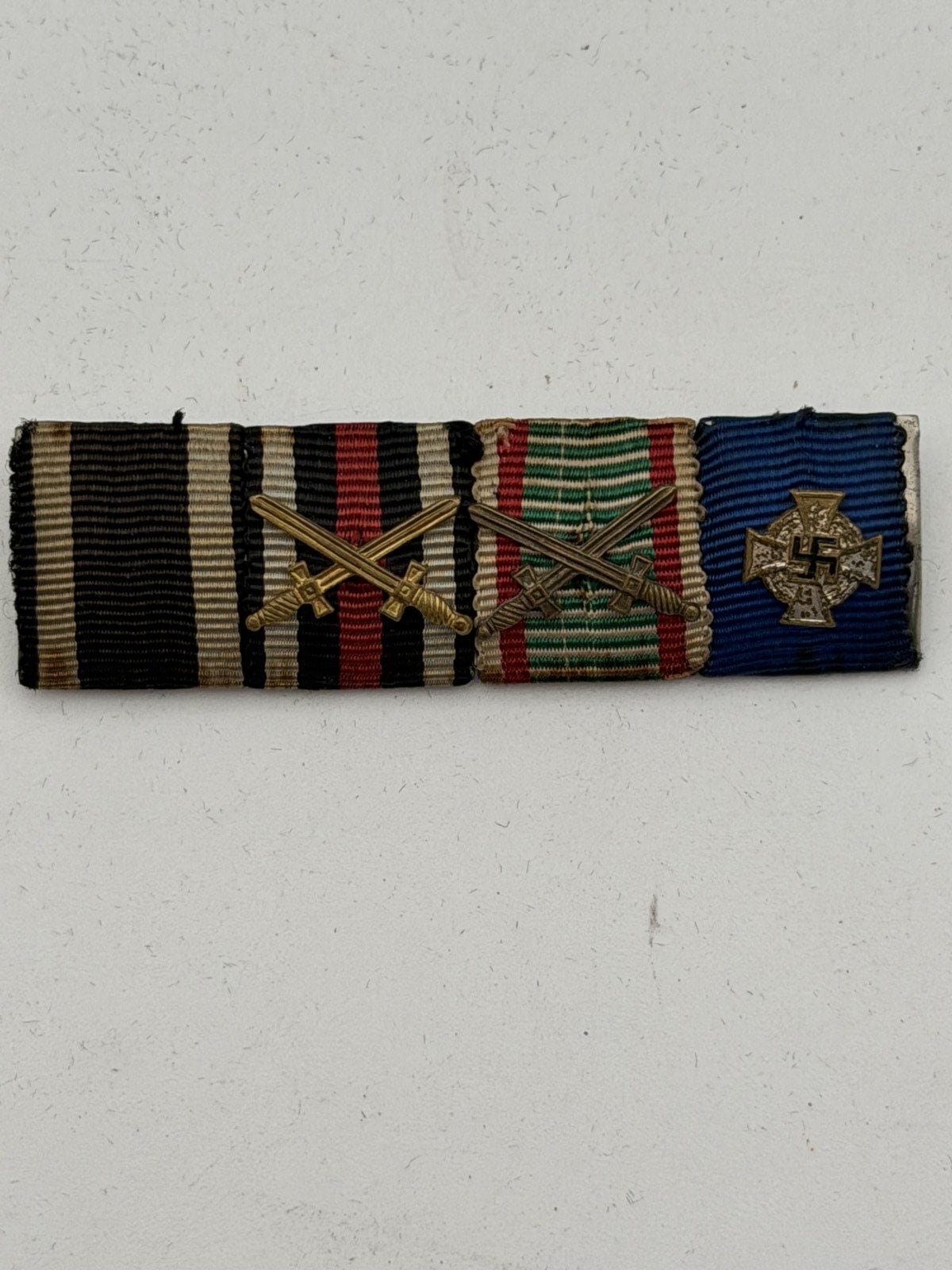
This original German Four-Place Ribbon Bar combines First World War decorations with a later political long-service award. Four period ribbons have been mounted on a full-length metal backing, while three miniature devices provide clear visual identification.
€ 90
1 in stock
This original German Four-Place Ribbon Bar combines First World War decorations with a later political long-service award. Four period ribbons have been mounted on a full-length metal backing, while three miniature devices provide clear visual identification.
The bar appears to represent the following awards, viewed in order:
The combination suggests that the original wearer served during the First World War, qualified for a Hungarian allied commemorative award and later completed long service within the NSDAP. Without an attributed uniform, document group or recipient’s name, however, the wearer cannot be identified.
Collectors can compare this example with other original German medals and ribbon bars available from Nordmenn Militaria.
The first ribbon represents the 1914 Iron Cross Second Class. Its black centre and narrow white edge stripes follow the recognised Imperial German pattern. Veterans normally wore the ribbon in a buttonhole or as part of a mounted ribbon bar when the full-size cross was not required.
The second ribbon carries a gilt crossed-swords device. President Paul von Hindenburg instituted the Honour Cross of the World War in 1934. The swords identified the combatant version and distinguished it from awards issued to non-combatants and next of kin.
The third ribbon displays the distinctive Hungarian pattern of white, green and red, together with another crossed-swords device. The Australian War Memorial’s documented example confirms this ribbon pattern and records the combatant medal as a Hungarian award dating from 1929.
German veterans could qualify for allied commemorative decorations through eligible wartime service. Consequently, Hungarian and Austrian awards often appear alongside German First World War decorations.
The final dark-blue ribbon carries a miniature silver political service cross. This configuration corresponds to the NSDAP 15-Year Long Service Award, also known as the NSDAP-Dienstauszeichnung in Silber für 15 Jahre.
The silver-grade decoration recognised 15 years of qualifying service. Its presence creates a direct chronological link between the wearer’s First World War record and later political service during the Third Reich period.
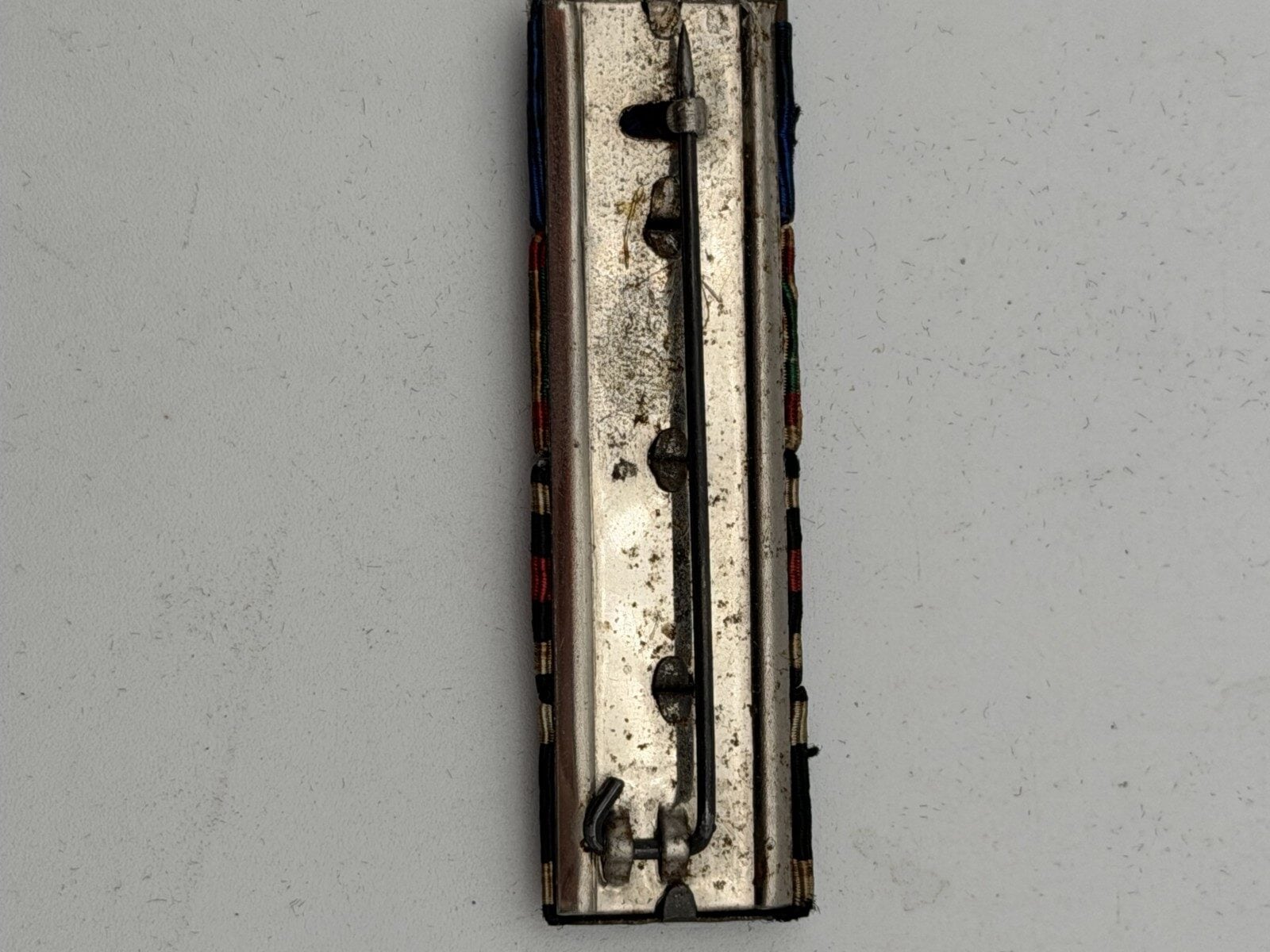
A tailor mounted the four ribbed ribbons over a silver-coloured metal base. Each crossed-swords or miniature award device passes through its corresponding ribbon. The reverse retains a long vertical fastening pin, hinge and open hook catch.
The supplied photographs show:
The construction, ribbon selection and award sequence appear consistent with a period-mounted German ribbon bar. Nevertheless, final authentication should include an in-hand inspection, UV examination of the textiles and magnified inspection of the device fasteners.
For comparison, this archived eMedals four-place NSDAP long-service ribbon bar used a magnetic metal core and carried comparable miniature political-service devices. Helmut Weitze’s ribbon-bar inventory was also checked, although no identical four-award combination could be located in its currently indexed stock.
The ribbon bar remains in good, honestly worn condition. The ribbons retain clearly recognisable colours, although light fading, minor edge wear and isolated loose threads can be seen. The miniature devices show age-toned surfaces and remain attached.
The metal backing displays oxidation, staining and handling marks consistent with prolonged age and storage. Importantly, the fastening pin remains present. No cleaning or restoration should be attempted because the untouched patina supports the piece’s historical character.
This example offers more historical depth than a standard military ribbon bar. The sequence records a career that appears to span the First World War, the interwar veterans’ award period and later NSDAP long service.
The Hungarian combatant ribbon also gives the bar an international element. Meanwhile, the miniature 15-year political service cross provides a particularly recognisable final device. Collectors can view another multi-award comparison in Nordmenn’s original ten-place Third Reich ribbon bar or browse the wider Nordmenn Militaria shop.
No. It is a ribbon bar, or Feldspange. The wearer used it to represent full-size decorations on a service uniform.
The swords normally identify a combatant or frontline version of the represented award. They appear here on the Hindenburg Cross and Hungarian commemorative ribbons.
The blue ribbon and miniature silver cross correspond to the NSDAP 15-Year Long Service Award. This represented the silver, second-class grade.
The combination provides clues about the wearer’s service, but it does not reveal a name. Identification would require accompanying documents, an attributed uniform or additional provenance.
The photographs show honest wear and oxidation but no obvious modern repair. An in-hand inspection remains necessary before making a final guarantee.