
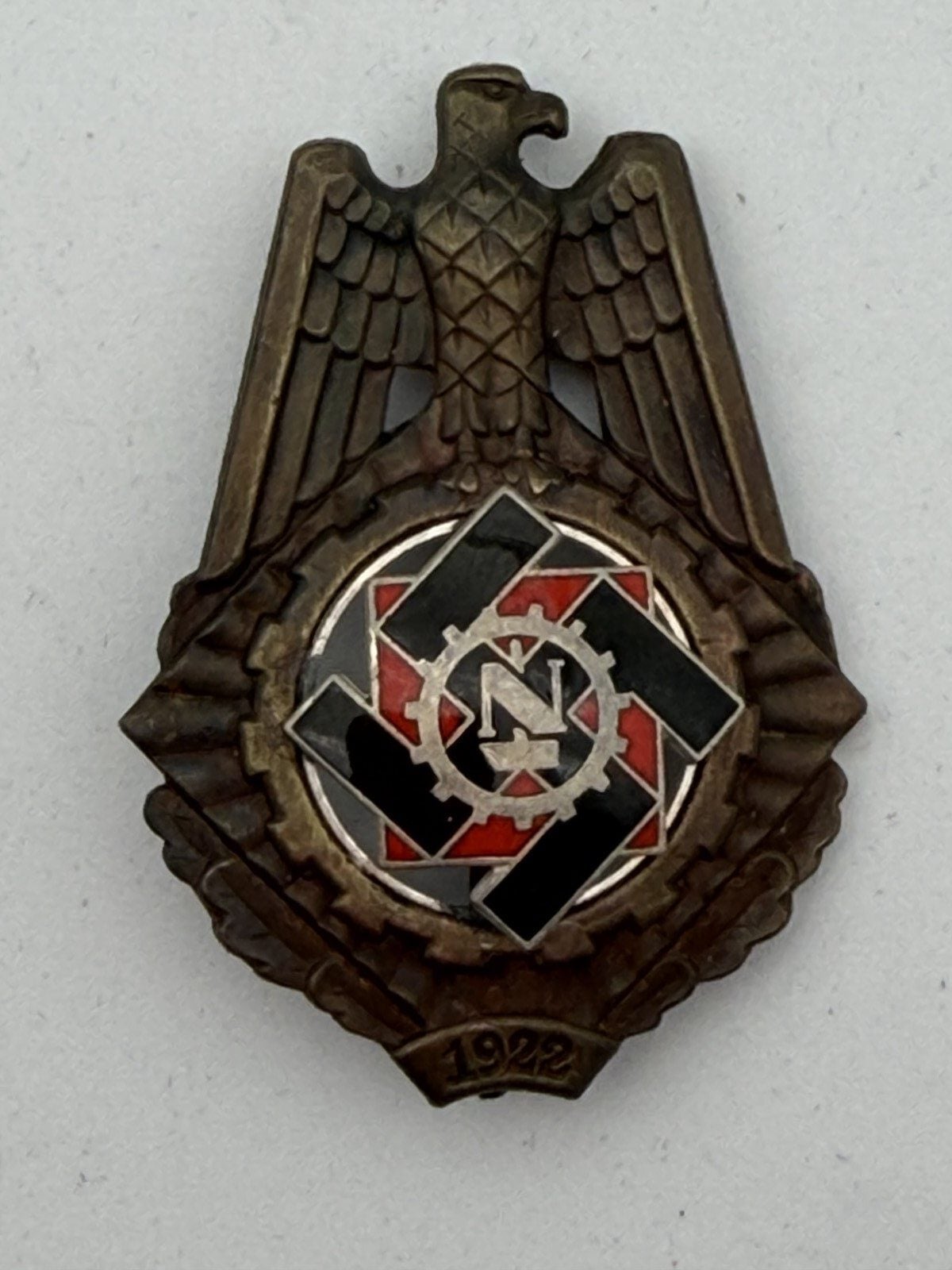
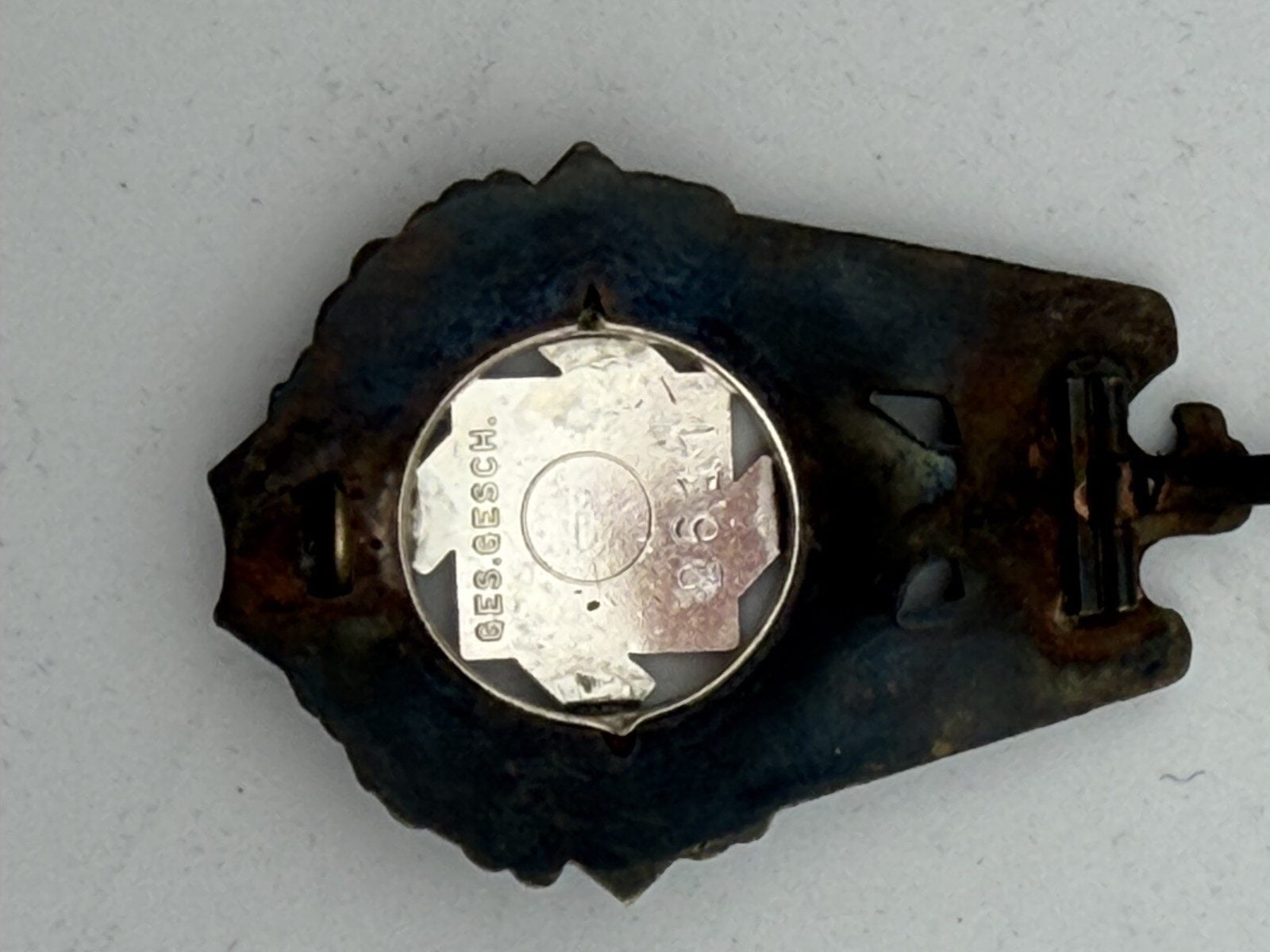
TeNo Honour Badge with entry-year date 1922 and reverse number 2149. Pierced eagle-and-oak-leaf body, coloured enamel centre and GES. GESCH. marking. Retains its long pin, hinge and catch. Maker inscription is not legible in the available photograph.
€ 795
1 in stock
A TeNo Honour Badge with the entry-year date 1922 and individual reverse number 2149. Its pierced eagle-and-oak-leaf body surrounds a separately fitted enamelled centre, with a long vertical pin on the reverse.
The dark bronze-toned body contrasts with the red, black and silver-coloured centre. The lower tablet carries the date 1922; the reverse centre is marked GES. GESCH. above the number.
The eagle extends across the upper part of the badge, above the central Technische Nothilfe emblem. Oak leaves frame the lower section and meet the dated tablet. The pierced areas allow the outline and relief to be seen clearly.
Inside the red square, the design combines a black swastika with a silver-coloured cogwheel and the stylised TN monogram. The hammer-shaped T can resemble a numeral when viewed sideways; it forms part of the organisation’s initials.
The reverse retains a block hinge, long flat pin and lower catch. Its centre is a separate component, with a brighter surface than the surrounding body. The precise metal alloy has not been tested.
The date refers to the qualifying member’s year of entry into the Technische Nothilfe. It is not a manufacturing date. The honour badge was introduced retrospectively in 1935 for qualifying early members.
The reverse number identifies this individual badge. No recipient name accompanies the listing, and the number should not be used to infer an owner without a matching record. GES. GESCH. abbreviates Gesetzlich Geschützt, indicating a protected design.
A reference entry on the TeNo Honour Badge explains the entry-year variants and the award’s introduction.
The badge type is attributed in specialist references to Wilhelm Fühner of Pforzheim. The available reverse photograph does not show a legible maker inscription on this example, so the attribution should be distinguished from a confirmed visible mark.
For comparison, eMedals records a 1922 badge attributed to Fühner. Helmut Weitze also records a cased TeNo 1922 example. Those references concern separate objects.
Strong relief remains across the eagle, leaves and date. The red and black enamel retains its colour, with no large missing section apparent in the photographs. Small surface marks and age toning are visible.
The reverse centre has scratches and handling marks, while the outer body carries a darker patina. Pin, hinge and catch are present. Dimensions and weight are not recorded in this listing.
Browse our military badges for related pieces. To request measurements or a clearer view of the pin, enquire about TeNo Honour Badge No. 2149.