
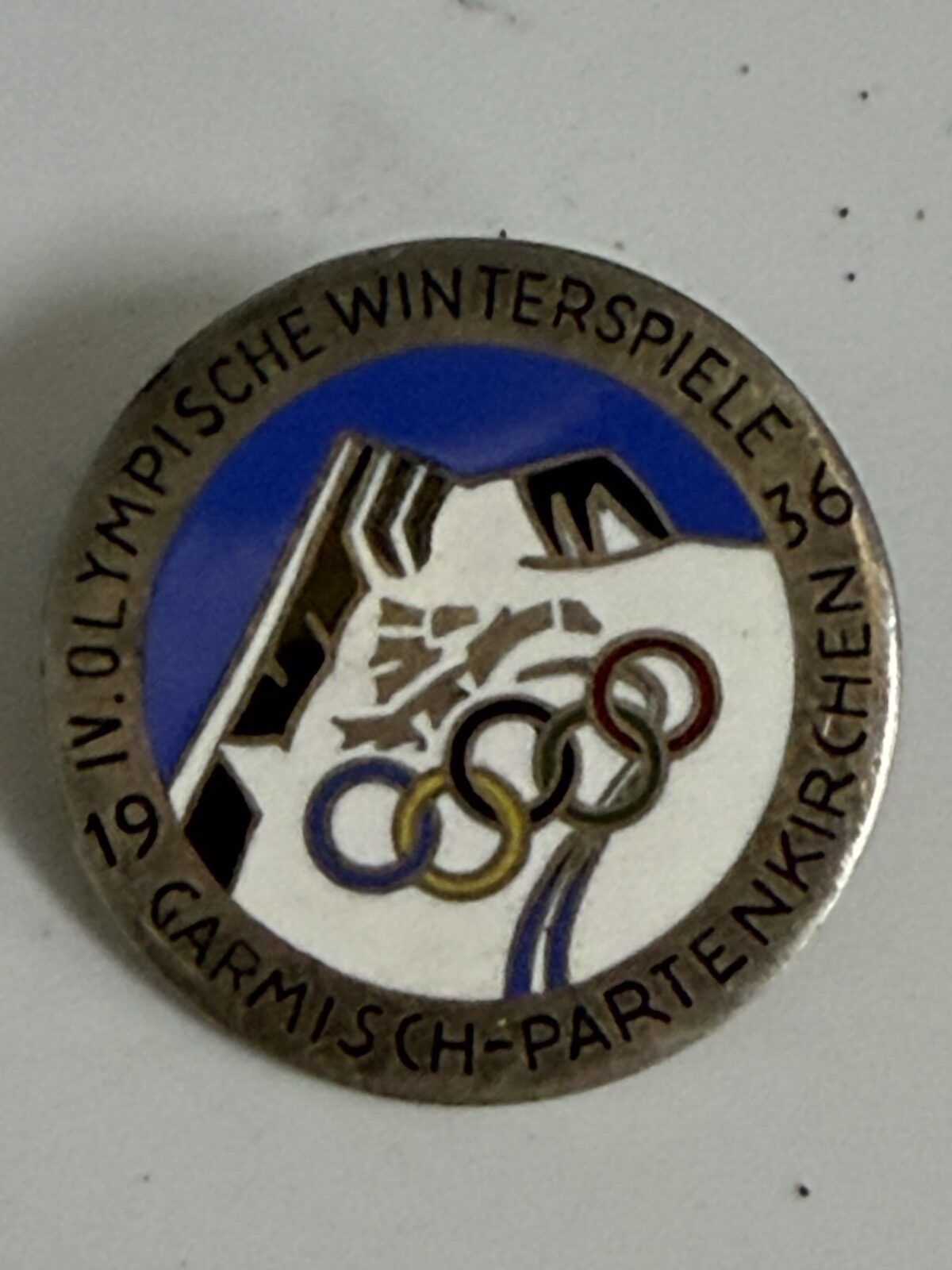
This 1936 Garmisch Winter Olympics Visitor Badge is an original official visitor’s badge produced for the IV Olympische Winterspiele, held at Garmisch-Partenkirchen from 6 to 16 February 1936.
Manufactured by the respected German badge maker C. Poellath of Schrobenhausen, the badge combines silvered non-ferrous metal with finely applied multicoloured vitreous enamel.
Its striking design displays the snow-covered mountain landscape of Garmisch-Partenkirchen beneath a deep blue enamel sky. The five Olympic rings appear prominently across the lower centre.
Around the outer border appears the inscription:
€ 100
1 in stock
This 1936 Garmisch Winter Olympics Visitor Badge is an original official visitor’s badge produced for the IV Olympische Winterspiele, held at Garmisch-Partenkirchen from 6 to 16 February 1936.
Manufactured by the respected German badge maker C. Poellath of Schrobenhausen, the badge combines silvered non-ferrous metal with finely applied multicoloured vitreous enamel.
Its striking design displays the snow-covered mountain landscape of Garmisch-Partenkirchen beneath a deep blue enamel sky. The five Olympic rings appear prominently across the lower centre.
Around the outer border appears the inscription:
IV. OLYMPISCHE WINTERSPIELE
1936
GARMISCH-PARTENKIRCHEN
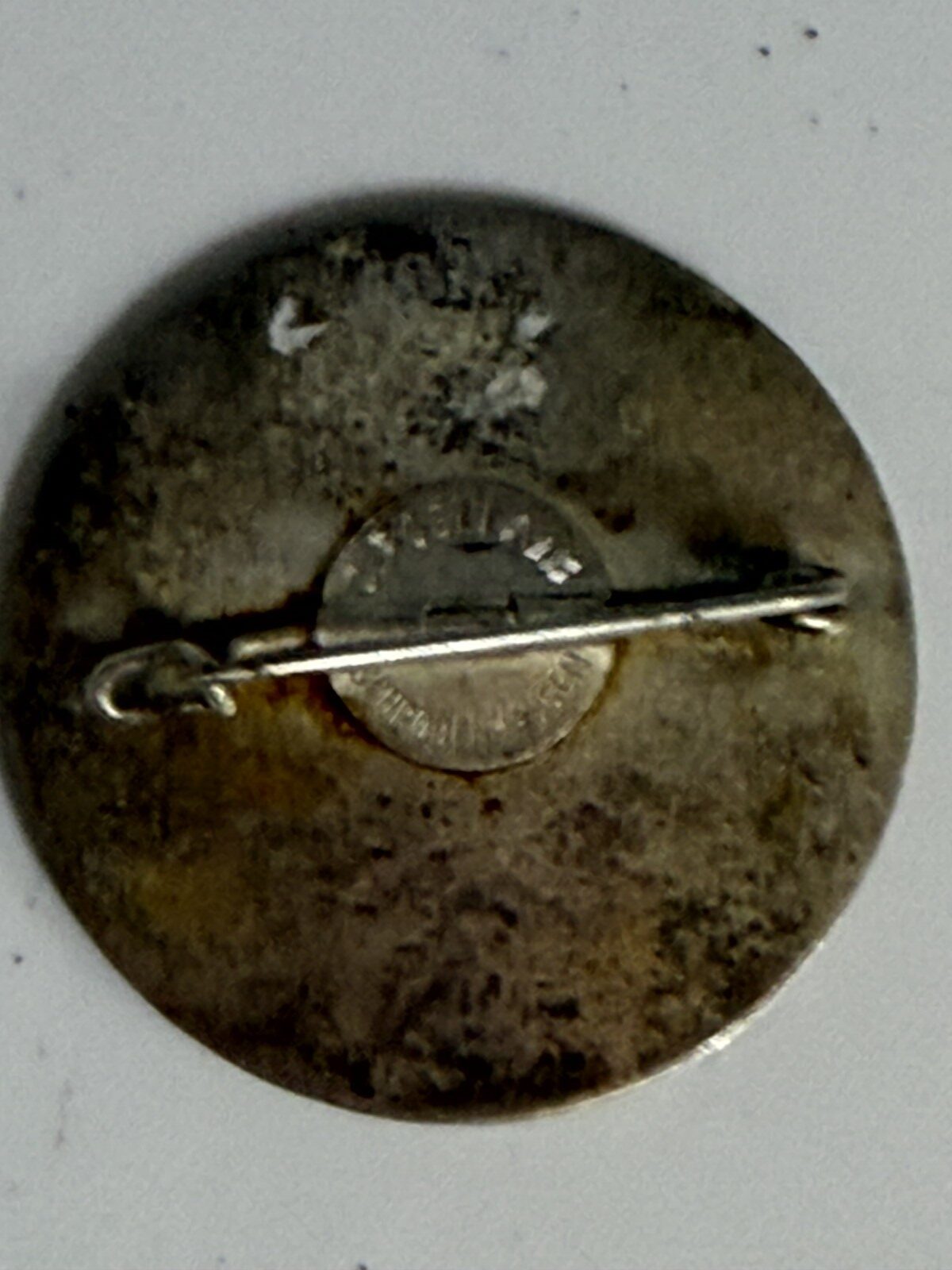
The badge retains its original horizontal pin fitting and clearly identifiable C. Poellath maker plate on the reverse.
This design is documented as an official visitor badge, or Besucherabzeichen, rather than an athlete’s participant badge.
That distinction is important.
Official participant and functionary badges used different constructions and, in some cases, additional surrounds, ribbons, rosettes or individual identification systems.
The present circular badge was intended for visitors to the Winter Games and also served as an attractive souvenir of the event.
Helmut Weitze identifies the identical approximately 35 mm C. Poellath badge as an official visitor’s badge.
More importantly, the Deutsches Historisches Museum in Berlin holds this exact type in its permanent collection. The museum records its example as:
Manufacturer: C. Poellath, Schrobenhausen
Date: 1936
Material: silvered and enamelled metal
Diameter: 3.5 cm.
That museum comparison provides particularly strong confirmation of the identification.
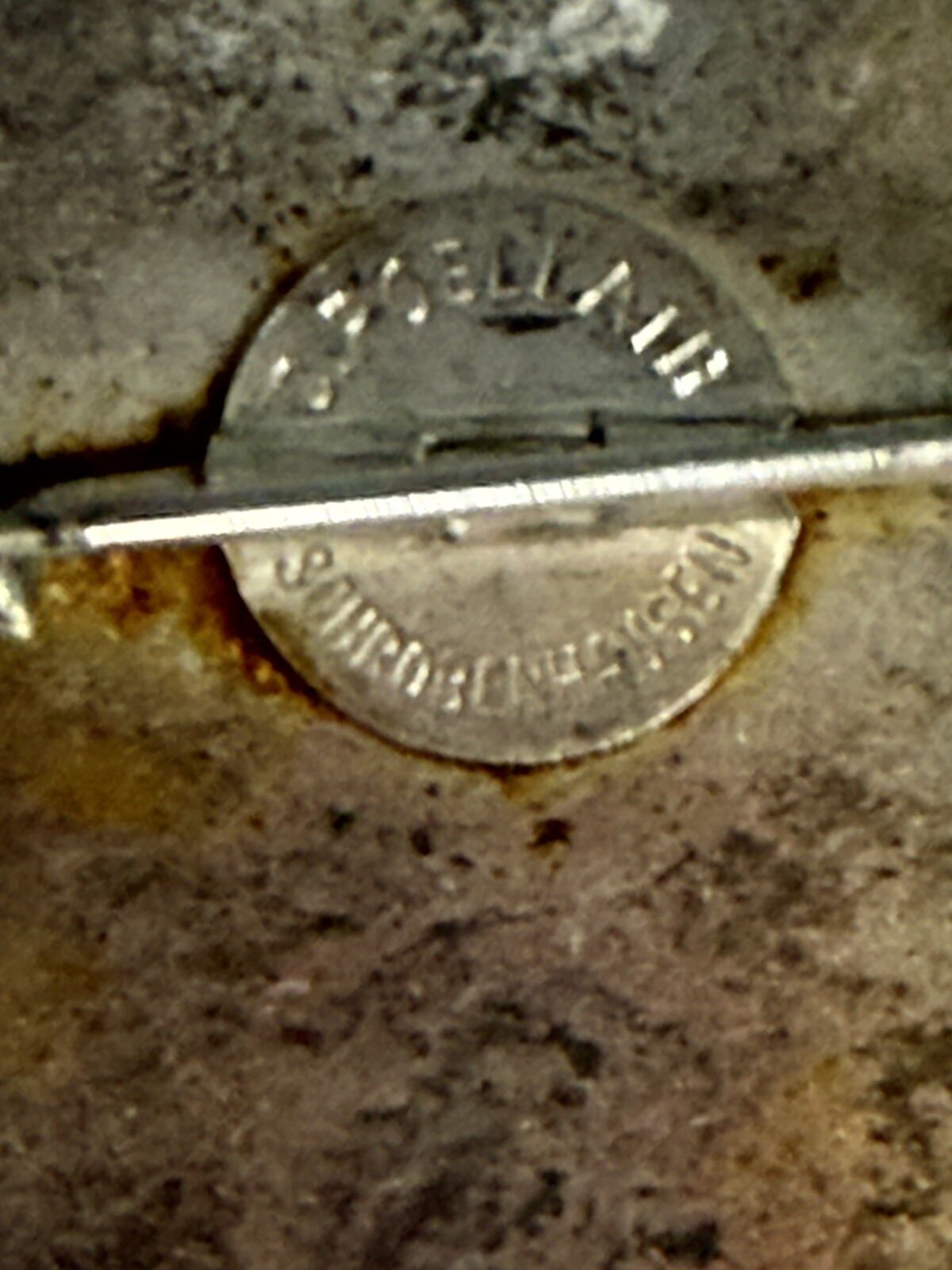
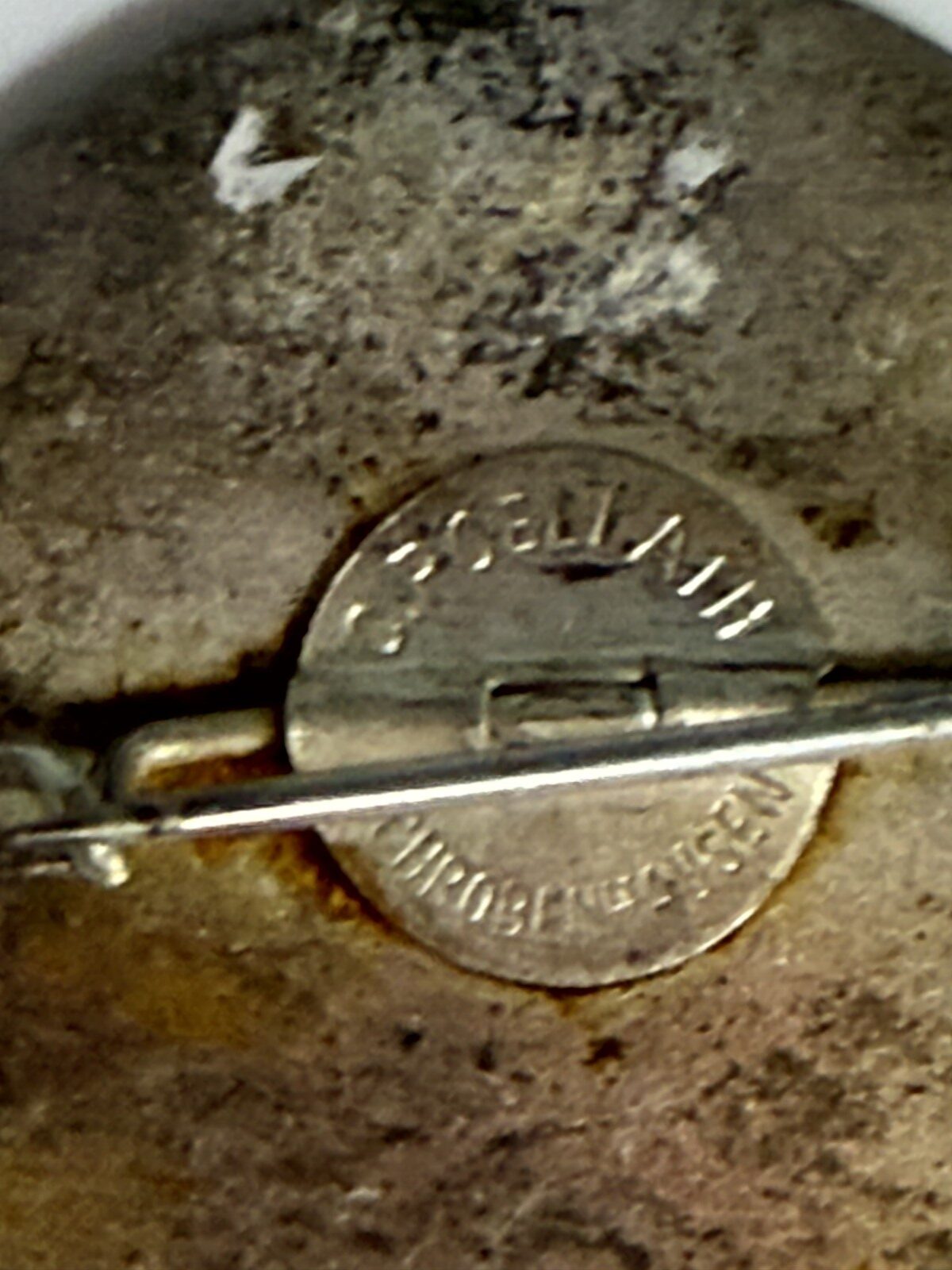
The reverse carries the manufacturer’s circular plate beneath the horizontal pin.
Although age and the pin partially obscure the lettering, the photographs clearly show the characteristic:
C. POELLATH
SCHROBENHAUSEN
mark.
This maker configuration matches documented Poellath badges.
Period C. Poellath pieces commonly employ a circular central maker plate carrying C. POELLATH around the upper section and SCHROBENHAUSEN around the lower section.
The reverse of your badge corresponds closely with documented examples of this mark.
eMedals also records an identical Garmisch-Partenkirchen badge as silvered bronze and enamel, measuring 35.2 mm, with the reverse marked C. POELLATH SCHROBENHAUSEN and fitted with a horizontal pin.
The badge consists of a silvered non-ferrous metal or bronze body with several areas of fired enamel.
The centre displays a stylised alpine landscape.
Deep blue enamel represents the sky, while white and black enamel defines the mountain formation.
Below the mountain appear the five Olympic rings in their traditional colours:
blue, yellow, black, green and red.
White enamel forms the principal lower field.
Meanwhile, black lettering contrasts against the silvered outer border.
This combination creates one of the most recognisable small badges associated with the 1936 Winter Olympics.
Based on the supplied photographs, I consider this example consistent with an original period C. Poellath visitor badge.
Several characteristics support that conclusion.
The front design matches museum and specialist-dealer examples. Its enamel colours, lettering proportions and mountain design correspond with recognised originals.
Furthermore, the reverse carries the correct C. Poellath circular maker plate.
The horizontal pin, hinge and catch also display appropriate period construction.
Natural oxidation and toning cover the reverse rather than an artificial uniform ageing treatment. In addition, the wear around the fittings appears consistent with genuine handling and storage.
The Deutsches Historisches Museum’s example provides especially useful confirmation because it records the same manufacturer, construction, finish and 35 mm format.
Ratisbon’s has likewise catalogued the same enamelled Garmisch badge with a C. Poellath, Schrobenhausen maker mark.
Original period manufacture – C. Poellath, Schrobenhausen – official 1936 Winter Olympics visitor badge.
The badge survives in good original collectible condition.
Most importantly, the coloured enamel remains attractive and retains strong visual contrast.
Minor surface marks and age-related wear are visible, as expected on an item intended to be worn.
The silvered outer metal has developed natural toning.
On the reverse, oxidation and darker areas are visible around the pin assembly. There also appears to be some old surface or mounting residue toward the upper reverse.
I would not attempt to remove this aggressively. The badge should not be polished because doing so could remove remaining original silver finish and disturb the natural patina.
The original horizontal pin remains present.
The IV Olympic Winter Games took place in Garmisch-Partenkirchen between 6 and 16 February 1936.
They represented the first Winter Olympic Games held in Germany and preceded the Berlin Summer Olympics by only a few months.
The Games attracted 646 athletes from 28 nations, according to the historical account accompanying Weitze’s documented visitor badge.
Events included alpine skiing, cross-country skiing, ski jumping, bobsleigh, speed skating, figure skating and ice hockey.
Among the best-known sporting results was Great Britain’s unexpected victory in the ice-hockey competition. Norwegian figure skater Sonja Henie also won her third consecutive Olympic women’s singles title.
The event additionally formed part of the German government’s extensive international presentation surrounding the 1936 Olympics.
Consequently, surviving badges have significance to collectors of both Olympic sporting history and German 1930s memorabilia.
The central mountain-and-rings motif was closely associated with the 1936 Winter Games.
The design places the Olympic rings against an Alpine landscape, immediately identifying the host location.
Unlike many later Winter Olympic emblems, the Garmisch design has a strongly architectural, geometric appearance characteristic of German graphic design during the mid-1930s.
The present visitor badge reproduces that imagery in high-quality coloured enamel.
Original badges from the Garmisch-Partenkirchen Games remain popular with both Olympic and German-history collectors.
This example is particularly attractive because it retains:
It also has excellent cross-collecting appeal.
A collector specialising in Olympic memorabilia, German enamel badges, C. Poellath insignia or 1936 sporting history could all reasonably include this badge within a collection.
| Detail | Specification |
|---|---|
| Item | Official Winter Olympics visitor badge |
| Event | IV Olympic Winter Games |
| Location | Garmisch-Partenkirchen |
| Date | 1936 |
| Maker | C. Poellath, Schrobenhausen |
| Material | Silvered non-ferrous metal / bronze |
| Decoration | Multicoloured vitreous enamel |
| Diameter | Approximately 35 mm |
| Attachment | Horizontal pin |
| Reverse marking | C. Poellath / Schrobenhausen |
| Country | Germany |
| Condition | Good original condition |
| Authenticity | Original period manufacture |
Original official visitor badge from the IV Olympic Winter Games held at Garmisch-Partenkirchen in 1936. Manufactured by C. Poellath of Schrobenhausen in silvered non-ferrous metal with superb multicoloured enamel, featuring the Alpine mountain emblem and five Olympic rings. The reverse retains its original horizontal pin and characteristic C. Poellath maker plate. A highly attractive and fully documented original piece of 1936 Winter Olympic memorabilia.
Explore related listings: Badges; Original 1936 Berlin Olympic Games Participant Badge by H. Osang – Number 514.
Use this as the primary authoritative reference.
Deutsches Historisches Museum – IV Olympic Winter Games Badge
The Deutsches Historisches Museum preserves an identical C. Poellath silvered and enamelled Garmisch 1936 badge in its collection.
Helmut Weitze – 1936 Garmisch Official Visitor Badge
Helmut Weitze also documents the C. Poellath example as the official visitor badge of the IV Olympic Winter Games.