
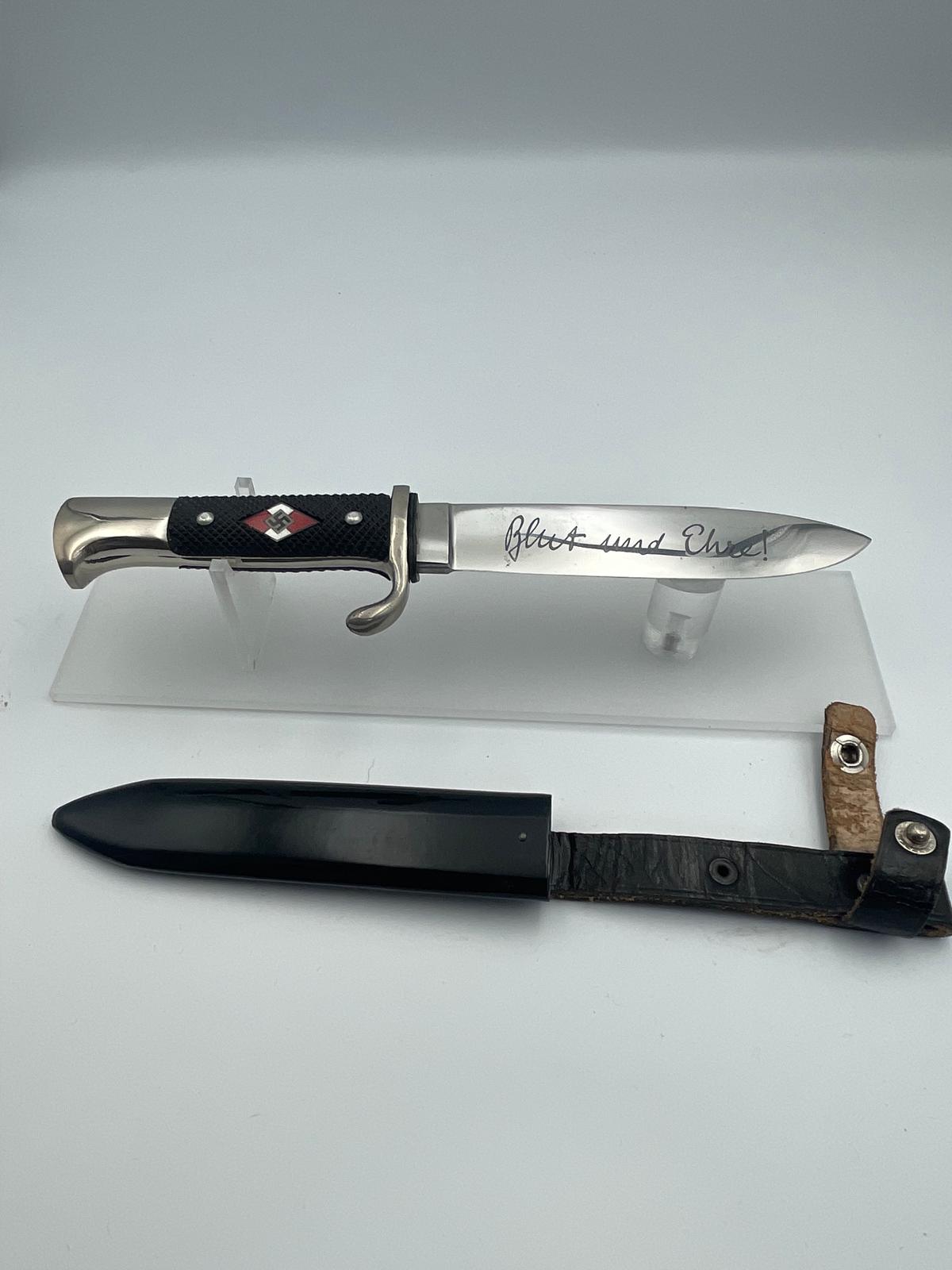
A particularly attractive original Anton Wingen Hitler Youth knife, manufactured in Solingen during 1938 and representing the desirable late transitional production period.
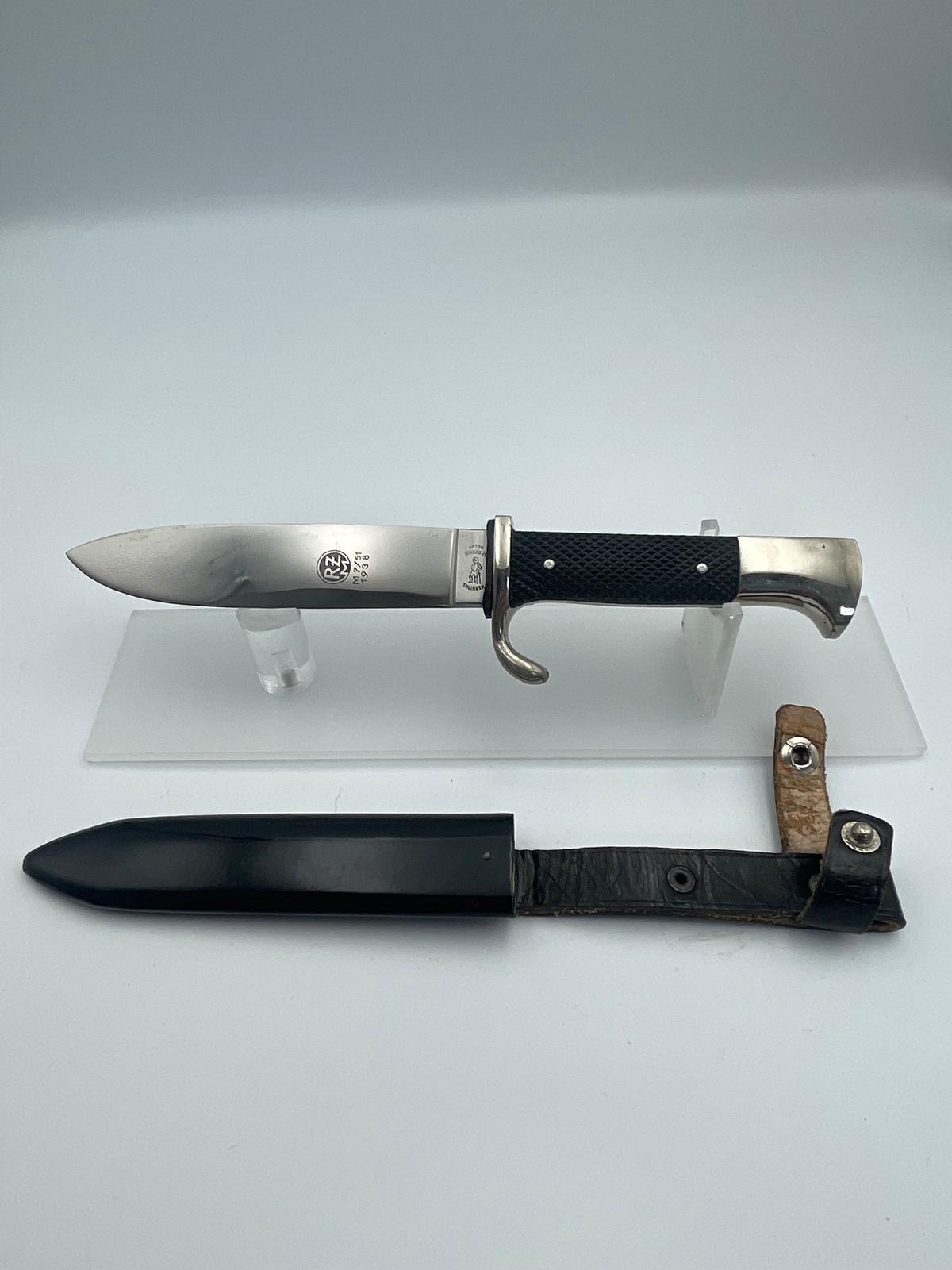
The reverse blade carries the correct RZM M7/51/1938 marking for Anton Wingen Jr. of Solingen. In addition, the ricasso retains the firm’s distinctive armoured-knight commercial trademark.
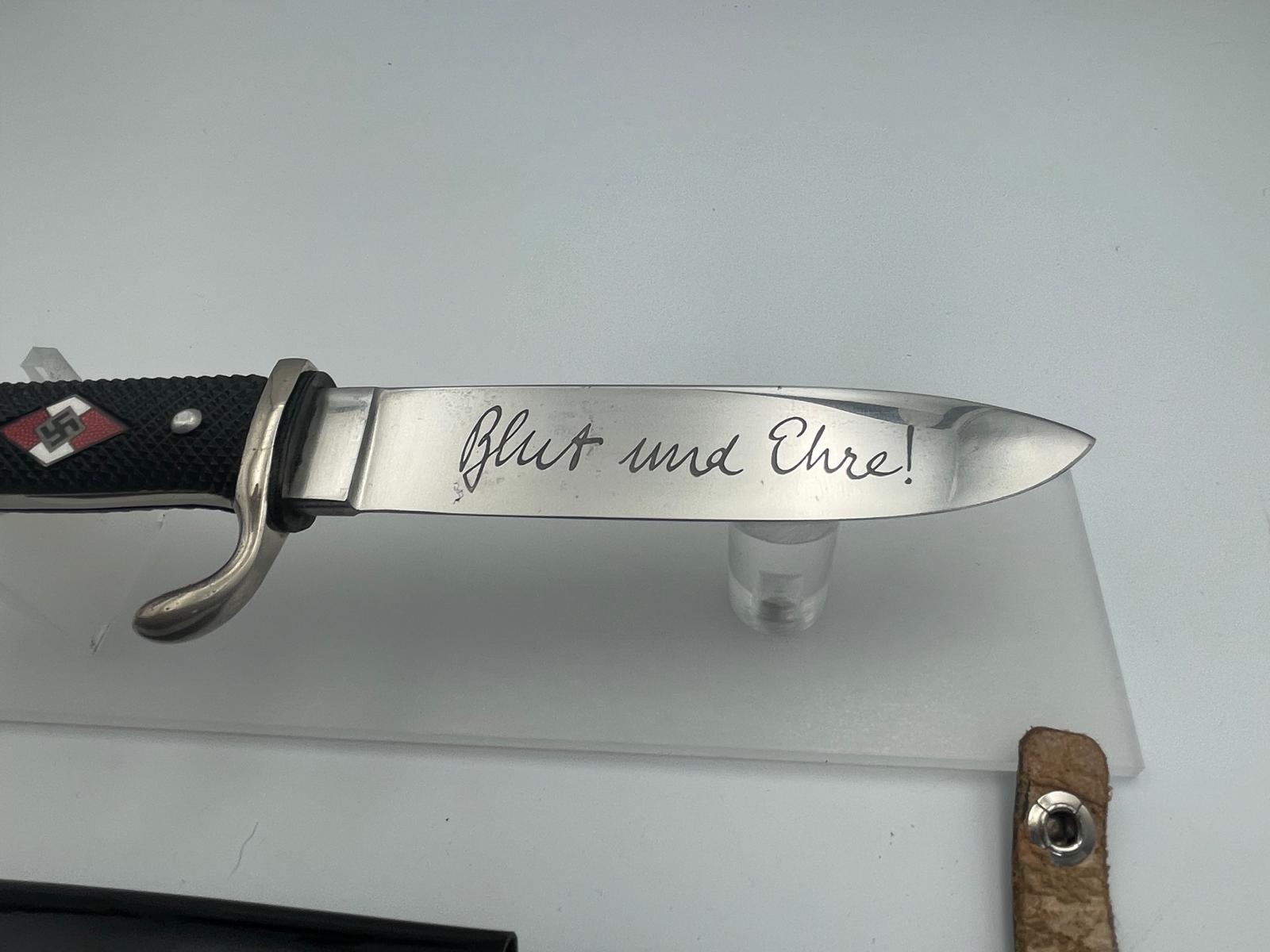
Most importantly, the bright blade still carries the early “Blut und Ehre!” motto. Since the motto was discontinued during 1938, the combination of a dated 1938 RZM marking and original motto makes this a particularly desirable transitional HJ Fahrtenmesser.
Complete with its enamel HJ grip diamond, black-painted steel scabbard and original leather belt hanger.
This excellent Anton Wingen Hitler Youth knife is a desirable late transitional example of the Model 1933 HJ Fahrtenmesser.
Produced during 1938, it combines features associated with both earlier and later manufacturing periods.
The blade retains the traditional Hitler Youth motto:
At the same time, the reverse carries the RZM-controlled maker identification:
This combination provides an important chronological feature.
Early HJ knives initially carried commercial maker names and trademarks. As RZM control increased, numbered manufacturer codes became standard.
Consequently, dated motto-bearing examples from 1938 represent an especially interesting transitional stage in HJ knife production.
The RZM designation M7/51 identifies the manufacturer as:
Anton Wingen Jr. operated one of Solingen’s established edged-weapon factories.
The company produced a wide range of military and political edged weapons during the Third Reich period. These included Hitler Youth knives, SA and NSKK daggers, police edged weapons and Luftwaffe daggers.
Lakesidetrader confirms that Anton Wingen Jr. received the RZM designation M7/51 during the 1930s.
The company is also strongly associated with the Othello trade name.
However, the distinctive trademark visible on the present knife is the firm’s armoured knight motif.
One particularly attractive aspect of this example is the survival of both forms of manufacturer identification.
The reverse blade displays:
Meanwhile, close to the crossguard sits the distinctive Anton Wingen armoured-knight trademark.
This combination gives the knife considerably more collector interest than an anonymous late-period example.
The commercial mark represents the traditional Solingen manufacturer identity.
Conversely, the RZM code demonstrates production within the increasingly regulated Third Reich supply system.
Together, these features strongly support the transitional character of the knife.
An exceptionally close reference appears in the Lakesidetrader archive.
Their example is catalogued as:
It is identified as an Anton Wingen Jr. knife from Solingen.
Significantly, the archived example also carries the Blut und Ehre! blade motto together with the RZM M7/51 1938identification.
Lakesidetrader describes these knives as transitional HJ production.
https://www.lakesidetrader.com/item.php?ID=26749&location=Archives
This is one of the strongest direct comparisons for the present example.
The year 1938 is especially important for this knife.
The Blut und Ehre! motto belonged to the earlier period of HJ Fahrtenmesser manufacture.
Specialist research places the discontinuation of the blade motto during August 1938.
Lakesidetrader gives the transitional production period as running from 14 September 1935 until 19 August 1938.
Therefore, a correctly dated M7/51/1938 knife retaining the motto fits naturally into the final phase of motto-bearing transitional manufacture.
This is not simply a generic HJ knife dated 1938.
Instead, it represents the closing period of one of the most recognisable HJ edged-weapon features.
The obverse blade carries the organisation’s well-known motto:
The phrase translates as:
The inscription remains exceptionally clear on this example.
Its flowing script extends prominently across the polished blade.
Unlike heavily worn examples, the lettering remains dark and sharply visible.
Moreover, the surrounding blade retains a particularly attractive finish.
The United States Holocaust Memorial Museum preserves an original HJ knife and scabbard within its collection, while other museum collections document original motto-bearing examples from the early production period.
https://encyclopedia.ushmm.org/content/en/artifact/hitler-youth-knife-and-case
The blade is a major strength of this Anton Wingen Hitler Youth knife.
Much of the original bright finish remains.
The point retains a strong shape.
Furthermore, the cutting edge does not display the destructive heavy grinding seen on many surviving HJ knives.
Only minor age and handling traces can be seen.
The motto remains prominent.
Likewise, the reverse RZM mark remains dark and clearly defined.
This strong blade condition substantially increases the desirability of the knife.
The reverse displays the circular RZM symbol above:
The code can be read as follows:
M7 – RZM edged weapons / knives and daggers category
51 – Anton Wingen Jr., Solingen
1938 – year of manufacture
A current Helmut Weitze example marked M7/51/1937 is likewise identified as Anton Wingen Jr. of Solingen.
Helmut Weitze catalogue reference, item 524815
The presence of an unequivocal date is particularly useful because it removes much of the uncertainty encountered with unmarked early HJ knives.
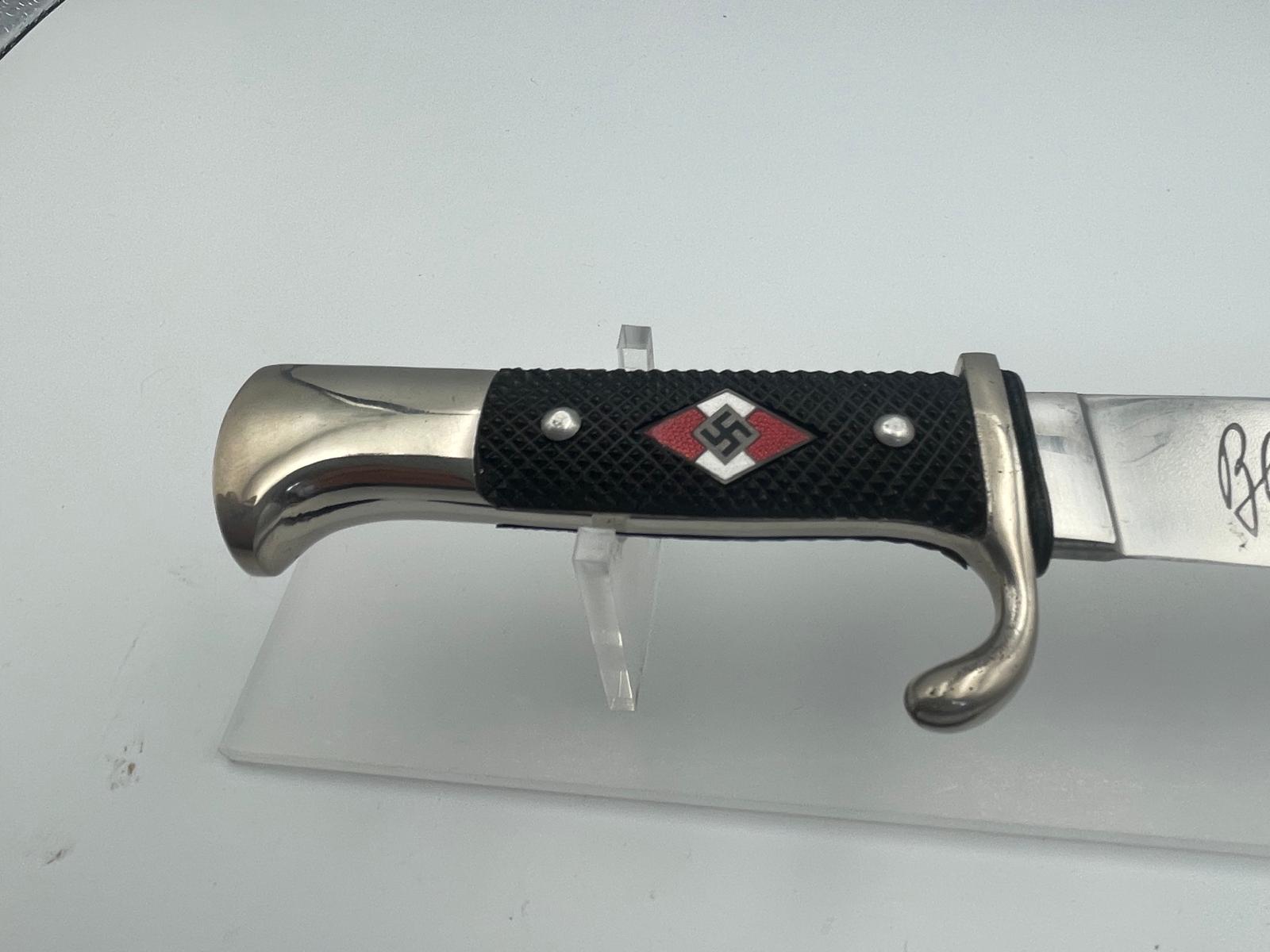
The obverse black grip contains the familiar enamel Hitler Youth diamond.
It consists of:
The emblem remains particularly attractive.
Its enamel retains good colour and definition.
Furthermore, the badge sits correctly within the shaped recess in the grip plate.
This original organisation emblem gives the knife its unmistakable HJ appearance.
Both grip plates use black composition material with the characteristic diamond-pattern chequering.
The texture remains crisp.
Two metal rivets secure each grip scale.
No major cracks or significant chips are visible in the supplied photographs.
Age-related wear remains modest.
Consequently, the grip presents considerably better than many heavily used HJ knives.
The hilt follows the established Model 1933 HJ knife form.
A bird’s-head style pommel finishes the upper section.
Meanwhile, the lower guard terminates in the familiar curved quillon.
The nickel-plated surface remains highly attractive.
Small handling marks and natural age toning can be seen on close inspection.
However, extensive corrosion or severe plating loss is absent.
The condition of the fittings complements the strong blade exceptionally well.
The knife retains its black-painted steel scabbard.
A substantial amount of the original dark finish survives.
The body appears straight, while the rounded lower section retains its proper profile.
Minor surface marks remain consistent with normal carrying and storage.
Importantly, the scabbard has not acquired the heavily restored appearance seen on many surviving HJ knife sets.
Its preservation works particularly well with the condition of the knife itself.
The scabbard also retains its leather carrying assembly.
The black leather belt loop remains attached to the scabbard.
In addition, the retaining strap and press-stud arrangement survive.
Natural surface creasing and age toning are visible.
The interior leather has developed the characteristic lighter brown colour associated with long-term ageing.
Complete HJ knives retaining their original carrying leather are more desirable than knife-and-scabbard combinations from which the hanger has been lost.
Millions of HJ knives were manufactured during the Third Reich period.
However, surviving condition varies dramatically.
Many examples encountered today suffer from:
The present Anton Wingen Hitler Youth knife avoids most of these weaknesses.
Instead, it combines:
1938 transitional production
Anton Wingen commercial trademark
RZM M7/51/1938 marking
strong Blut und Ehre motto
excellent grip diamond
attractive nickel fittings
original black scabbard
and
complete leather suspension
For these reasons, it sits above the average HJ Fahrtenmesser encountered on the collector market.
The available photographs provide a strong and coherent authentication profile.
Important positive characteristics include:
Most importantly, an extremely similar Anton Wingen M7/51/1938 motto-bearing knife is documented in a major specialist edged-weapons archive.
That direct comparison substantially strengthens the identification.
The HJ Fahrtenmesser appeared during the early years of National Socialist rule.
Its design drew heavily from the appearance of German military sidearms.
The United States Holocaust Memorial Museum notes that HJ knives reflected the increasingly paramilitary character of the organisation.
The knife became one of the most recognisable pieces of Hitler Youth equipment.
Early blades carried Blut und Ehre!.
Later production abandoned the motto and increasingly relied upon RZM-controlled markings.
Therefore, the present 1938 example captures an important transitional point between those two manufacturing phases.
Overall condition is very good to excellent collector condition.
The blade remains especially impressive.
Its original polish, crisp motto and strong markings provide excellent visual appeal.
Black grip plates retain their original texture.
Likewise, the enamel diamond remains attractive.
Nickel fittings show only modest age-related wear.
The scabbard retains substantial black finish.
Finally, the leather hanger remains complete but displays honest age and wear.
No restoration is recommended.
Polishing the fittings or blade would reduce the historical integrity of the piece.
Item: Hitler Youth Fahrtenmesser
Model: Model 1933
Production type: Transitional
Manufacturer: Anton Wingen Jr.
Location: Solingen
RZM code: M7/51
Date: 1938
Commercial trademark: Armoured knight
Blade motto: Blut und Ehre!
Grip: Black chequered composition
Grip insignia: Enamel Hitler Youth diamond
Hilt: Nickel-plated metal
Scabbard: Black-painted steel
Hanger: Original leather belt hanger and retaining strap
Condition: Very good to excellent
Rarity: Desirable late transitional version
Short ID: HJ-AW-M751-38
Explore related listings: Hitler Youth Knives & Edged Weapons; Original Hitler Youth Membership Badge RZM M1/52 by Deschler & Sohn – Numbered No. B 79642; https://nordmenn-militaria.com/.
Anton Wingen M7/51 1938 transitional HJ knife
https://www.lakesidetrader.com/item.php?ID=26749&location=Archives
This is the most important direct reference because the archived example carries the same maker, RZM code, 1938 date and Blut und Ehre! motto.
Anton Wingen Jr. RZM M7/51
https://www.lakesidetrader.com/Education/Maker-Mark/Anton-Wingen-Jr-Solingen-RZM-M7-51/
This reference documents Anton Wingen’s manufacturer history and RZM designation.
Anton Wingen HJ Fahrtenmesser
Helmut Weitze catalogue reference, item 524815
Hitler Youth knife museum reference
https://encyclopedia.ushmm.org/content/en/artifact/hitler-youth-knife-and-case
Anton Wingen Jr. of Solingen manufactured the knife.
The RZM code M7/51 confirms the maker.
The reverse blade is dated 1938.
It combines the later RZM code and date with the earlier Blut und Ehre! blade motto.
This combination belongs to the transitional production period.
Yes.
M7/51 is the documented RZM manufacturer code for Anton Wingen Jr., Solingen.
It is Anton Wingen’s armoured-knight commercial trademark.
It translates as Blood and Honour.
The phrase served as a Hitler Youth motto.
The motto was discontinued during 1938.
Therefore, dated 1938 motto-bearing examples represent the final period of this early feature.
The photographs show period-style enamel, correct construction and age consistent with the rest of the knife.
The scabbard’s form, finish and wear are consistent with an original HJ knife scabbard.
Yes.
The belt loop and retaining strap remain with the scabbard.
Original Transitional Hitler Youth Fahrtenmesser Model 1933 – Anton Wingen Jr., Solingen – RZM M7/51/1938 – Armoured-Knight Commercial Trademark – Original “Blut und Ehre!” Motto – Enamel HJ Diamond – Black Steel Scabbard – Original Leather Hanger – Very Good to Excellent Condition