
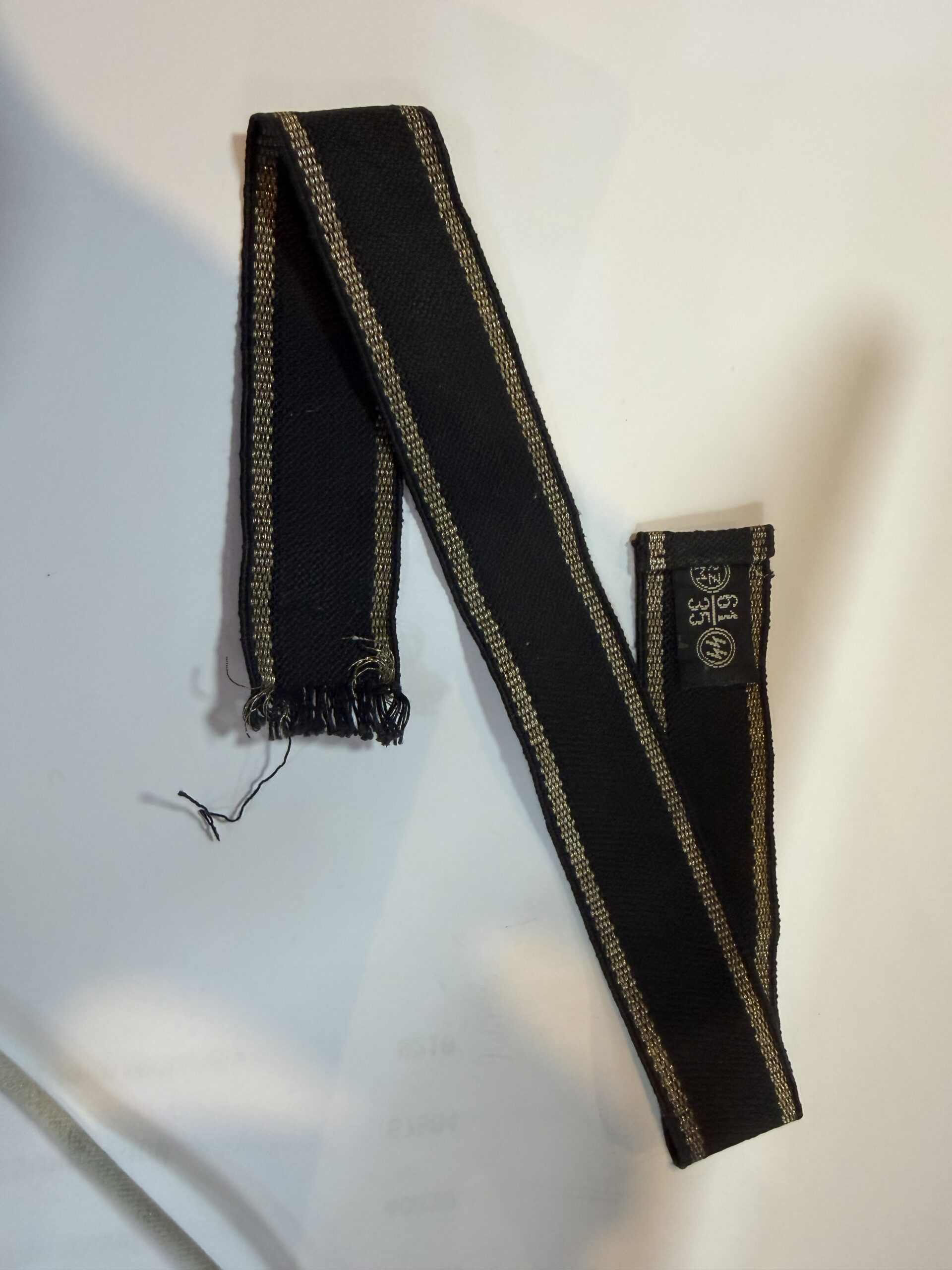
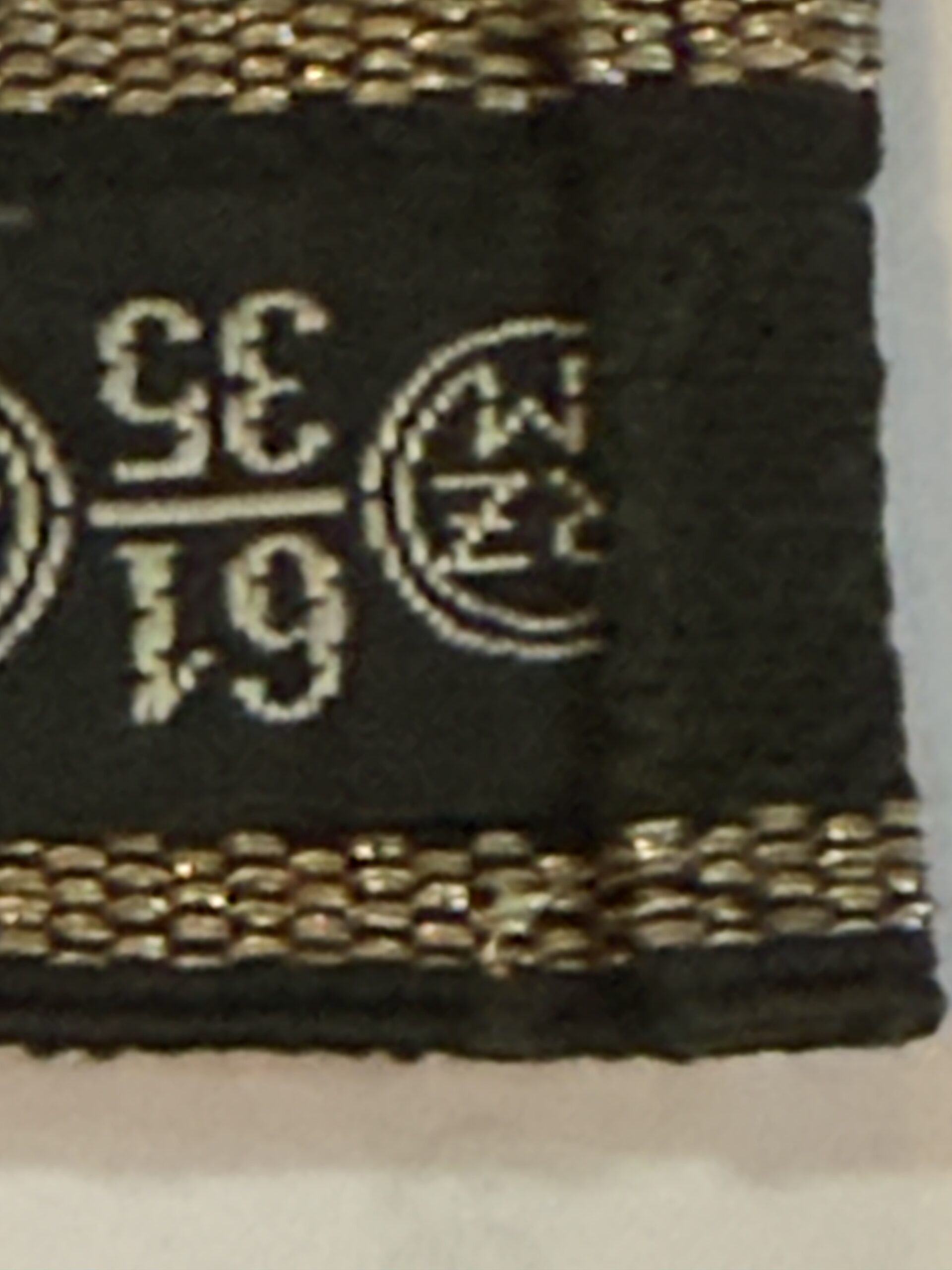
Original period blank SS cuff title with a dense black RZM-pattern body, approximately seven-row silver-aluminium borders and a surviving woven RZM 61/35 SS label. The title was removed from a uniform and retains honest fraying and attachment threads. Although strongly compatible with regional SD staff use, the blank form also served certain Allgemeine-SS Standartenstab and Reserve-Sturmbann appointments.
€ 1.550
1 in stock
This original blank SS cuff title is a scarce, uniform-removed example of early SS cloth insignia. It features a dense black woven body, narrow silver-aluminium borders and a surviving woven RZM 61/35 SS label. Moreover, the opened end retains frayed threads and visible evidence of earlier sleeve attachment.
The central field carries no wording, numeral or unit designation. Therefore, the band belongs to the distinctive group of blank SS staff cuff titles. Collectors frequently associate this pattern with regional Sicherheitsdienst personnel. However, the same design also served several Allgemeine-SS staff appointments.
Consequently, this example should be catalogued as a blank SS or SD staff-pattern cuff title. An exclusive SD attribution would require its original tunic, an associated SD sleeve diamond or documented wearer provenance.
SS cuff titles appeared on the lower left sleeve. They identified a unit, formation, office or specialist appointment. Early RZM-pattern examples used prepared black band material with woven metallic borders. Manufacturers then added wording or numerals when regulations required them.
A deliberately blank band carried a separate meaning. Surviving attributed SD uniforms document black cuff titles with seven-thread silver-aluminium borders. For example, the published Hermann Historica Dave Delich collection includes an SD officer’s black service uniform with a machine-applied blank seven-thread title and an accompanying SD sleeve diamond.
The SD, or Sicherheitsdienst, acted as the intelligence service of the SS and Nazi Party. During the Nazi period, it became increasingly involved in political persecution, anti-Jewish policy and the crimes of the Einsatzgruppen. The United States Holocaust Memorial Museum provides detailed historical context concerning the organisation and its role.
Nevertheless, blank titles were not unique to the SD. Specialist uniform references record that, from June 1937, men and officers below SS-Standartenführer serving on a Standarte staff wore blank silver-bordered titles. In addition, members of a Reserve-Sturmbann staff used the same blank configuration.
Therefore, this title has three principal possible applications:
The strongest possible attribution is regional SD service. Known uniforms show the same combination of a plain black centre and narrow silver-aluminium borders.
On a complete SD uniform, the separate SD sleeve diamond would normally provide decisive branch identification. Collar insignia, tailoring details and a named interior label might offer further confirmation. However, this loose title no longer retains those associated features.
The absence of an inscription does not make the cuff title incomplete. In the regional SD application, the blank centre formed the intended design. Furthermore, no obvious stitch ghosts, pulled fibres or shadowing suggest that wording was removed from this example.
The central field appears continuously woven and undisturbed. Therefore, the title was most probably manufactured and worn in its present blank configuration.
The alternative Allgemeine-SS applications remain equally important.
From June 1937, officers holding the rank of SS-Standartenführer or above could wear a title carrying the Arabic number of their Standarte. By contrast, men and officers below that rank serving on the same Standarte staff wore a blank silver-bordered cuff title.
The later Sturmbann system also distinguished staff appointments. Personnel on an ordinary Sturmbann staff wore silver-bordered titles carrying a Roman numeral. However, staff personnel assigned to a Reserve-Sturmbann wore a blank title with silver borders.
Consequently, the blank SS cuff title cannot identify a particular rank, Standarte, district or wearer by itself. The RZM label also provides no branch information. Even so, its construction remains correct for these documented staff applications.
The reverse retains an important black woven label. It displays:
Standard woven RZM/SS labels placed the manufacturer or production code above the final two digits of the manufacturing year. Accordingly, 35 indicates 1935, while 61 represents the manufacturer or production code. It is not a personal service number or unit designation.
The label does not prove SD use. Likewise, it cannot identify a Standarte, Reserve-Sturmbann or geographical command. It records controlled production rather than the title’s eventual wearer.
A 1935 production date does not prevent later issue. Tailors, uniform depots and units could retain prepared RZM band material before applying it to a garment. Therefore, a band manufactured in 1935 could have entered service after the June 1937 staff regulations.
Modern copies of the exact 61/35 label exist. For that reason, no responsible authentication should rely on the label alone. The textile weave, metallic borders, label attachment, oxidation, sewing and wear must form one coherent object. Reproduction dealers openly sell new 61/35 labels, while specialist militaria dealers identify this particular label as one of the frequently copied SS textile markings.
In this example, the label should be assessed as part of the whole title. Its position, weave and apparent age relationship with the surrounding material are more important than the numbers alone.
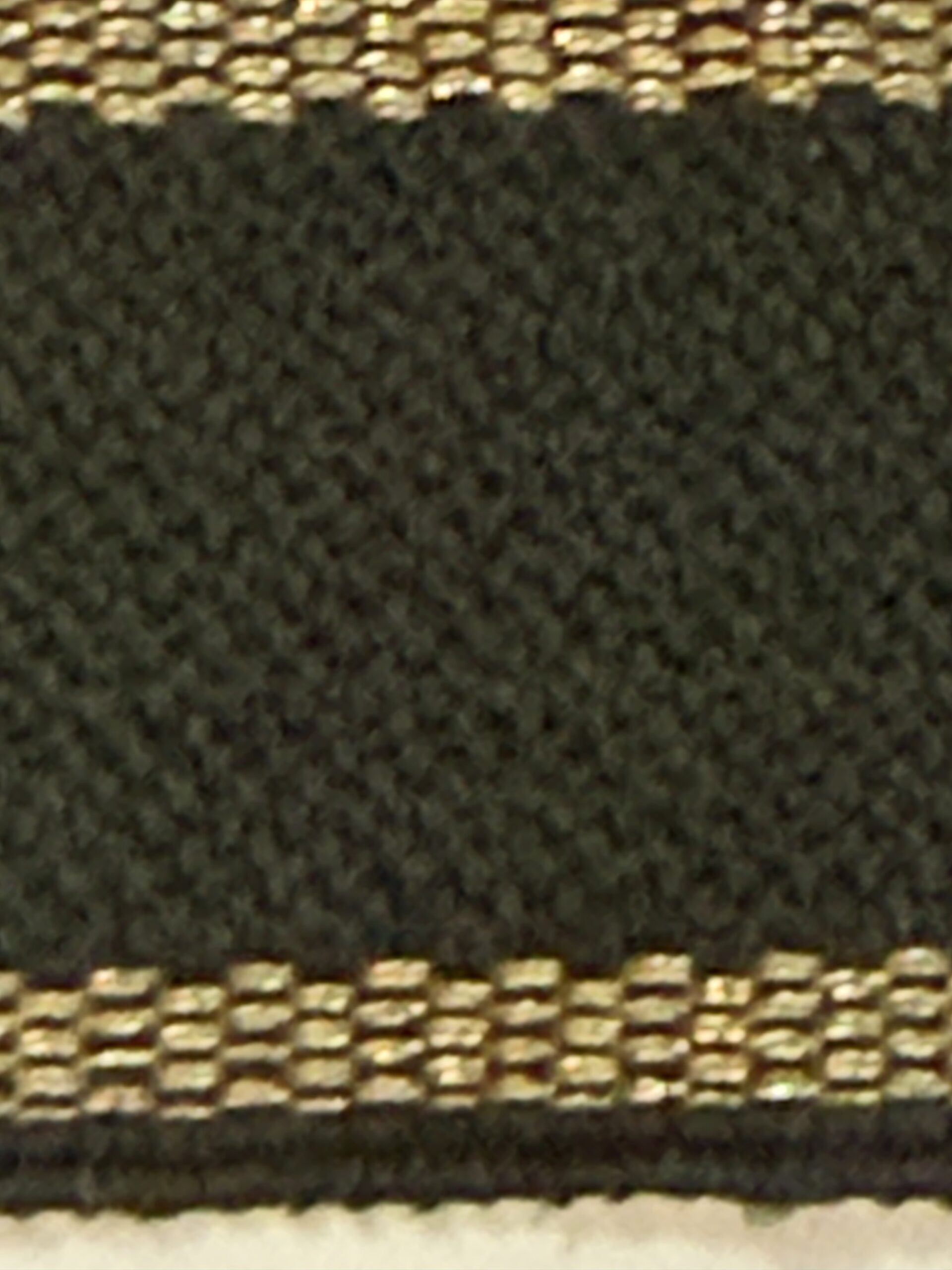
The black body has a compact woven structure with a fine diagonal surface. This creates the dense, slightly textured appearance associated with early RZM cuff-title band material.
Both long edges carry approximately seven rows of metallic thread. The border is woven into the structure rather than added as a separate length of braid. This construction corresponds with documented early RZM-style cuff titles, which commonly used six or seven metallic border threads.
The metallic borders now display an attractive silver-grey to warm bronze patina. Age, oxidation and wear to the original surface can create this variation. Moreover, the colour changes appear irregular rather than artificially uniform.
The central black field remains strong and well defined. No obvious modern synthetic sheen appears in the supplied photographs. Likewise, the band does not show a modern heat-sealed cut.
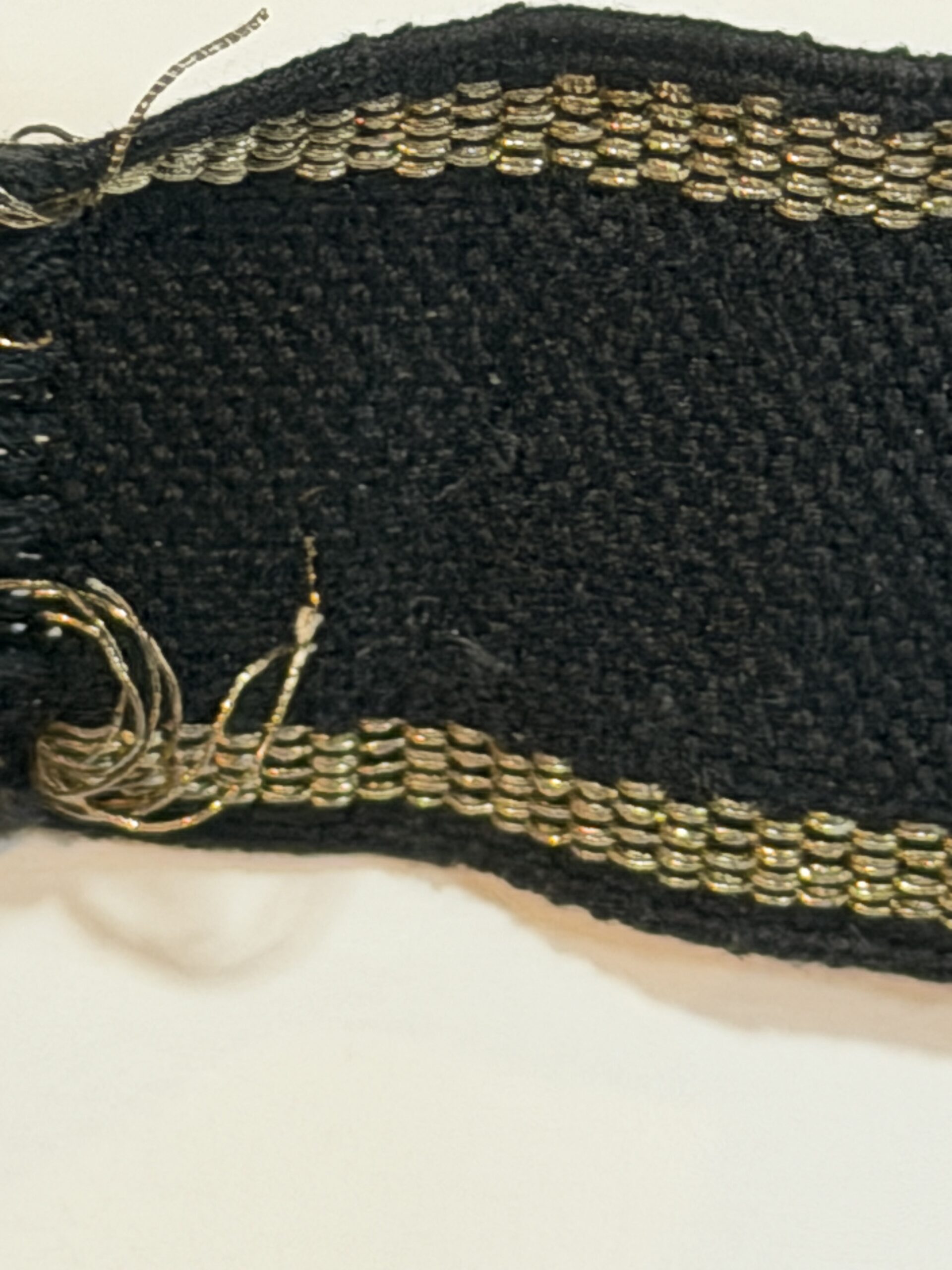
This blank SS cuff title displays convincing evidence of removal from a uniform.
One end remains folded and finished. By contrast, the opposite end is open and frayed. Loose black threads survive at the opened end, together with displaced strands from the metallic borders.
These features are consistent with a cuff title that was opened or cut when removed from a sleeve. They also give the piece genuine service character, which many collectors prefer over untouched surplus stock.
The black woven field remains stable. Furthermore, the metallic borders retain their complete visual form along most of the surviving length. The woven RZM label remains legible and securely associated with the finished end.
No attempt should be made to trim the loose threads, straighten the frayed metallic strands or clean the textile. Such treatment would remove useful historical evidence and reduce collector value.
The submitted photographs show several positive characteristics:
Taken together, these features support a pre-1945 assessment. The title presents as an original period-manufactured band with genuine uniform-removal characteristics.
Nevertheless, the surviving label should not act as the sole guarantee. A final unconditional certificate should include in-hand examination under magnification. Ultraviolet screening, fibre comparison and inspection of the label’s reverse weave would provide further supporting evidence.
The most accurate authentication conclusion is:
Original early RZM-pattern blank SS cuff title with woven RZM 61/35 SS label, manufactured circa 1935 and subsequently removed from a uniform. Compatible with regional SD staff wear and documented Allgemeine-SS staff applications. Exact branch and wearer attribution remain unconfirmed.
A labelled and worn blank SS cuff title offers more historical character than an anonymous piece of unused band stock. Its possible SD association places it within a specialised area of security-service uniform research.
At the same time, the Standartenstab and Reserve-Sturmbann applications broaden its Allgemeine-SS significance. The title therefore illustrates how one apparently simple insignia could represent several staff functions.
The surviving 1935 RZM label adds early production interest. Moreover, the undisturbed black centre preserves the title’s intended blank appearance. These combined qualities make it suitable for an advanced cloth-insignia collection, research archive or carefully interpreted museum display.
Collectors can explore further examples in our SS Cuff Titles collection. Related administrative insignia include the Original SS-Inspektion Cuff Title and the Original SS-Hauptamt Officer Cuff Title.
The Original Allgemeine-SS Officer’s Black Visor Cap also provides useful uniform context for displaying early black SS insignia.
This historical artefact is offered solely for collecting, preservation and academic study. Its sale does not endorse the ideology, organisations or crimes associated with National Socialism.
| Feature | Description |
|---|---|
| Organisation | Schutzstaffel, with possible SD or Allgemeine-SS staff application |
| Period | Third Reich period; woven label dated 1935 |
| Type | Blank RZM-pattern staff cuff title |
| Body | Dense black woven textile |
| Borders | Approximately seven rows of silver-aluminium thread at each edge |
| Inscription | None; apparently manufactured as a blank title |
| Label | Woven RZM 61/35 SS label |
| Condition | Worn and uniform removed |
| Removal evidence | Open frayed end, loose attachment threads and displaced border strands |
| Possible application | Regional SD staff, Standartenstab or Reserve-Sturmbann staff |
| Exact attribution | Unconfirmed without original uniform or wearer provenance |
| Length | 41 cm |
The Bundesarchiv guide to SS records identifies major surviving SS and Reich Security Main Office holdings. These include the important R 58 Reichssicherheitshauptamt collection.
The United States National Archives guide to Nazi Party and SS records lists captured record groups including T175, covering the Reichsführer-SS and Chief of German Police, and T354, which includes SS-Oberabschnitt records.
These archives can support organisational or named-wearer research. However, neither archive maintains a serial-number register for individual surviving cuff titles. Therefore, 61/35 cannot be traced to one wearer.
It is fully compatible with documented SD uniform use. Surviving attributed SD tunics carry the same blank black band with seven-thread silver-aluminium borders. However, the blank form was not exclusive to the SD.
After June 1937, men and officers below SS-Standartenführer serving on an Allgemeine-SS Standarte staff could wear this pattern. Reserve-Sturmbann staff personnel also used blank silver-bordered cuff titles.
The number 61 represents the manufacturer or production code. The number 35 indicates manufacture in 1935. It does not identify a wearer, rank, unit or SD office.
The central field shows no obvious stitch ghosts or damage from removed embroidery. Therefore, the evidence supports manufacture and wear as an intentionally blank title.
Yes. The open frayed end, retained black threads and disrupted metallic border strands strongly support uniform removal.
The visible weave, border construction, woven label, oxidation and coherent wear support period manufacture. As with every valuable SS textile, final certification should include careful in-hand examination.