
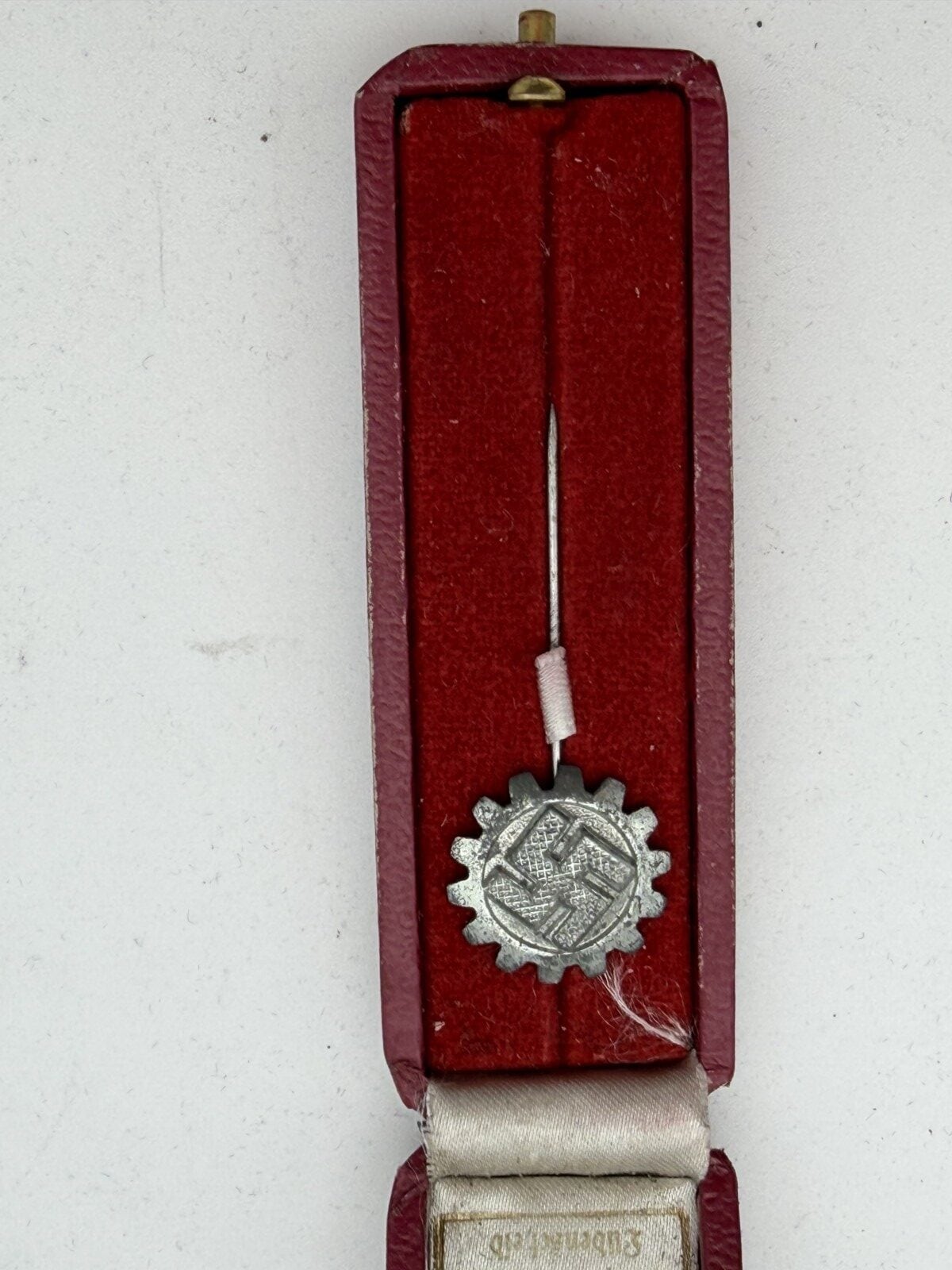
Original Deutsche Arbeitsfront membership stickpin featuring the DAF cogwheel and swastika emblem on a long metal lapel pin. The badge comes inside a fitted red case bearing a faded Otto Schickle, Pforzheim label. An unusual cased example with attractive age toning and considerable historical interest.
€ 100
1 in stock
This original cased DAF membership stickpin displays the distinctive Deutsche Arbeitsfront cogwheel and swastika emblem. A long, straight metal pin supports the silver-coloured device. Most importantly, the accompanying narrow red case retains an interior label for Otto Schickle, Pforzheim.
The complete presentation makes this example substantially more appealing than the loose DAF membership pins normally encountered. Although the exterior shows age and storage wear, the fitted red velvet interior still displays the stickpin effectively.
The circular device takes the form of a fourteen-tooth cogwheel. A raised swastika fills the centre, while fine cross-hatched texture covers the recessed background.
Strong definition remains throughout the design. In particular, the cogwheel teeth retain their shape, and the raised central emblem remains clear. Furthermore, natural toning and minor surface wear give the metal an appropriately aged appearance.
The emblem sits on a long, straight stickpin suitable for wear through a civilian lapel. A small section of pale thread surrounds the lower part of the shaft. This thread may have helped secure the pin inside the case and should remain in place unless closer examination proves otherwise.
Specialist dealer Richter Historica documents the same general type of DAF membership badge mounted on a long pin. Compare the design with this documented DAF membership stickpin.
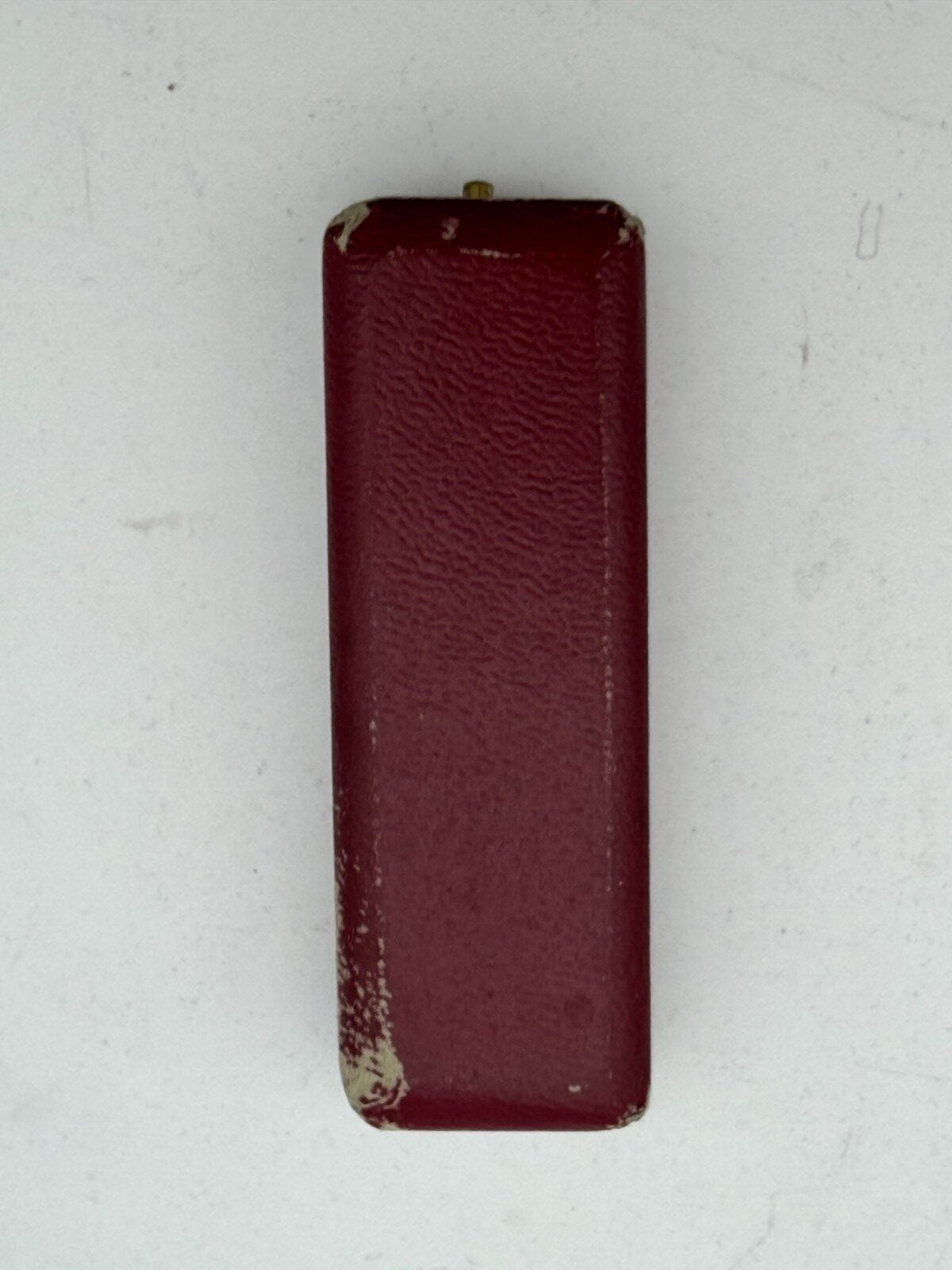
A long red fitted case accompanies the cased DAF membership stickpin. Its exterior has a textured covering, rounded corners and a brass-coloured release button.
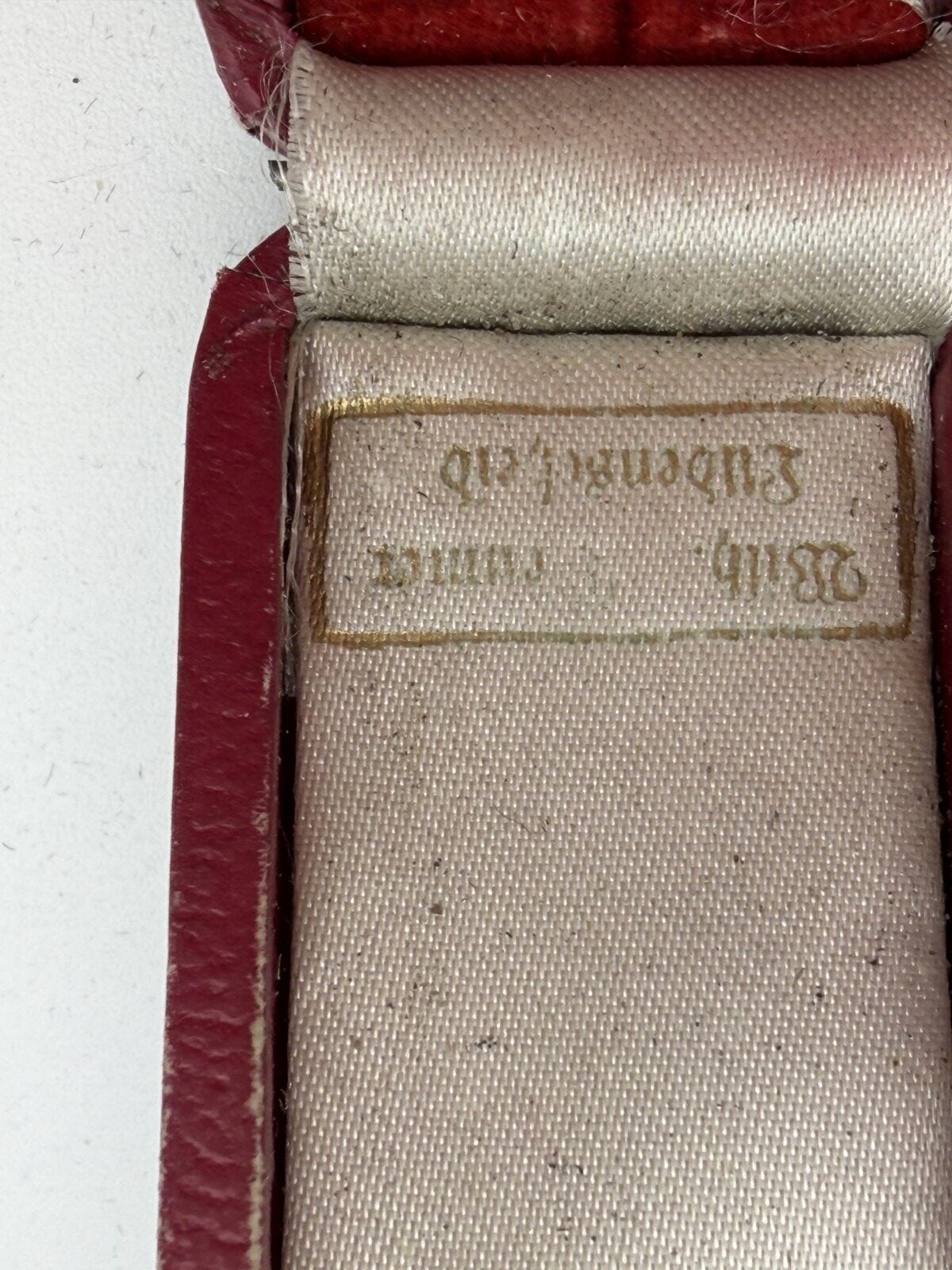
Inside, red velvet-covered supports hold the pin securely. Light-coloured woven fabric lines the hinged section. In addition, a faded gold-bordered label appears inside the case.
The label reads:
Otto Schickle
Pforzheim
Otto Schickle operated as a recognised Pforzheim manufacturer of German orders, decorations and badges. The company produced numerous military and political awards during the Third Reich period.
However, the label identifies the case rather than conclusively proving the manufacturer of the stickpin. No reverse photograph showing an RZM code or maker’s mark accompanies the present images. Therefore, the safest catalogue wording remains:
“DAF membership stickpin contained in an Otto Schickle, Pforzheim-labelled case.”
The listing should not describe the badge itself as maker-marked by Otto Schickle unless a clear reverse mark confirms that attribution.
The National Socialist regime established the Deutsche Arbeitsfront, commonly abbreviated as DAF, on 10 May 1933. The organisation replaced Germany’s independent trade unions and placed both workers and employers under central state control.
Robert Ley led the organisation throughout its existence. By the late 1930s, the DAF had become one of the largest organisations within Nazi Germany.
Its cogwheel represented labour and industry. Meanwhile, the central swastika connected the organisation directly to the NSDAP and the National Socialist state.
Members wore small badges or stickpins with civilian clothing to indicate their affiliation. Different manufacturers produced these pieces in several materials, finishes and fastening configurations. Consequently, collectors now encounter enamelled badges, plain metal versions, short pins and longer lapel stickpins.
The Imperial War Museum identifies the cogwheel surrounding a swastika as the principal DAF emblem. View a period DAF object in the Imperial War Museum collection.
Helmut Weitze also maintains an extensive specialist reference section covering original DAF membership pins and related insignia. Compare further Deutsche Arbeitsfront badges at Helmut Weitze.
The cased DAF membership stickpin remains in good original condition.
Clear detail survives across the cogwheel and central emblem. The metal displays age toning, minor rubbing and small surface marks. Nevertheless, no major distortion appears in the photographs.
Its long pin remains present and largely straight. The pale thread around the lower shaft shows some fraying but appears old.
External wear affects the red case more noticeably. Losses appear around the corners and edges, while the surface carries scratches and handling marks. Internally, the red velvet remains bright, although loose fibres, dust and small marks show normal age.
The Otto Schickle label has faded considerably. Even so, enough lettering survives to identify both the company and Pforzheim location.
The visible construction appears consistent with a period DAF lapel stickpin. Positive features include:
However, the available photographs do not show the reverse of the emblem. A reverse photograph should reveal whether the badge carries an RZM code, manufacturer’s mark or Ges. Gesch. marking.
For that reason, the safest originality statement reads:
“The visible features support period manufacture, although examination of the reverse remains necessary to record any maker or RZM marking.”
Most standard DAF membership pins reach the market without packaging. In contrast, this cased DAF membership stickpin retains an unusual period jeweller’s case with an identifiable Pforzheim label.
The presentation case provides the principal collector premium. Moreover, its Otto Schickle label connects the set to one of Pforzheim’s recognised award manufacturers.
Explore further NSDAP and political organisation badges at Nordmenn Militaria.
Alternatively, browse the complete Nordmenn Militaria collection.