
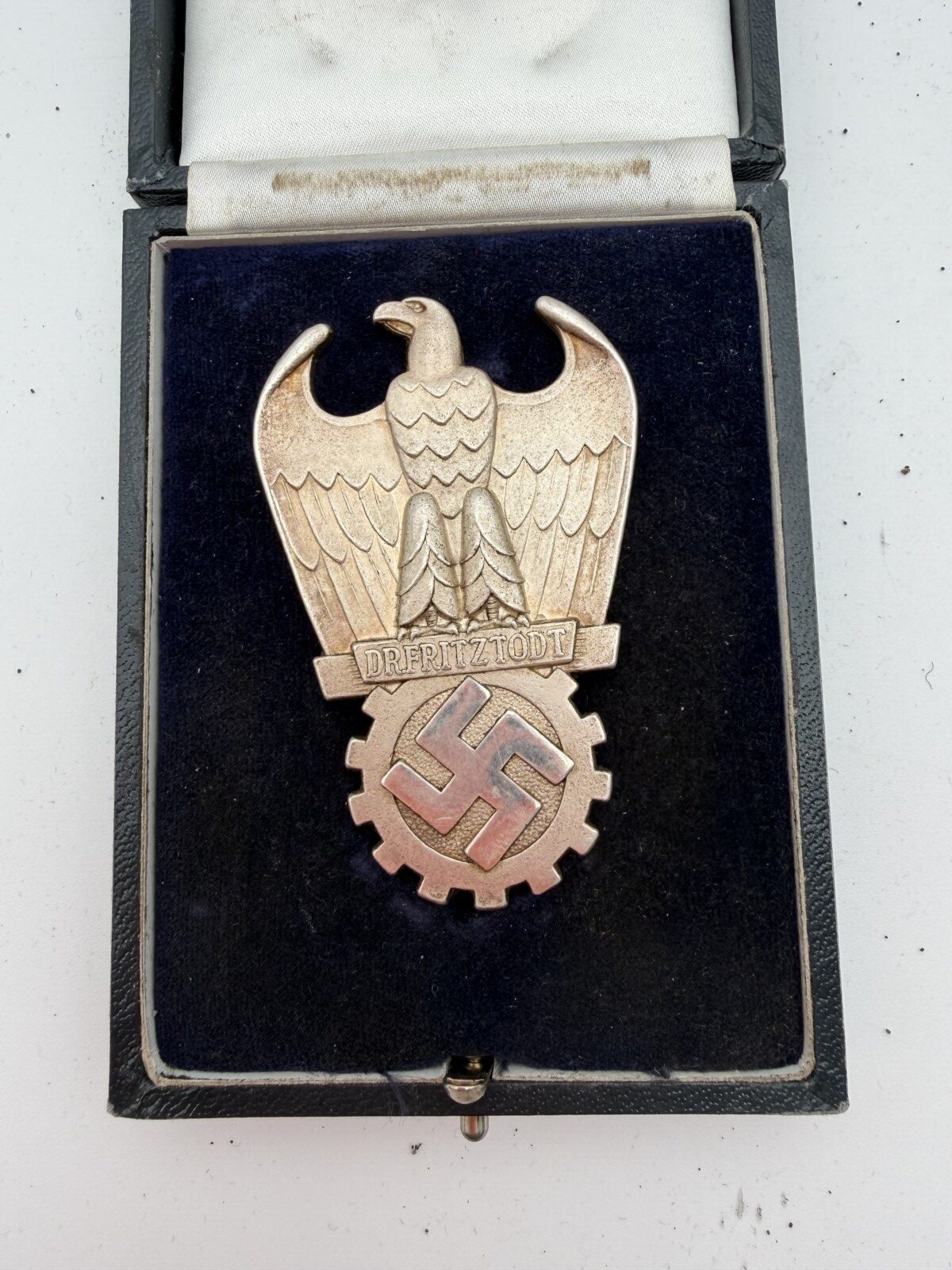
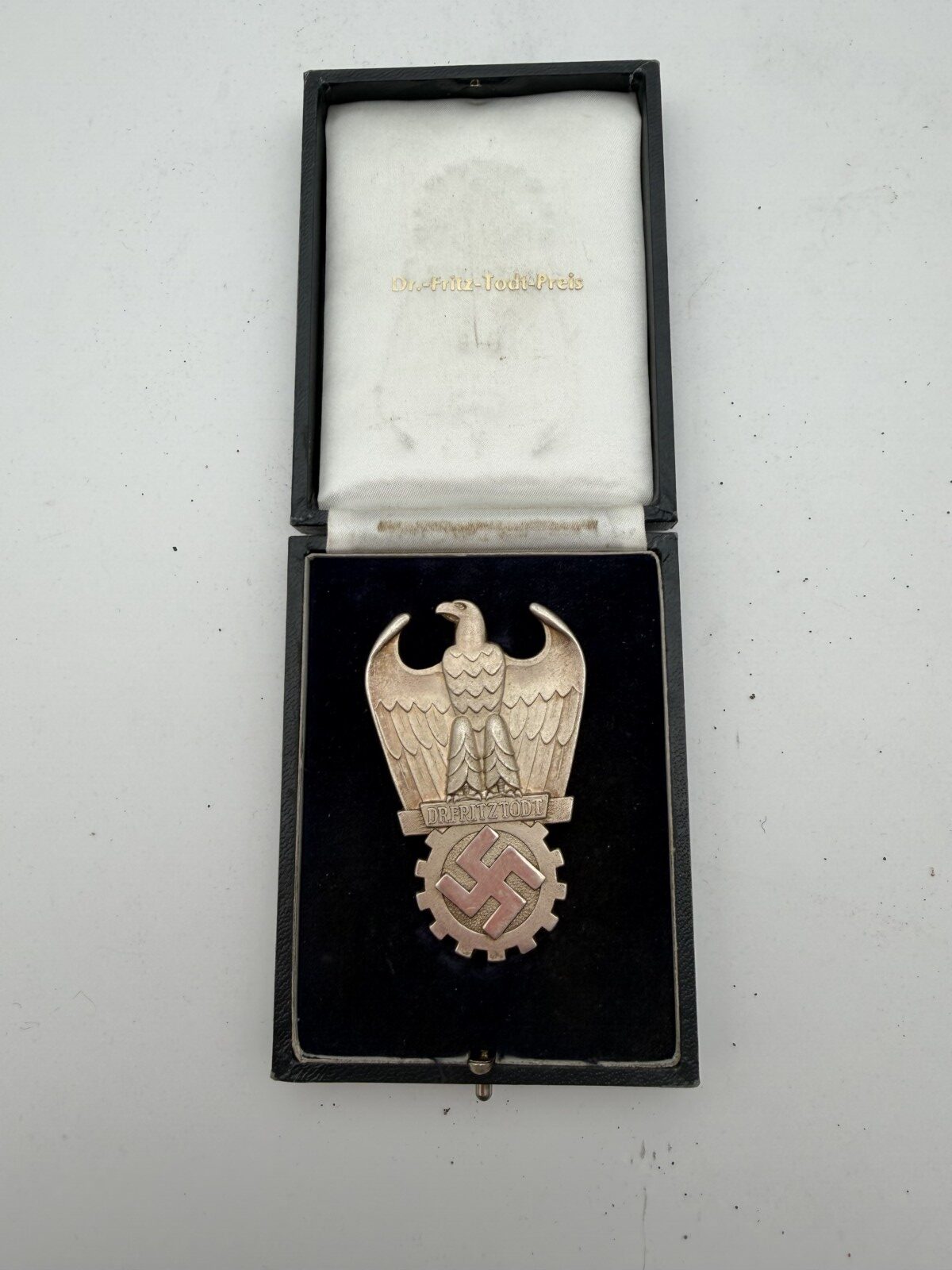
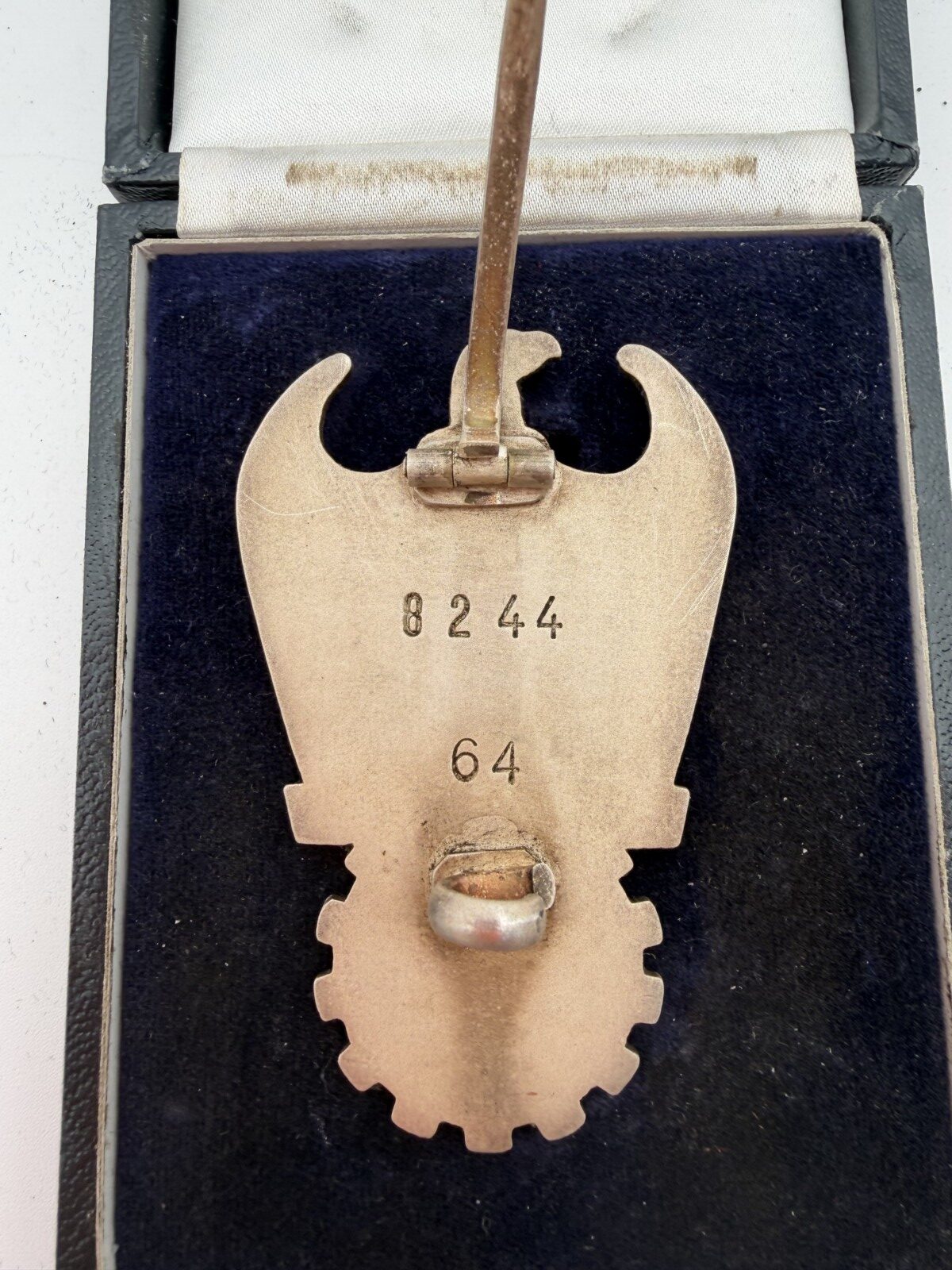
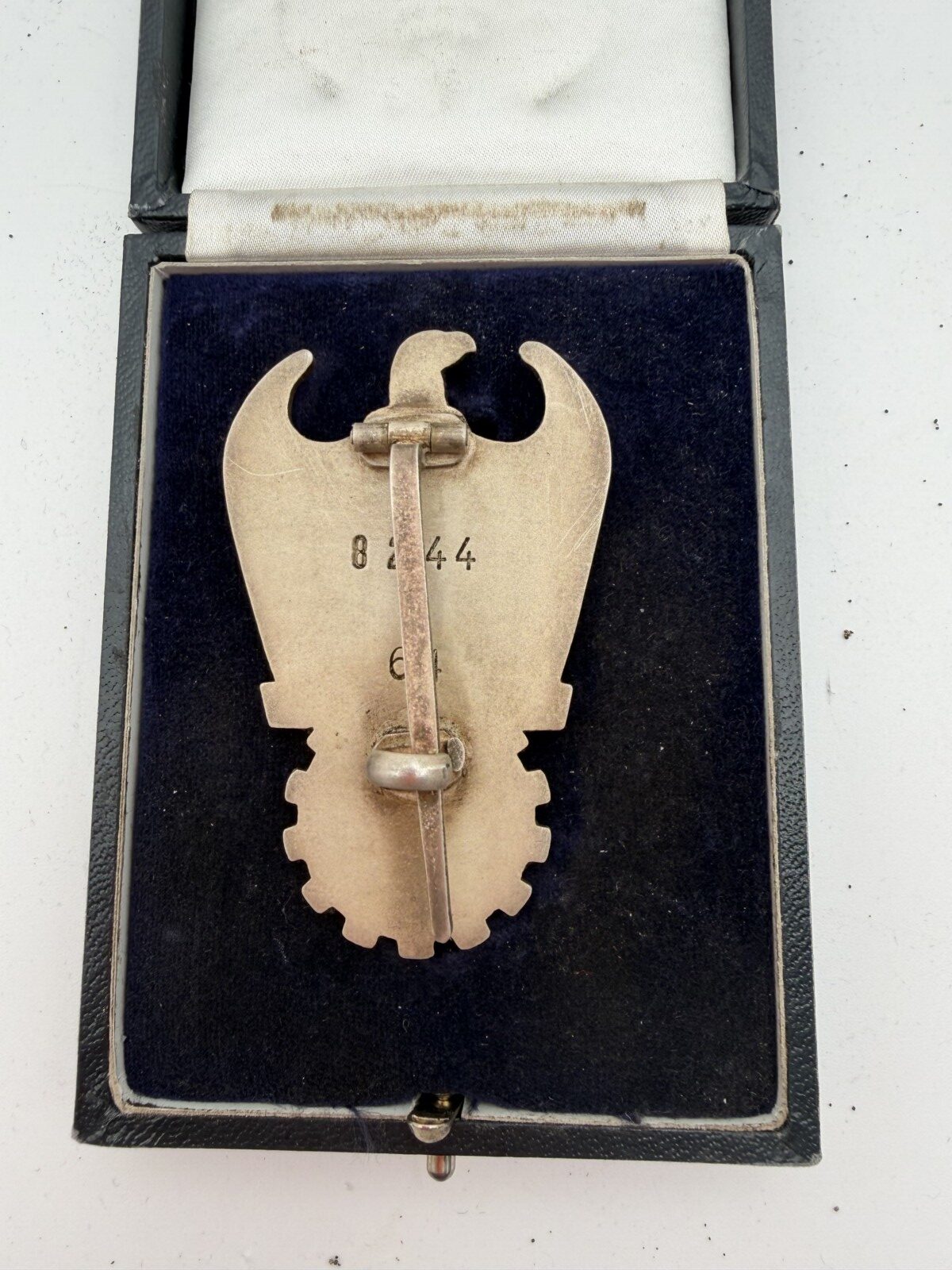
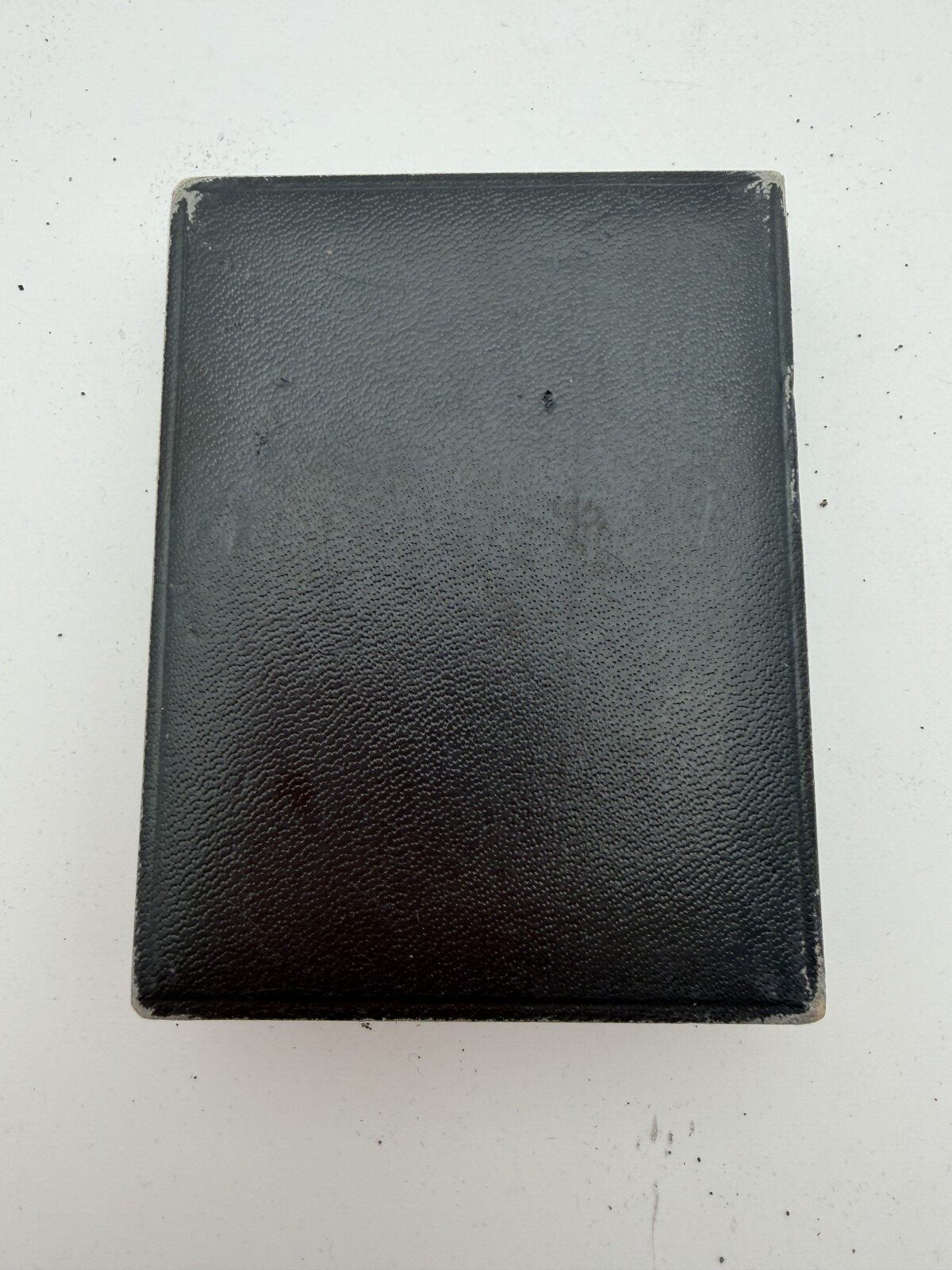
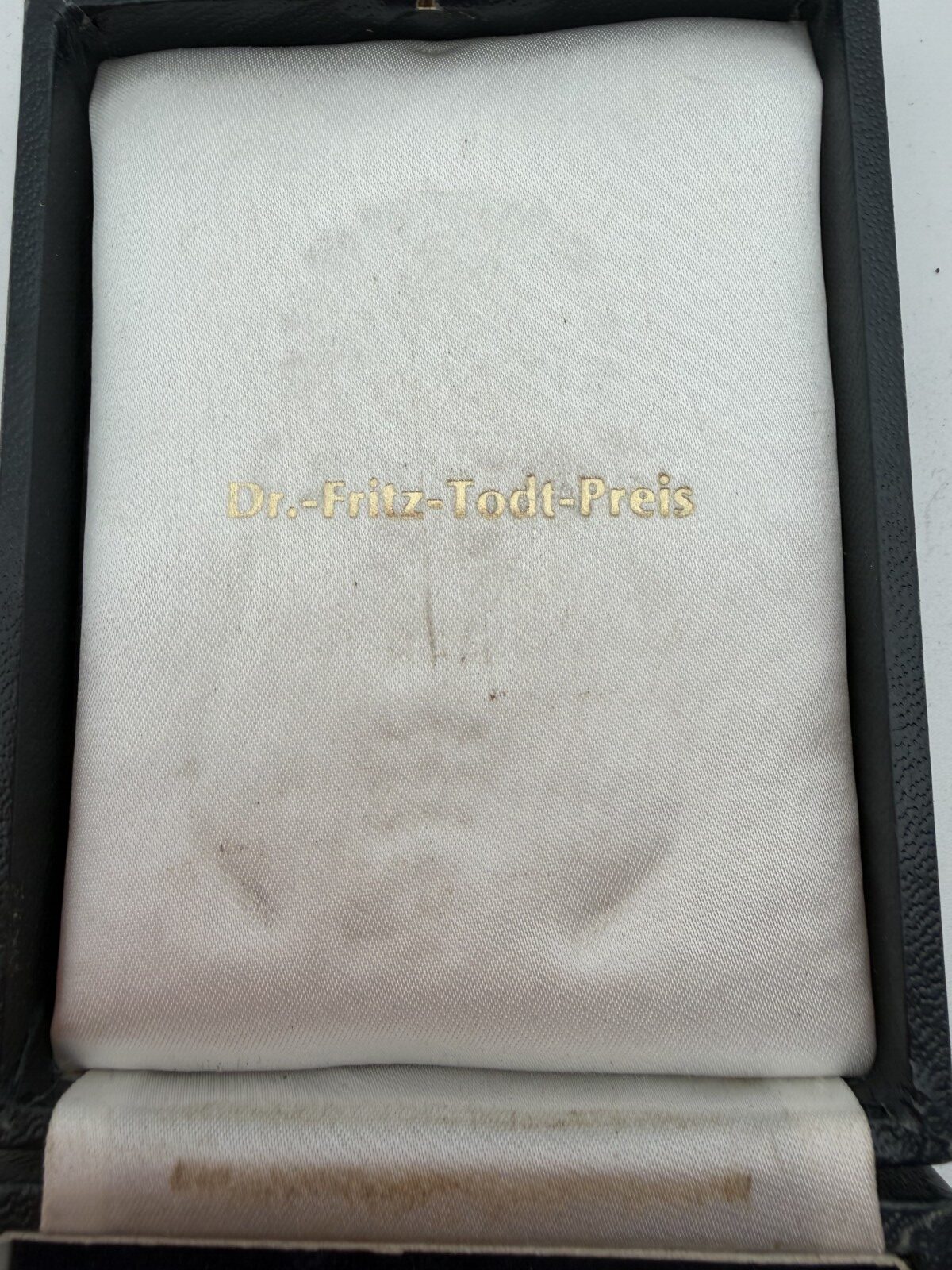
Exceptionally rare original Dr Fritz Todt Prize in Silver No. 64, dated 8 February 1944 and complete with its original fitted presentation case. Measuring 64 × 39.62 mm and weighing 33.5 g, the badge is consistent with fine-zinc construction and appears to have lost most of its original silver finish. The reverse is individually stamped 8244 / 64, indicating the first award date and award number 64. A highly desirable numbered example with the original recipient currently under archival research.
€ 2.950
1 in stock
This Dr Fritz Todt Prize in Silver No. 64 is an exceptionally rare, individually numbered example of the German technical and industrial award instituted during the Second World War.
The badge retains its original fitted presentation case and carries the important reverse markings:
8244
64
The upper number represents the date 8 February 1944, the date of the first presentations of the Dr Fritz Todt Prize. The lower 64 is consistent with an individual Verleihungsnummer, or award number.
Most importantly, this example has now been physically measured and weighed.
Height: 64.00 mm
Width: 39.62 mm
Weight: 33.5 g
Maker mark: None visible
Pin marking: None
These measurements strongly support a fine-zinc or zinc-alloy construction, rather than solid silver.
The obverse features a large stylised German eagle above the cogwheel emblem associated with the German Labour Front.
Across the eagle appears the raised inscription:
DR FRITZ TODT
A large swastika occupies the centre of the cogwheel below.
The die work remains well defined. Individual feather details survive across the wings and breast, while the lettering remains sharp and clearly legible.
Furthermore, the surfaces display an attractive untouched warm patina consistent with considerable age.
The reverse is particularly important because it carries two separately struck number groups.
The first reads:
8244
This corresponds to 8 February 1944.
The second reads:
64
Documented numbered Todt Prize badges establish that such lower numbers were used as individual award numbers.
For example, Helmut Weitze documents an extremely rare Silver first-model badge stamped 8.2.44 / 57. Weitze specifically identifies 57 as its Verleihungsnummer.
An even closer numerical comparison appears in the Wormser auction archive. Wormser sold a Silver Todt Prize manufactured in zinc and stamped:
8244 / 56
Only eight numbers separate that documented example from the present No. 64. Wormser described No. 56 as a probable contemporary original.
Consequently, the markings on this badge fit convincingly within the known system of early numbered awards.
Earlier examination raised the question of whether this badge might possibly be made from silver because its surface displays a warm champagne tone rather than the familiar grey appearance of exposed zinc.
The confirmed weight now makes that interpretation highly unlikely.
At:
64 × 39.62 mm and 33.5 g
the badge falls comfortably within the weight range expected from zinc construction.
Ratisbon’s documents an original Silver Todt Prize measuring 65.7 × 41.9 mm and weighing 37.6 g. That example is explicitly recorded as zinc and retains approximately 95% of its original silver finish.
Helmut Weitze also describes its standard second-model Silver badge as:
Feinzink versilbert — silver-plated fine zinc.
Weitze attributes that version to C. F. Zimmermann of Pforzheim.
Therefore, the present No. 64 should presently be catalogued as:
fine zinc / zinc-alloy construction, originally issued as the Silver grade, with the original silver finish now largely or almost completely depleted.
That description is considerably safer than suggesting solid-silver construction.
Although little obvious bright silvering remains today, this is not unusual for genuine zinc awards of this period.
Ratisbon’s specifically comments that the silver finish on these badges is frequently faded away. Its 37.6 g example is notable precisely because approximately 95% of its original silvering survives.
On No. 64, the remaining surface now displays shades of champagne, pale bronze and grey-brown.
Importantly, the badge should not be cleaned or polished.
Any microscopic surviving silver finish could provide useful evidence during future XRF examination.
The reverse retains its complete long vertical pin.
No maker’s mark appears on the pin.
This absence does not automatically create an authenticity concern because genuine Todt Prize badges are documented without maker markings.
Ratisbon’s zinc Silver example is specifically described as having no maker’s mark.
Conversely, Weitze’s numbered first-model No. 57 carries 21 inside the pin, corresponding to Gebrüder Godet & Co., Berlin.
Therefore, production differences clearly existed.
I would not attribute No. 64 positively to Godet or Zimmermann unless further evidence emerges.
The fitted presentation case substantially increases the desirability of this example.
Its exterior retains the correct black textured covering. Age-related rubbing appears around the corners and edges, while the original sprung closure remains present.
Inside, a dark velvet-covered fitted base holds the award.
The lid retains its pale silk lining with the gold inscription:
Dr.-Fritz-Todt-Preis
Natural age spotting and staining are visible within the silk.
Rather than detracting from the case, these features contribute to its convincing untouched appearance.
Complete cased examples are substantially more desirable than loose Todt Prize badges.
The Dr Fritz Todt Prize was established on 12 November 1943 and named in memory of engineer and Reich minister Fritz Todt.
Todt had served as General Inspector for German Roads and later became Reich Minister for Armaments and Munitions. He died in an aircraft accident on 8 February 1942.
The award recognised technical inventions and improvements considered important to Germany’s wartime economy.
Three grades existed:
Gold, Silver and Steel.
The first presentations occurred on 8 February 1944, exactly matching the date stamped onto No. 64.
Technical achievements relating to armaments, ammunition, military equipment, raw-material savings, labour efficiency and energy consumption could qualify for consideration. Weitze records the original monetary awards as 50,000 Reichsmark for Gold, 30,000 RM for Silver and 10,000 RM for Steel.
The most significant comparison is not merely another Todt Prize. It is another numbered Silver award from the same first award date.
Helmut Weitze’s No. 57 carries:
8.2.44 / 57
and is described as an extremely rare first-model Silver award.
Wormser’s zinc example carries:
8244 / 56
and was catalogued as a likely contemporary original.
The present badge carries:
8244 / 64
Therefore, No. 64 falls only seven numbers above Weitze’s No. 57 and eight numbers above Wormser’s No. 56.
That relationship is an important positive feature.
Nevertheless, the different inscription and hardware variants mean that I would not claim all three necessarily came from the same manufacturer or production batch without documentary evidence.
The original recipient remains unidentified.
However, the individual award number gives this example an important research advantage over an anonymous unnumbered badge.
We know from documented surviving groups that Todt Prize numbers were associated with individual awards and paperwork. Therefore, there remains a realistic possibility of connecting Silver No. 64 with its original engineer, inventor or technical specialist through surviving archival documentation.
Research should concentrate on the first presentations of 8 February 1944 and surviving name lists and allocation records.
Until documentary evidence is located, the catalogue should state:
Recipient: presently unidentified – archival research continuing.
That is more defensible than attempting to attach a speculative name.
Following comparison with Weitze, Wormser and Ratisbon’s examples, I regard this badge as a strong candidate for genuine wartime manufacture.
The strongest points include the convincing die work, individually struck 8244 / 64 markings, appropriate zinc-range weight, period-style broad pin, convincing hinge and catch, age-consistent surfaces and matching fitted case.
Particularly important is Wormser’s independently documented zinc No. 56, because the form of its reverse numbering closely parallels No. 64.
The measurements also support the construction. Ratisbon’s documented zinc Silver example measures 65.7 × 41.9 mm and weighs 37.6 g, compared with 64 × 39.62 mm and 33.5 g for No. 64.
I therefore find nothing in the confirmed weight or dimensions that contradicts zinc wartime construction.
The award remains in very good untouched condition.
Its obverse retains strong definition to the eagle, lettering and cogwheel. Surface toning is visible throughout, while the original silver finish appears to have largely faded or chemically altered.
The reverse displays comparable age toning.
The pin, hinge and catch remain complete.
Meanwhile, the case displays expected exterior wear together with age spotting to the internal silk.
The entire set should remain unpolished and uncleaned.
The combination present here is considerably more interesting than a standard loose Silver Todt Prize.
This example possesses a low two-digit individual award number, the first presentation date, complete original fitted case, untouched finish and potentially traceable recipient.
Furthermore, its confirmed dimensions and weight support the expected zinc construction.
As a result, Dr Fritz Todt Prize in Silver No. 64 represents an excellent research piece for an advanced collection of German civil awards, industrial decorations or wartime technical history.
| Detail | Specification |
|---|---|
| Award | Dr.-Fritz-Todt-Preis |
| Grade | Silver |
| Date | 8 February 1944 |
| Reverse marking | 8244 / 64 |
| Award number | No. 64 |
| Height | 64.00 mm |
| Width | 39.62 mm |
| Weight | 33.5 g |
| Material | Fine zinc / zinc alloy |
| Original finish | Probably silvered |
| Surviving finish | Heavily depleted / age toned |
| Maker mark | None visible |
| Pin marking | None |
| Case | Original fitted presentation case |
| Recipient | Presently unidentified |
| Condition | Very good, untouched |
Explore related listings: Special items; Original German Medals and Awards – Nordmenn Militaria.
Helmut Weitze – Dr Fritz Todt Prize in Silver
A documented silvered fine-zinc example can be compared with the Dr Fritz Todt Prize in Silver offered by Helmut Weitze.
For the numbered comparison:
Helmut Weitze – Numbered Silver Todt Prize No. 57
Helmut Weitze also documents the exceptionally rare Silver No. 57, dated 8.2.44, providing an important reference for the numbering system used on No. 64.
For the material and weight comparison:
Ratisbon’s – Silvered Zinc Dr Fritz Todt Prize
Ratisbon’s records this example as zinc, 65.7 × 41.9 mm and 37.6 g, making it especially useful when assessing your 64 × 39.62 mm, 33.5 g badge.
The badge displays numerous characteristics consistent with genuine wartime manufacture. These include its construction, individually struck date and award number, zinc-range weight, period-style fittings and matching presentation case.
It represents 8 February 1944, the first presentation date of the Dr Fritz Todt Prize. Weitze independently documents Silver No. 57 with the same date.
The evidence strongly supports 64 being an individual award or presentation number, rather than a maker’s code.
No. The confirmed 33.5 g weight at 64 × 39.62 mm strongly favours zinc or fine-zinc construction. Genuine Silver-grade examples were normally manufactured from silvered zinc.
The recipient has not yet been identified with documentary certainty. The numbered reverse nevertheless gives us a realistic chance of eventually connecting the badge with its original recipient through archival research.