
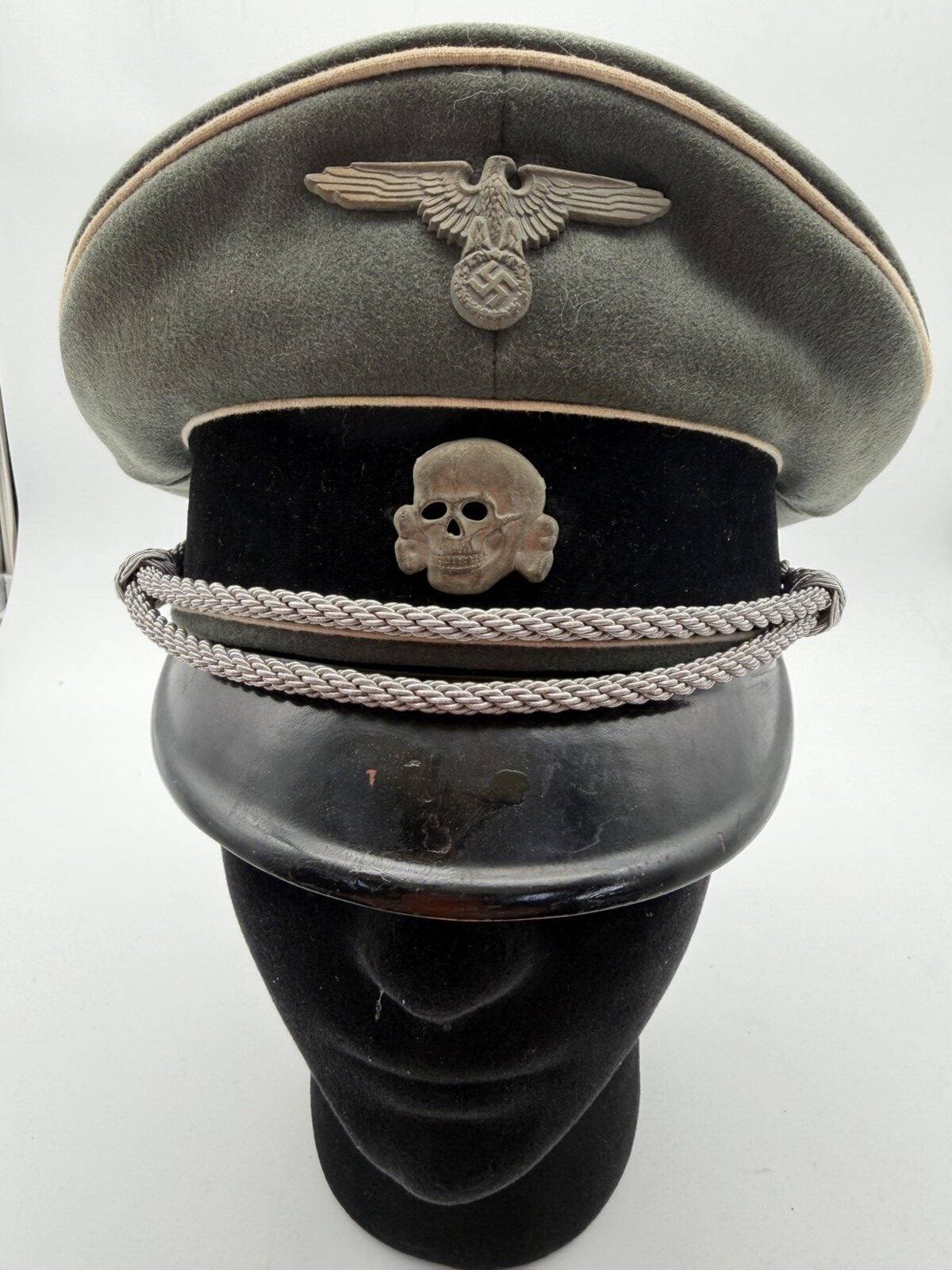
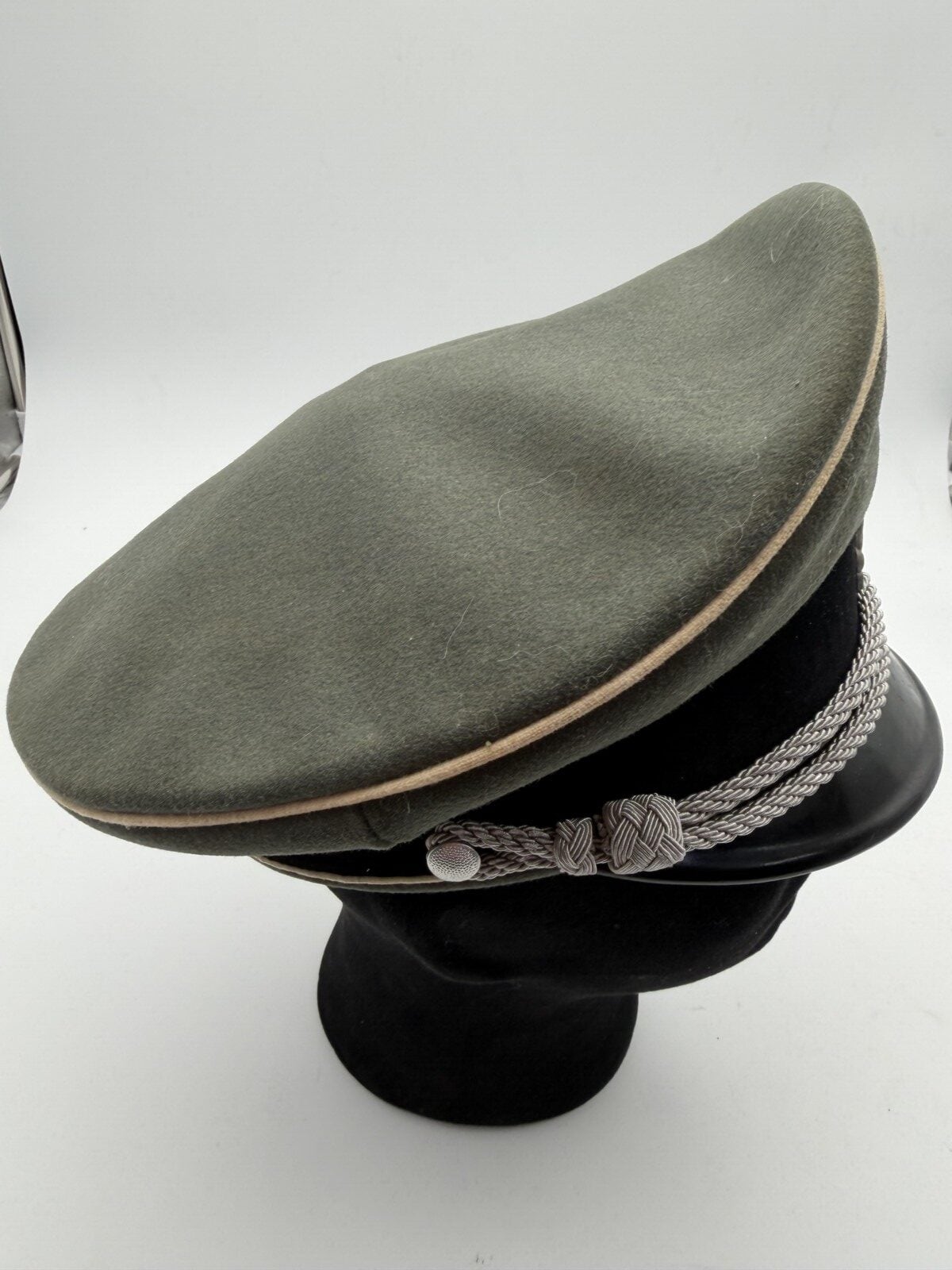
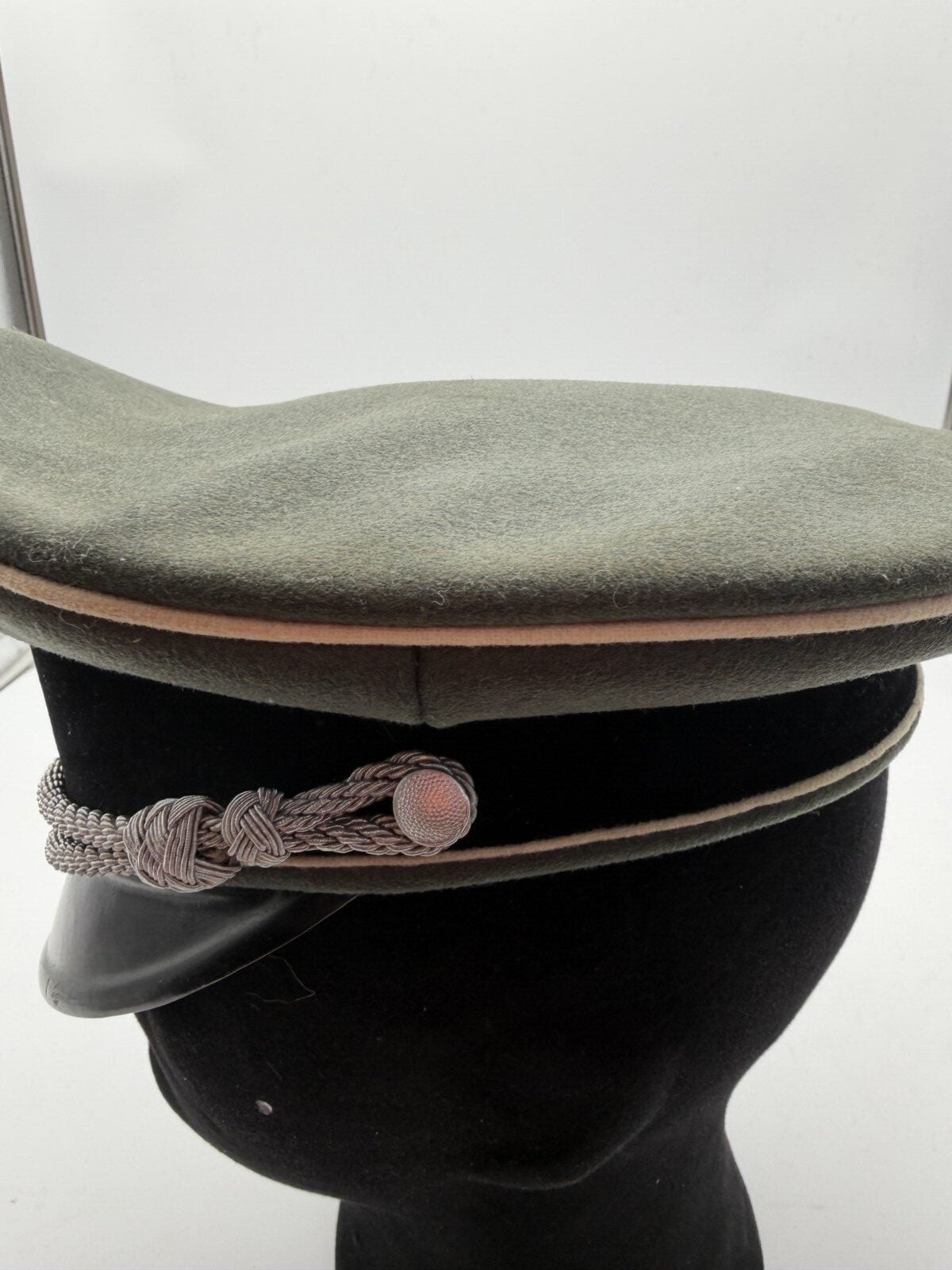
Original Waffen-SS officer’s Schirmmütze manufactured by Uniformfabrik Franz Fiedler, Saarbrücken 3, featuring a fine field-grey crown, black velvet centre band, aged white piping, silver officer cords and black visor.
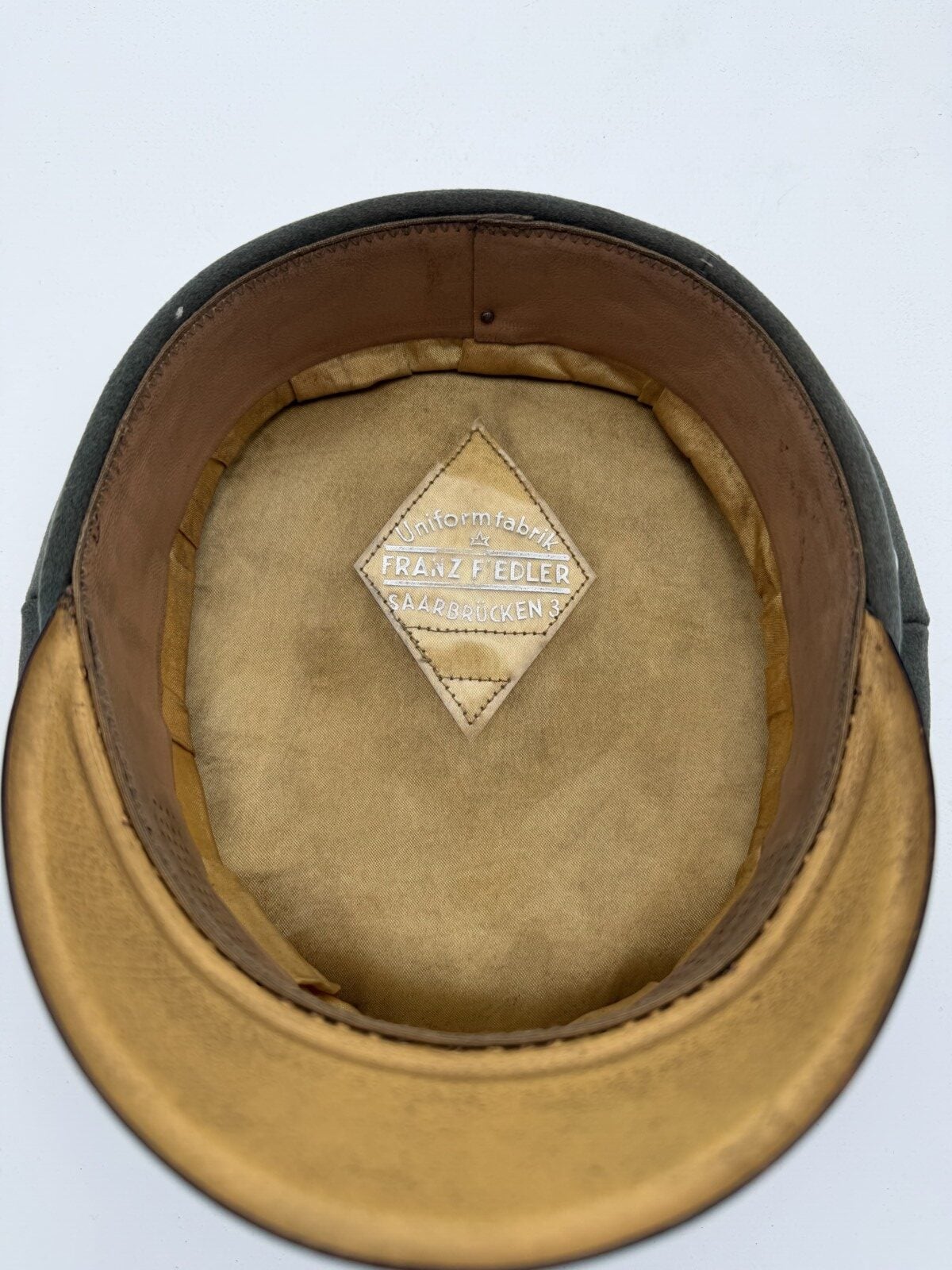
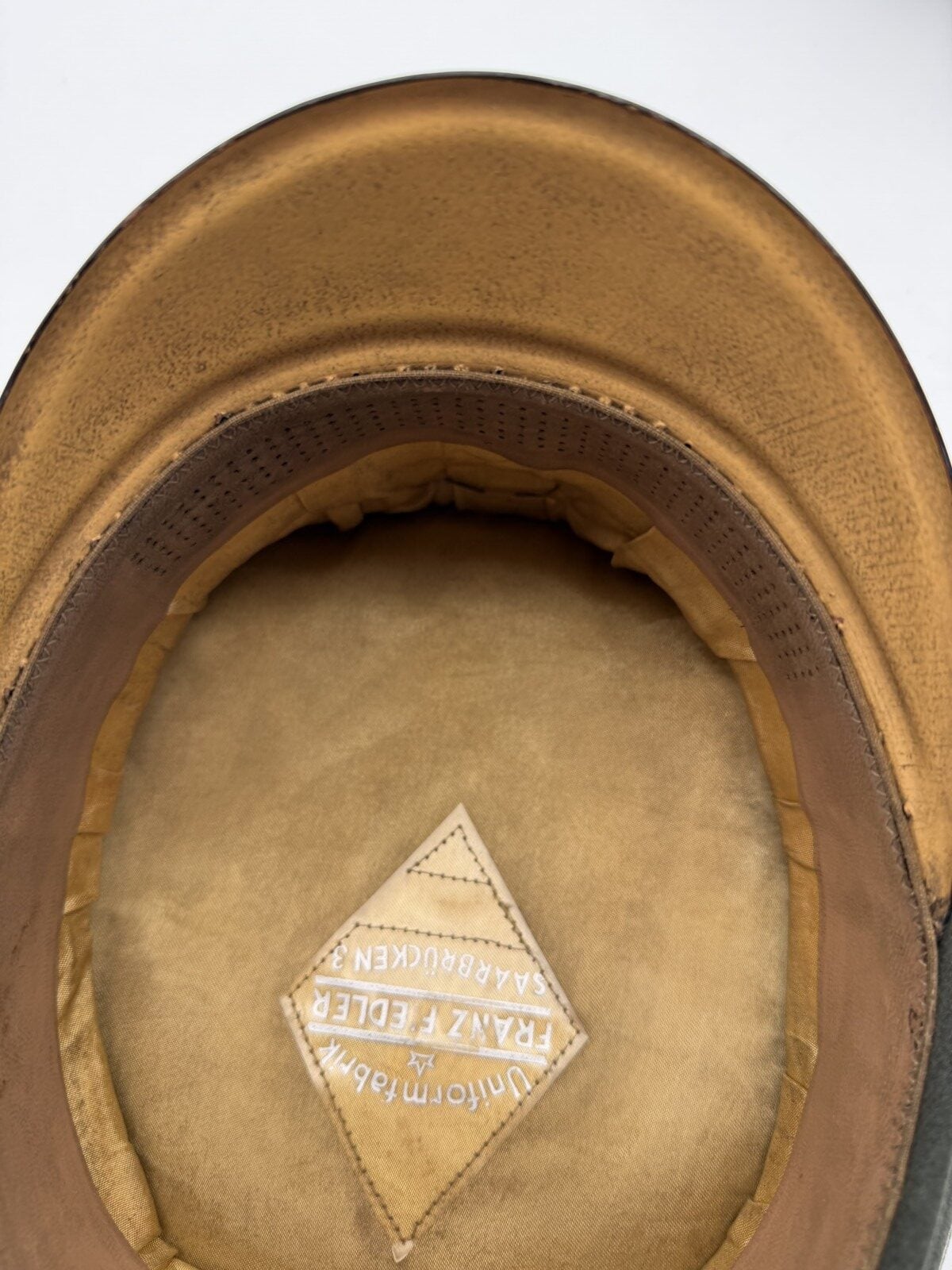
The interior retains its clearly marked Franz Fiedler manufacturer’s diamond, champagne-coloured lining and ventilated brown leather sweatband.
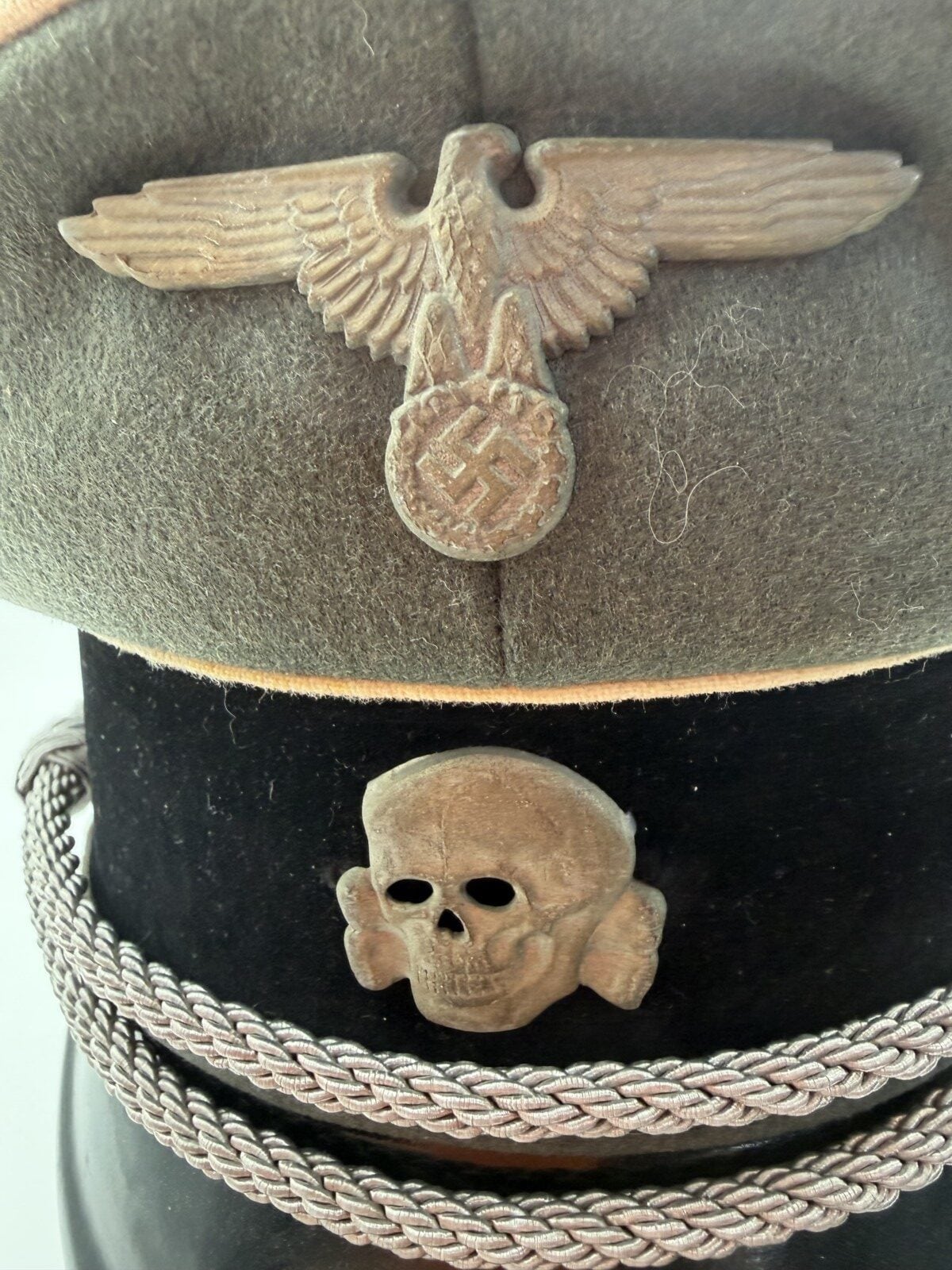
Both SS metal insignia display substantial untouched patination. Detailed comparison indicates a probable F. W. Assmann & Söhne zinc eagle together with a probable Assmann variant 4b-type Totenkopf, although reverse inspection remains necessary for definitive maker attribution.
€ 7.000
1 in stock
This original Franz Fiedler Waffen-SS Officer Visor Cap is a privately purchased field-grey Schirmmütze displaying the classic officer configuration of a fine wool crown, black velvet centre band, light piping, silver aluminium cap cords and metal SS insignia.
Particularly important is the surviving manufacturer’s label for Uniformfabrik Franz Fiedler, Saarbrücken 3.
Unlike an anonymous officer cap, this interior marking links the piece to a documented German uniform manufacturer whose activities can be traced through period commercial sources.
Furthermore, the cap retains convincing age, wear and patination across its cloth, leather, visor and metal components.
The maker deserves considerably more attention than it normally receives.
Period advertisements establish Uniform-Fabrik Franz Fiedler in Saarbrücken decades before the Second World War.
A 1914 advertisement already records Uniformfabrik Franz Fiedler, Saarbrücken 3, while by the late 1920s the company advertised from Beethovenstraße 5, Saarbrücken III, with a second operation in Trier. Its advertisements specifically offered uniforms and effects.
The business continued manufacturing uniforms and headgear after the war. A 1952 Saarbrücker Bergmannskalender advertisement gives the exact wording Uniformfabrik Franz Fiedler, Saarbrücken 3, Beethovenstraße 5 and specifically lists Schirmmützen among its products.
Consequently, the maker’s name inside this cap relates to a genuine, long-established Saarbrücken uniform manufacturer rather than an unidentified or invented trade name.
Specialist militaria dealer FJM44 has also documented an original wartime Heer officer field blouse manufactured by Uniformfabrik Franz Fiedler Saarbrücken-Trier, further demonstrating the firm’s wartime military-uniform association.
Importantly, however, the manufacturer remained active after 1945.
Therefore, the maker label alone cannot authenticate an SS cap. Construction, materials and insignia must also agree with wartime manufacture.
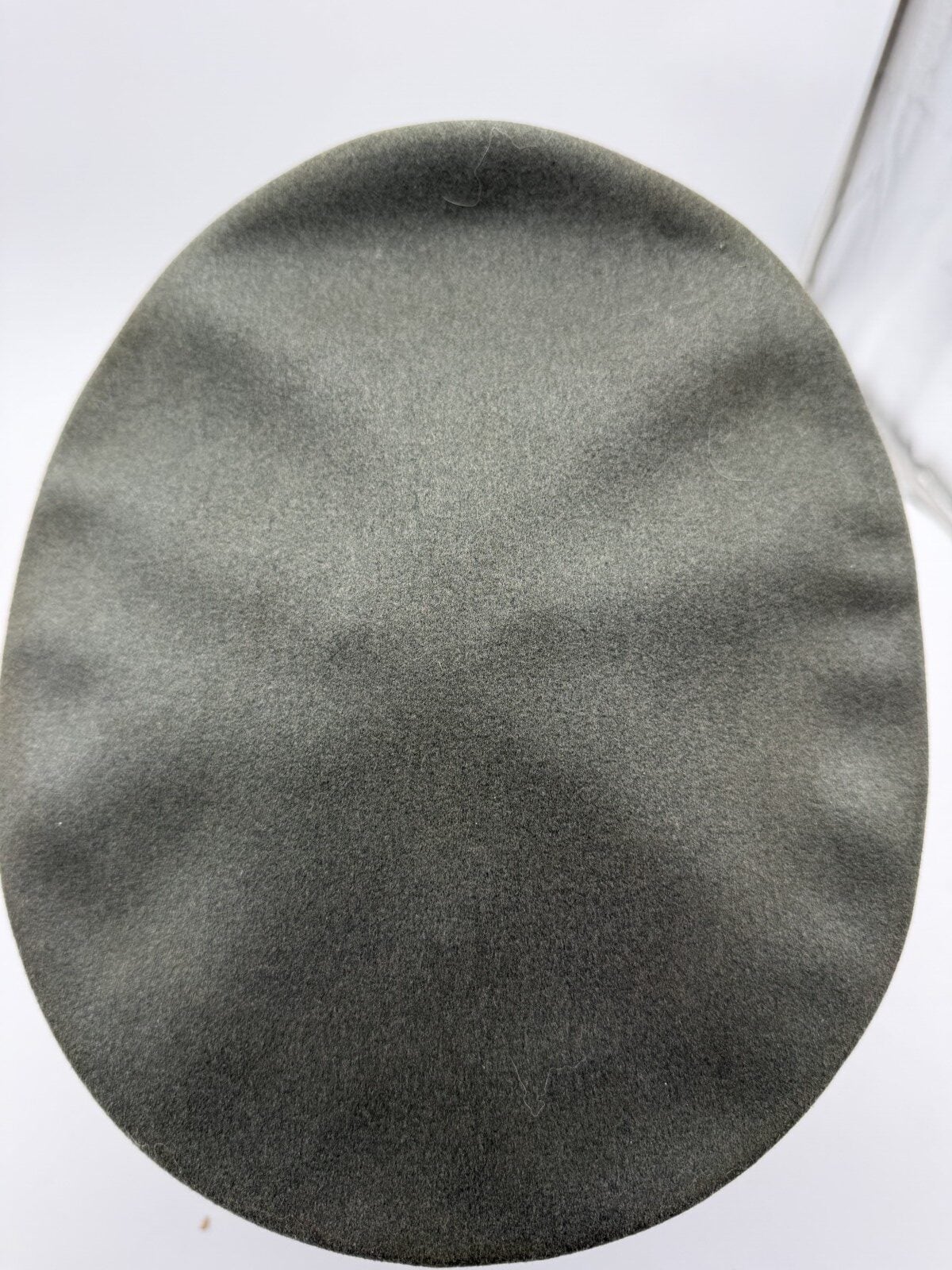
The upper body uses fine field-grey cloth with a dense, softly napped surface.
Its material has the quality expected from privately purchased officer headgear rather than coarse enlisted issue cloth.
A pronounced saddle profile remains visible.
Although storage has softened the crown in several areas, the overall shape survives very well.
Natural compression also appears around the sides and rear.
No extensive moth destruction can be seen in the photographs supplied.
Instead, the cloth shows moderate surface ageing together with scattered fibres and storage traces.
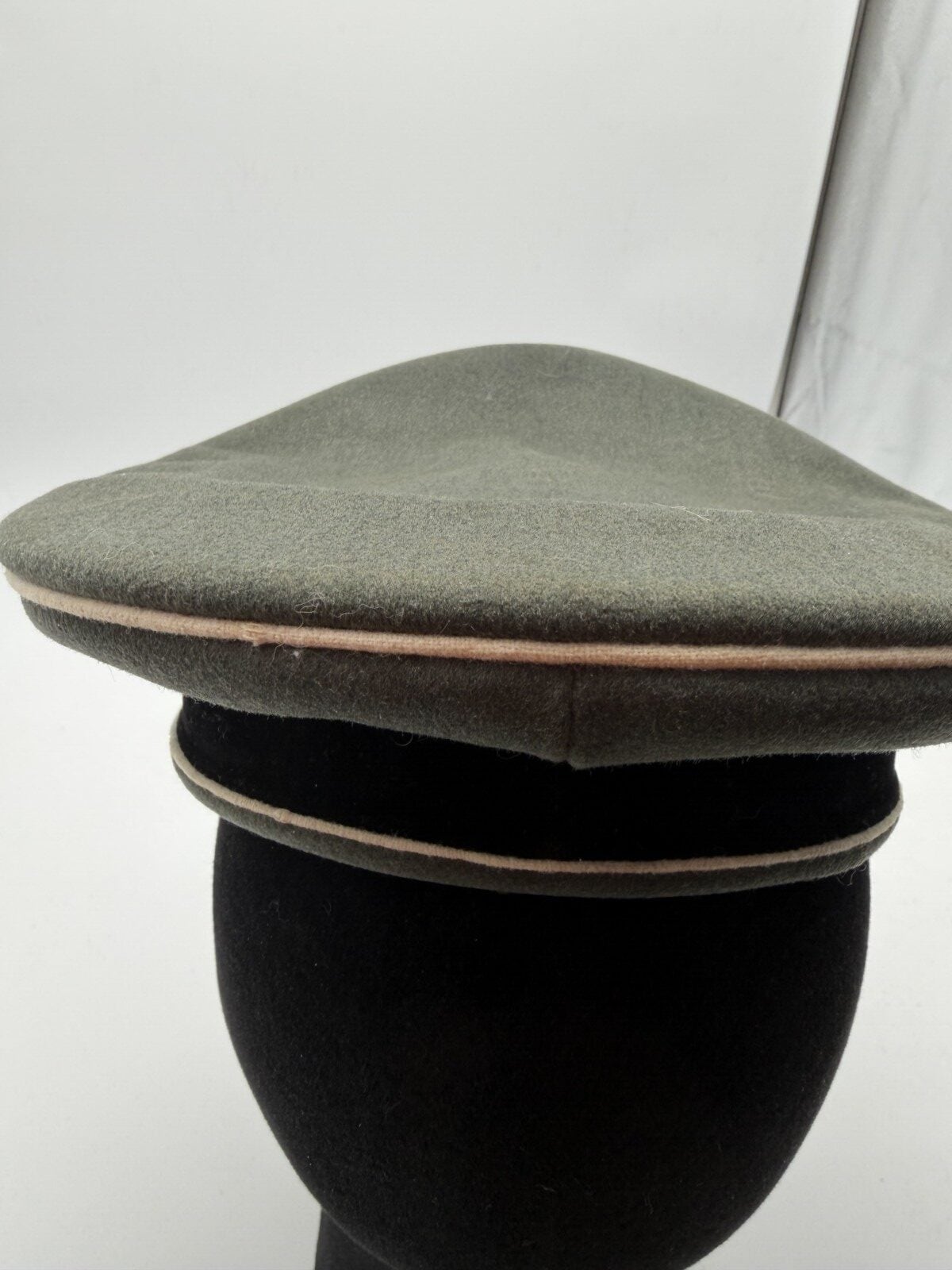
Pale piping surrounds the upper crown and both borders of the centre band.
Today it has developed a cream or light beige appearance.
Nevertheless, I believe this represents aged white piping, rather than a separate tan Waffenfarbe.
That distinction is important.
Waffen-SS regulations briefly introduced branch Waffenfarben during 1940. Subsequently, the coloured system was withdrawn and white became the standard visor-cap piping irrespective of branch. Helmut Weitze specifically notes the return to universal white piping after the end of 1940.
Accordingly, this cap should be catalogued simply as a Waffen-SS officer visor cap.
I would not call it an infantry cap solely because of the white piping.
Deep black velvet forms the broad centre band.
Its plush surface provides the expected contrast against the field-grey crown.
Age has not materially weakened the appearance of the velvet.
Meanwhile, the cream-toned piping above and below remains clearly visible.
This field-grey, black velvet and white-piped construction corresponds closely with documented Waffen-SS officer examples. Weitze currently describes a Sprengpfeil-manufactured officer cap with fine field-grey cloth, black velvet, white Waffenfarbe and a Vulkanfibre visor.
The Franz Fiedler Waffen-SS Officer Visor Cap therefore follows the recognised officer configuration extremely closely.
Braided silver-grey officer cords cross the front immediately above the visor.
Both decorative knots remain present.
Matching pebbled side buttons secure the cords.
Moreover, the braiding retains good definition despite considerable surface dulling.
The muted appearance is preferable to freshly polished aluminium because it corresponds naturally with the overall age of the cap.
These cords establish the officer configuration and separate the cap from enlisted and NCO versions normally encountered with a leather chinstrap.
The black visor remains firmly attached.
Much of its original glossy finish survives.
However, scratches and handling marks appear across the surface.
A concentrated patch of wear can also be seen toward the centre-front.
Rather than detracting substantially, that damage gives the cap the appearance of genuine prolonged use.
Turning the cap over reveals a tan-brown underside displaying widespread dark spotting and natural age variation.
Comparable Waffen-SS officer visors documented by Weitze use Vulkanfibre peaks.
I would therefore describe this as a black Vulkanfibre-type officer visor unless an in-hand material examination establishes otherwise.
Inside, a broad brown leather sweatband surrounds the opening.
Multiple rows of ventilation perforations extend around the forward section.
Age darkening appears within the leather.
Additionally, the outer edges exhibit natural wear and dryness.
The leather should not receive modern polish or general leather dressing.
Behind it sits a champagne or pale gold rayon-type lining.
The lining remains complete and displays attractive natural ageing.
Most importantly, the manufacturer’s diamond remains clearly readable.
The centre marking reads:
Uniformfabrik
FRANZ FIEDLER
SAARBRÜCKEN 3
This represents one of the strongest features of the cap.
The spelling should be recorded carefully as FIEDLER, not Fedler.
Historical advertisements use the same manufacturer name and Saarbrücken postal district. The company was already producing uniforms before the Third Reich and remained a specialist uniform manufacturer for decades afterward.
Consequently, the manufacturer’s diamond adds genuine research value to this Franz Fiedler Waffen-SS Officer Visor Cap.
I have compared the eagle more closely than I did initially.
The obverse shows several characteristics associated with F. W. Assmann & Söhne of Lüdenscheid.
These include the general horizontal wing profile, feather arrangement, compact central body and form of the lower feathering.
The present surface has lost much of its original bright silver appearance.
Instead, extensive grey, beige and brown oxidation now dominates.
That appearance can occur on wartime Feinzink insignia after deterioration of the original silver wash.
Known Assmann Waffen-SS visor eagles occur in zinc construction.
Additionally, documented late-war examples exist without visible maker markings. Giel’s Militaria records exactly such an Assmann eagle as an unmarked late-war zinc example with soldered attachment prongs.
Probable F. W. Assmann & Söhne Feinzink Waffen-SS visor-cap eagle, based upon obverse characteristics.
I would not claim an RZM number until we see the reverse.
Assmann also manufactured marked variants, including the documented SS RZM 155/42 zinc form.
The Totenkopf gives me even more confidence regarding the likely manufacturer.
Its broad rounded cranium, large eye apertures, triangular nasal opening, prominent cheek structure, dental arrangement and compact lateral bones compare closely with the recognised Assmann pattern.
In particular, the form resembles the type collectors commonly identify as Assmann variant 4b.
A documented F. W. Assmann & Söhne example described by WorldWarCollectibles uses zinc construction with an originally silvered surface and brass reverse prongs.
Your skull now displays substantial loss of its original finish.
Muted brown-grey patination dominates the face.
Nonetheless, the underlying die detail remains visible.
Probable F. W. Assmann & Söhne variant 4b-type Feinzink Totenkopf, pending reverse inspection.
At present I would favour Assmann rather than Zimmermann or Deschler for this skull.
That is an important distinction from the previous EREL cap.
For the Franz Fiedler Waffen-SS Officer Visor Cap, the apparent similarity between the eagle and skull is encouraging.
Both display comparable oxidation.
Their remaining silver-grey surfaces have deteriorated to similar muted tones.
Furthermore, each insignia appears compatible with zinc construction.
A mixed-maker insignia set would not automatically present a problem on a wartime cap.
However, confirmation that both fittings are Assmann products would give the cap an especially attractive same-manufacturer configuration.
Therefore, the reverse photographs remain worthwhile.
I would specifically look for construction characteristics, prong style and any surviving Assmann, Ges. Gesch., RZM or numerical markings.
Taken as a complete object, this cap displays numerous promising characteristics.
The field-grey officer cloth agrees with documented originals.
Likewise, the black velvet band, aged white piping, aluminium cords, ventilated leather sweatband and rayon lining form a coherent private-purchase officer configuration.
The manufacturer also checks out historically.
Franz Fiedler operated a genuine uniform business in Saarbrücken long before the Second World War and continued producing uniforms and caps later.
Importantly, age is not completely uniform across every component.
Leather has darkened differently from cloth.
Metal has oxidised differently from the aluminium cords.
The visor shows another distinct form of deterioration.
That variety is generally more encouraging than the artificially even ageing frequently encountered on manufactured reproductions.
Nevertheless, Waffen-SS officer caps have been reproduced extensively.
For that reason, I would still want photographs beneath the sweatband together with the reverse of the eagle, Totenkopf and cord buttons before describing the cap as guaranteed untouched original throughout.
On the evidence currently available, however, the Franz Fiedler Waffen-SS Officer Visor Cap is a strong period example with convincing construction and a particularly interesting documented manufacturer.
Overall condition is good to very good original worn condition.
The crown remains structurally strong.
Black velvet retains an excellent deep colour.
Aged piping survives around the cap.
Officer cords remain complete.
Both metal insignia remain mounted and carry substantial age patination.
Conversely, the visor shows noticeable scratches and surface wear.
The interior likewise displays staining and natural ageing.
These characteristics should remain untouched.
For preservation, the Franz Fiedler Waffen-SS Officer Visor Cap should not be aggressively cleaned, polished or reshaped.
Original Waffen-SS officer headgear remains one of the most heavily studied areas of German military collecting.
A clearly manufacturer-marked example has additional value because the cap can be compared against surviving products from the same tailoring firm.
Franz Fiedler is also considerably less commonly encountered on Waffen-SS headgear than names such as EREL, Clemens Wagner or Sprengpfeil.
The unusual maker therefore adds collector interest.
Additionally, probable Assmann metal insignia provide another useful research avenue.
Explore related listings: Military Visor & Peaked Caps; Original SS Officer White Summer Visor Cap | Allgemeine-SS; Original Waffen-SS Artillery Crusher Cap | Feldmütze; Rudolf Rettberg Waffen-SS Panzer Visor Cap | Hohenstaufen.
For the best current market comparison, use Helmut Weitze’s documented standard Waffen-SS officer visor. Helmut Weitze – Waffen-SS Officer Visor Cap Reference
For the manufacturer’s history, the Saarland University archive preserves a Franz Fiedler uniform-factory advertisement specifically listing Schirmmützen. Saarland Archive – Uniformfabrik Franz Fiedler
For the probable skull pattern, use this documented Assmann variant 4b comparison. F. W. Assmann & Söhne Waffen-SS Totenkopf Reference
For the probable eagle pattern, this reference documents a late-war unmarked Assmann zinc eagle. F. W. Assmann & Söhne SS Cap Eagle Reference