
Gebrüder Heller First Model Luftwaffe Dagger – M1935 Borddolch
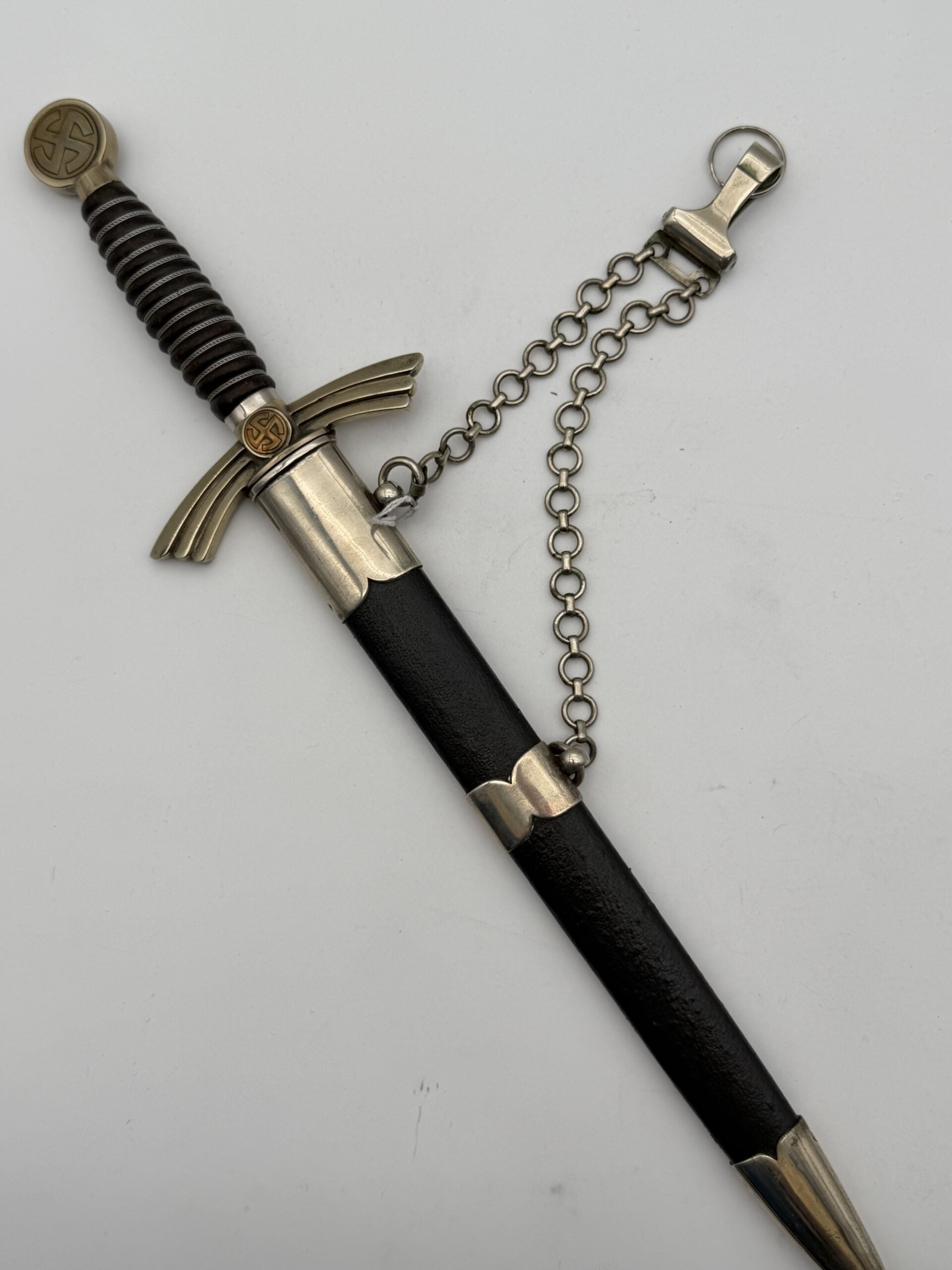
This Gebrüder Heller First Model Luftwaffe dagger is an attractive example of the early Model 1935 Luftwaffe Fliegerdolch, commonly known to collectors as the Borddolch.
Introduced around late 1934 to early 1935, this distinctive pattern preceded the familiar Second Model Luftwaffe Officer’s Dagger introduced in 1937. Its heavy early fittings, dark blue leather covering and chain suspension give the M1935 dagger an unmistakable appearance.
Gebrüder Heller of Marienthal bei Schweina manufactured this example. Heller is a recognised producer of First Model Luftwaffe daggers and other German edged weapons of the period.
Most importantly, the complete configuration shown here retains the dagger, matching leather-covered scabbard and its characteristic early chain hanger.
€ 1.695
1 in stock
Gebrüder Heller First Model Luftwaffe Dagger M1935
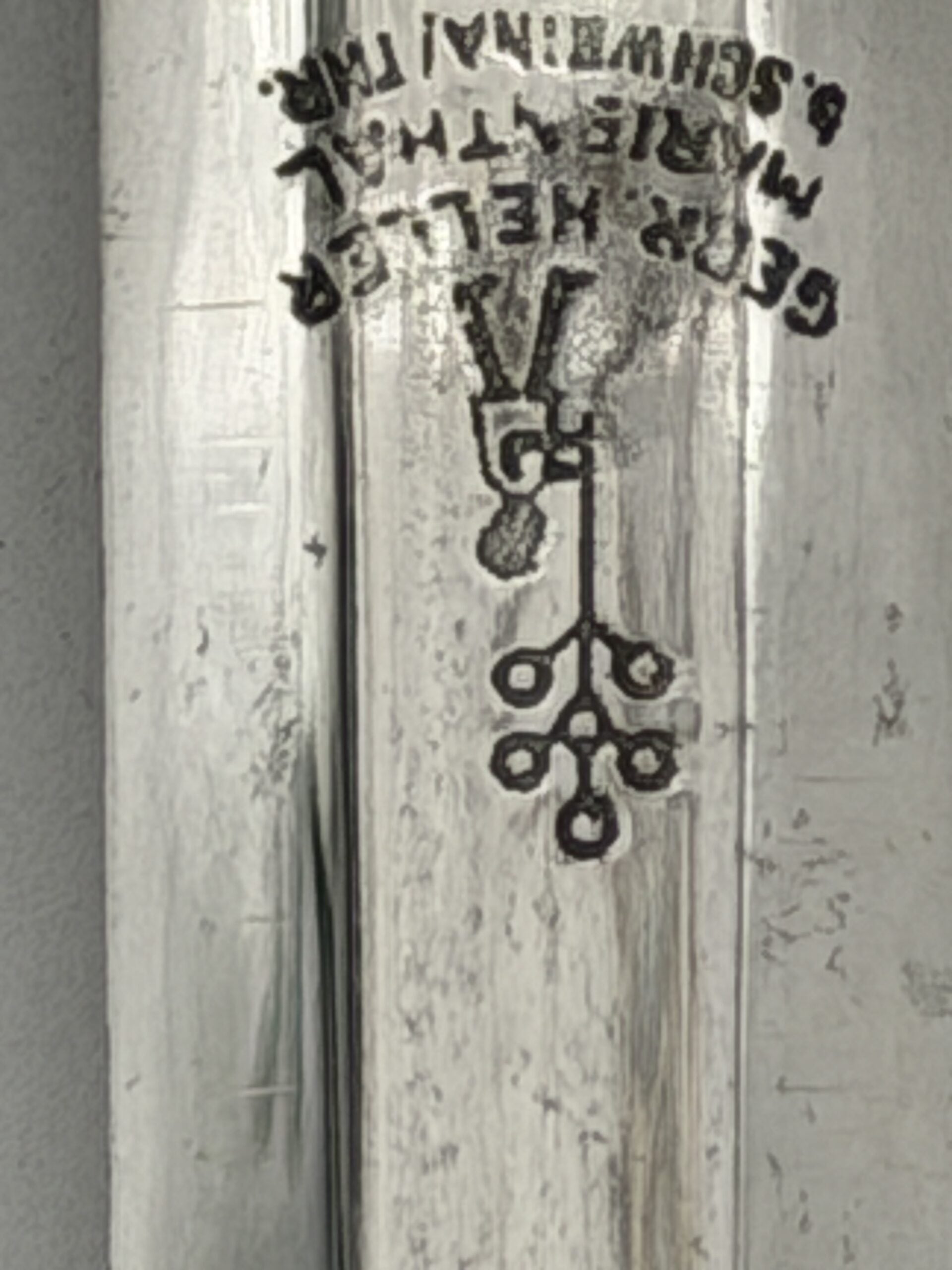
The blade bears the distinctive maker’s trademark of Gebrüder Heller, Marienthal bei Schweina, Thüringen.
Heller’s identifying device is generally known among collectors as the “Balloon Seller” trademark. Specialist maker archives record the firm as a manufacturer of Army, SA and First Model Luftwaffe daggers, together with DLV edged weapons.
The mark on this blade remains clearly recognisable despite normal age and surface wear.
Collectors can compare the trademark with the documented Gebrüder Heller maker-mark reference.
A closely related Gebrüder Heller First Model Luftwaffe dagger also provides a useful construction comparison.
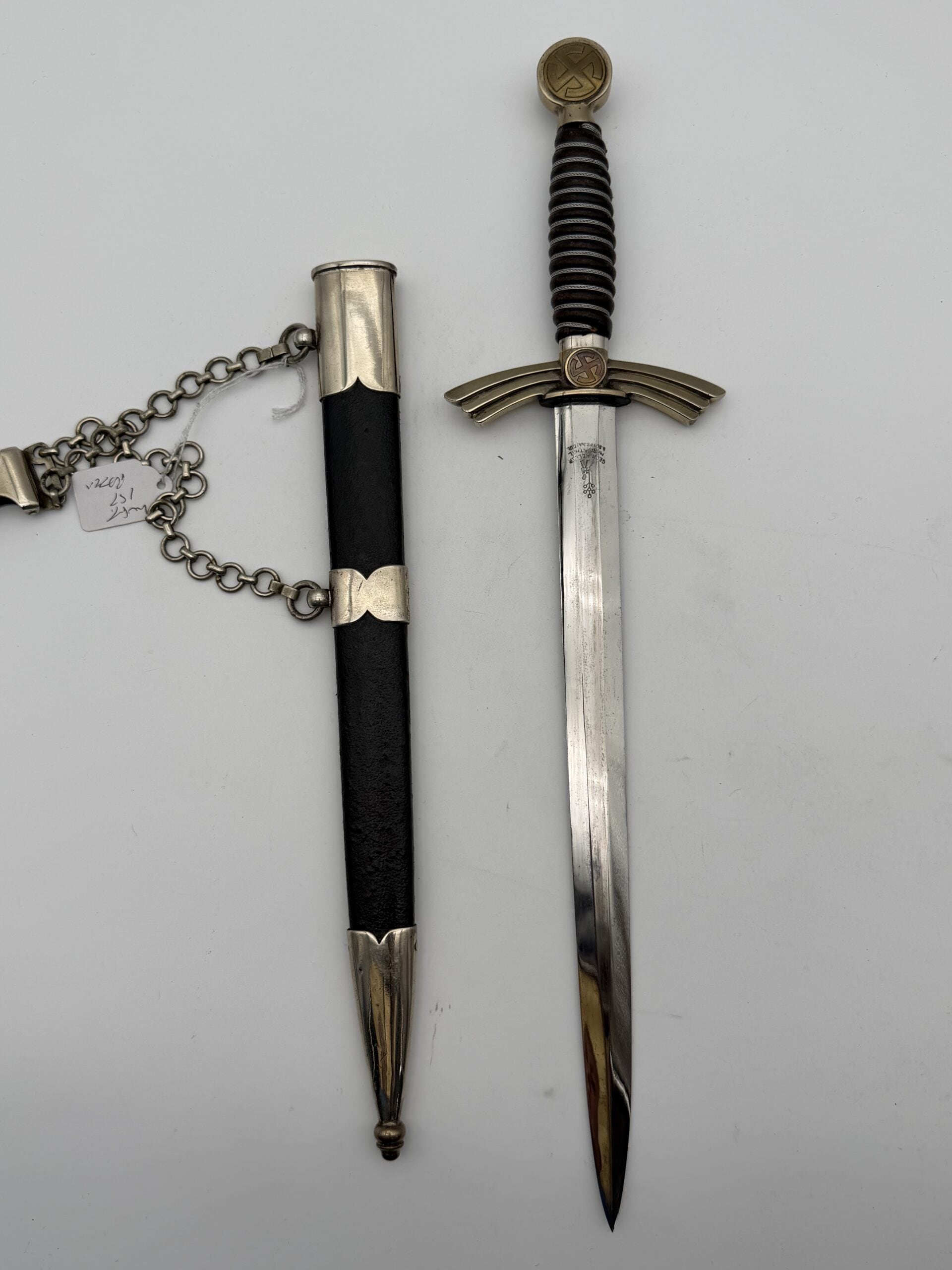
The long double-edged blade retains a pleasing bright finish.
A pronounced central ridge runs from the ricasso towards the spear-point tip. In addition, both edges remain well defined.
Normal age, light surface marks and traces of scabbard contact are visible. Nevertheless, the blade remains very presentable and displays considerably better than many heavily oxidised surviving examples.
Near the ricasso sits the important Heller maker inscription and trademark.
Consequently, the blade provides both strong visual appeal and a positive manufacturer reference for the dagger.
One of the defining characteristics of the First Model Luftwaffe dagger is its dark blue leather-covered grip.
The leather on this example has aged to an exceptionally deep blue tone. Under some lighting it appears almost black, although the correct catalogue description is dark Luftwaffe blue.
Multiple strands of twisted wire spiral around the grip from the pommel towards the crossguard.
Importantly, the leather remains substantially intact. Natural compression, surface ageing and gentle wear contribute to an attractive period appearance.
The large circular pommel displays the distinctive early Luftwaffe sunwheel swastika.
A brass or gilt-toned medallion provides strong contrast against the silvered outer fitting. The recessed design remains well defined.
Unlike the later M1937 dagger, the First Model uses this simple circular geometric pommel design rather than the later oak-leaf decoration.
That feature immediately distinguishes the early Borddolch from its successor.
The crossguard consists of the characteristic three-tier swept-wing design.
A second brass-toned sunwheel swastika appears within the central circular medallion.
The guard retains attractive age toning while preserving strong contours and definition.
Moreover, the combination of dark blue grip, silvered fittings and warm brass medallions gives the First Model Luftwaffe dagger its distinctive pre-war appearance.
The matching scabbard is another important strength of this Gebrüder Heller First Model Luftwaffe dagger.
Dark blue leather covers the main scabbard body. Consequently, it visually matches the grip exactly as intended on the M1935 pattern.
Silvered metal fittings protect the throat, centre and lower portion.
The elongated lower chape terminates in the characteristic rounded ball.
Ageing and surface wear remain visible throughout. However, the leather covering appears substantially complete and maintains excellent overall presentation.
Documented M1935 scabbards use a steel base covered with blue leather and fitted with metal mounts.
Especially desirable is the survival of the early Luftwaffe chain suspension.
Two lengths of metal chain connect the scabbard suspension points to the upper attachment clip. This arrangement differs completely from the later fabric suspension straps associated with the Second Model Luftwaffe dagger.
Original chains are frequently separated from surviving First Model daggers.
Therefore, the complete chain assembly materially improves both collectability and display value.
Specialist references document M1935 daggers with precisely this type of dual-chain suspension arrangement.
The First Model Luftwaffe dagger emerged during the rapid development of the newly established German air force.
Often called the Fliegerdolch or Borddolch, the pattern was based closely on the earlier DLV leader’s dagger. It entered Luftwaffe use around 1935 and initially served officers and senior NCOs.
During 1937, the better-known Second Model Luftwaffe Officer’s Dagger appeared. However, the earlier pattern did not immediately disappear from service.
As a result, First Model daggers remain an important physical link with the formative pre-war Luftwaffe.
For primary-source historical research, the German Federal Archives – Bundesarchiv maintains surviving Wehrmacht and Luftwaffe material within its military holdings.
The photographs show numerous characteristics consistent with an original Gebrüder Heller First Model Luftwaffe dagger.
Notable features include:
Comparable Heller examples display the same basic combination of blue leather, wire-wrapped grip, brass sunwheel medallions and chain suspension.
Based on the photographs supplied, no obvious modern reproduction feature immediately stands out. Nevertheless, definitive authentication of any high-value edged weapon should include direct examination of the blade tang, internal fittings, leather edges, assembly points and chain hardware.
Overall condition: Very good to excellent collector condition.
The blade remains bright and retains a strong spear-point profile.
Light scratches, age marks and normal runner contact remain visible. However, substantial polish survives across both faces.
Meanwhile, the Heller trademark remains identifiable.
The dark blue grip leather shows attractive age without major distracting loss. Similarly, the grip wire remains well positioned.
Silvered fittings display gentle age toning, while the brass sunwheel medallions retain their distinctive contrasting appearance.
Furthermore, the matching scabbard remains visually impressive. Its dark blue covering complements the grip extremely well.
Finally, the survival of the chain hanger is particularly important because these assemblies are frequently missing or incomplete.
This Gebrüder Heller First Model Luftwaffe dagger offers several qualities sought by advanced collectors.
These include:
Compared with the much more frequently encountered M1937 pattern, the M1935 Borddolch represents an earlier and visually distinctive stage in Luftwaffe edged-weapon development.
Explore related listings: Luftwaffe Daggers; Third Reich Edged Weapons collection; Original SMF Luftwaffe Presentation Dagger; Original WWII German Luftwaffe Officer’s Dagger by SMF Solingen with Waffenamt Acceptance Mark.
Bundesarchiv – German Armed Forces 1933–1945
Bundesarchiv – Luftwaffe Unit Records
Gebrüder Heller Maker-Mark Reference
Gebrüder Heller First Model Luftwaffe Reference
DG.DE – M1935 First Model Luftwaffe Dagger Reference
Gebrüder Heller of Marienthal bei Schweina, Thüringen manufactured the dagger. The company’s characteristic maker inscription and trademark appear on the blade.
This is the M1935 First Model Luftwaffe dagger, usually called the Fliegerdolch or Borddolch by collectors.
No. The leather has aged to an extremely dark tone, but First Model Luftwaffe daggers characteristically used dark blue leather on the grip and scabbard.
They are the characteristic brass or gilt-toned sunwheel swastika medallions fitted to the pommel and crossguard of the First Model dagger.
Yes. The original-style dual-chain hanger is an important part of the M1935 configuration. Many surviving daggers have lost their suspension assemblies.
Yes. Specialist maker references document Gebrüder Heller as a manufacturer of First Model Luftwaffe daggers.
The M1935 uses dark blue leather, sunwheel swastikas and a chain suspension. By contrast, the M1937 Second Model uses a flying-eagle crossguard, light-coloured spiral grip and pebbled metal scabbard.