
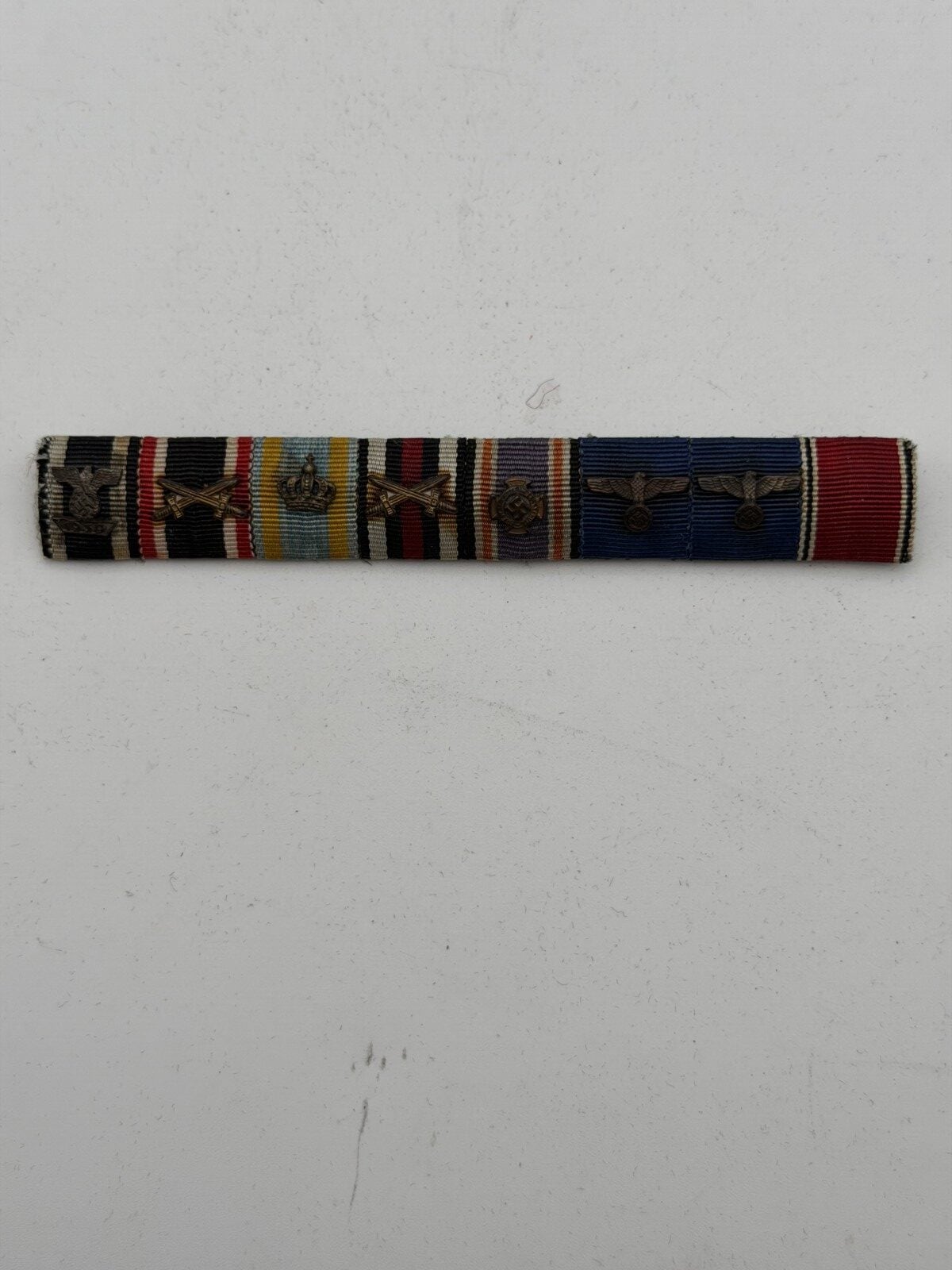
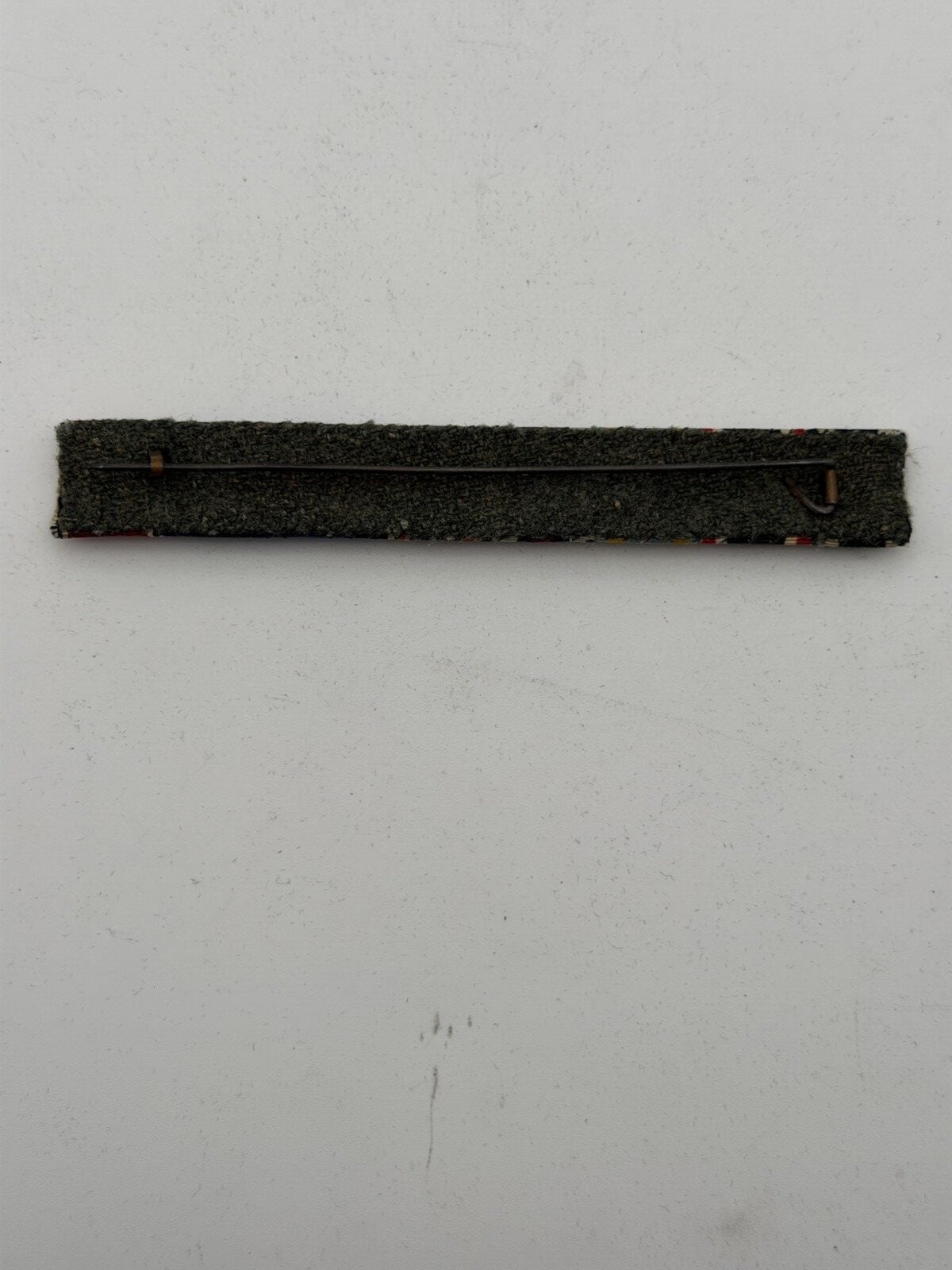
Original German eight-place ribbon bar representing military service during both world wars. The bar includes the 1914 Iron Cross ribbon with a 1939 repeat-clasp device, War Merit Cross with Swords, Bavarian Military Merit award, Hindenburg Cross, Luftschutz decoration, paired Wehrmacht long-service ribbons and the 13 March 1938 Medal. Complete with dark wool backing and full-length steel pin.
€ 400
1 in stock
This original German Eight-Place Ribbon Bar represents the career of a highly decorated veteran who served during both world wars. Its exceptional combination includes a 1914 Iron Cross ribbon with a 1939 repeat-clasp device, a War Merit Cross ribbon with swords, an Imperial German state award, the Hindenburg Cross and two Wehrmacht long-service decorations.
Eight individually folded ribbons cover a dark wool backing. Numerous miniature metal devices remain attached, including the 1939 eagle clasp, crossed swords, a crown, a Luftschutz miniature and two Wehrmacht eagles. Furthermore, the reverse retains its original full-length horizontal pin.
From left to right, the bar appears to represent:
This historically coherent combination points to a First World War combat veteran who continued or returned to professional military service. His decorations also indicate recognised service during the opening years of the Second World War.
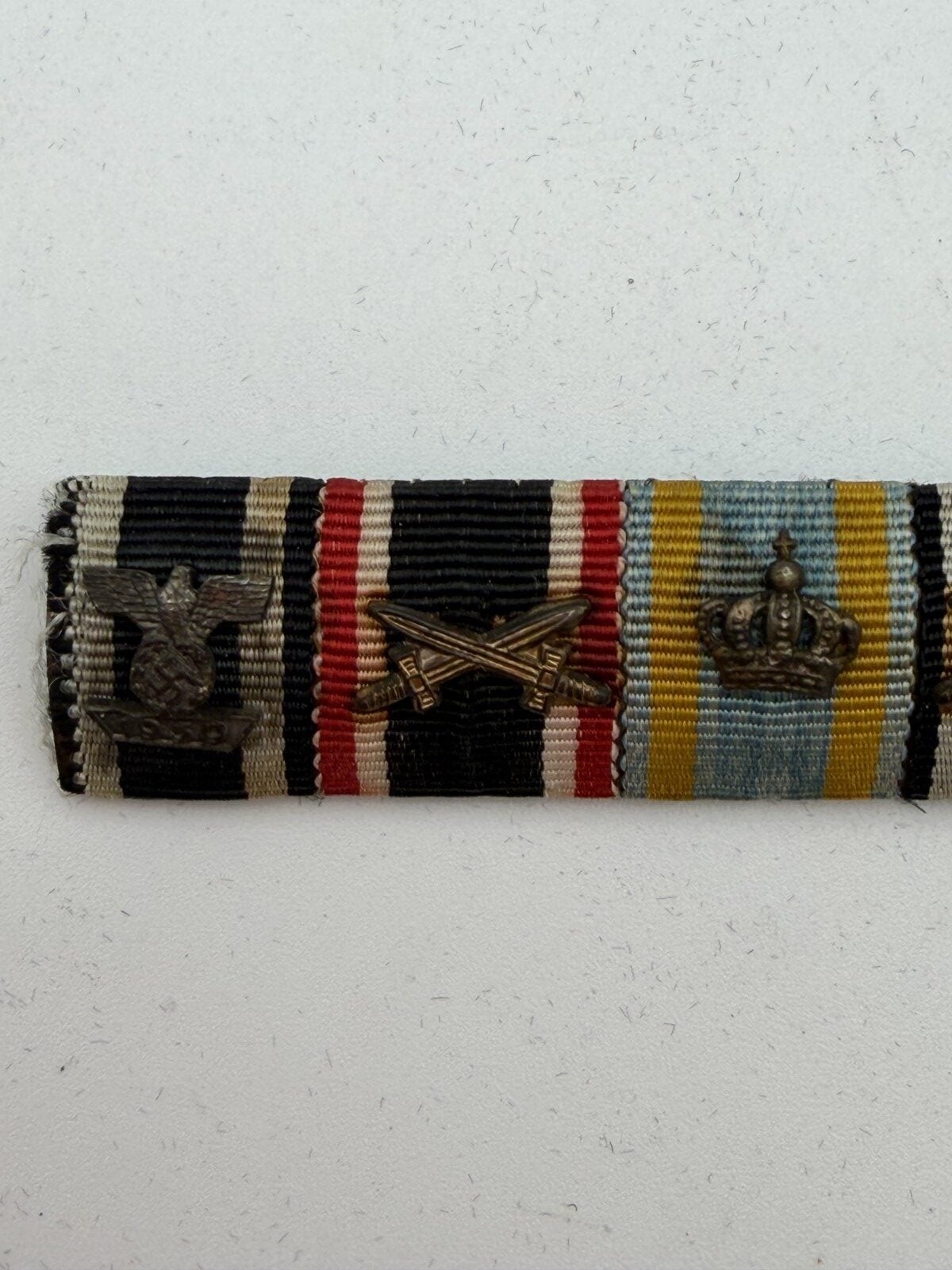
The first position carries the black and white ribbon of the 1914 Iron Cross Second Class.
A miniature national eagle sits above a dated rectangular bar. These elements represent the 1939 Spange zum Eisernen Kreuz, commonly called the Repeat Clasp to the Iron Cross.
German authorities established the clasp on 1 September 1939. It allowed a recipient of the 1914 Iron Cross to display a second award of the same class earned during the Second World War.
The miniature device retains clear eagle, wing and wreath detail. Although age toning has darkened the surface, the lower bar still shows the characteristic proportions of a 1939 clasp.
For comparison, Helmut Weitze documents another eight-award ribbon bar containing a 1914 Iron Cross ribbon with an applied 1939 repeat clasp. View the documented eight-place ribbon bar at Helmut Weitze.
The second ribbon represents the War Merit Cross Second Class with Swords. Its red, white and black colour arrangement corresponds with this wartime decoration.
A prominent pair of crossed swords sits across the ribbon. The swords identify the combat-related grade and distinguish it from the award without swords.
Sharp definition remains along the miniature blades, crossguards and grips. Moreover, the darkened finish matches the patina found on the neighbouring devices.
The third position carries a pale blue and light-coloured striped ribbon with a miniature crown-and-swords device.
This combination appears consistent with a Bavarian Military Merit Cross with Crown and Swords. Bavaria granted these decorations to enlisted personnel and non-commissioned officers for bravery or military merit.
The crown retains its upper cross, orb, arches and lower band. However, the exact class should remain unspecified unless recipient documentation or closer examination establishes it with certainty.
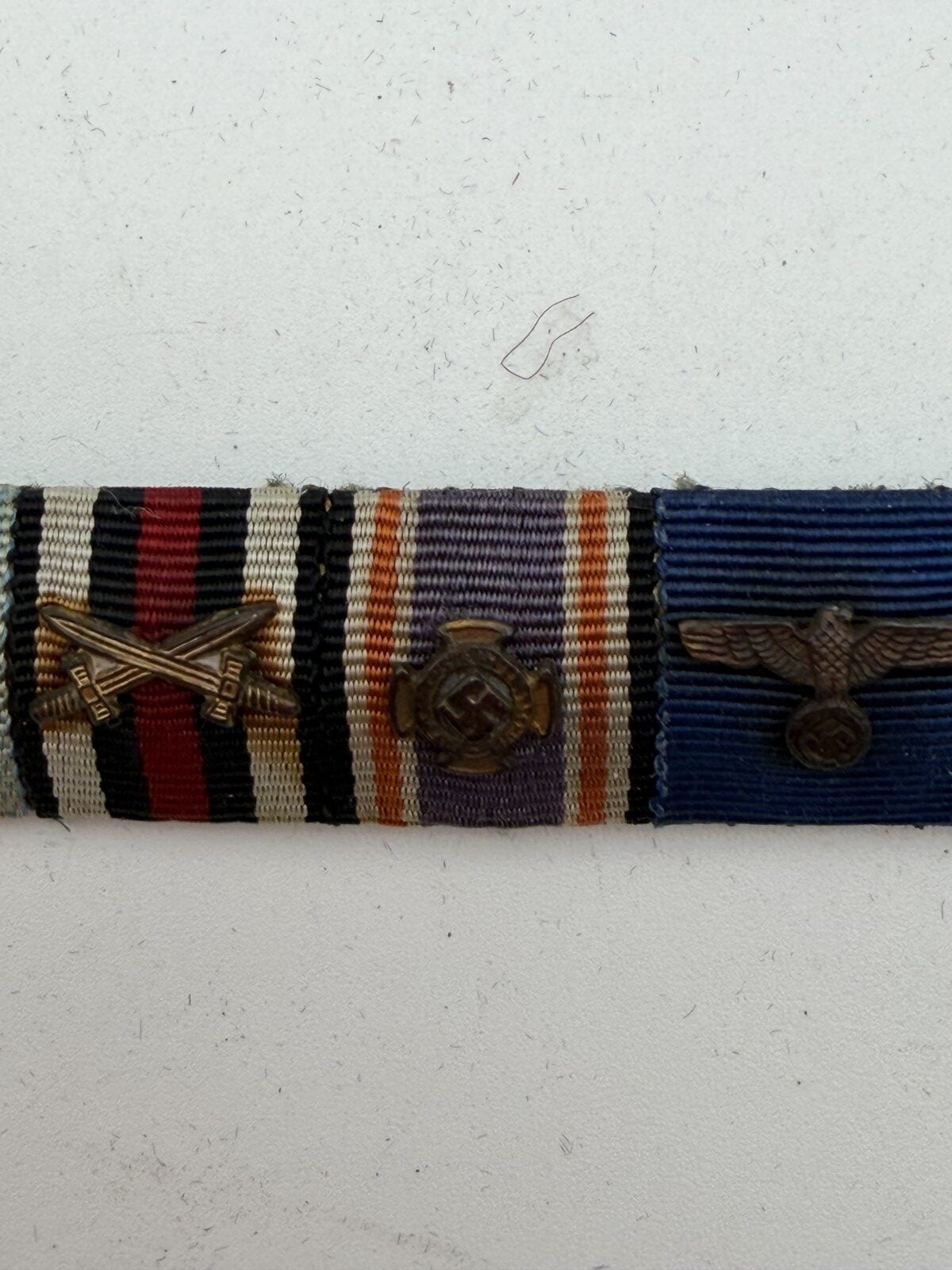
The fourth ribbon represents the Honour Cross of the World War 1914–1918 for Front-Line Combatants, widely known as the Hindenburg Cross.
Crossed swords identify the front-line combatant grade. Its black, white and red ribbon recalls the national colours of Imperial Germany.
Both swords remain securely attached. Natural oxidation covers their surfaces and corresponds with the age of the surrounding devices.
The fifth position carries the violet ribbon of the Air Defence Honour Decoration Second Class, or Luftschutz-Ehrenzeichen 2. Stufe.
A small circular decoration appears in the centre. Its design includes the national emblem and surrounding wreath associated with the Luftschutz award.
This ribbon suggests that the wearer undertook an air-defence, civil-protection or related administrative role alongside his military career.
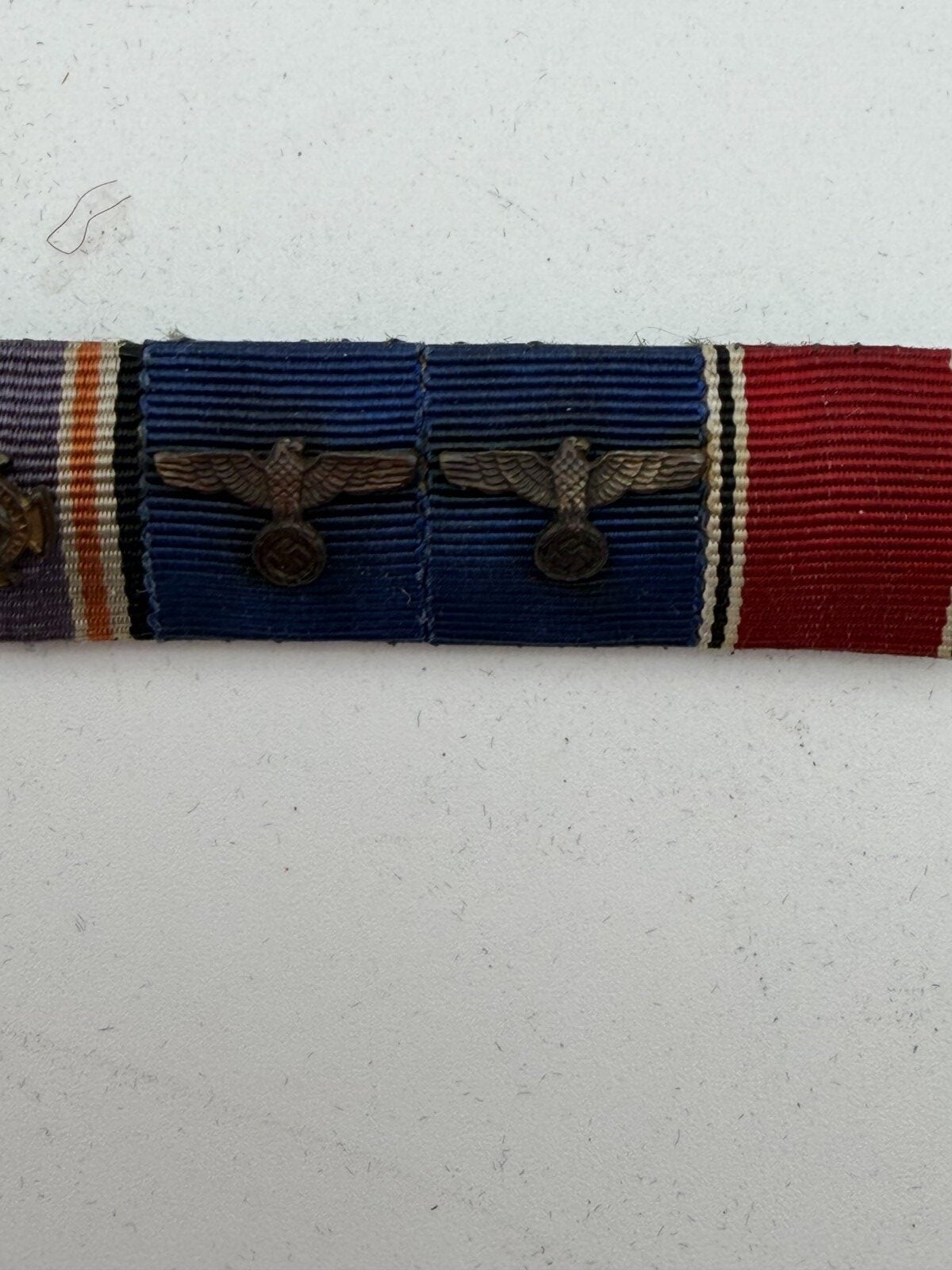
Two cornflower-blue ribbons occupy the sixth and seventh positions. Each carries a miniature national eagle.
Together, these represent the Wehrmacht Long Service Awards for 12 and 4 years. German regulations allowed qualifying personnel to display two long-service grades simultaneously.
The first eagle originally carried the gilt finish associated with the 12-year award. In contrast, the second used the silver finish of the four-year grade. Age has darkened both devices, although subtle differences in tone remain visible.
Helmut Weitze documents comparable paired Wehrmacht long-service awards with gold and silver ribbon eagles. View original Wehrmacht medal and ribbon combinations at Helmut Weitze.
The final red ribbon with narrow black and white edge stripes represents the Commemorative Medal of 13 March 1938.
This decoration marked Germany’s annexation of Austria. No additional device appears on the ribbon, which agrees with normal ribbon-bar practice for the standard award.
The German Eight-Place Ribbon Bar uses quality ribbed ribbons folded over a dark wool base. Each ribbon section sits tightly beside the next, creating a compact bar suitable for wear above a uniform breast pocket.
On the reverse, a long steel pin extends across almost the entire width. A cylindrical hinge supports one end, while the opposite end engages with a curved wire catch.
This construction matches recognised period ribbon bars. Furthermore, the backing shows natural age, embedded fibres, slight thinning and minor edge wear.
The devices also share a consistent dark patina. None displays the bright, chemically uniform surface commonly encountered on modern reproduction fittings.
The ribbon bar remains in very good, visibly worn condition.
Strong colour survives throughout most of the ribbons. Nevertheless, age, light fading and minor soiling appear in several sections. Small areas of fraying also affect the outer edges and individual joins.
Every principal metal device remains present. The crown, swords, Luftschutz miniature, Wehrmacht eagles and 1939 clasp all retain useful detail.
Likewise, the reverse fastening system remains complete. The pin appears straight, while the original hinge and catch remain securely mounted.
Several characteristics support period manufacture:
Nothing visible in the supplied photographs immediately suggests modern assembly. However, a UV examination should confirm that the ribbons, stitching and wool backing contain no modern fluorescent fibres.
The German Eight-Place Ribbon Bar documents an extensive military career spanning Imperial Germany and the Third Reich period.
The wearer apparently experienced First World War combat, earned the Iron Cross and an Imperial state award, accumulated professional military service and later received additional decorations during the Third Reich era. Most importantly, the 1939 repeat clasp indicates renewed qualification for the Iron Cross during the Second World War.
Ribbon bars with eight authentic ribbons and multiple original devices remain much scarcer than ordinary two or three-place examples. Therefore, this combination holds strong appeal for collectors of German decorations, Wehrmacht uniforms and Imperial veteran groups.
Ratisbon’s maintains an extensive photographic archive of original German medal and ribbon bars. Compare original German ribbon and medal bars in the Ratisbon’s price guide.
For further examples within the Nordmenn collection, compare this bar with the original ten-place Third Reich ribbon bar.
Also view this original Waffen-SS ribbon bar with long-service devices or explore the complete Nordmenn Medals collection.