
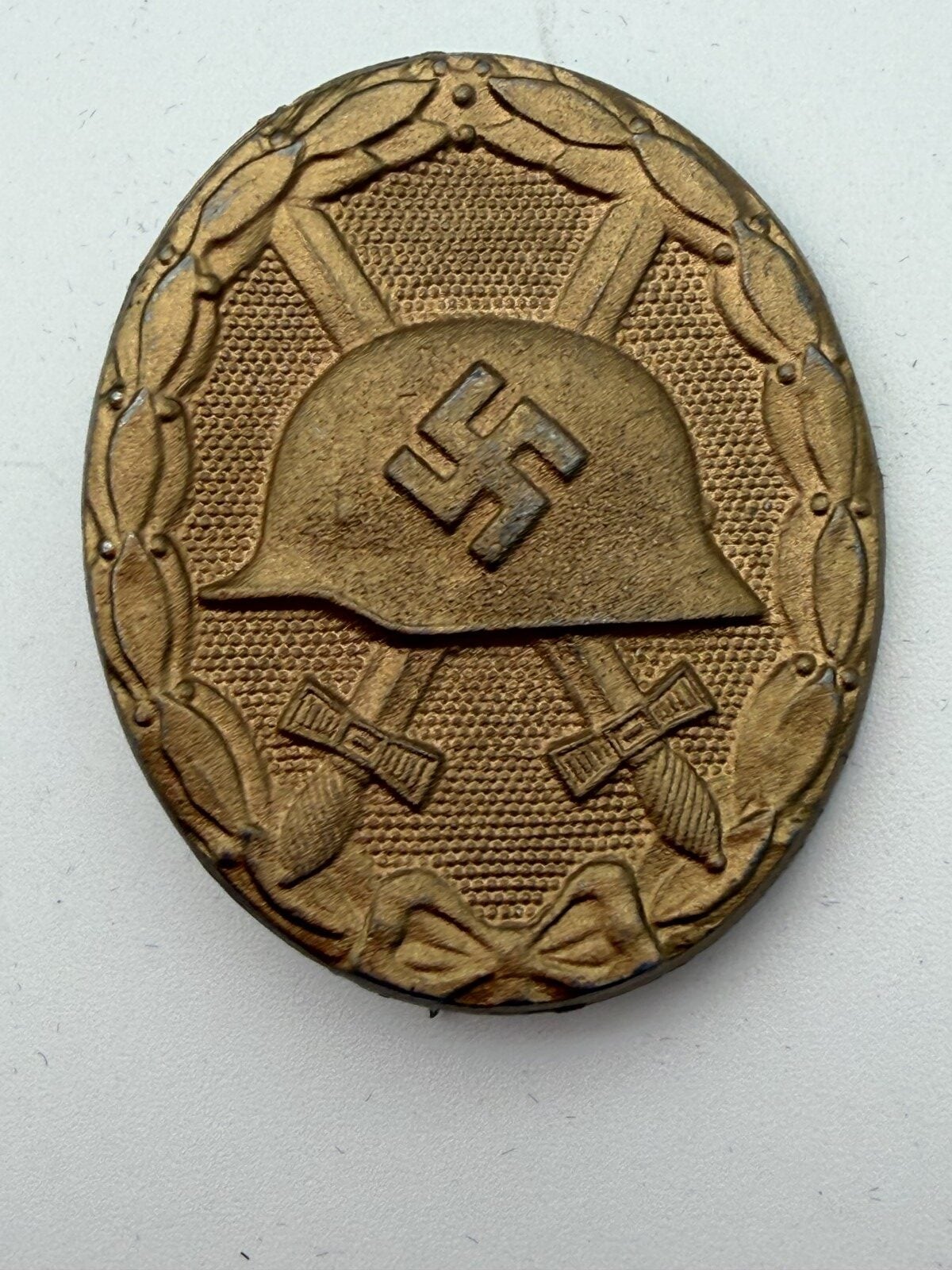
Attractive Gold Wound Badge 1939, or Verwundetenabzeichen 1939 in Gold, featuring the classic M35 steel helmet over crossed swords within a laurel wreath.
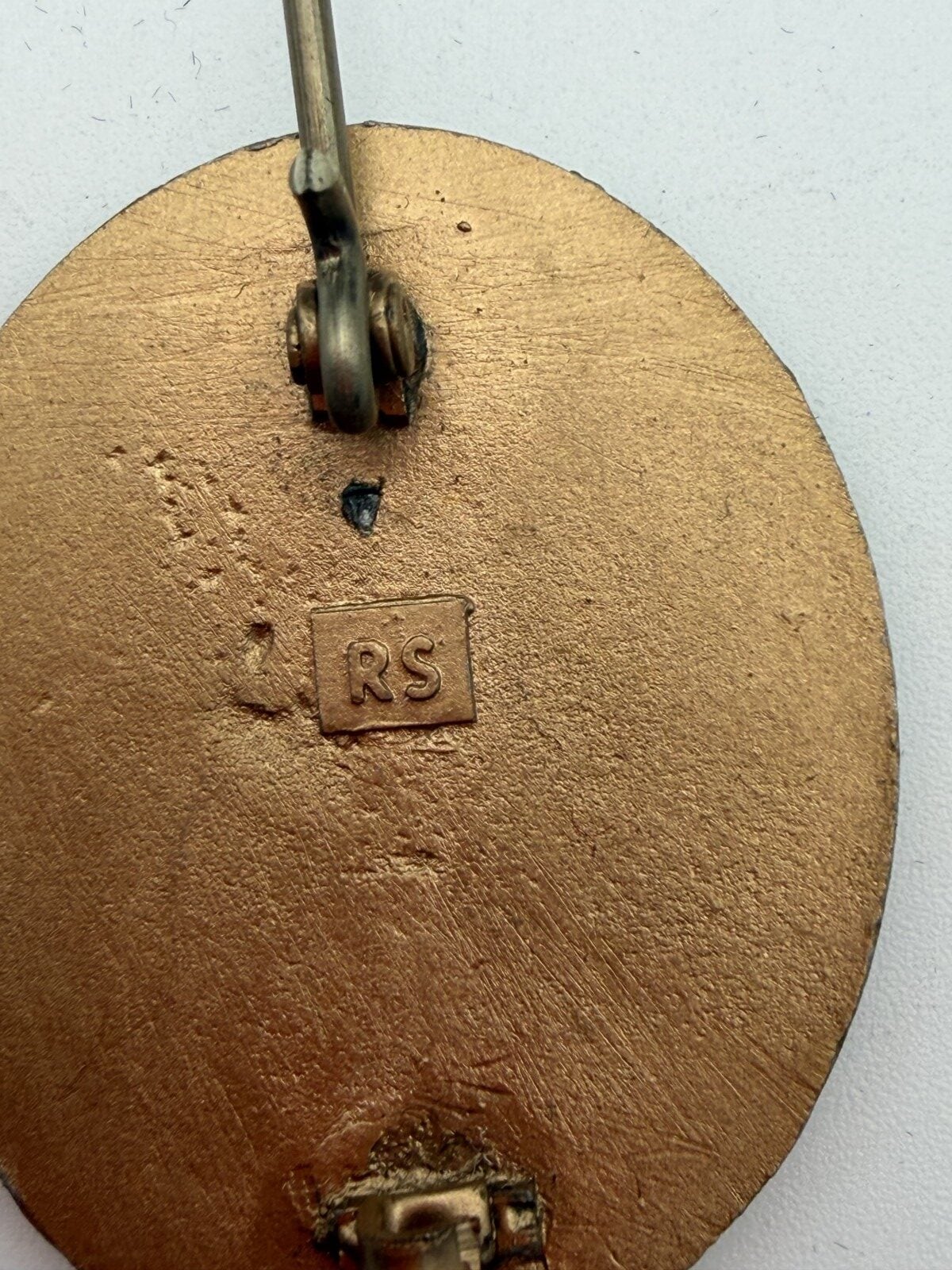
The solid reverse carries a prominent rectangular RS maker mark, associated with Rudolf Souval of Vienna, together with its vertical pin, hinge and catch assembly.
€ 350
1 in stock
This Gold Wound Badge 1939 is a solid-backed example of the German Verwundetenabzeichen 1939 in Gold.
Its distinctive oval design comprises a laurel wreath surrounding a German M35 steel helmet, with crossed swords positioned behind it.
A raised national emblem appears centrally on the helmet.
The finely textured field surrounding the central design remains sharply defined, while considerable gold-toned finish survives across the obverse.
The Gold grade represented the highest level of the 1939 Wound Badge.
The decoration existed in three principal classes:
Gold could also be awarded irrespective of the wound count in cases involving extremely serious permanent injury, and it could be awarded posthumously.
This made the Gold Wound Badge considerably less common than the Black and Silver grades.
The 1939 badge replaced the First World War helmet design with the more modern M35-style steel helmet.
Two crossed swords sit behind the helmet, while an oval laurel wreath surrounds the entire composition.
Weitze records both hollow and solid types, with Gold badges commonly encountered as solid gilded base-metal pieces. Later wartime production also included zinc examples as strategic metals became scarcer.
Your badge is clearly of solid construction.
The most significant feature on the reverse is the maker mark:
The mark appears within a rectangular cartouche.
The initials RS are widely associated with Rudolf Souval of Vienna, a major Austrian manufacturer of German military awards. MedalBook records “RS” among Souval’s known marks and gives the firm the LDO number L/58 and Präsidialkanzlei number 98.
Weitze likewise documents original wartime awards bearing the R.S. mark and identifies them as Rudolf Souval products.
Therefore, the natural maker attribution is:
Rudolf Souval, Wien
However, the attribution to wartime production requires an additional step.
Rudolf Souval remained active after May 1945.
The company continued manufacturing Third Reich-pattern awards, sometimes using wartime dies or components.
eMedals has documented a group of Souval-made decorations produced around 1970 that includes a Gold Grade Wound Badge.
Consequently:
An RS mark alone does not prove pre-May 1945 manufacture.
This is especially important with Souval pieces.
Collectors normally examine:
A specialist WarRelics discussion of Souval Gold Wound Badges specifically notes that certain post-war examples can be identified by their catch construction.
Therefore, for Nordmenn I would currently use:
“RS-marked Rudolf Souval Gold Wound Badge, 1939 pattern – wartime manufacture subject to final hardware verification.”
That protects the catalogue from over-attribution.
The reverse is completely solid and retains an attractive gold-bronze finish.
A vertical pin assembly runs almost the full height of the badge.
The upper hinge is soldered directly to the reverse, while the lower retaining catch also remains present.
The surrounding surface shows genuine age marks, scratches and minor spotting.
Importantly, the RS cartouche is sharply visible and positioned centrally beneath the upper hinge.
The fastening system should now be compared directly with published pre-1945 Souval configurations.
The finish remains unusually strong.
Rather than appearing uniformly bright, the surface displays darker colour within recessed areas and softer wear across high points.
The wreath leaves, helmet and sword grips retain particularly good definition.
Several small grey areas appear where the underlying metal or finish has been exposed.
Do not polish this badge.
Cleaning could remove exactly the surface characteristics required to determine the age and construction.
The 1939 Wound Badge was instituted on 1 September 1939, at the beginning of the Second World War.
It continued the German military tradition established by the First World War Wound Badge while adopting updated Wehrmacht imagery.
Award criteria evolved during the war.
Eventually, eligibility extended beyond Wehrmacht personnel, and from 1943 certain civilians wounded by enemy air attacks could also qualify.
The Gold grade nevertheless remained reserved for the most serious categories of injury.
Unlike many military awards, the Wound Badge did not primarily recognise tactical achievement.
Instead, it directly recorded physical sacrifice.
The Gold grade could indicate five or more qualifying wounds, total blindness, major disability or other catastrophic combat injuries.
Consequently, a genuine wartime Gold Wound Badge carries particularly strong historical significance.
The badge itself has several positive characteristics:
However, I would not yet give it an unconditional wartime-original certificate.
The reason is not that the badge looks obviously wrong.
The issue is specifically Rudolf Souval’s documented post-war continuation production.
Until the reverse hardware and die are matched against a recognised wartime RS Gold Wound Badge, the correct commercial description is:
If the reverse setup proves to be a recognised wartime Souval configuration, the wording can then be changed to:
Condition is very good.
The gold finish survives extensively on both the obverse and reverse.
Fine scratches and small marks indicate handling and age.
The central helmet remains sharply detailed.
Likewise, the laurel leaves retain good relief.
The RS mark is clear.
The pin, hinge and catch remain present.
No cleaning or restoration is recommended.
Explore related listings: Medals, Badges and Awards; Nordmenn Militaria – Medals & Awards; Original WWII German Iron Cross 1st Class Screwback – L/58 Rudolf Souval.
For Gold Wound Badge construction and current market comparison:
Helmut Weitze – Gold Wound Badge 1939 Reference
For a confirmed Gold badge from the Vienna Mint:
Helmut Weitze – Hauptmünzamt Wien Gold Wound Badge
For the essential Souval post-war-production warning:
eMedals – Post-War Rudolf Souval Award Production