
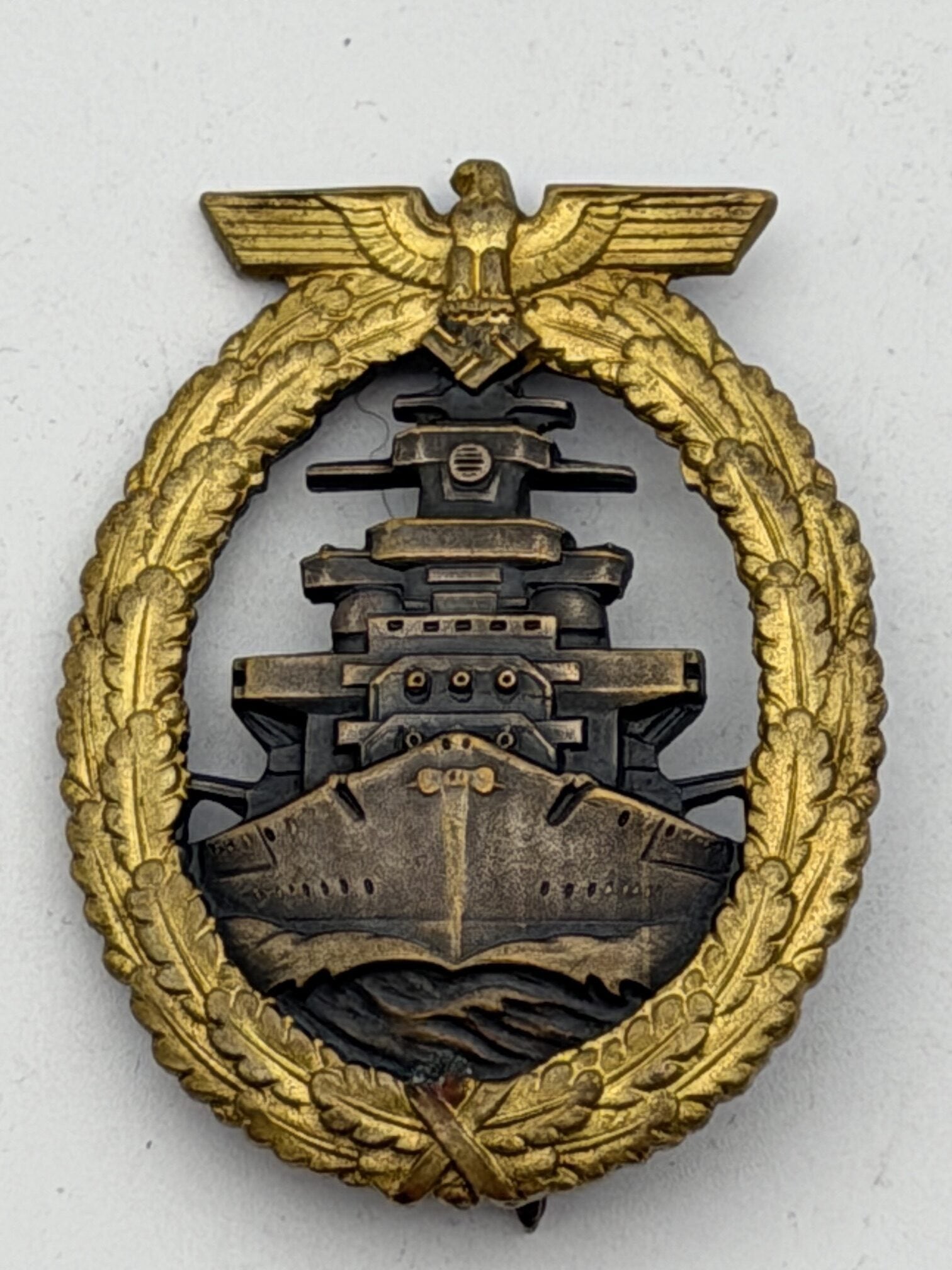
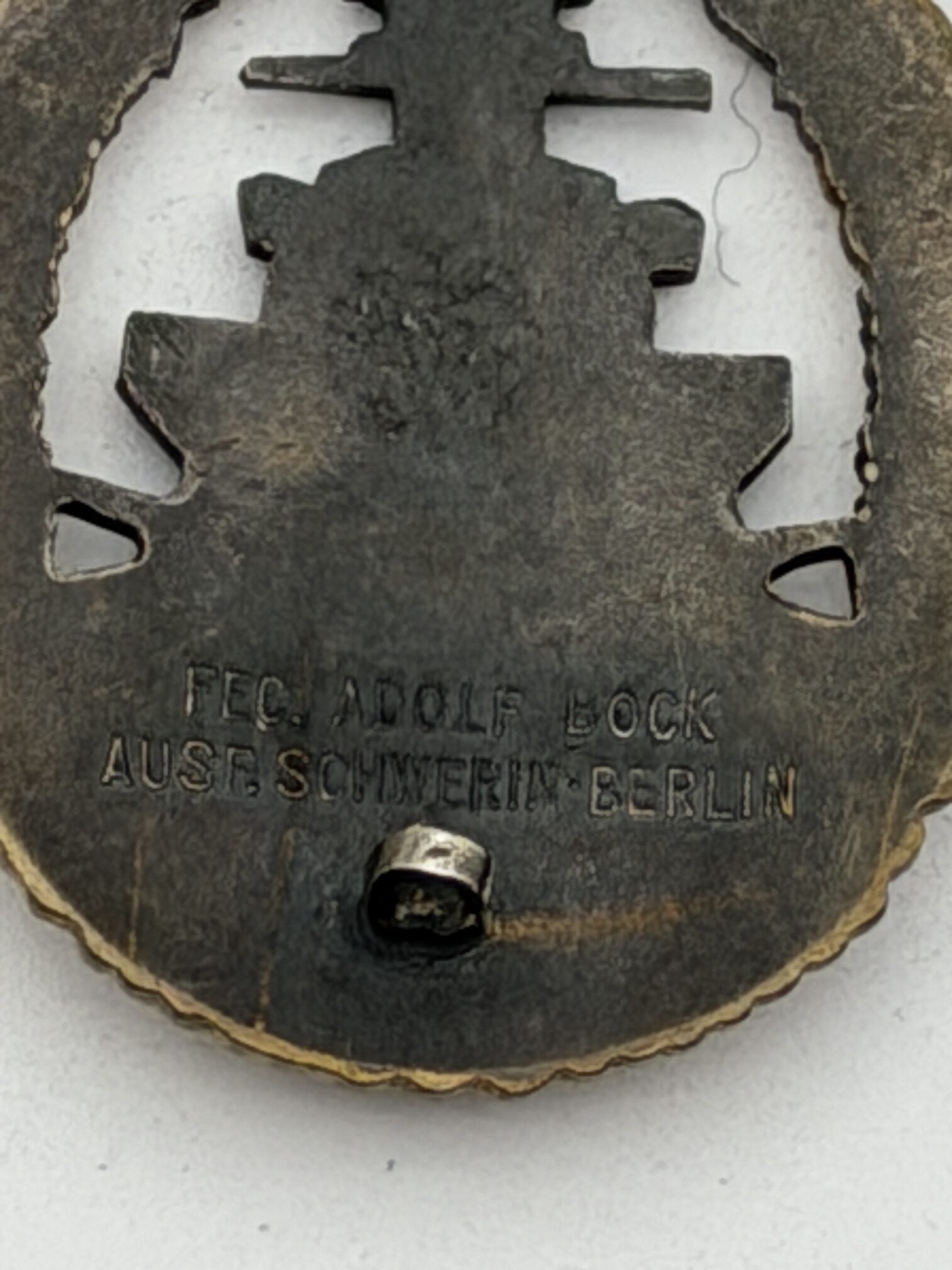
This original High Seas Fleet Badge is an early tombak example manufactured by C. Schwerin & Sohn of Berlin. The reverse carries the complete raised marking “FEC. ADOLF BOCK / AUSF. SCHWERIN BERLIN”. Moreover, its recorded weight of 33.35 grams corresponds closely with documented early Schwerin tombak badges.
€ 950
1 in stock
This original High Seas Fleet Badge is an early tombak example manufactured by C. Schwerin & Sohn of Berlin. The reverse carries the complete raised marking “FEC. ADOLF BOCK / AUSF. SCHWERIN BERLIN”. Moreover, its recorded weight of 33.35 grams corresponds closely with documented early Schwerin tombak badges.
The badge retains extensive gilt finish across the eagle and oak-leaf wreath. In addition, the central battleship preserves its contrasting darkened finish. Natural surface wear and age toning give the piece an attractive, unaltered appearance.
Großadmiral Erich Raeder instituted the Flotten-Kriegsabzeichen on 30 April 1941. It recognised qualifying operational service by Kriegsmarine personnel aboard battleships and cruisers.
Normally, a recipient required twelve weeks of service with good conduct. However, wounds, death in action, outstanding combat performance or the loss of a ship could shorten this requirement. The award appeared on the lower left breast of the naval uniform.
Berlin marine artist Adolf Bock designed the award. His design presents a heavily armed surface warship advancing directly through rough waves. A gilt oak-leaf wreath surrounds the ship, while the Kriegsmarine eagle crowns the composition.
The commanding frontal view produced a particularly forceful design. Consequently, the Flotten-Kriegsabzeichen became one of the most visually impressive naval combat awards of the period.
C. Schwerin & Sohn produced this High Seas Fleet Badge from tombak, also described in German references as Buntmetall. Early tombak badges generally display better definition and finish than later zinc production.
The front consists of three strongly contrasting elements:
The battleship displays its main armament, bridge windows, rangefinder, deck structures, portholes and pronounced bow. Furthermore, the sharply defined oak leaves and acorns retain substantial gilt finish.
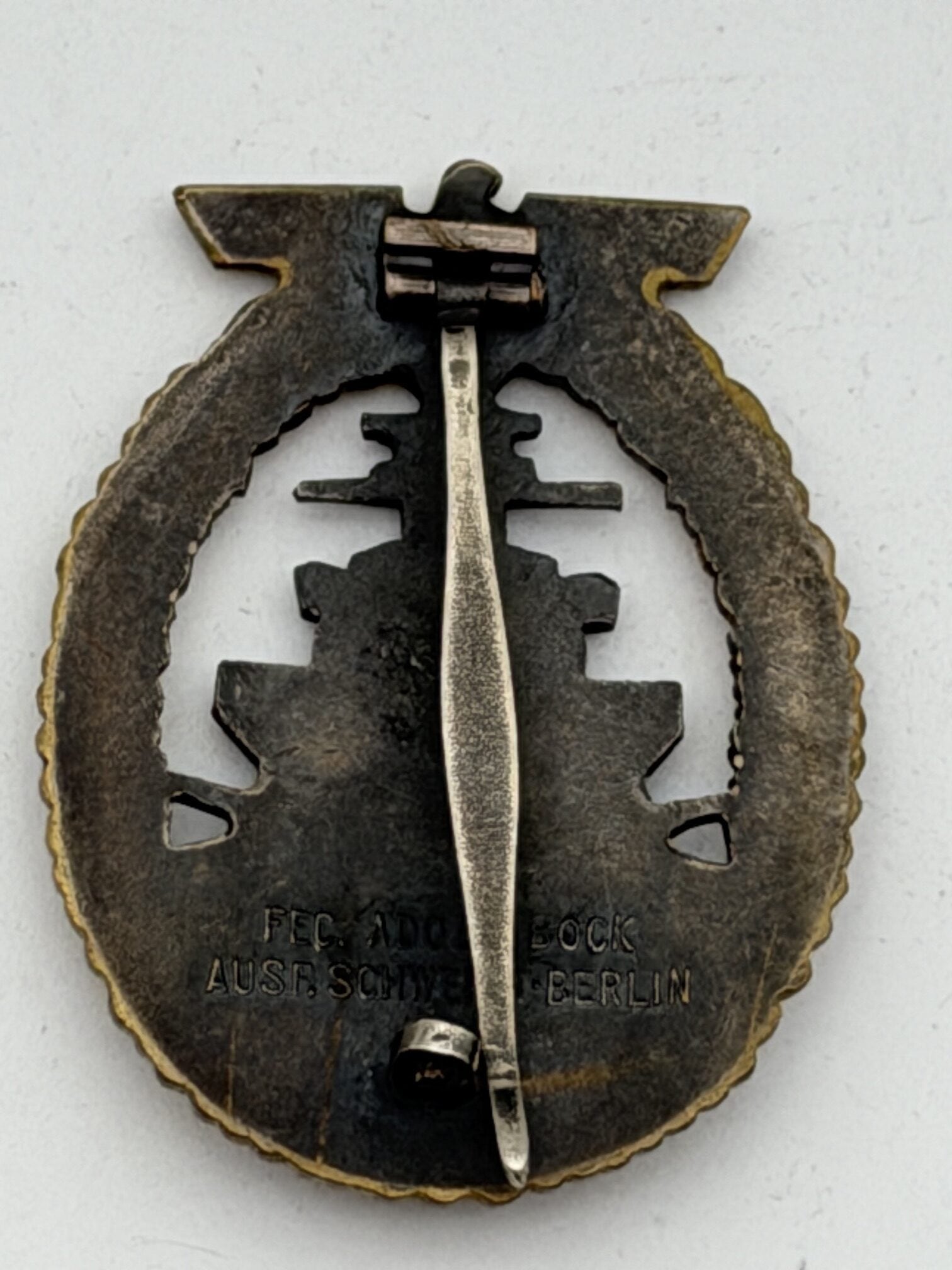
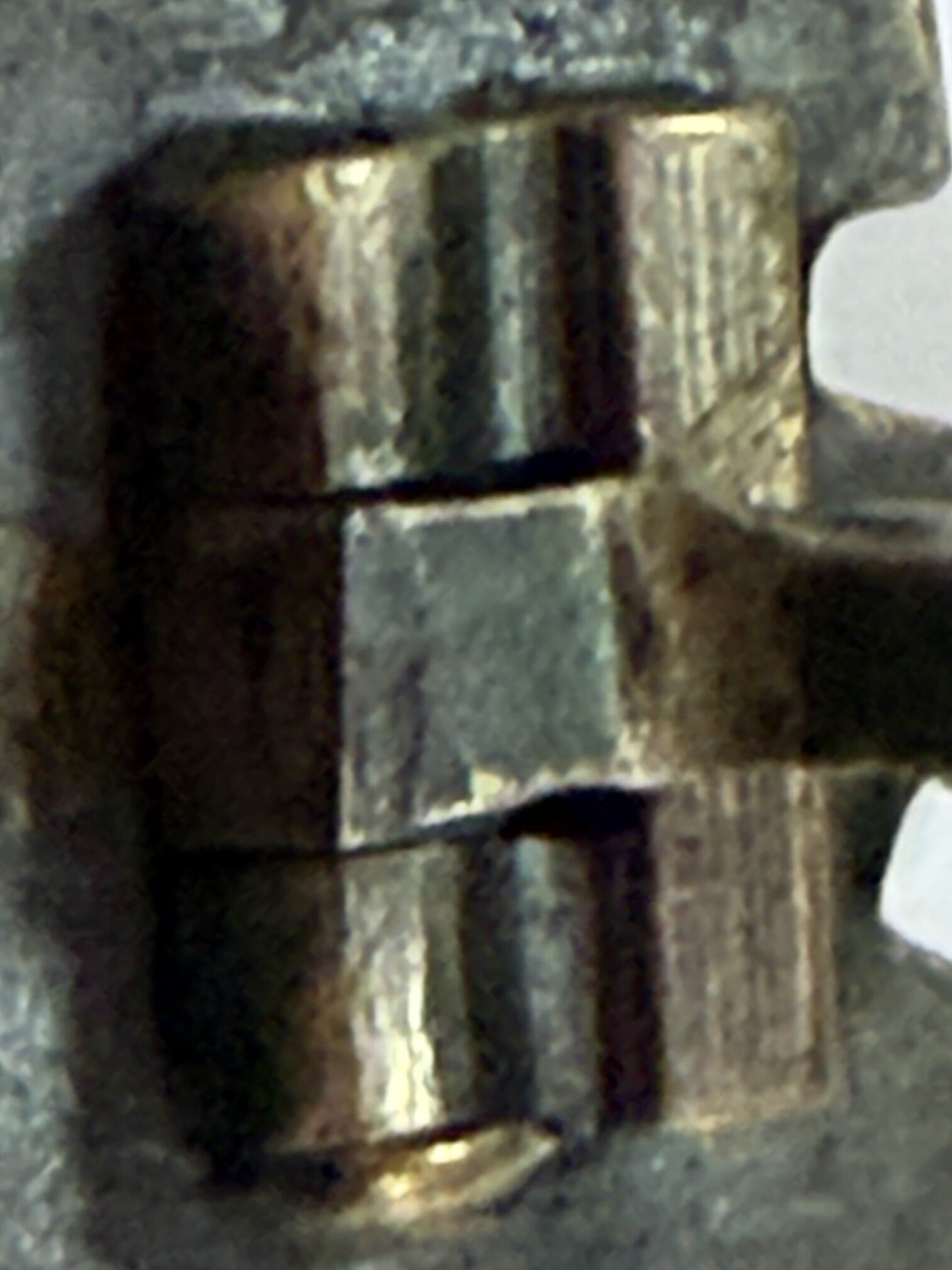
The reverse has the correct concave profile. It also retains a broad vertical pin, block hinge and formed retaining catch. The pin displays brighter contact wear, which is consistent with genuine use.
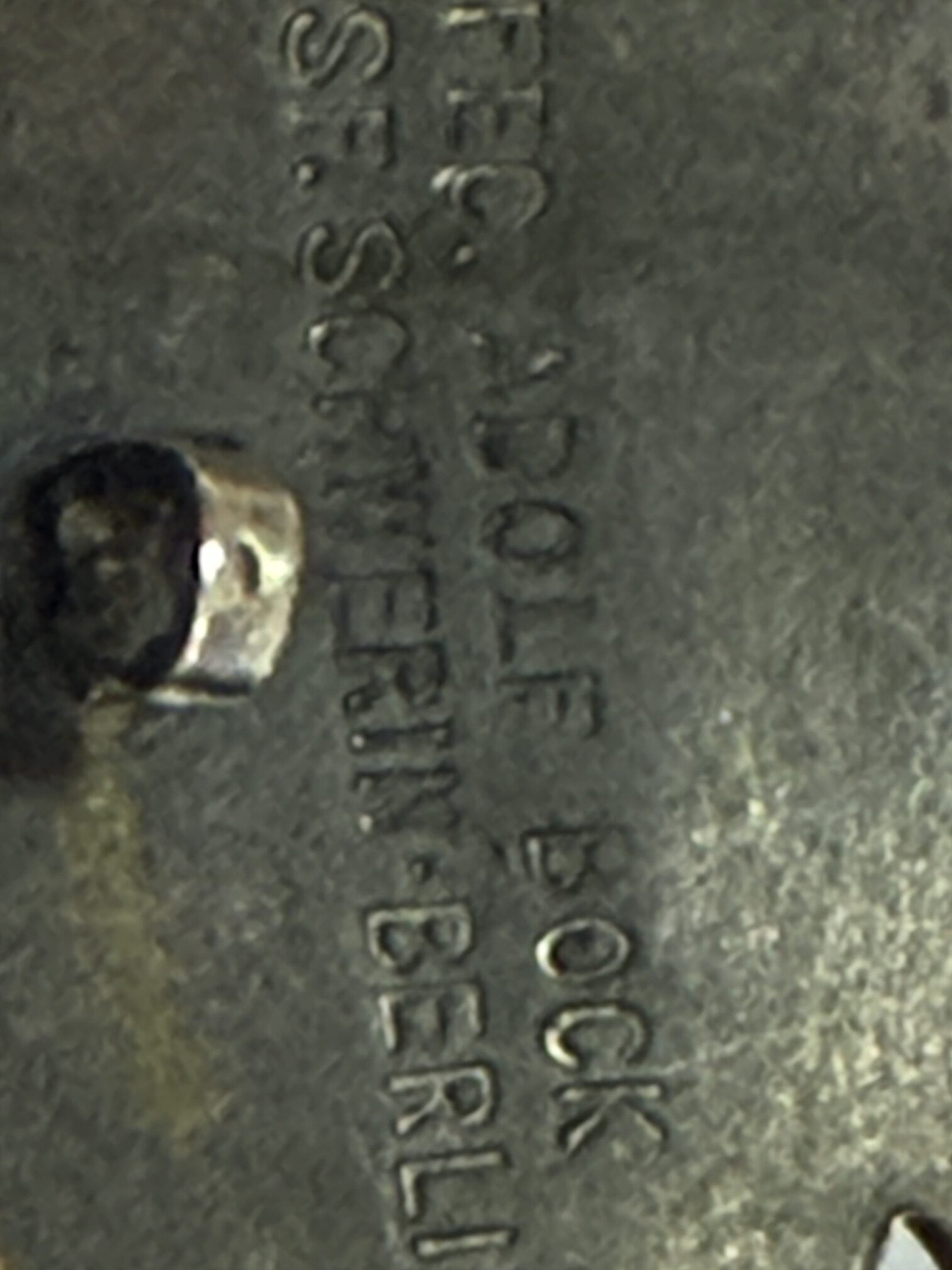
The complete reverse inscription reads:
FEC. ADOLF BOCK
AUSF. SCHWERIN BERLIN
The abbreviation “FEC.” derives from the Latin fecit and identifies Adolf Bock as the designer. Meanwhile, “AUSF.”abbreviates Ausführung and identifies Schwerin as the executing manufacturer. Therefore, the marking records both the designer and the Berlin maker.
The lettering has the expected raised formation, spacing and position. It appears as an integral part of the struck badge rather than a later-added marking.
This Schwerin badge weighs 33.35 grams. A published reference example of the same tombak Schwerin pattern weighs 34.39 grams and measures approximately 57.03 by 44.08 millimetres. The recorded weight of this badge is therefore entirely credible for the early tombak type.
Several characteristics support its identification as a period original:
Taken together, the die, material, hardware and marking provide a convincing combination. No clear evidence of modern reproduction or replaced fittings appears in the supplied photographs.
The High Seas Fleet Badge remains in very good, lightly worn condition.
The gilt wreath and eagle retain a particularly strong finish. However, gentle high-point wear remains visible on the raised oak leaves and eagle. The battleship has developed an attractive grey-brown patina, while darker finish survives around the superstructure and waves.
The reverse displays consistent age toning. In addition, the pin, hinge and catch remain complete. The pin shows expected contact wear from opening, closing and uniform use. No clear modern repair is visible from the supplied photographs.
The photographs show the badge only. No presentation case, packet or award document accompanies it unless separately stated.
Early tombak Schwerin badges rank among the most desirable standard-production versions of this Kriegsmarine award. Collectors value their crisp detail, contrasting finishes and fully named reverse marking.
This example offers several important advantages. It has retained extensive gilding, a clearly readable maker inscription and its characteristic Schwerin fastening system. Most importantly, its 33.35-gram weight supports the early tombak attribution.
The badge would complement a focused Kriegsmarine collection, a naval awards display or a broader collection of German combat decorations.
For related items, browse our internal Medals, Badges and Awards collection. Further specialist information appears in our Kriegsmarine Awards and War Badges reference volume.
For institutional comparisons, see the Imperial War Museums collection example. A period award certificate for service aboard the battleship Gneisenau also survives in the Deutsche Digitale Bibliothek collection.
An original early-production High Seas Fleet Badge by Schwerin, Berlin. This attractive tombak example retains strong gilt finish, excellent battleship detail and a complete fastening system. The full Adolf Bock and Schwerin inscription remains clearly legible. Furthermore, the recorded weight of 33.35 grams compares favourably with accepted original examples.
Berlin marine artist Adolf Bock designed the badge. The wording “FEC. ADOLF BOCK” records his role as designer.
C. Schwerin & Sohn of Berlin manufactured it. The second line, “AUSF. SCHWERIN BERLIN,” identifies the executing maker.
Yes. The exposed yellow-toned base metal, surviving finish, construction and 33.35-gram weight support an early tombak attribution.
The vertical pin, block hinge and retaining catch are present. No clear modern replacement or repair appears in the photographs.
Explore related listings: Heer, Luftwaffe, Kriegsmarine.