
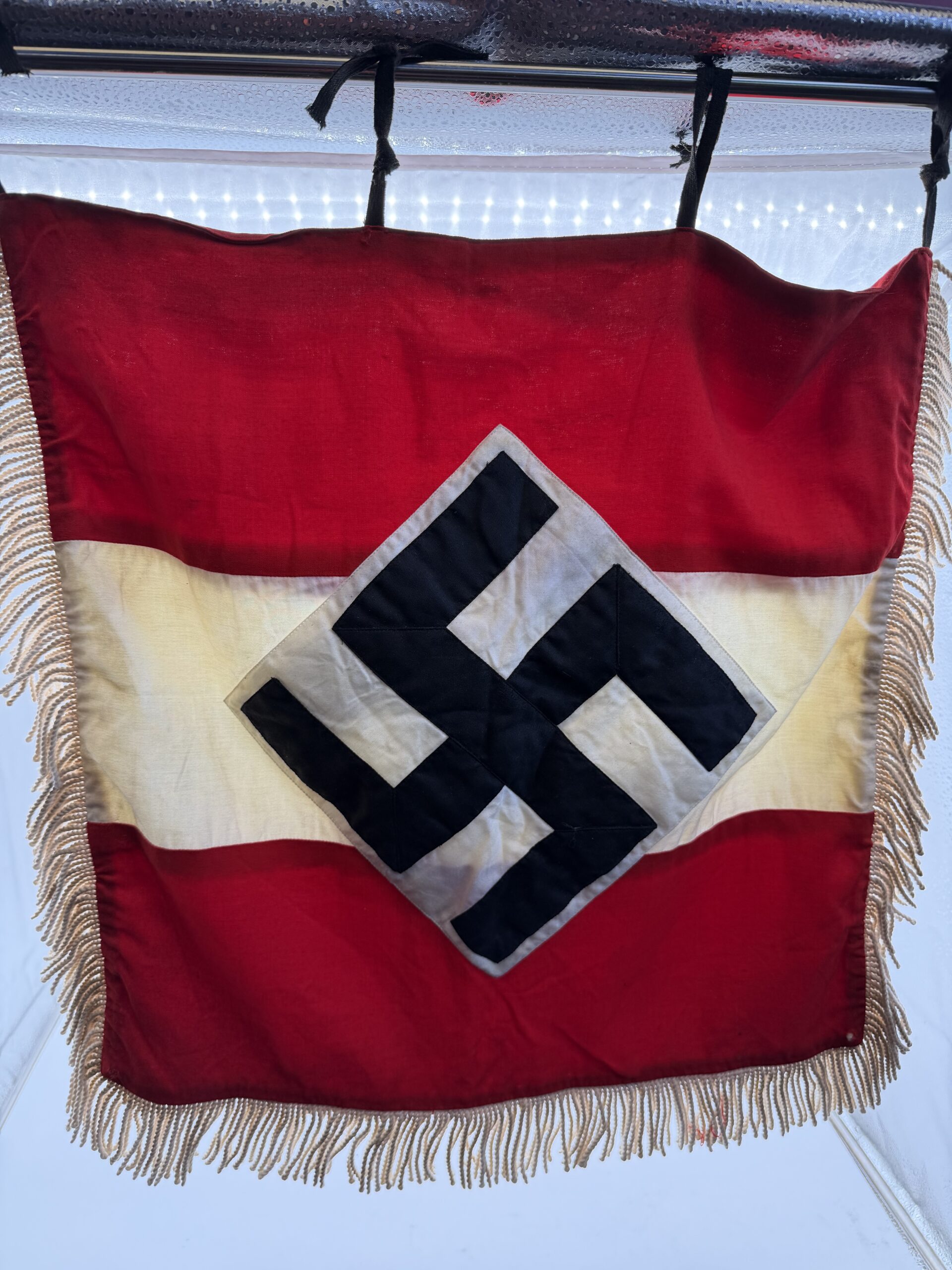
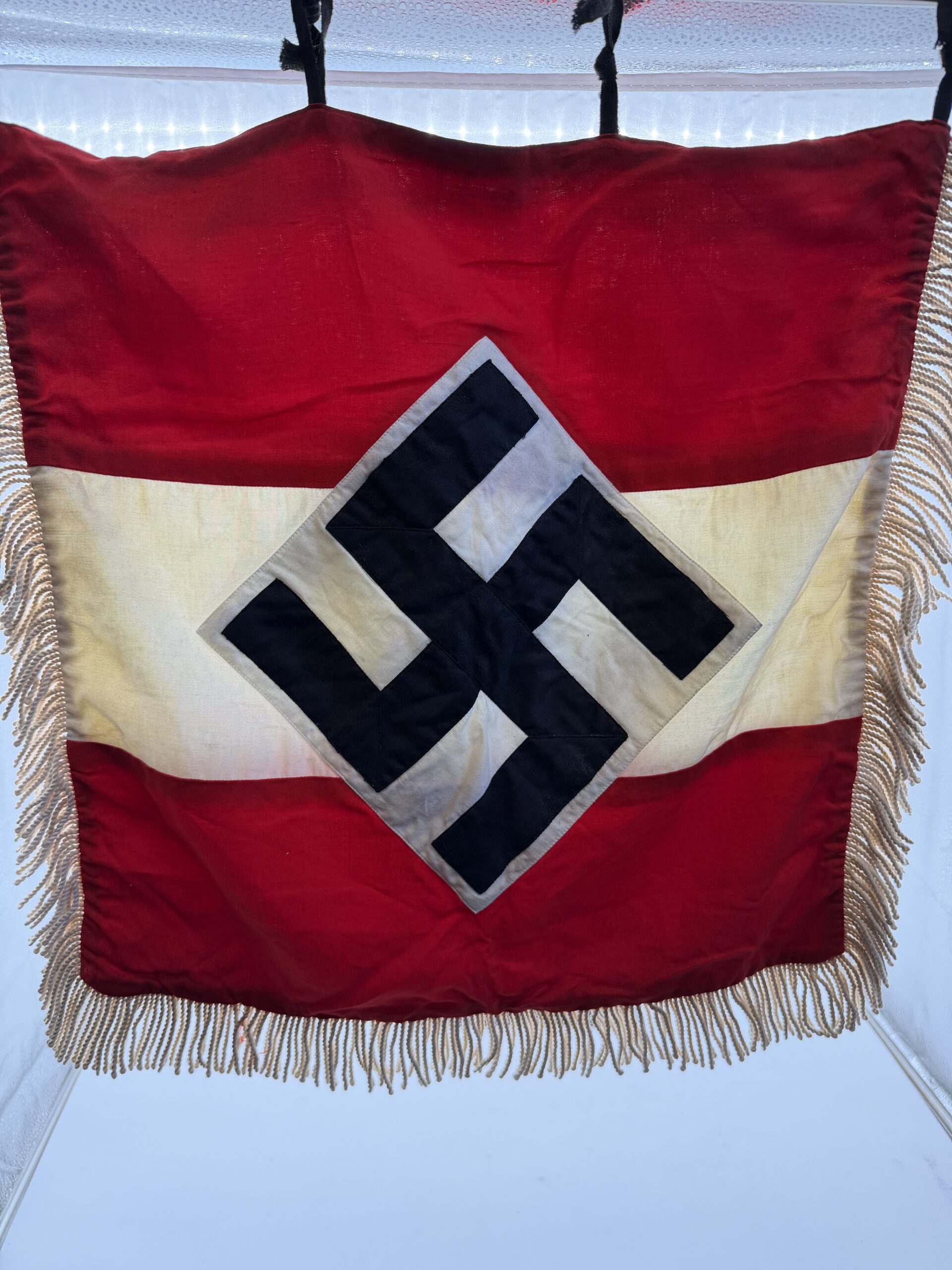
This Hitler Youth trumpet banner represents an attractive surviving example of the ceremonial textile equipment carried by Hitlerjugend musical formations during the Third Reich. Its bold red, white and black design follows the organisational colours of the Hitler Youth. Furthermore, its square format, suspension ties and decorative fringe identify it as a banner intended for attachment to a fanfare trumpet or similar ceremonial brass instrument.
€ 950
1 in stock
This Hitler Youth trumpet banner represents an attractive surviving example of the ceremonial textile equipment carried by Hitlerjugend musical formations during the Third Reich. Its bold red, white and black design follows the organisational colours of the Hitler Youth. Furthermore, its square format, suspension ties and decorative fringe identify it as a banner intended for attachment to a fanfare trumpet or similar ceremonial brass instrument.
The banner uses a double-sided, multi-piece construction. Each face carries the familiar Hitler Youth design of red upper and lower fields divided by a broad white horizontal band. A large white diamond sits at the centre. Black cloth forms the swastika within that diamond.
Unlike a printed flag, the maker assembled this banner from separately cut textile components. The construction therefore required considerable hand preparation and machine sewing. This feature gives the banner a strong visual presence and distinguishes it from inexpensive printed flags and later decorative reproductions.
The item should appeal to collectors of Third Reich uniforms and insignia, political organisation textiles, ceremonial equipment and original Hitler Youth material.
The Hitlerjugend, usually abbreviated to HJ, served as the youth organisation of the National Socialist German Workers’ Party. It developed several divisions according to age and gender. These included the Hitler Youth for boys aged approximately 14 to 18 and the Deutsches Jungvolk for younger boys.
After 1933, the Nazi regime used these organisations to control leisure activities, education, physical training and political instruction. Membership expanded rapidly during the 1930s. German legislation and administrative pressure later made youth service effectively compulsory for most eligible children. The organisation combined sport, marching, camping, ideological instruction and increasingly military-style preparation.
Musical formations played an important role in Hitler Youth public ceremonies. Fanfare and marching bands accompanied parades, rallies, sporting events, commemorations and local gatherings. Trumpets, fanfares and drums created an organised military appearance. In addition, they helped transform public youth activities into carefully managed political spectacles.
The Hitler Youth trumpet banner hung from the body of the instrument below the player’s hands. As the musician marched, the banner displayed the organisation’s emblem towards spectators. The fringe emphasised movement and increased the banner’s ceremonial appearance.
For broader historical context, the United States Holocaust Memorial Museum’s Hitler Youth overview explains the organisation’s development and role in the ideological indoctrination of German children. Its Hitler Youth collection gallery also illustrates related uniforms, insignia and period material.
The banner displays substantial traditional textile construction. The maker joined red and cream-white panels to create the principal field. Each face then received a separate white diamond and a separately assembled black emblem.
The two faces show minor differences in alignment and shape. These variations are consistent with individually prepared appliqué work. They also demonstrate that the design was not simply printed through a single layer of fabric.
The black swastika consists of several carefully cut fabric sections. The maker folded or finished the edges before securing the emblem to the white diamond. Machine stitching follows the principal contours. Meanwhile, the diamond itself sits as a separate applied component rather than forming part of the white horizontal stripe.
This layered method gives the emblem a slightly raised appearance. It also produces visible seam lines, folds and minor variations that collectors expect from individually assembled period textiles.
Both sides carry a complete Hitler Youth emblem. Consequently, the design remained visible regardless of the direction in which the musician faced.
The red material retains a strong colour. However, it also displays natural variation caused by age, storage and exposure. The central white bands have developed cream toning, particularly towards the edges and folds. Similar age-related toning appears around the white diamonds.
The black appliqué remains dark and provides a strong contrast against the lighter central field. Although both faces follow the same general layout, small differences remain visible in the placement of the swastikas and diamonds. These irregularities enhance the banner’s individually constructed character.
Four black textile ties remain attached along the upper edge. These straps secured the banner to the trumpet or fanfare. Their survival adds significantly to the banner’s completeness because suspension ties often became detached or shortened through use.
A twisted cream-coloured fringe runs along both vertical sides and the lower edge. Most of the fringe remains present. It shows expected compression, minor tangling and small areas of disturbance. Nevertheless, it continues to frame the banner effectively.
The upper edge lacks fringe because this section rested against the instrument. Instead, the maker finished it as a practical reinforced attachment edge.
Together, the suspension system and three-sided fringe confirm that the object served as a musical banner rather than a conventional wall flag, podium cloth or vehicle pennant.
The banner survives in good displayable condition for an original ceremonial textile of this period.
The red cloth shows creasing, minor surface marks and uneven colour associated with age and storage. The white material displays visible yellowing and scattered discolouration. However, this toning remains consistent with the overall age of the object.
Both central emblems remain complete. The machine stitching appears largely secure, while the separately applied black and white components retain their intended shape. The fringe remains substantially complete, although individual strands show age, compression and occasional displacement.
The four black suspension ties remain present. They show wear and minor fraying, particularly towards their loose ends. This wear appears compatible with actual attachment and handling.
No modern repairs, replaced panels or added insignia can be confirmed from the supplied photographs. Nevertheless, a physical inspection remains necessary before issuing an unconditional guarantee of originality.
Several visible features support a period attribution:
The banner has double-sided construction rather than a printed reverse. It uses separately joined red and white fields. In addition, each face carries individually applied white and black textile components.
The stitching shows natural variation. The two emblems do not match with modern mechanical precision. Moreover, the white panels and fringe display uneven oxidation rather than uniform artificial staining.
The suspension ties also show convincing age and use. Their placement corresponds with the banner’s intended attachment to a musical instrument.
However, reproductions of Hitler Youth trumpet banners have circulated for many years. Some copies also use multi-piece construction and decorative fringe. Therefore, photographs alone cannot provide absolute authentication.
Before sale, the banner should undergo examination under normal and ultraviolet light. The inspection should cover every colour of cloth, the sewing threads, the fringe and the suspension ties. Magnified photographs of the seams and the attachment of the fringe would also strengthen the catalogue record.
Subject to satisfactory physical examination, the object may be described as an original Third Reich Hitler Youth fanfare trumpet banner, circa 1933–1945.
Original organisational banners form an important specialist area within political and ceremonial militaria. Unlike badges or mass-produced metal insignia, textiles suffered heavily from use, post-war destruction, damp storage and deliberate disposal.
Trumpet banners faced additional risks. They hung outdoors during marches, moved continuously while in use and often encountered rain, dust and repeated handling. The narrow attachment ties and loose fringe also made them vulnerable to damage.
This example retains its main textile field, both appliquéd emblems, four suspension ties and most of its original fringe. Therefore, it presents well and offers a strong visual representation of Hitler Youth musical and ceremonial culture.
Collectors wishing to study comparable flags and construction methods may also consult Flags and Banners of the Third Reich by A. S. Walker or browse the wider military books and reference section.
This Hitler Youth trumpet banner combines strong visual appeal with noteworthy period-style construction. Its red, white and black multi-piece design immediately identifies the Hitler Youth organisation. Meanwhile, the square format, four upper suspension ties and three-sided fringe establish its ceremonial musical function.
Both faces retain separately assembled appliqué emblems. The fabric shows age-related toning, creasing and minor marks, while the fringe and attachment ties display believable evidence of handling. Most importantly, the banner remains substantially complete and suitable for display.
Although final authentication should always include direct textile examination and ultraviolet testing, the visible construction provides several encouraging indications of period manufacture. Consequently, this banner deserves consideration as a scarce surviving example of Hitler Youth fanfare equipment and as a significant addition to an advanced collection of Third Reich ceremonial textiles.
Object: Fanfare trumpet banner
Organisation: Hitlerjugend
German terminology: HJ-Fanfarentuch, Fanfarenbehang or Trompetenbanner
Period: Circa 1933–1945
Construction: Double-sided, multi-piece textile appliqué
Colours: Red, cream-white and black
Attachment: Four black suspension ties
Decoration: Twisted light-coloured fringe on three edges
Condition: Good, with age toning, creasing, marks and minor fringe disturbance
Explore related listings: Miscellaneous.