
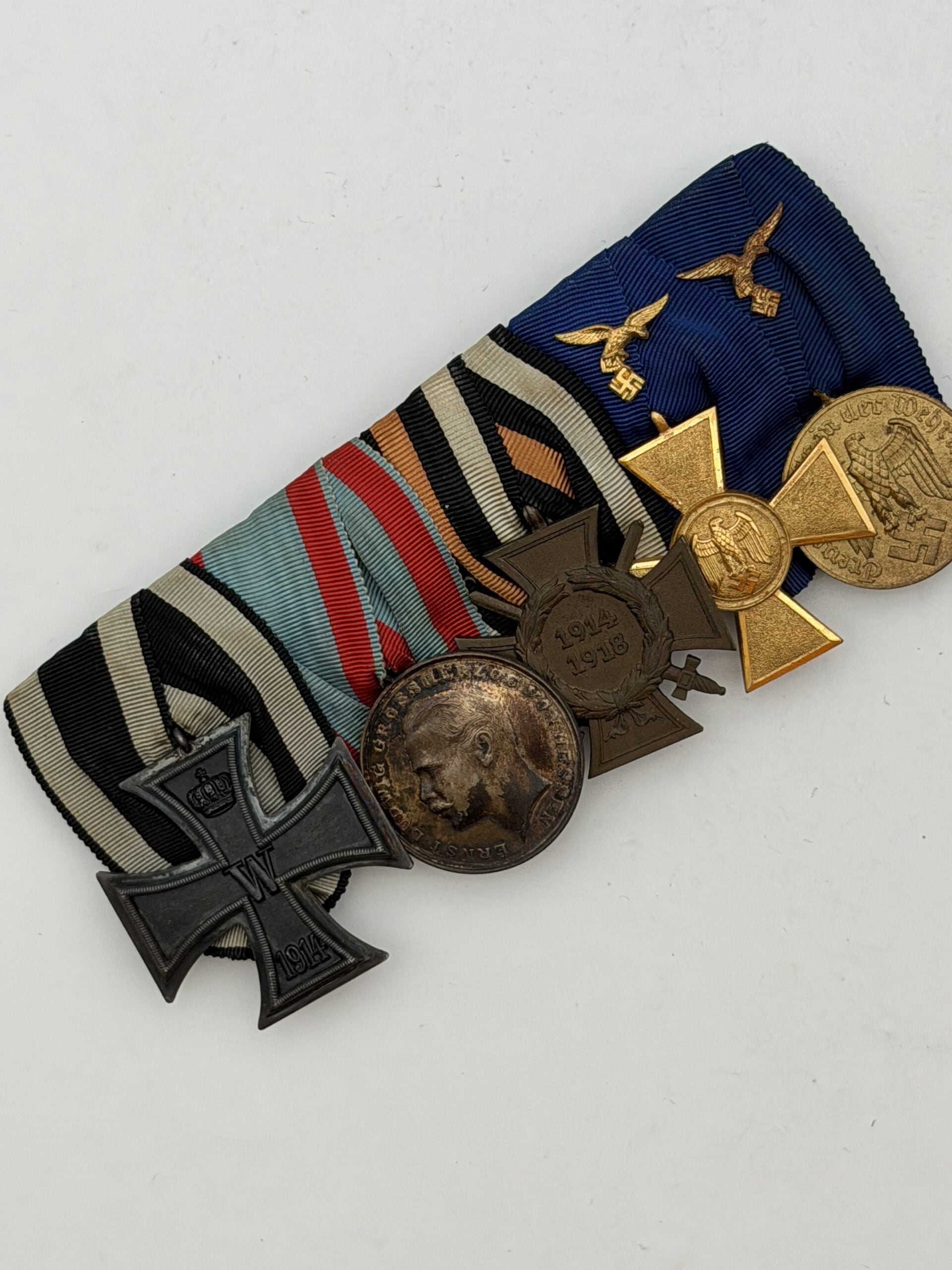
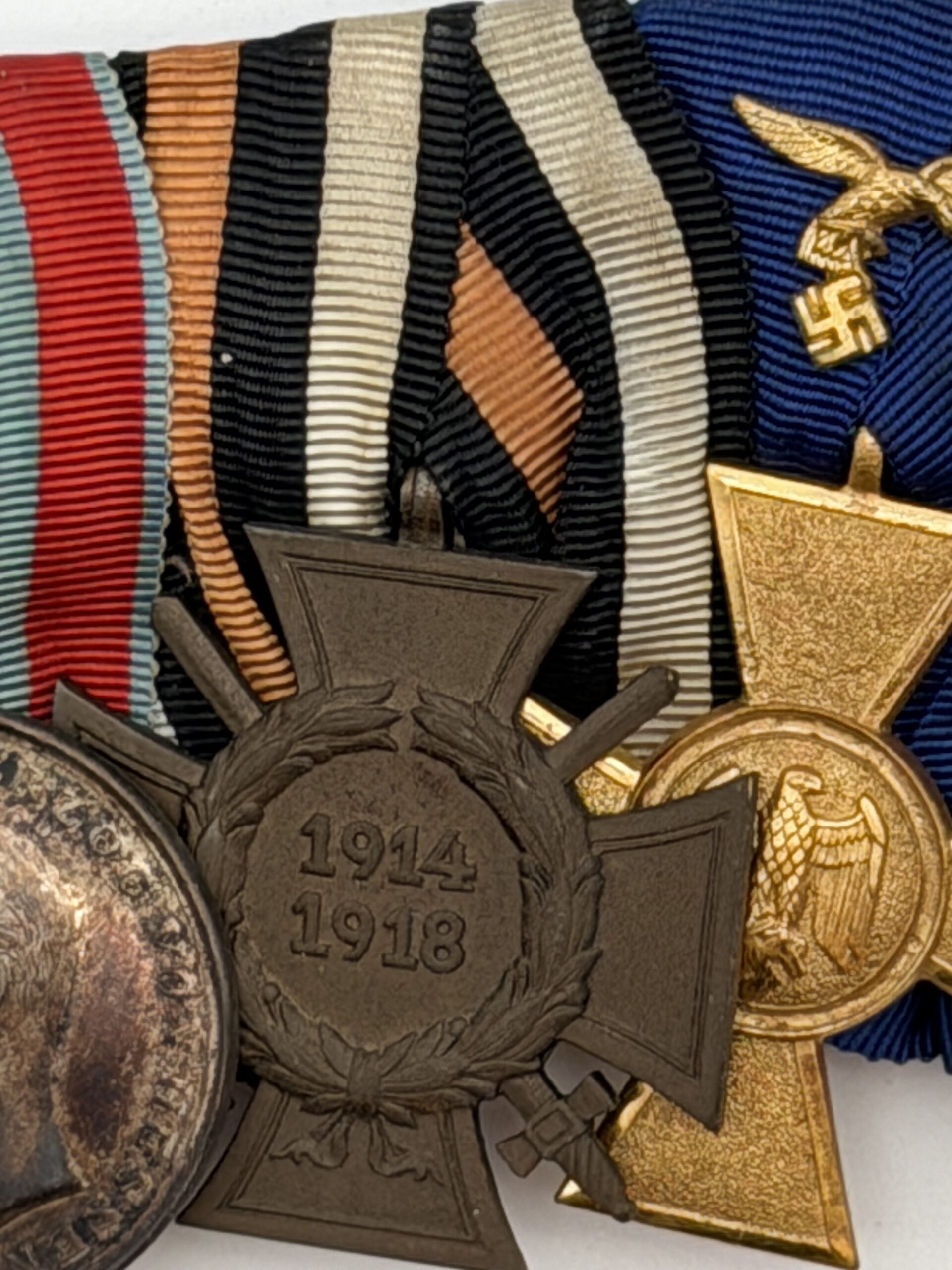
This exceptional Kuno Heribert Fütterer medal bar is attributed to General der Flieger Kuno Heribert Fütterer, one of the senior career officers of the German Luftwaffe. More importantly, the five-place group charts a military career that began during the First World War and continued through the Reichswehr period into senior Luftwaffe service.
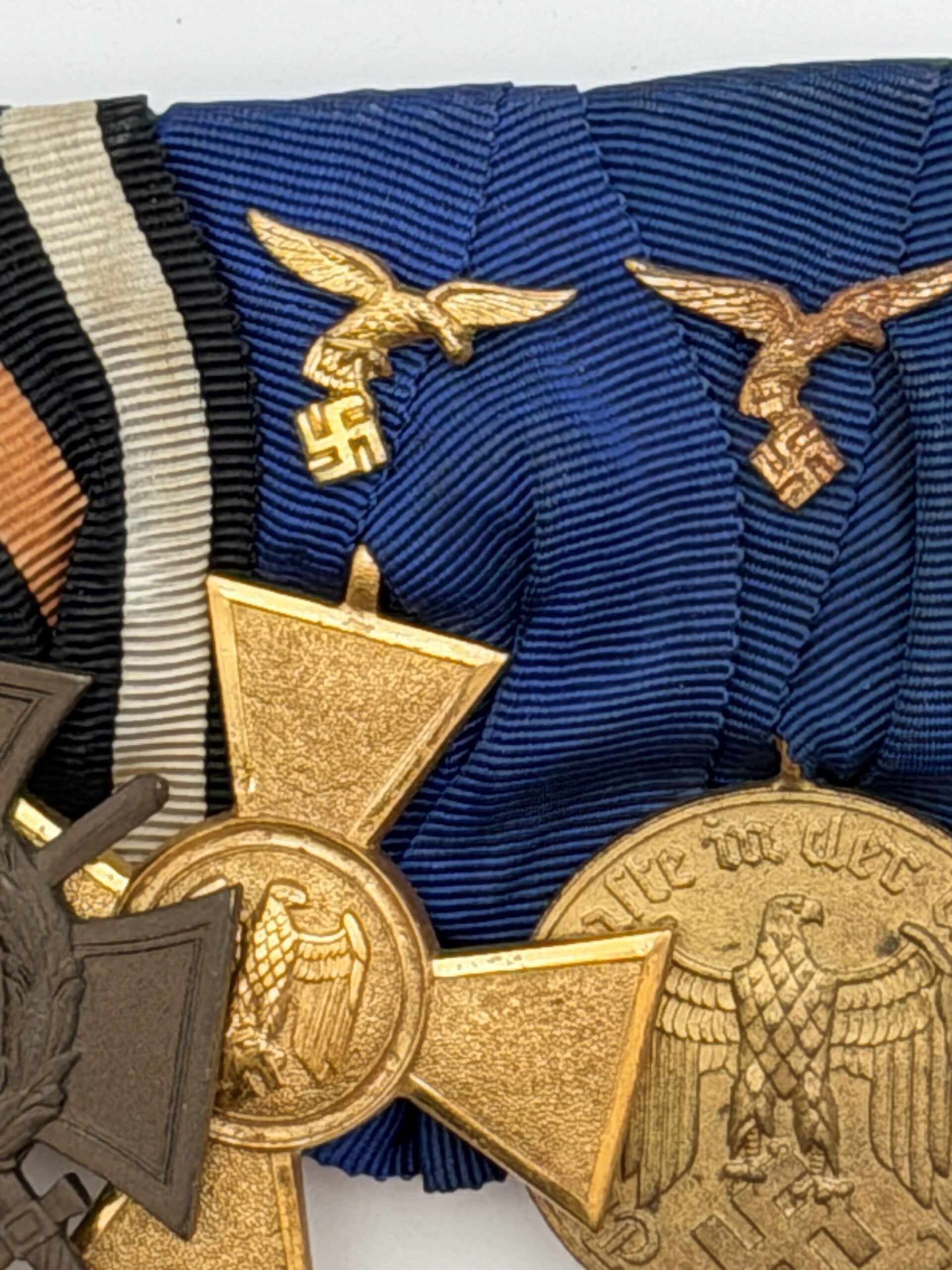
The bar contains the 1914 Iron Cross 2nd Class, Hessian Ernst Ludwig Bravery Medal, Honour Cross of the World War 1914–1918 with Swords, 25-Year Wehrmacht Long Service Cross and 12-Year Wehrmacht Long Service Medal. Both long-service awards retain Luftwaffe flying-eagle ribbon devices, directly identifying the branch in which Fütterer completed his later career.
Published auction evidence provides particularly strong support for the attribution. Ratisbon’s previously catalogued what appears to be this exact medal bar as belonging to General der Flieger Kuno Heribert Fütterer in its Treasures of the Luftwaffe – 12th USA Auction. Therefore, the group should no longer be treated merely as an anonymous Luftwaffe veteran’s medal bar.
€ 1.800
1 in stock
This exceptional Kuno Heribert Fütterer medal bar is attributed to General der Flieger Kuno Heribert Fütterer, one of the senior career officers of the German Luftwaffe. More importantly, the five-place group charts a military career that began during the First World War and continued through the Reichswehr period into senior Luftwaffe service.
The bar contains the 1914 Iron Cross 2nd Class, Hessian Ernst Ludwig Bravery Medal, Honour Cross of the World War 1914–1918 with Swords, 25-Year Wehrmacht Long Service Cross and 12-Year Wehrmacht Long Service Medal. Both long-service awards retain Luftwaffe flying-eagle ribbon devices, directly identifying the branch in which Fütterer completed his later career.
Published auction evidence provides particularly strong support for the attribution. Ratisbon’s previously catalogued what appears to be this exact medal bar as belonging to General der Flieger Kuno Heribert Fütterer in its Treasures of the Luftwaffe – 12th USA Auction. Therefore, the group should no longer be treated merely as an anonymous Luftwaffe veteran’s medal bar.
Instead, it represents a published and attributable career group associated with a named German general officer.
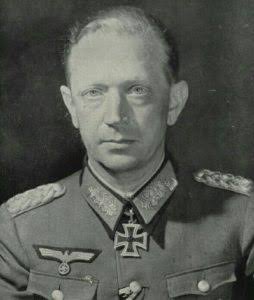
Kuno Heribert Fütterer was born in 1894 and entered Imperial German military service during the opening period of the First World War. Initially commissioned into the Prussian Army, he subsequently transferred to flying service during the conflict.
His wartime record included the award of both classes of the Iron Cross together with the Hessian bravery decoration represented on this bar. Consequently, the surviving medal group corresponds closely with decorations known from his First World War career.
Following Germany’s defeat in 1918, Fütterer remained within the much-reduced professional armed forces. His continued Reichswehr service later enabled him to become part of the experienced officer cadre from which the rapidly expanding Luftwaffe drew many senior commanders.
During the Third Reich period, Fütterer rose through the Luftwaffe hierarchy. Among his appointments was service connected with Hungary, including senior Luftwaffe representation and air attaché duties.
By the closing stages of the Second World War he had reached the senior rank of General der Flieger.
The combination of Imperial, Reichswehr-era service entitlement and Luftwaffe long-service decorations seen here is therefore completely compatible with his documented military career.
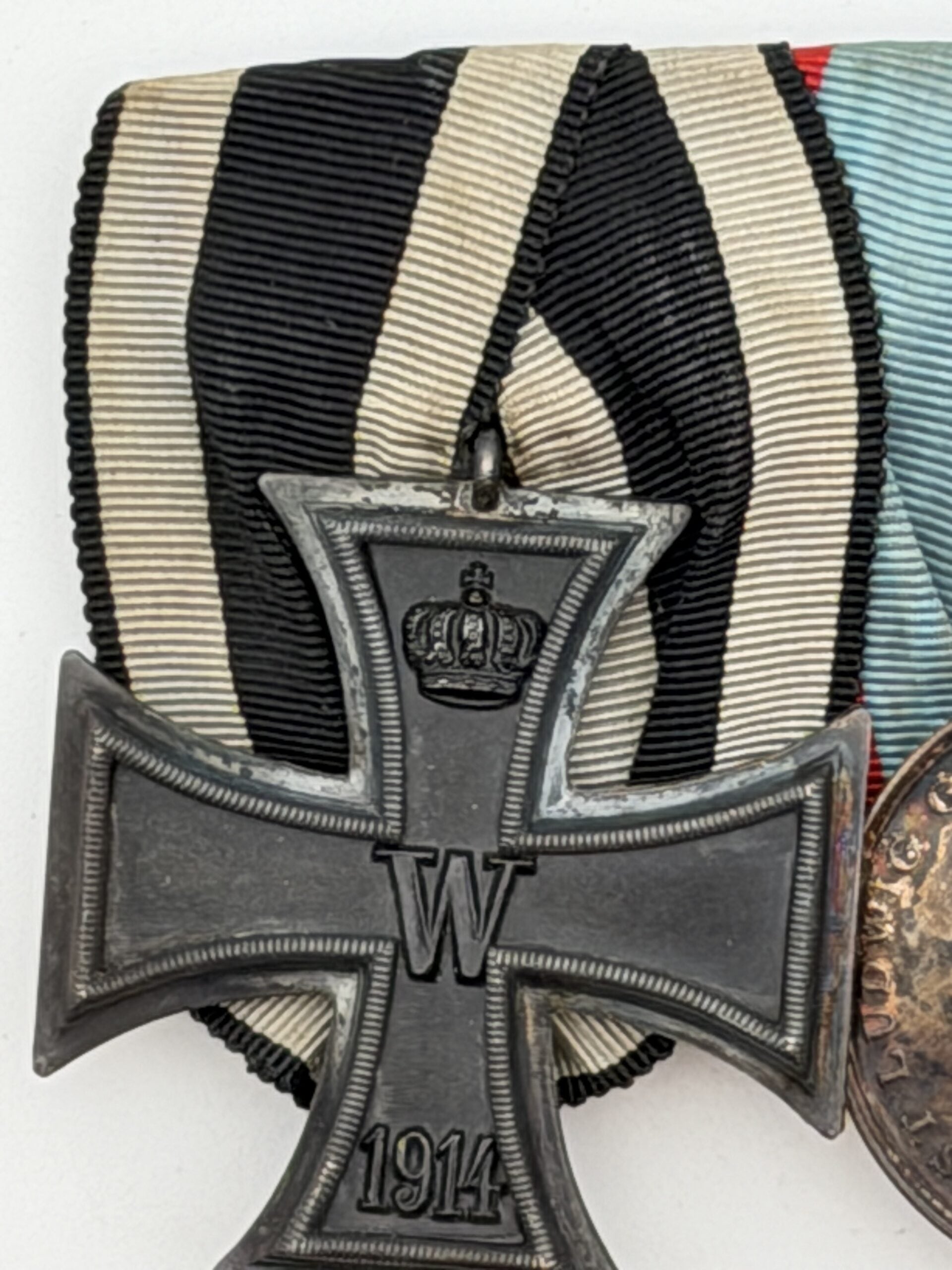
At the beginning of the bar sits the Eisernes Kreuz 2. Klasse 1914.
The decoration retains the familiar Imperial German design with a blackened iron centre surrounded by a silver-coloured frame. Its obverse carries the Prussian crown, the royal cypher W and the date 1914.
Fütterer’s award of the Iron Cross during the First World War provides an important link between the physical medal bar and his recorded service.
Age has produced attractive darkening and surface patination. Nevertheless, the cross retains strong detail and an appearance entirely consistent with a period-worn award.
Further historical information concerning the Iron Cross can be found through the Deutsches Historisches Museum.
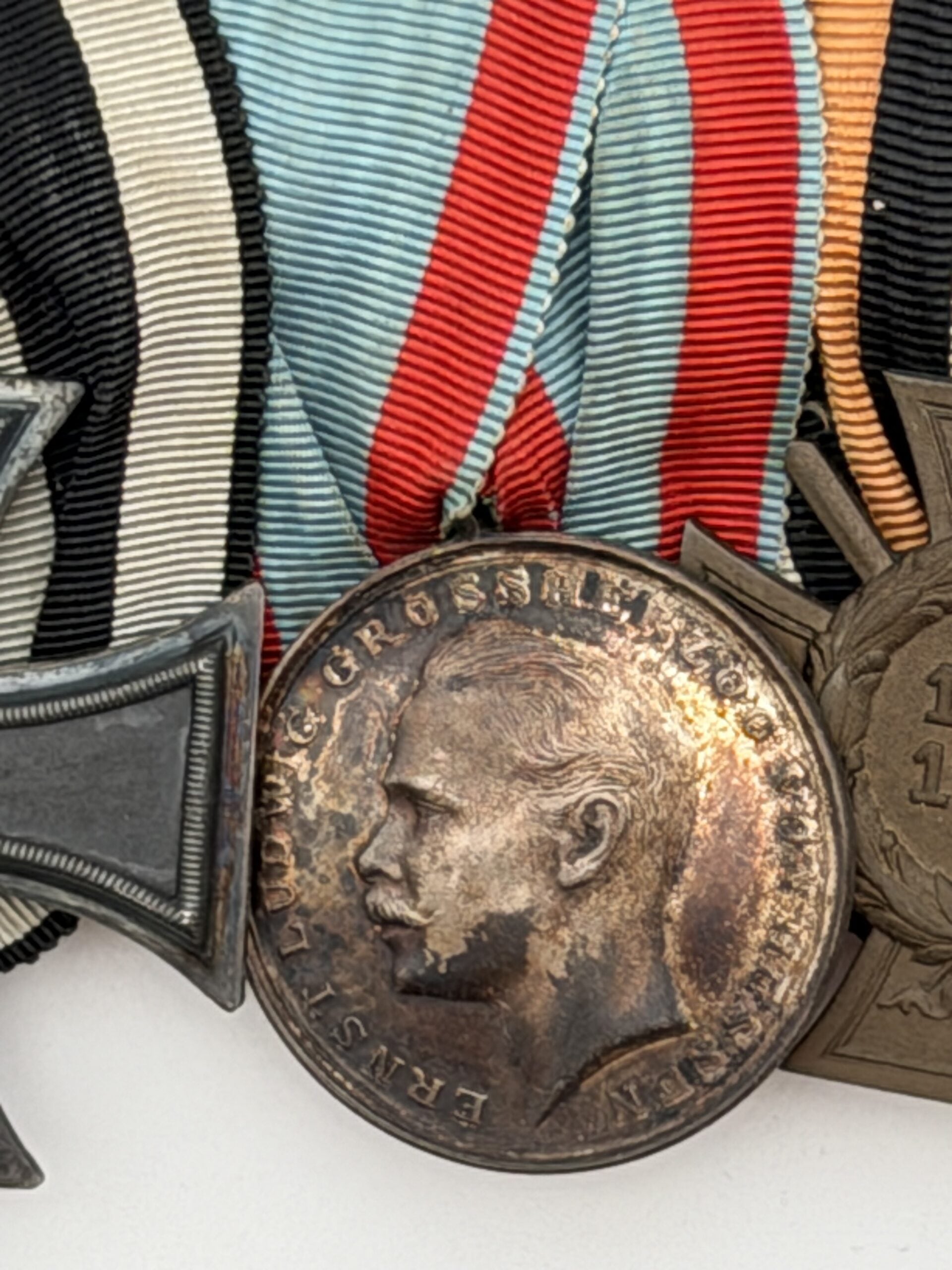
The second decoration carries the portrait of Grand Duke Ernst Ludwig of Hesse.
Its inscription identifies the ruler as ERNST LUDWIG GROSSHERZOG VON HESSEN, while the pale blue and red ribbon corresponds with the Hessian wartime award commonly associated with the Für Tapferkeit, or “For Bravery,” decoration.
This award has particular importance within the group because Fütterer is recorded as having received a Hessian bravery decoration during the First World War.
Heavy natural toning now covers much of the medal. However, the portrait remains well defined, while traces of the original surface survive around the lettering and raised detail.
A closely comparable Hessian bravery medal is held by the Australian War Memorial.
Because the reverse remains hidden beneath the mounted arrangement, it cannot be confirmed photographically without disturbing the bar. Accordingly, the medal should remain untouched rather than being removed simply to inspect the inscription.
Occupying the central position is the Ehrenkreuz des Weltkrieges 1914/1918 für Frontkämpfer.
President Paul von Hindenburg instituted this decoration in 1934. The version with crossed swords recognised frontline military service during the First World War.
Its central wreath encloses the dates 1914–1918, while crossed swords appear between the lower arms. Furthermore, the award hangs from the regulation black, white and red ribbon.
Within this group, the Honour Cross reinforces the First World War combat status already indicated by the Iron Cross and Hessian decoration.
A museum reference example can be studied through the Imperial War Museums.
The fourth decoration is the gilt Wehrmacht-Dienstauszeichnung 1. Klasse für 25 Jahre.
A gilt national eagle occupies its central medallion, while the eight-pointed cross retains an attractive original finish. Above the award sits a cornflower-blue ribbon fitted with a gilt Luftwaffe flying-eagle device.
This ribbon eagle is particularly significant because it identifies the wearer’s branch as the Luftwaffe.
Germany introduced the Wehrmacht long-service awards in 1936. Previous qualifying military service could be credited toward the required total, including periods of service before the creation of the Luftwaffe.
Accordingly, Fütterer’s Imperial Army and Reichswehr career provides the logical foundation for his entitlement to the 25-year award.
The original regulations governing these decorations can be consulted in the 1936 Reichsgesetzblatt.
At the far right sits the circular gilt Wehrmacht-Dienstauszeichnung 3. Klasse für 12 Jahre.
The obverse displays the German national eagle together with the inscription TREUE DIENSTE IN DER WEHRMACHT. Once again, the blue ribbon carries a gilt Luftwaffe flying-eagle device.
This decoration deserves special clarification.
A previous auction description identified the circular medal as an eight-year service award. However, Wehrmacht long-service regulations did not establish an eight-year grade.
The recognised classes were based on 4, 12, 18 and 25 years of service.
Therefore, the circular gilt decoration represented here is correctly identified as the 12-Year Wehrmacht Long Service Medal.
Furthermore, regulations permitted the 25-year cross to be worn alongside the 12-year medal. The combination seen on this medal bar is consequently regulation-correct.
One of the strongest features of the Kuno Heribert Fütterer medal bar is its previously published auction attribution.
Ratisbon’s offered an apparently identical five-place group as:
“Medal Bar – General der Flieger Kuno Heribert Fütterer.”
The bar appeared in the specialist Treasures of the Luftwaffe – 12th USA Auction.
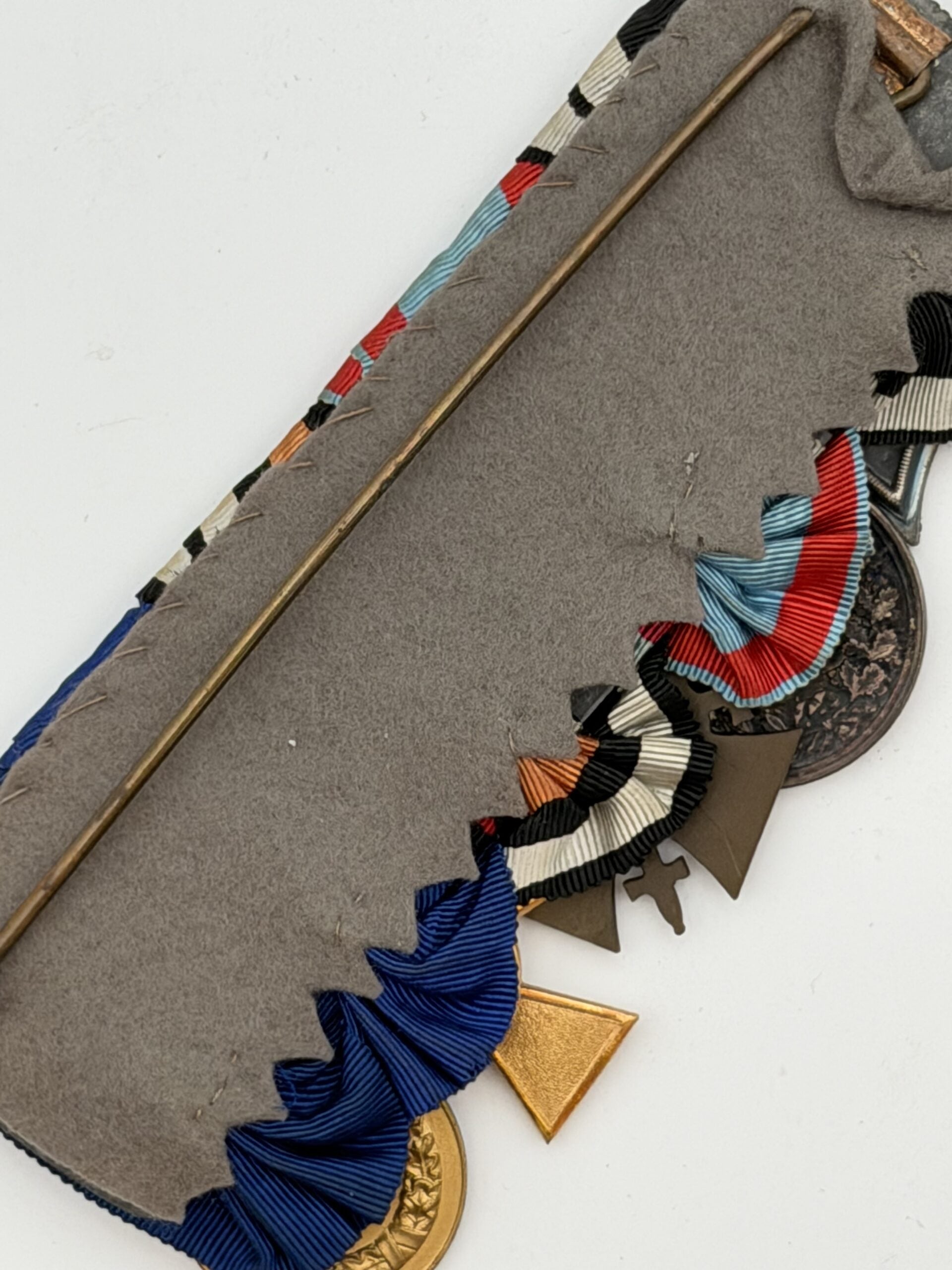
That catalogue described the same sequence of decorations seen on the present bar. In addition, the reverse construction was recorded with grey backing material and a long attachment needle, matching the surviving assembly shown here.
The auction achieved a hammer price of approximately US$950 before buyer’s premium.
Auction hammer prices should not be confused with specialist retail values. Nevertheless, the published sale provides valuable provenance evidence and establishes a documented market history for the medal bar.
The attribution substantially increases the historical importance of the group when compared with an unidentified Luftwaffe medal bar.
A search was also undertaken for a corresponding Milestone Auctions appearance.
Although Milestone has handled numerous German medal bars, Luftwaffe decorations and long-service awards, no sufficiently documented listing has yet been located that can be conclusively identified as this exact Fütterer group.
Therefore, Milestone provenance should not currently be stated as established fact.
If an earlier Milestone catalogue, invoice or lot label becomes available, its photographs should be compared directly with the distinctive ribbon folds, medal patination, felt losses and individual eagle devices seen here.
Such a photographic match could potentially extend the documented provenance further.
The medals remain mounted in traditional German parade-bar fashion.
Each ribbon has been folded carefully over a rigid internal backing. Meanwhile, individual awards hang closely together across the front to create the formal presentation expected when worn on a service or dress uniform.
The reverse provides valuable construction evidence.
Grey felt covers much of the metal backing structure, although several areas have suffered age-related losses. A long horizontal metal pin runs across the reverse and provides the attachment system for the uniform.
Hand stitching remains visible around several edges.
Rather than detracting significantly, the damaged felt exposes parts of the underlying mounting and allows the construction method to be examined more closely.
No attempt should be made to replace or cosmetically restore this backing.
The ribbons display convincing age and period textile construction.
Black-and-white ribbon accompanies the Iron Cross, while the Hessian award hangs from its distinctive pale blue and red striped ribbon. The Hindenburg Cross uses the familiar black, white and red combination.
Most strikingly, both long-service awards hang from deep cornflower-blue ribbons.
Two gilt Luftwaffe flying-eagle devices remain attached above the decorations. Their survival is important because these small devices are frequently lost from veteran medal bars.
The eagles also give the group immediate visual association with the Luftwaffe.
Based on the supplied photographs, this medal bar displays numerous characteristics consistent with a genuine period-mounted group.
The award sequence is historically coherent.
Construction follows traditional German medal-bar practice.
Ribbon materials show appropriate ribbing, ageing and folding.
Metal surfaces display differential patination rather than uniform artificial ageing.
The 25-year and 12-year long-service combination conforms to period regulations.
Both gilt Luftwaffe ribbon eagles remain present.
The grey reverse felt shows natural deterioration.
Moreover, the published Ratisbon’s attribution provides important comparative evidence.
Taken together, these characteristics strongly support the assessment of the assembly as an original period Luftwaffe medal bar attributed to General der Flieger Kuno Heribert Fütterer.
Nevertheless, any attribution ultimately depends upon maintaining the connection between the object and its auction documentation. Therefore, invoices, printed catalogues, screenshots and previous ownership records should always remain permanently associated with the medal bar.
The group remains in very good untouched period condition.
The 1914 Iron Cross displays attractive age-related darkening while retaining strong detail.
In comparison, the Hessian medal shows heavier oxidation and toning. Its portrait and inscription remain clearly readable despite this patination.
The Hindenburg Cross retains a pleasing dark bronze appearance.
Both Luftwaffe long-service decorations preserve notably stronger gilt finishes.
Ribbon colours remain attractive and comparatively strong.
Small marks, minor fading and normal service wear remain visible throughout.
Losses to the grey reverse felt represent the principal condition issue. However, the original long pin, mounting plate and much of the hand stitching remain intact.
The medal bar should be preserved in its present state.
Few medal groups demonstrate the transition between Imperial Germany and the Luftwaffe as effectively as this example.
Fütterer’s First World War decorations represent his early combat career.
Conversely, the two Luftwaffe long-service awards reflect decades of continued professional military service.
His eventual promotion to General der Flieger gives the bar an additional dimension beyond ordinary veteran medal groups.
Named German general officer medal bars are considerably scarcer than anonymous examples. Furthermore, an attribution supported by a published specialist auction appearance carries substantially greater research and collecting interest.
For an advanced Luftwaffe collection, this group offers military history, named attribution, combat-service provenance and strong visual appeal within a single object.
Attributed wearer: General der Flieger Kuno Heribert Fütterer
Published auction attribution: Ratisbon’s, Treasures of the Luftwaffe – 12th USA Auction
Milestone Auctions: searched; no conclusively matching published appearance presently established
Current status: private collection
All supporting auction records should remain with the medal bar because documentary continuity significantly affects its historical and commercial value.
Rarity: Scarce as an attributed general officer’s medal bar
Historical importance: High
Visual appeal: Excellent
Originality: Strongly consistent with period manufacture
Provenance potential: Very good
Research potential: High
Recommended collection level: Advanced Luftwaffe or German medal collection
Explore related listings: Luftwaffe; Third Reich Medals and Awards; Nordmenn Militaria collection.
For museum information relating to the Iron Cross, consult the Deutsches Historisches Museum.
A comparable Hessian bravery decoration can be examined through the Australian War Memorial.
The Imperial War Museums provides a museum reference for the 1914–1918 Honour Cross.
Original regulations concerning Wehrmacht long-service awards can be studied in the 1936 Reichsgesetzblatt.
For further personnel research into Fütterer’s military career, the Bundesarchiv should remain the principal archival destination.
Future research should concentrate on identifying surviving personnel records for Fütterer in the Bundesarchiv.
Relevant documents could potentially confirm his complete promotion history, unit appointments and authorised decorations.
Luftwaffe personnel records may also clarify the dates upon which his long-service awards became due.
Because of his diplomatic and military service in Hungary, Hungarian archival sources may additionally contain material relating to his air attaché and liaison appointments.
US and Allied wartime intelligence files could provide further biographical material concerning his senior commands.
Any newly discovered documentary evidence should be added permanently to the medal bar’s provenance dossier.
This Kuno Heribert Fütterer medal bar represents far more than a collection of five German military decorations.
Its medals trace the career of a man who entered military service during the First World War, survived the dramatic reduction of Germany’s armed forces after 1918 and subsequently rose within the Luftwaffe to the rank of General der Flieger.
The Iron Cross and Hessian bravery decoration document his Imperial wartime service. Meanwhile, the Front Fighter Honour Cross acknowledges that earlier combat career from the perspective of the 1930s.
His 25-year and 12-year Wehrmacht long-service awards reveal the extraordinary length of his professional military service. Their surviving Luftwaffe eagle devices also identify the branch in which his later career developed.
Most importantly, the published Ratisbon’s attribution links this physical medal bar directly with General der Flieger Kuno Heribert Fütterer.
For that reason, the group should be catalogued and preserved as a named senior Luftwaffe officer’s career medal bar, rather than as an anonymous five-place decoration group.
Its combination of provenance, First World War history, Luftwaffe association and senior-officer attribution makes it a highly desirable museum-standard object for an advanced collection.