
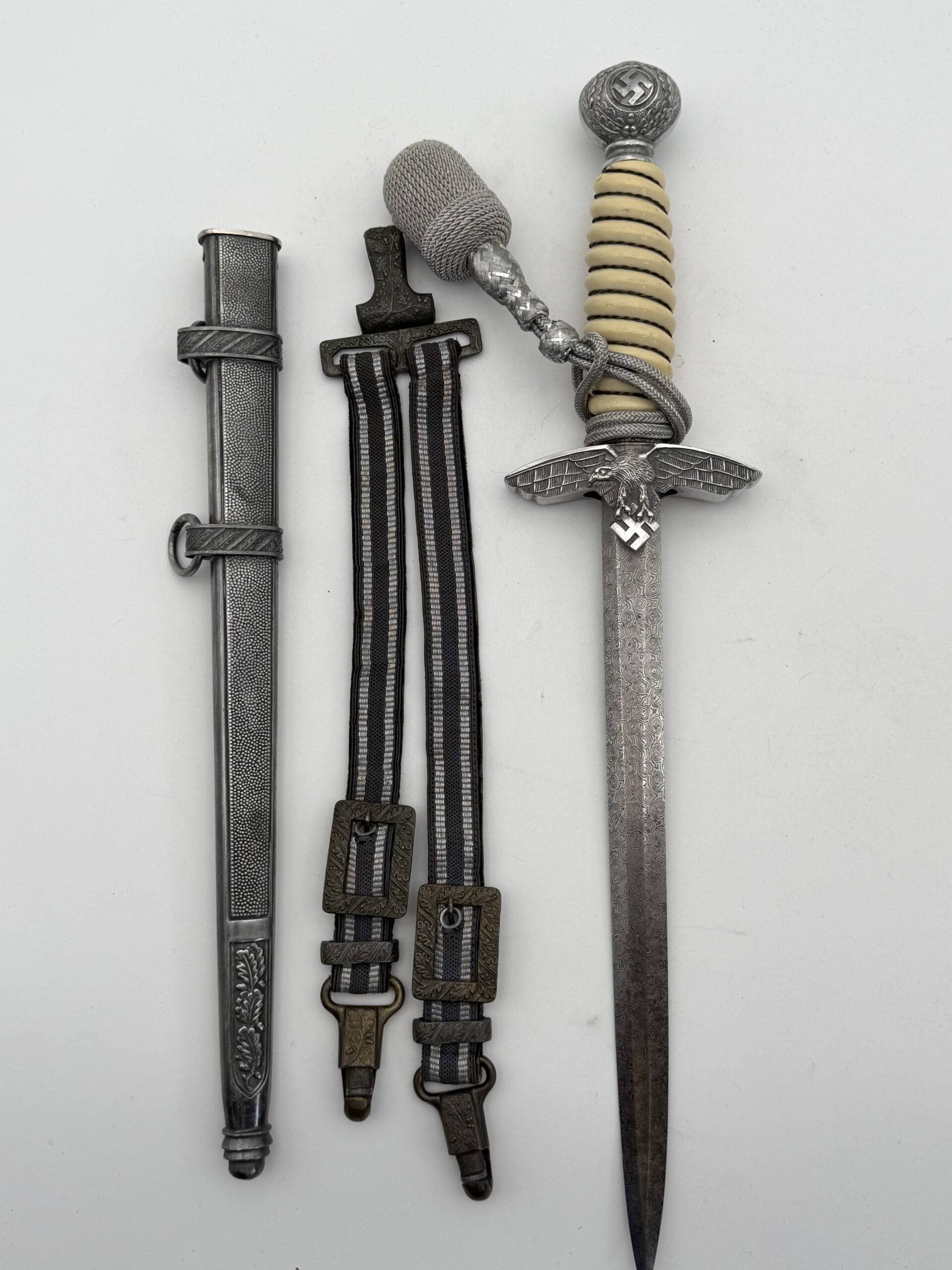
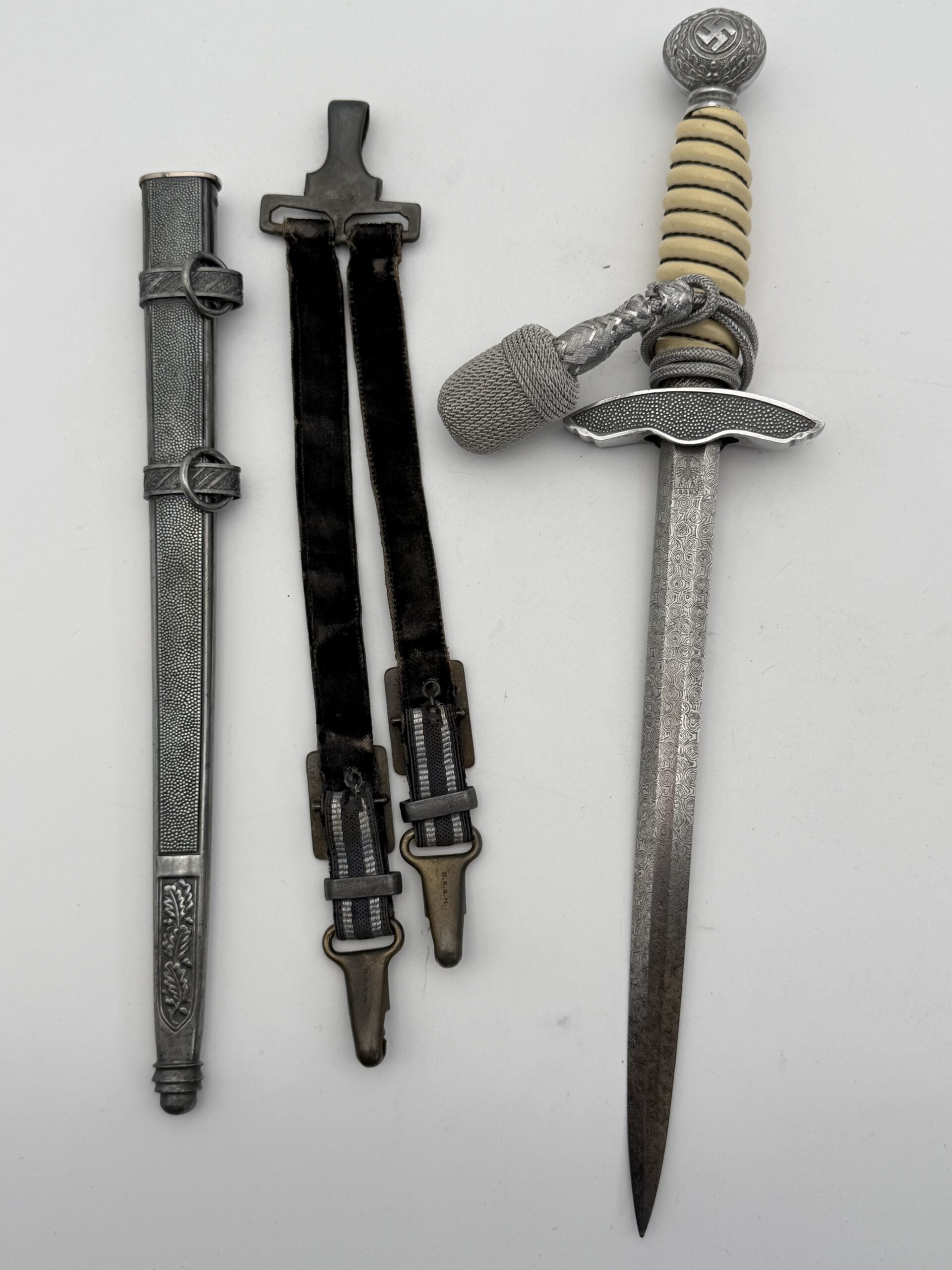
Exceptional Luftwaffe faux Damascus dagger manufactured by Peter Daniel Krebs, Solingen. This scarce M1937 Second Model Luftwaffe Officer’s Dagger features the distinctive artificial Damascus “small roses” blade, Krebs lobster trademark, original scabbard, deluxe two-piece hangers and silver-grey officer portepee.
A highly attractive and unusually complete example of one of the more desirable special-order Luftwaffe edged weapons.
€ 7.500
1 in stock
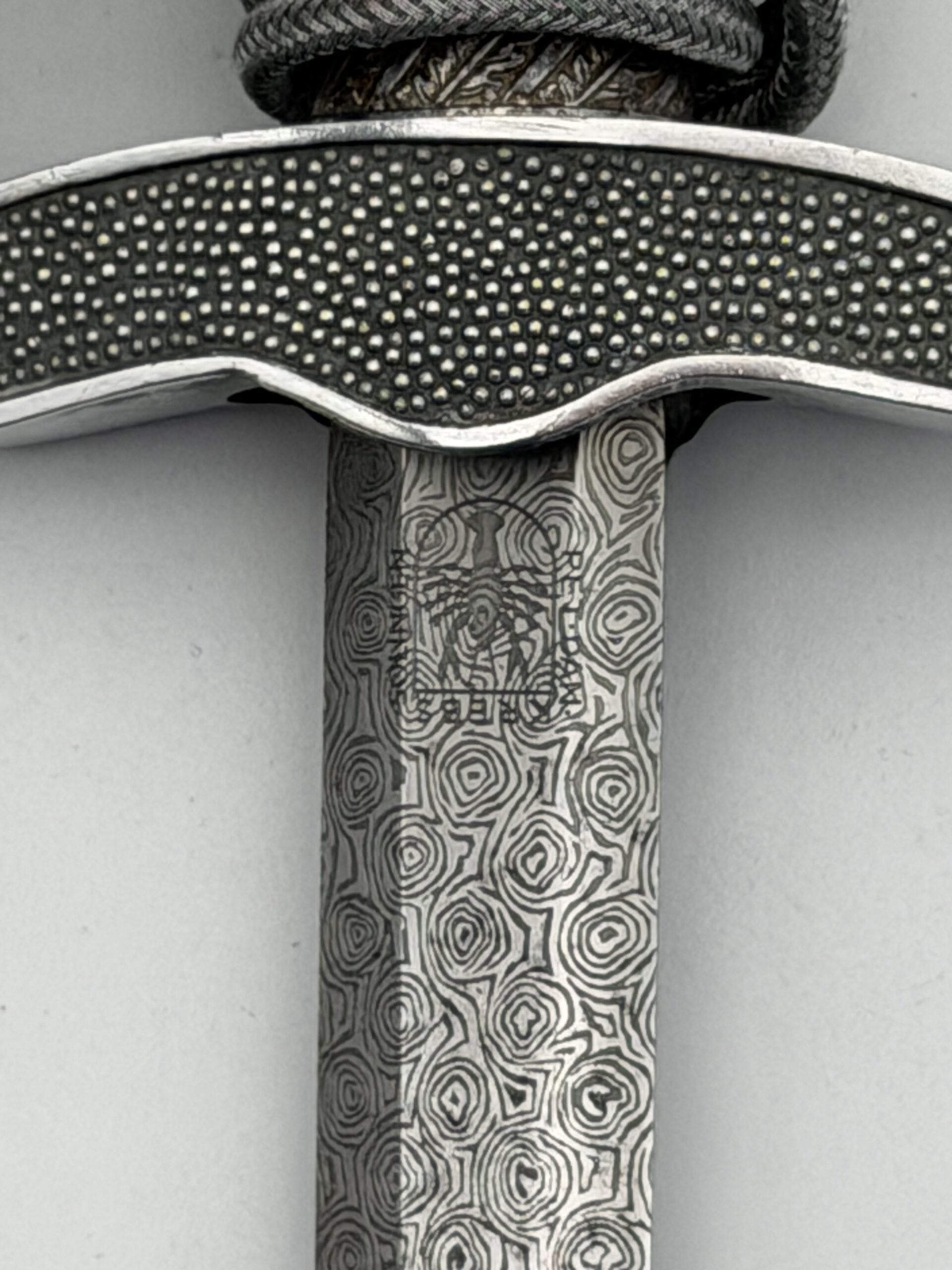
This Luftwaffe faux Damascus dagger represents a particularly attractive special version of the M1937 Second Model Luftwaffe Officer’s Dagger. Peter Daniel Krebs of Solingen manufactured the piece, and the characteristic lobster-in-shield trademark remains visible beneath the crossguard.
Most Luftwaffe officer daggers received conventional polished blades. However, selected private-purchase examples could feature more elaborate blade finishes. The striking artificial Damascus or Pseudo-Damast treatment found here therefore gives the dagger a dramatically different appearance.
Moreover, this example survives as a remarkably complete ensemble. Its original-style scabbard accompanies both suspension straps and the silver-grey officer portepee.
The blade forms the centrepiece of this Luftwaffe faux Damascus dagger.
Instead of a conventional polished surface, the double-edged blade carries an elaborate artificial Damascus pattern. Numerous tightly formed circular and rosette shapes run across the steel. Collectors commonly refer to this configuration as the “small roses” pattern.
Importantly, this is faux or artificial Damascus rather than conventional forged pattern-welded Damascus steel. The decorative pattern was created to reproduce the luxurious visual effect of genuine Damast while keeping production considerably more economical.
Nevertheless, the process required substantially more work than a standard polished Luftwaffe blade. Consequently, these decorative blades represented an upgraded private-purchase option and occur much less frequently.
The surviving finish remains particularly clear. Strong contrast between the light steel and darker pattern allows the rosette structure to remain visible almost to the blade edges.
Near the ricasso appears the distinctive Peter Daniel Krebs maker trademark. Its shield-shaped device contains the firm’s familiar lobster emblem, identifying the Solingen manufacturer.
Peter Daniel Krebs belonged to Solingen’s established edged-weapon industry. During the Third Reich period, the company supplied several forms of military edged weapon.
For collectors, maker-marked Krebs Luftwaffe daggers already attract considerable interest. Adding the artificial Damascus blade transforms this example into a significantly scarcer variation.
The combination of the Krebs trademark and the distinctive rosette blade pattern also provides an important reference point. Similar Peter Daniel Krebs artificial Damascus Luftwaffe daggers are documented in specialist collections.
Collectors researching this subject can compare this dagger with an archived Peter Daniel Krebs artificial Damascus Luftwaffe dagger.
Introduced during 1937, the Second Model became the characteristic dress dagger associated with Luftwaffe officers.
Its design differs markedly from the earlier Luftwaffe flying dagger. A rounded fluted grip replaced the earlier leather-covered form, while a large flying eagle became the dominant crossguard feature.
This dagger displays all of those characteristic elements.
The light cream-to-ivory coloured grip shows attractive age toning. Original twisted metallic wire follows the spiral grooves and remains securely positioned.
Above it sits the rounded pommel. Oak-leaf ornament surrounds a prominent swastika on each side, while the finely textured background provides additional contrast.
Below the grip, the crossguard takes the form of the Luftwaffe eagle in flight. Detailed feathers extend across both wings, while the eagle grasps a swastika beneath its body.
The reverse displays the characteristic pebbled field. Consequently, the hilt remains visually impressive from either side.
The steel scabbard displays the familiar textured surface associated with the Second Model Luftwaffe Officer’s Dagger.
Two separately applied suspension bands surround the body. Each carries diagonal oak-leaf decoration together with its suspension ring.
Further decorative oak leaves appear on the lower scabbard fitting. Meanwhile, the rounded lower terminal completes the classic M1937 profile.
Surface ageing remains even and attractive. No major distracting damage is apparent from the supplied photographs, while the fittings retain strong definition.
A major advantage of this Luftwaffe faux Damascus dagger is the presence of its complete two-piece suspension system.
Both hanger straps retain their woven silver-grey and dark blue facing. Their reverse surfaces carry the darker backing normally hidden when worn against the uniform.
Decorated rectangular adjustment buckles remain fitted to each strap. Matching slides, lower suspension clips and the large upper attachment fitting complete the assembly.
Age toning to the metal fittings appears consistent throughout. Furthermore, the contrasting darker hanger backing displays convincing wear and age.
Complete original Luftwaffe dagger hangers have become increasingly desirable in their own right. Therefore, their presence significantly improves the presentation of an already scarce dagger.
Explore further examples in our Luftwaffe Daggers collection.
The dagger also retains its silver-grey Luftwaffe officer portepee.
Its woven stem remains wrapped around the grip and crossguard in the traditional manner. A substantial woven knot and acorn hang beside the hilt.
The cord displays gentle age toning rather than an unnaturally bright modern appearance. As a result, it complements the dagger and hangers extremely well.
Finding the dagger, scabbard, complete hangers and portepee together creates a far more impressive collector ensemble than the dagger alone.
Several visible characteristics support the period configuration of this example.
The Krebs lobster trademark corresponds with known Peter Daniel Krebs manufacture. In addition, the hilt proportions, eagle crossguard, pommel decoration and scabbard construction conform to established Second Model Luftwaffe characteristics.
The blade represents the most important feature. Its dense artificial Damascus rosette pattern closely corresponds with documented Krebs examples.
Furthermore, the hanger construction, woven facing, metal fittings and dark backing follow recognised Luftwaffe officer suspension patterns.
Ageing also appears reasonably consistent across the individual components. However, as with any high-value militaria item, definitive authentication should always combine photographic examination with direct inspection.
The Luftwaffe emerged as an independent branch of the German armed forces during the rapid military expansion of the 1930s.
Officer dress regulations consequently developed their own distinctive forms of uniform, insignia and edged weapon. The Model 1937 dagger became one of the most recognisable elements of Luftwaffe officer dress.
For wider historical research, the German Federal Archives – Bundesarchiv maintains extensive surviving records relating to the Luftwaffe and the German armed forces between 1933 and 1945.
Standard M1937 Luftwaffe Officer’s Daggers remain obtainable. Artificial Damascus examples occupy a different level of collecting interest.
Several factors distinguish this example:
Together, these features create an unusually complete Luftwaffe faux Damascus dagger suitable for an advanced Luftwaffe or German edged-weapons collection.
Collectors can also compare it with our SMF Luftwaffe Presentation Dagger with faux Damascus blade or browse our wider Third Reich edged weapons collection.
Overall condition: Excellent collector condition.
The artificial Damascus pattern remains exceptionally prominent across the blade. Furthermore, the point appears intact and the maker trademark remains identifiable.
The cream grip displays attractive natural ageing without obvious major damage visible in the supplied photographs. Its metallic wire remains complete and properly positioned.
Both hilt fittings show attractive age toning while retaining strong decorative definition. Similarly, the scabbard presents well with consistent surface patina.
The hangers show expected age and use, although all principal components remain present. Finally, the portepee retains excellent overall shape and provides the finishing element to this unusually complete set.
No. The blade is the scarce artificial or faux Damascus form, sometimes described as Pseudo-Damast. Its elaborate rosette pattern creates the appearance of Damascus without conventional pattern-welded construction.
The visible lobster-in-shield trademark identifies Peter Daniel Krebs of Solingen.
It is the M1937 Second Model Luftwaffe Officer’s Dagger.
The ensemble includes the dagger, steel scabbard, two-piece Luftwaffe officer hangers and silver-grey officer portepee.
Standard Luftwaffe officer daggers normally have polished blades. The artificial Damascus “small roses” treatment represents a considerably scarcer and more decorative special-order variation.
Primary category: Luftwaffe Daggers
Secondary category: Third Reich Edged Weapons
Additional category: Special Items