
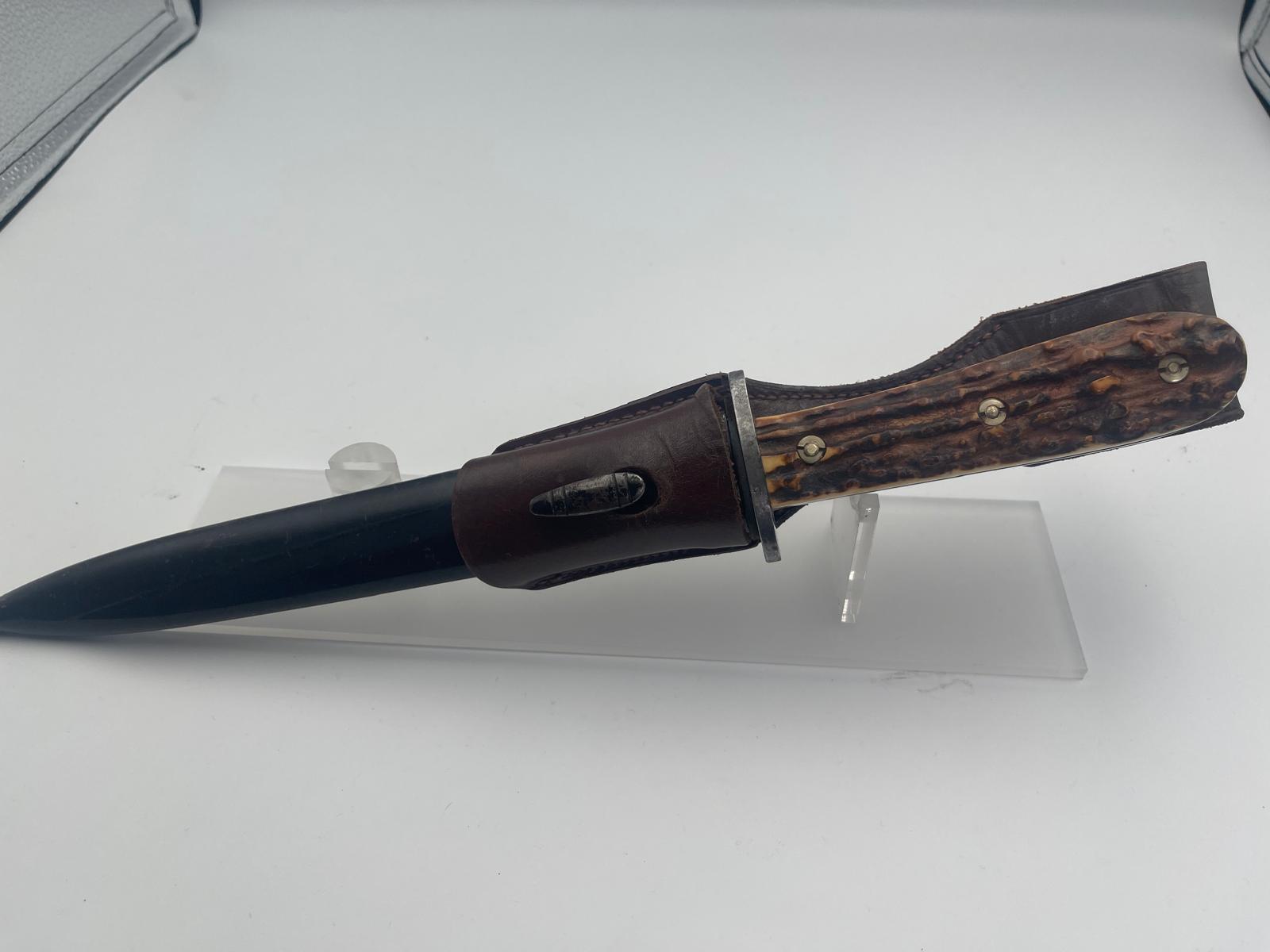
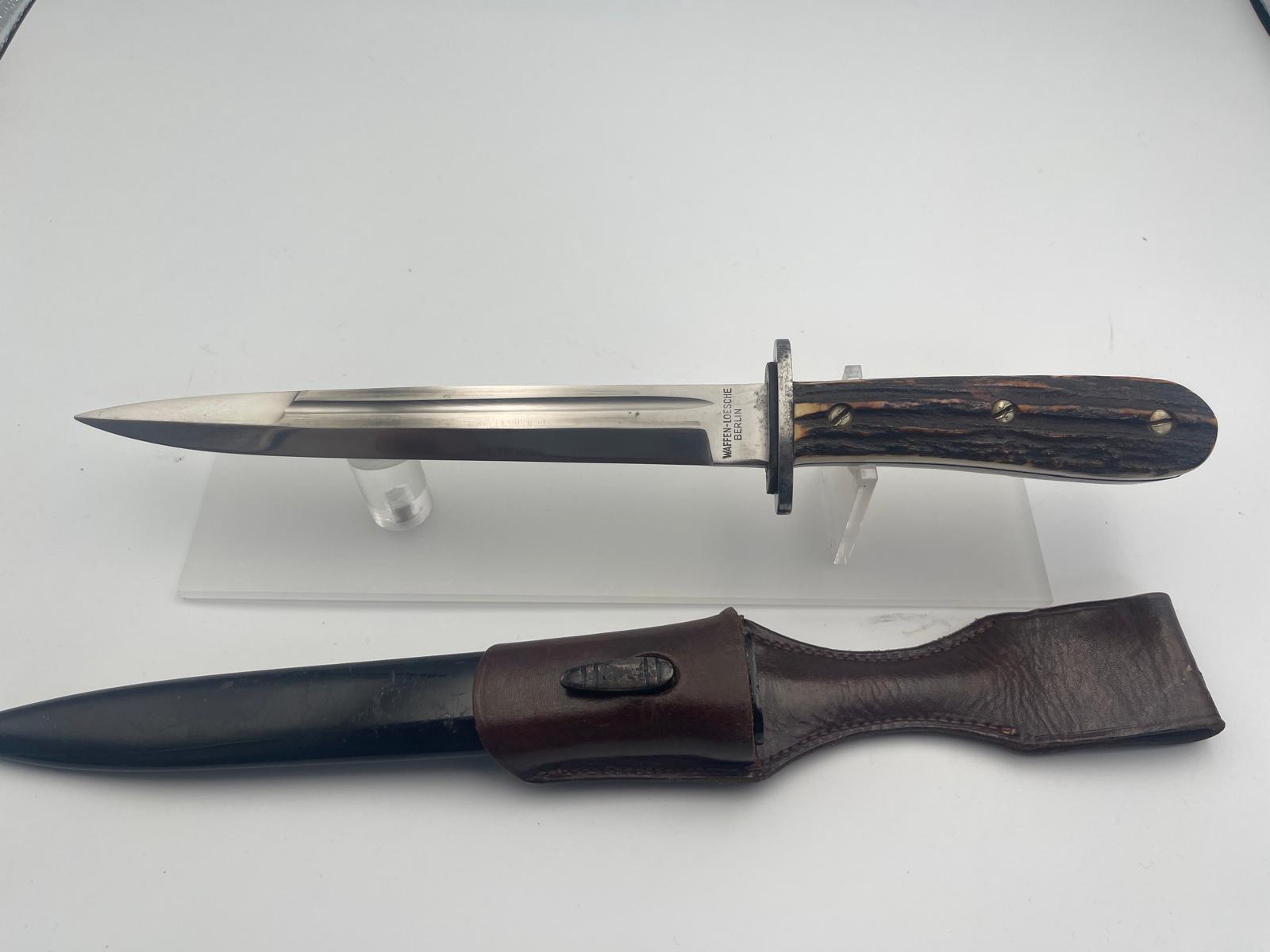
A scarce original Luftwaffe Forestry sidearm, traditionally associated with German forestry personnel of the Third Reich period and retailed by Waffen-Loesche, Berlin.
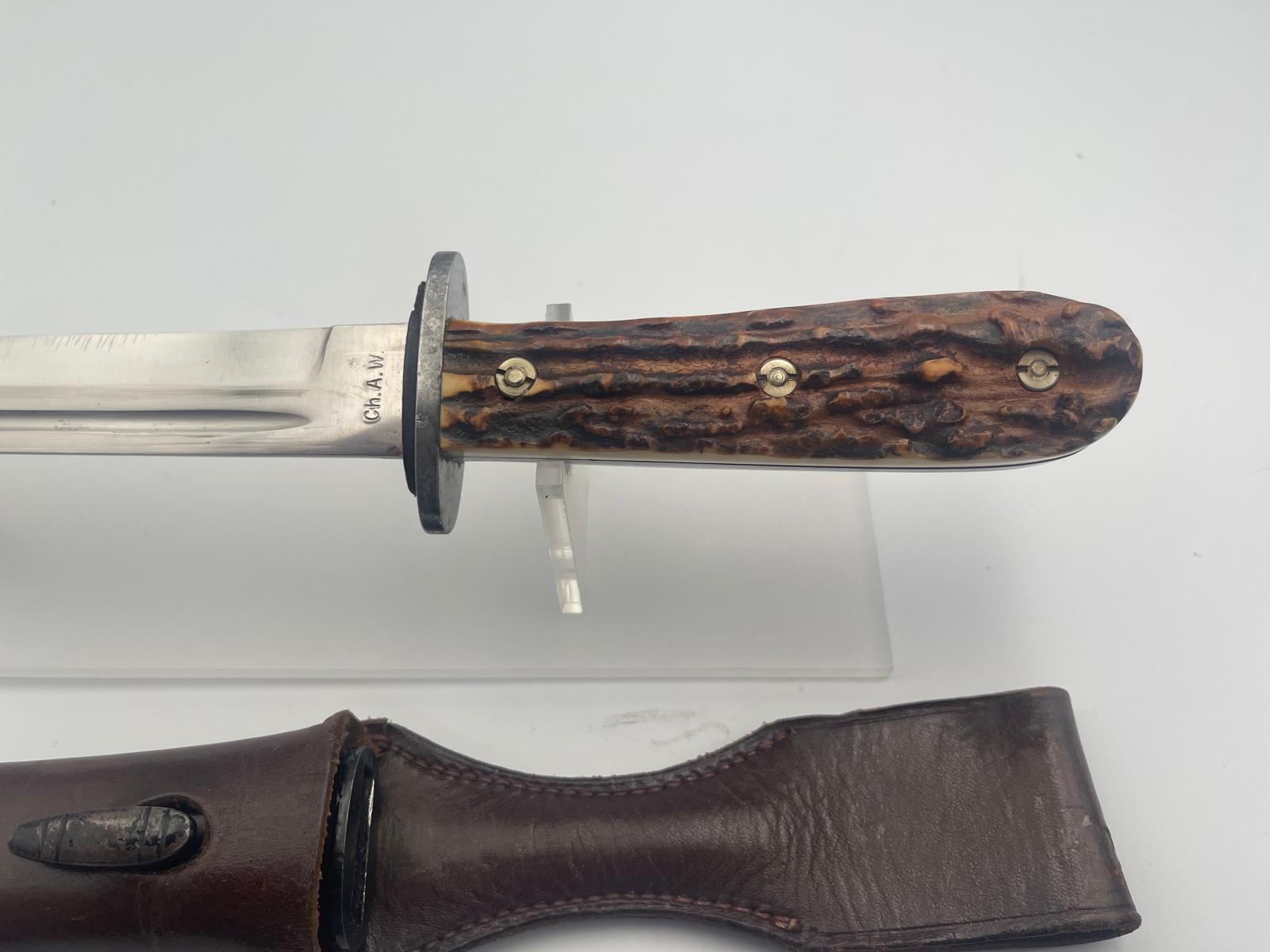
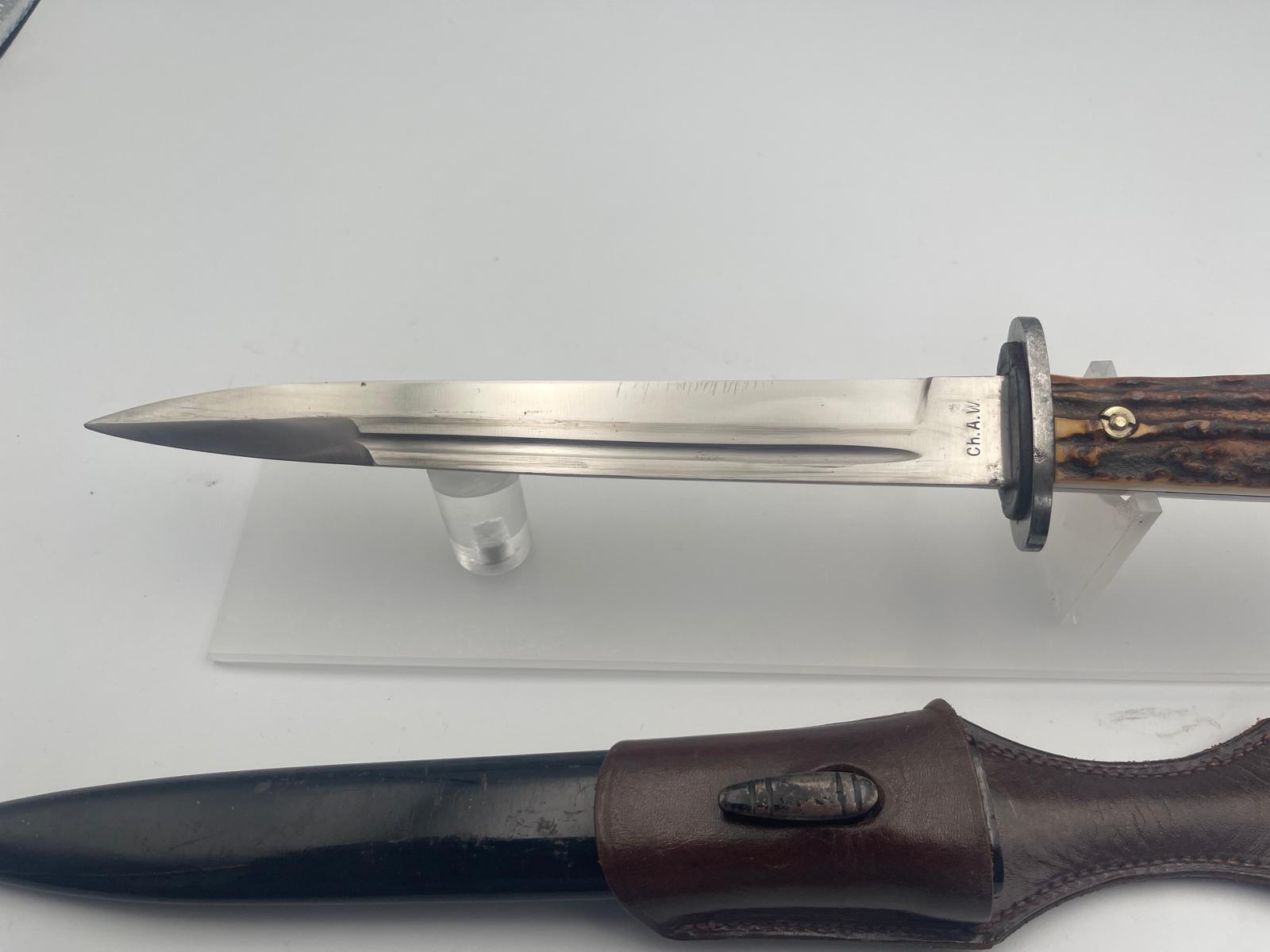
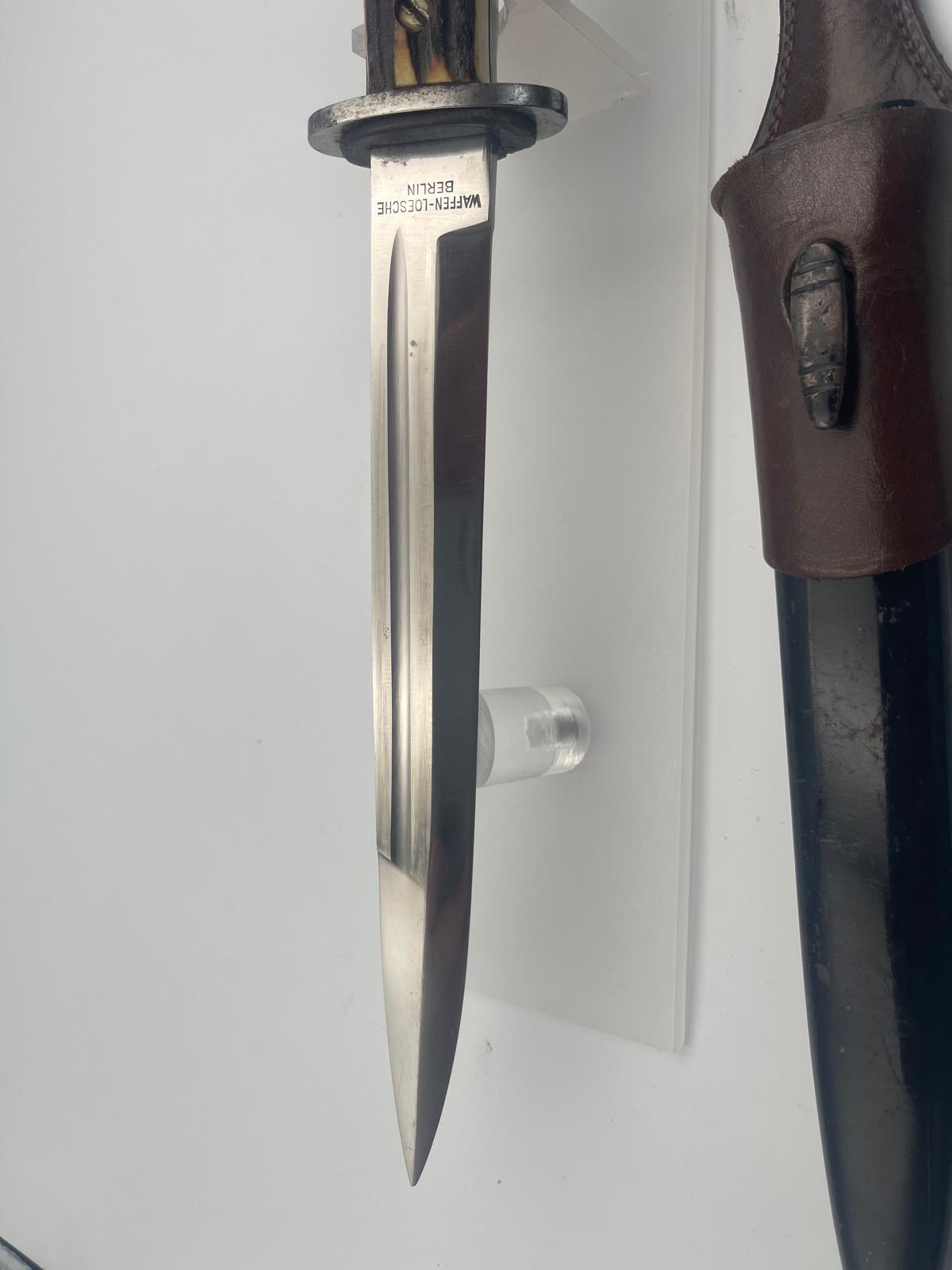
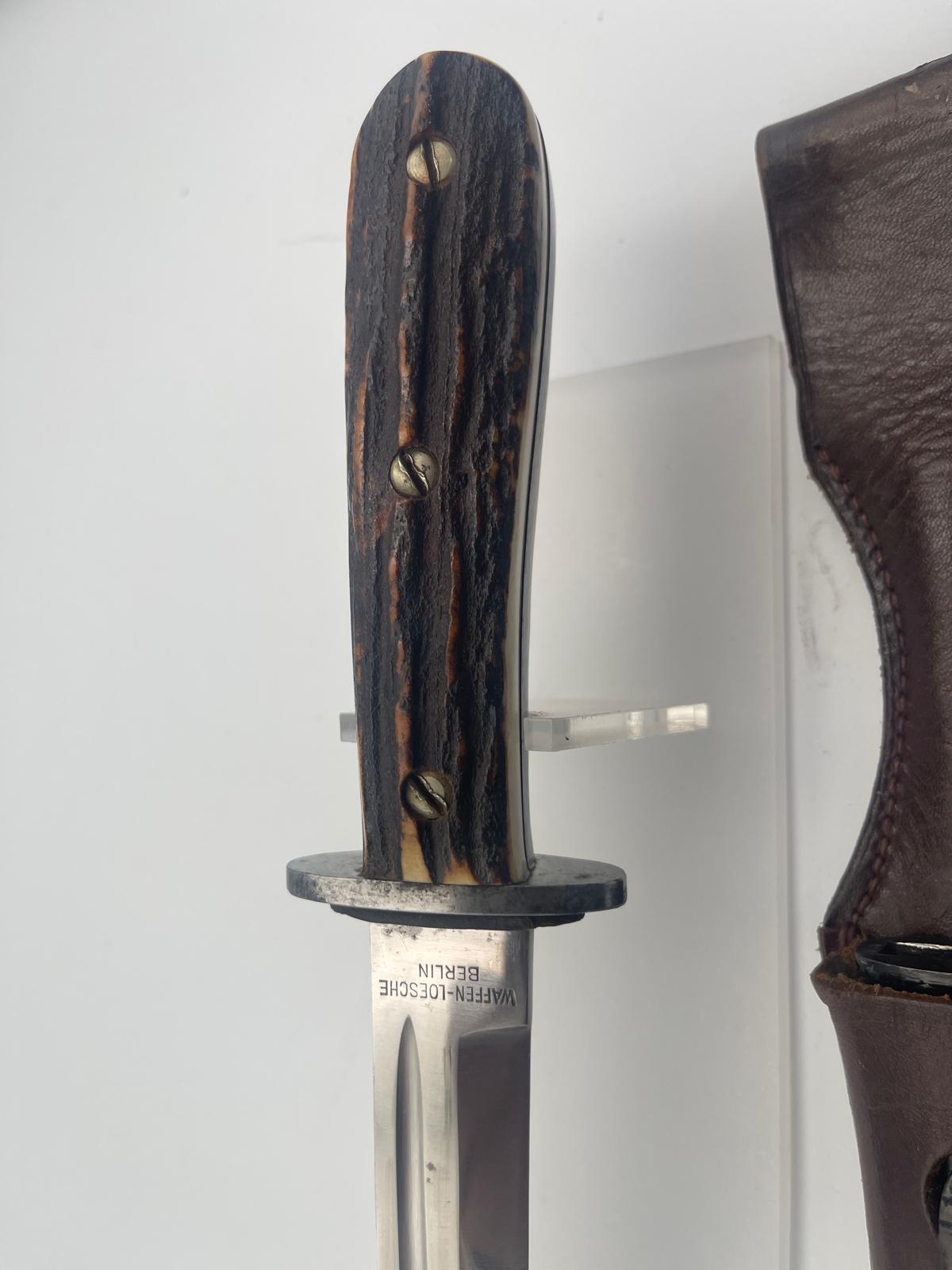
The polished steel blade carries “WAFFEN-LOESCHE BERLIN” on one ricasso and “Ch.A.W.” on the opposite side. Genuine stag-horn grip scales are secured by three fittings, while a plain steel oval guard completes the characteristic hilt.
The sidearm retains its black-painted steel scabbard together with a brown leather frog. Condition is particularly attractive, with a strong blade, excellent stag grips and coherent age throughout.
This item is correctly described as a forestry sidearm or forestry knife, rather than a conventional bayonet.
€ 1.695
1 in stock
This exceptionally interesting Luftwaffe Forestry sidearm represents one of the more unusual German edged weapons associated with the Third Reich period.
Unlike the standard military bayonet, the piece has a straightforward hunting and forestry-style configuration.
A polished steel blade extends from a simple oval crossguard. Meanwhile, substantial natural stag-horn scales form the grip.
Three fittings secure each grip plate firmly to the tang.
The design combines the appearance of a German hunting knife with the robust construction expected from a service sidearm.
Consequently, collectors generally refer to this pattern as a forestry sidearm, forestry knife, or in German as a Seitengewehr für Förster.
The term “bayonet” has often appeared in older English-language collector descriptions of this pattern.
However, that description can be misleading.
The present piece lacks the normal functional mounting arrangement expected on a military rifle bayonet.
Instead, its construction centres on:
Therefore, forestry sidearm is the more appropriate catalogue description.
German dealers commonly use the term:
Seitengewehr für Förster
The word Seitengewehr literally refers to a weapon worn at the side. In this context, it does not require the item to function as an infantry rifle bayonet.
The reverse ricasso carries the clearly applied marking:
BERLIN
Waffen-Loesche operated as a well-known Berlin dealer in hunting arms, sporting weapons and related equipment.
A period commercial reference records:
Waffen-Loesche, Berlin C2, An der Spandauerbrücke 11 – Jagd- und Sportwaffen, Munition.
This contemporary evidence is particularly relevant because the firm’s established involvement in hunting and sporting arms fits naturally with the forestry character of the present sidearm.
The Waffen-Loesche marking appears on numerous recognised surviving examples of this distinctive stag-gripped pattern.
The opposite ricasso carries:
This marking has generated considerable discussion among advanced collectors.
Older reference literature has often interpreted Ch.A.W. as referring to Chromolit-Besteckfabrik / Arthur Wingen.
Indeed, auction houses have traditionally catalogued examples as products associated with Arthur Wingen of Solingen.
However, later specialist research has questioned whether that interpretation is definitive.
Different explanations for Ch.A.W. have been proposed, including an organisational or inventory-related abbreviation rather than a conventional manufacturer trademark.
For that reason, the strongest catalogue wording is:
Marked “Ch.A.W.” – exact meaning remains the subject of specialist research.
It would be unwise to present a specific manufacturer behind this abbreviation as absolutely proven without additional documentary evidence.
The substantial grip is one of the most attractive features of this Luftwaffe Forestry sidearm.
Natural stag-horn scales cover each side of the tang.
Their deeply textured surfaces retain:
Three circular fittings secure the scales.
Importantly, the stag remains intact.
No major cracks or losses are visible from the supplied photographs.
The natural material also differentiates this sidearm immediately from ordinary military dress weapons with composition grips.
The blade retains an excellent bright polished finish.
A broad fuller runs along much of its length.
Furthermore, the blade narrows cleanly toward the point.
The surface displays only light marks and small age-related imperfections.
These signs remain consistent with careful period use and storage.
The polished blade is important because specialist discussion has noted that these Waffen-Loesche forestry knives used polished steel rather than simply a decorative plated finish. This supports their interpretation as functional sidearms or hunting-style knives rather than purely ceremonial dress pieces.
A plain oval steel guard separates the blade from the grip.
Its uncomplicated construction differs greatly from the elaborate eagle, oak-leaf or clamshell fittings found on many traditional German forestry Hirschfänger.
That simplicity forms an important part of the distinctive Waffen-Loesche pattern.
Age has created a restrained grey patina across the metal.
The surface has not been excessively polished.
Consequently, the guard retains an attractive untouched appearance.
The sidearm retains its black steel scabbard.
Much of the dark finish remains present.
Light scratches and age marks appear across the surface.
However, the scabbard remains straight and presents very well.
The simple black finish corresponds closely with published and surviving Waffen-Loesche forestry sidearms.
Current examples offered by Helmut Weitze also retain comparable black-painted steel scabbards.
The brown leather belt frog remains with the sidearm.
This accessory greatly improves the completeness of the set.
The leather displays:
Its deep brown colour provides an attractive contrast against the black scabbard.
Importantly, the leather appears naturally aged rather than recently manufactured.
The complete combination of sidearm, scabbard and leather frog is considerably more desirable than an isolated knife.
For decades, collectors and specialist dealers have associated this pattern with Luftwaffe forestry personnel.
Helmut Weitze currently lists several virtually identical examples as:
“Luftwaffe Seitengewehr für Förster.”
Those pieces display the same essential features:
Although the designation Luftwaffe Forestry sidearm is firmly established in the modern collector market, the exact wartime organisational attribution remains debated.
Specialist researchers have pointed out that no conclusive Luftwaffe forestry regulation has yet been located that specifically illustrates this exact weapon.
Other researchers have suggested possible associations with the Forstschutzkommando or other forestry-related organisations.
Therefore, the most academically careful wording is:
This wording recognises the established collector identification without presenting an unresolved historical attribution as proven fact.
Such caution strengthens rather than weakens the catalogue entry.
One alternative interpretation connects these sidearms with the Forstschutzkommando.
The organisation operated within the forestry administration rather than directly within the Luftwaffe.
Specialist research has demonstrated that the Reich forestry organisational structure placed the Forstschutzkommando under the Reichsforstverwaltung.
However, no surviving evidence presently proves that every Waffen-Loesche/Ch.A.W. sidearm belonged to this organisation.
Consequently, the present example should not be catalogued unconditionally as a Forstschutzkommando weapon either.
The safest attribution remains:
Third Reich forestry sidearm – traditionally identified as Luftwaffe Forestry issue.
The visible construction strongly supports a period original attribution.
Important positive characteristics include:
Furthermore, the combination corresponds closely with several recognised examples currently offered by specialist militaria dealers.
No obvious modern reproduction characteristics are visible in the supplied photographs.
On photographic evidence, the sidearm presents as a strong original pre-1945 example.
Overall condition is very good to excellent.
The polished blade remains exceptionally bright.
Only minor marks and isolated areas of spotting appear.
The fuller retains crisp definition.
Likewise, the stag grip remains highly attractive.
Both scales show excellent natural texture and strong colour.
The steel guard displays appropriate age-related patination.
Meanwhile, the black scabbard retains substantial original finish.
The brown leather frog remains complete and shows convincing period wear.
No aggressive cleaning or restoration is recommended.
This Luftwaffe Forestry sidearm is considerably scarcer than ordinary German dress sidearms.
Its appeal comes from the combination of:
Waffen-Loesche Berlin marking
Ch.A.W. marking
natural stag grips
polished blade
original steel scabbard
and
brown leather frog
The unresolved history surrounding this pattern also gives it considerable research interest.
Collectors have studied the type for decades, yet relatively few examples appear on the market.
A complete example in strong condition therefore deserves a premium over worn or incomplete specimens.
Item: Third Reich forestry sidearm
Collector designation: Luftwaffe Forestry sidearm
Alternative description: Forestry knife / Forst sidearm
German collector term: Seitengewehr für Förster
Distributor: Waffen-Loesche, Berlin
Opposite marking: Ch.A.W.
Ch.A.W. attribution: Unresolved / subject to specialist research
Blade: Polished steel with fuller
Grip: Natural stag horn
Grip fittings: Three per side
Guard: Plain steel oval crossguard
Scabbard: Black-painted steel
Frog: Brown leather
Period: Third Reich, circa late 1930s–1940s
Condition: Very good to excellent
Rarity: Scarce
Short ID: LW-FORST-WL-CHAW
Price: €1,695
Explore related listings: Luftwaffe Daggers.
Helmut Weitze currently lists an almost identical Waffen-Loesche/Ch.A.W. forestry sidearm with stag grip, black scabbard and leather frog for €1,350.
Another Waffen-Loesche example with Ch.A.W. 304 provides a useful construction comparison.
A period Berlin commercial listing records Waffen-Loesche as a dealer in Jagd- und Sportwaffen and ammunition.
These sources provide both market comparison and historical context for the Waffen-Loesche marking.
No.
Although older collectors and some dealers have used the word bayonet, the item is better described as a forestry sidearm or forestry knife.
The established collector designation is Luftwaffe Forestry sidearm.
German dealers often call the type Seitengewehr für Förster.
Waffen-Loesche was a Berlin dealer in hunting and sporting weapons.
The company name appears clearly on the blade.
The precise meaning remains debated.
Older references associate it with Arthur Wingen/Chromolit, while later research has proposed other interpretations.
Therefore, the catalogue does not assign the abbreviation unconditionally to one manufacturer.
The photographs show genuine natural stag-horn characteristics rather than moulded imitation material.
Its leather, stitching, ageing and construction appear consistent with a period brown leather frog.
Comparable specialist dealer examples currently sit around €950–€1,795.
Original Third Reich Forestry Sidearm – Traditionally Identified as Luftwaffe Forestry Issue – Waffen-Loesche Berlin – Ch.A.W. Marked – Natural Stag-Horn Grip – Polished Steel Blade – Black Steel Scabbard – Brown Leather Frog – Scarce Original Example