
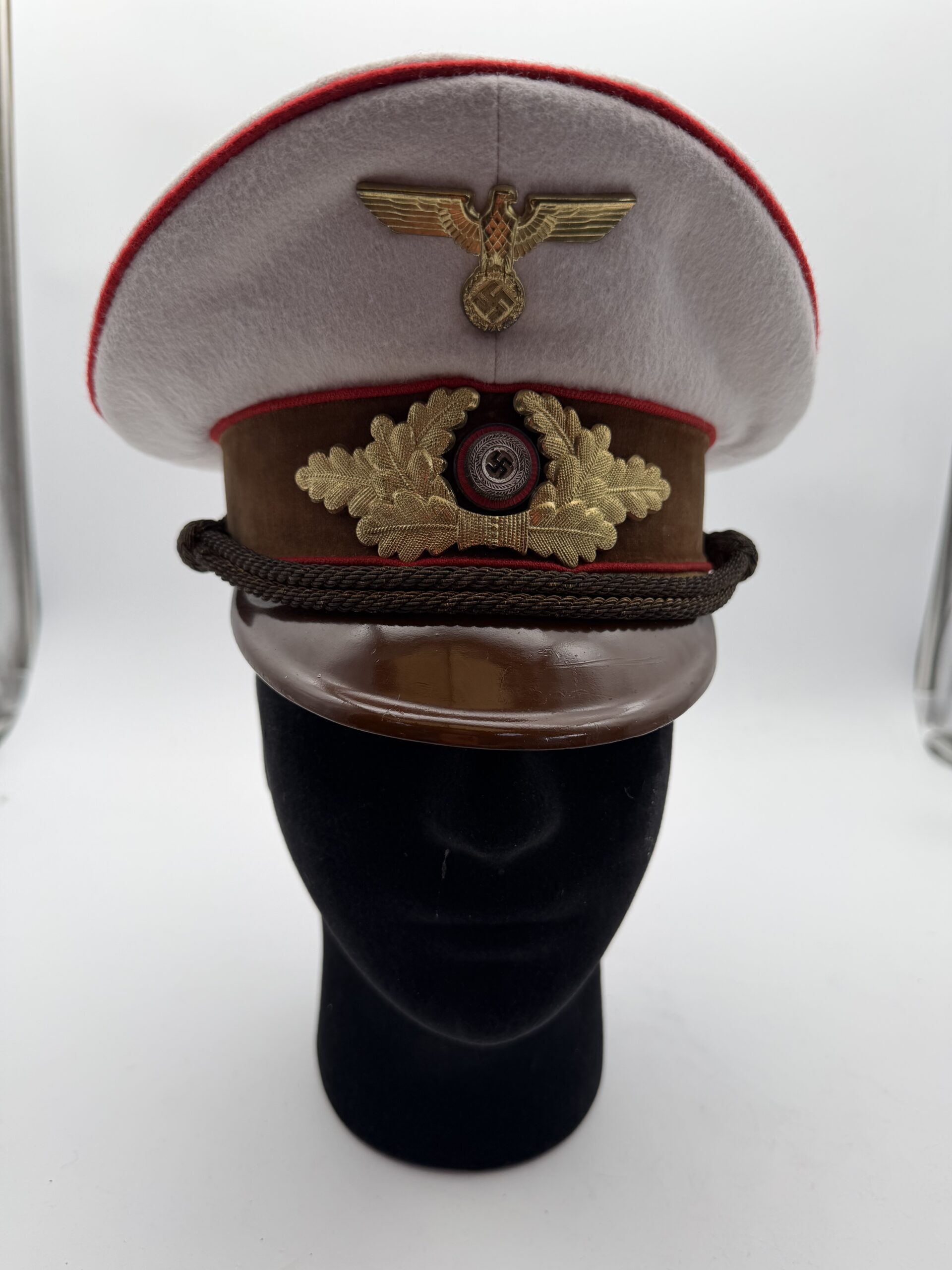
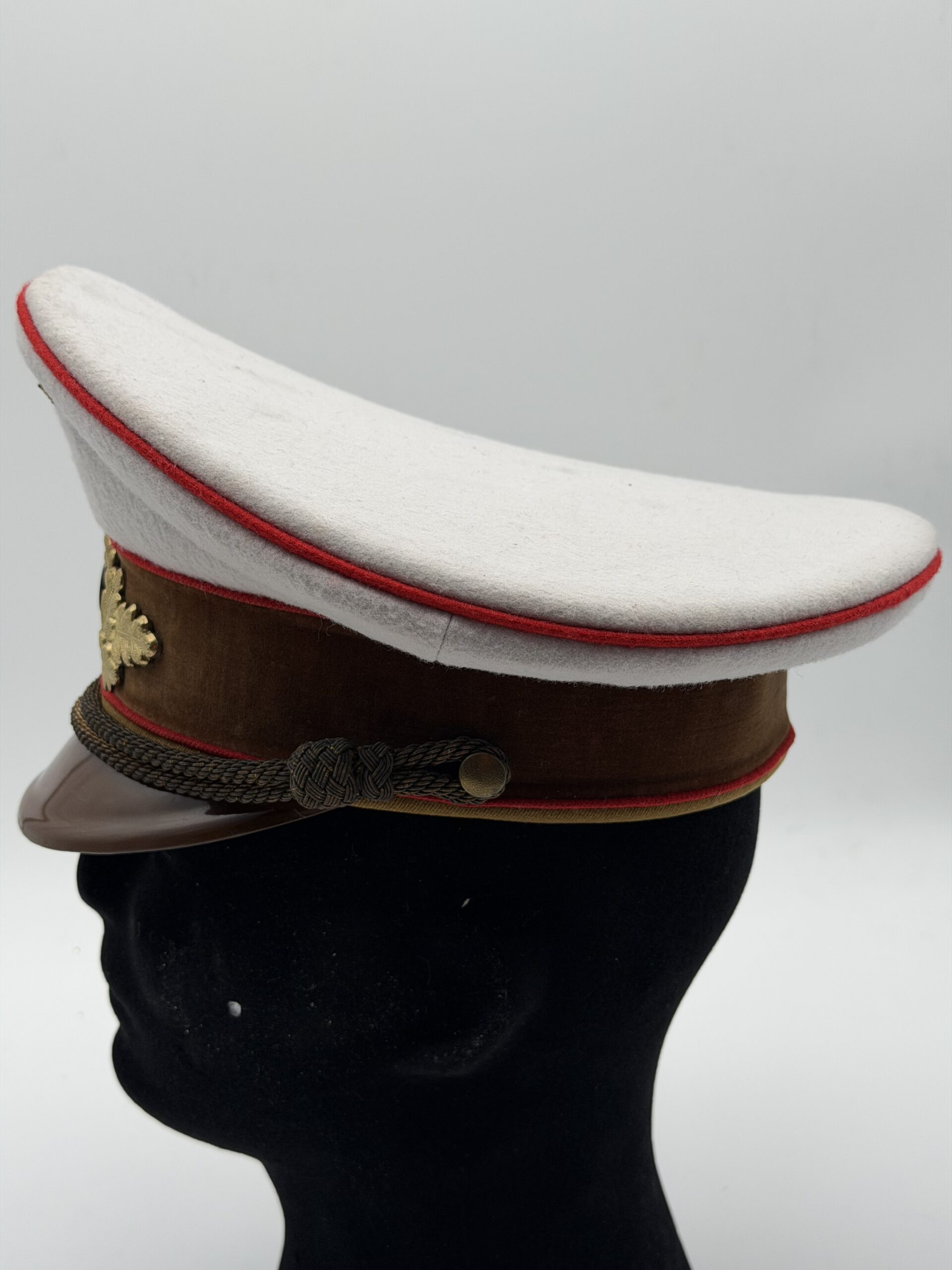
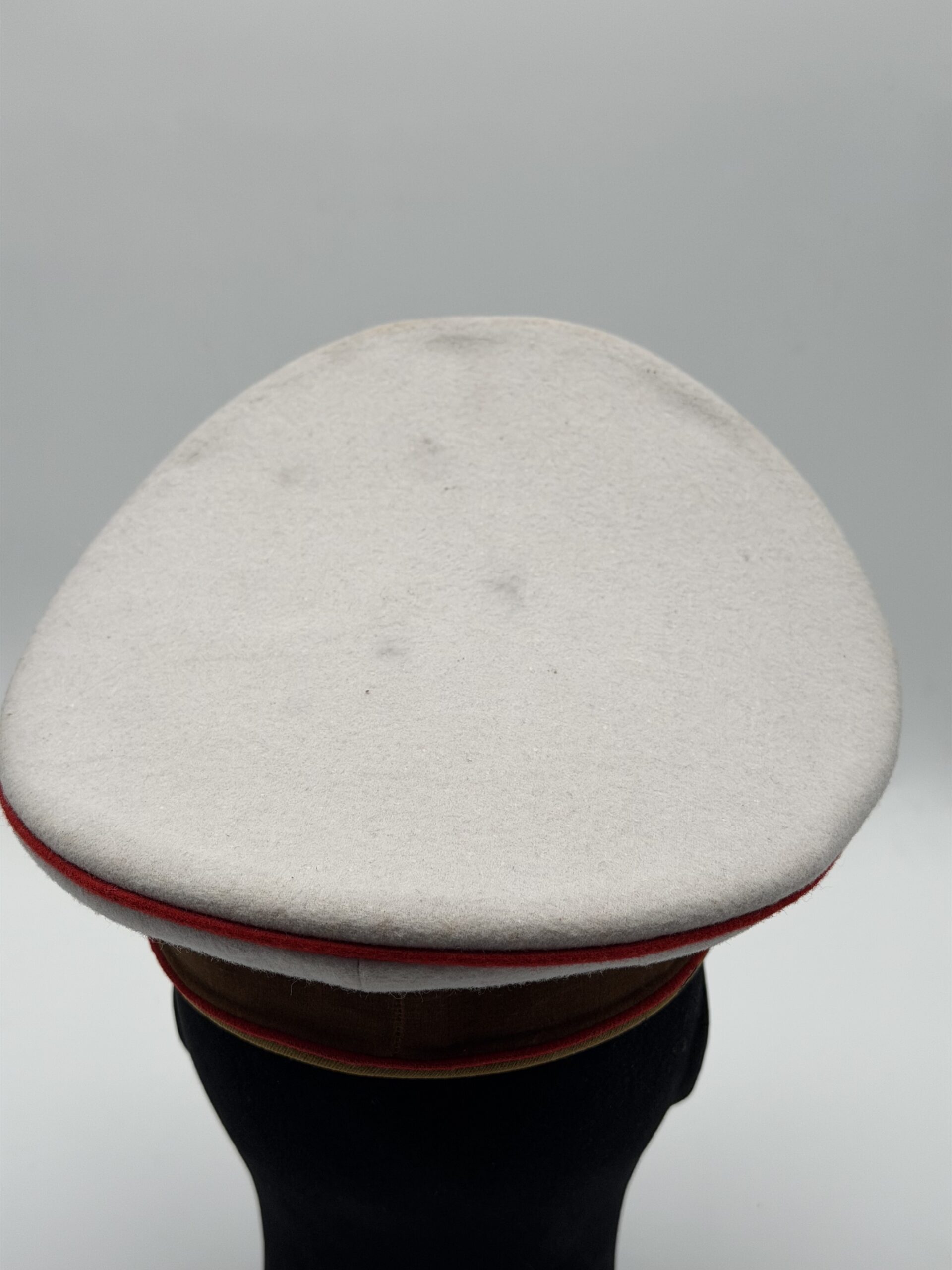
This NSDAP Gauleitung visor cap is a rare white summer-pattern cap for a Political Leader serving within the Gau-level administration. It dates from approximately 1939–1945. The cap combines a white crown, red administrative piping, a brown velvet band and high-quality gilt insignia.
€ 4.000
1 in stock
This NSDAP Gauleitung visor cap is a rare white summer-pattern cap for a Political Leader serving within the Gau-level administration. It dates from approximately 1939–1945. The cap combines a white crown, red administrative piping, a brown velvet band and high-quality gilt insignia.
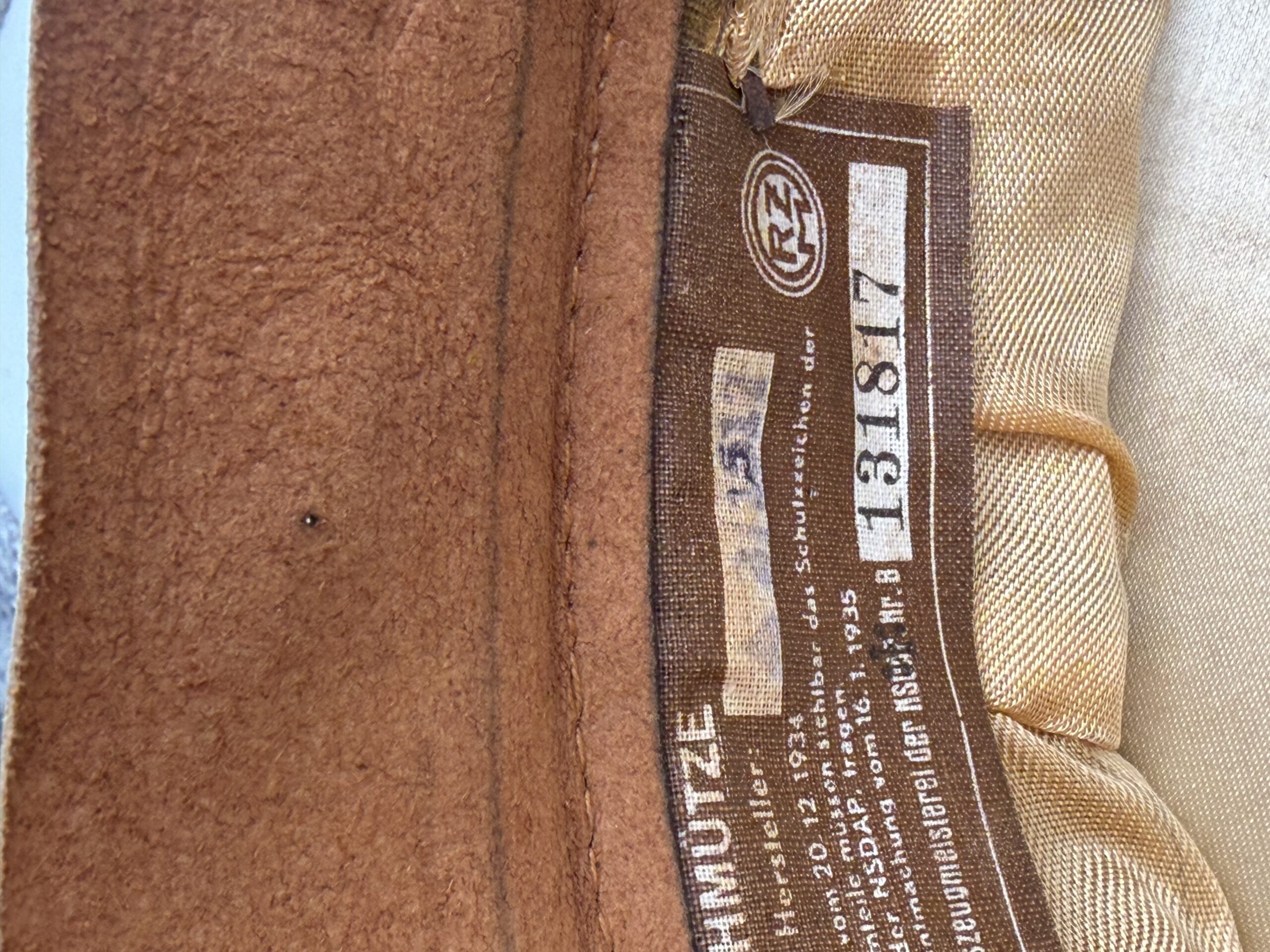
Its most important feature is the hand-embroidered metallic-thread oak-leaf wreath. This deluxe private-purchase detail sets the cap apart from standard examples fitted with stamped metal wreaths. Moreover, the interior retains an original-style RZM Tuchmütze control label beneath the leather sweatband.
Object: Political Leader’s peaked cap
German designation: Schirmmütze für Politische Leiter
Organisation: Nationalsozialistische Deutsche Arbeiterpartei
Administrative level: Gauleitung
Pattern: M39 Political Leader’s visor cap
Date: Approximately 1939–1945
Country: Germany
Materials: Wool or felted cloth, velvet, metallic embroidery, enamel, gilt metal, rayon, leather and vulcanised fibre
Maker: Unidentified; manufacturer field on the RZM label is substantially abraded
RZM number: The large numbered field reads 131817
Size: Not recorded
Provenance: Not supplied
Condition: Good used condition with age-related wear
The cap has a high, carefully shaped saddle-form crown covered in white, finely napped cloth. Red piping follows the entire upper circumference. Further red piping borders the upper and lower edges of the brown velvet centre band.
Within the Political Leader uniform system, red piping identified personnel assigned to the Gauleitung, or regional administrative level. However, this colour does not prove that the wearer personally held the rank of Gauleiter. Numerous Political Leaders and staff officials served within each Gau administration.
The white crown represents the summer or warm-weather form of the Political Leader’s cap. Period regulations permitted a white summer version during the warmer part of the year. The final M39 Political Leader cap pattern appeared in July 1939 and remained in use until the collapse of the regime in 1945.
A vertical seam runs through the front of the crown. The seam sits centrally behind the national eagle and continues the balanced construction of the cap. The crown retains a strong profile, although light surface soiling and minor age discolouration remain visible.
A gilt metal Political Leader’s national eagle appears on the front of the white crown. The eagle displays outstretched wings and holds a wreath containing the swastika.
The insignia retains clear feather detail and a substantial proportion of its original gilt finish. Slight darkening appears around recessed areas. Meanwhile, minor wear to the raised surfaces creates a natural contrast across the design.
The eagle appears consistent with Political Leader cap insignia of the period. Nevertheless, its reverse, attachment prongs and the holes through the crown have not been photographed. Therefore, a complete hands-on assessment should confirm that the eagle has not been replaced.
The brown velvet band carries an impressive hand-embroidered gold metallic-thread oak-leaf wreath. Individual leaves curve upward from a central bound stem. Fine thread work defines the veins, edges and overlapping surfaces of each leaf.
At the centre sits a multi-part enamelled Political Leader cockade. It combines red, black and silver-coloured elements around the central swastika. The cockade remains well positioned between the two halves of the wreath.
This embroidered wreath represents a deluxe private-purchase option. Most surviving Political Leader caps use a stamped metal wreath. In contrast, specialist workshops produced hand-embroidered examples for senior or affluent Political Leaders who required superior presentation quality.
Helmut Weitze describes comparable metallic-thread wreaths as luxury-quality insignia. The firm also records very few complete Political Leader caps carrying this embroidered treatment.
Importantly, the bullion wreath indicates quality rather than a single defined political rank. The red piping remains the principal visible indicator of the cap’s Gauleitung assignment.
A double metallic officer-style chin cord rests above the visor. The cord has darkened considerably through oxidation and age. Protected sections may retain traces of the original gold-coloured surface beneath the knots or beside the buttons.
Two subdued gilt buttons secure the cord at each side. The knotted sliders remain present and show similar darkening. Therefore, the cord may be original to the cap. However, close inspection should determine whether it has been replaced during the cap’s collecting history.
The visor has a brown lacquered upper surface with a slightly curved profile. Fine scratches, shallow marks and light finish wear remain visible. These marks appear consistent with normal handling and storage rather than deliberate distressing.
A narrow gold-coloured trim follows the lower edge of the cap band immediately above the visor.
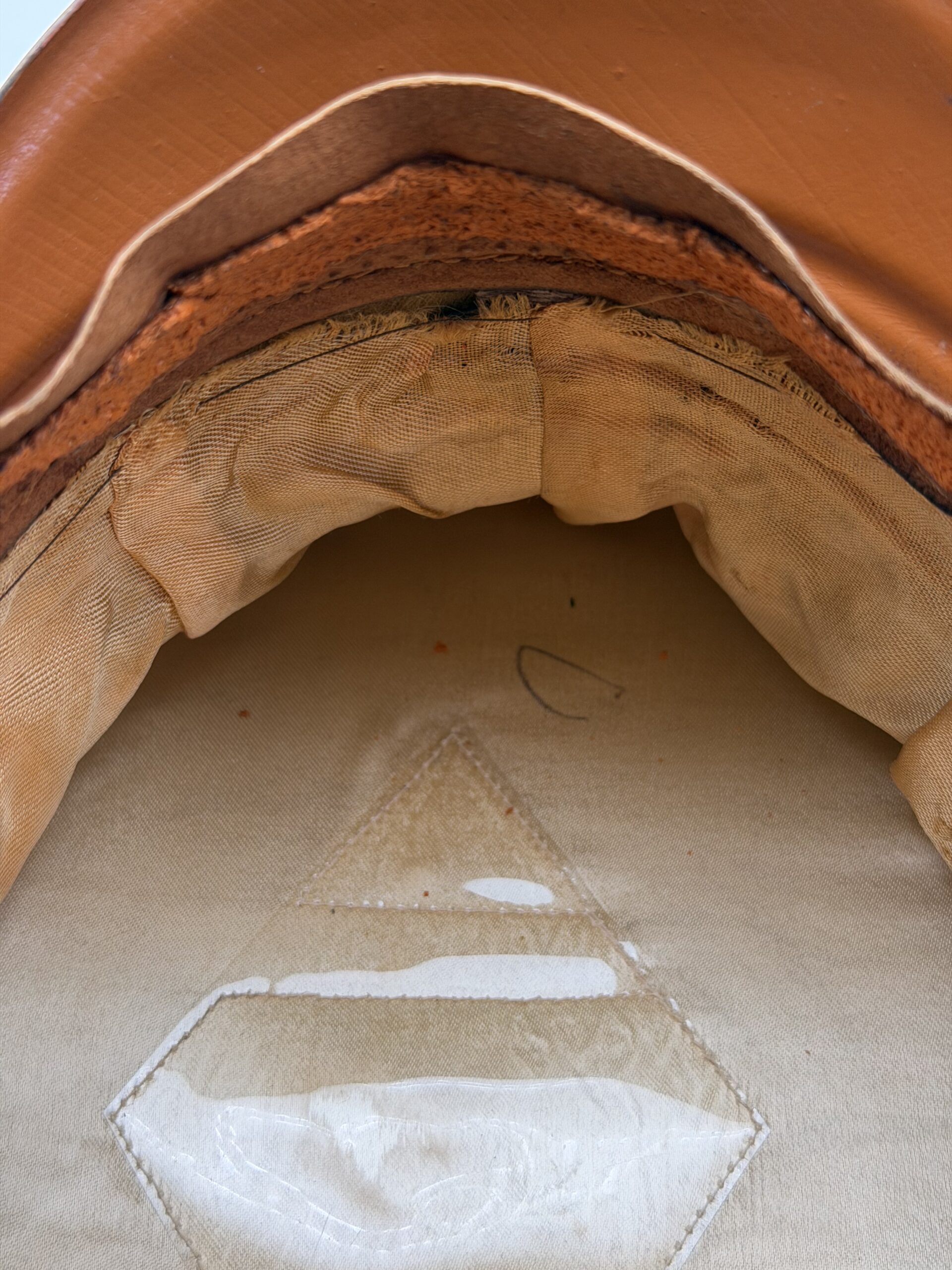
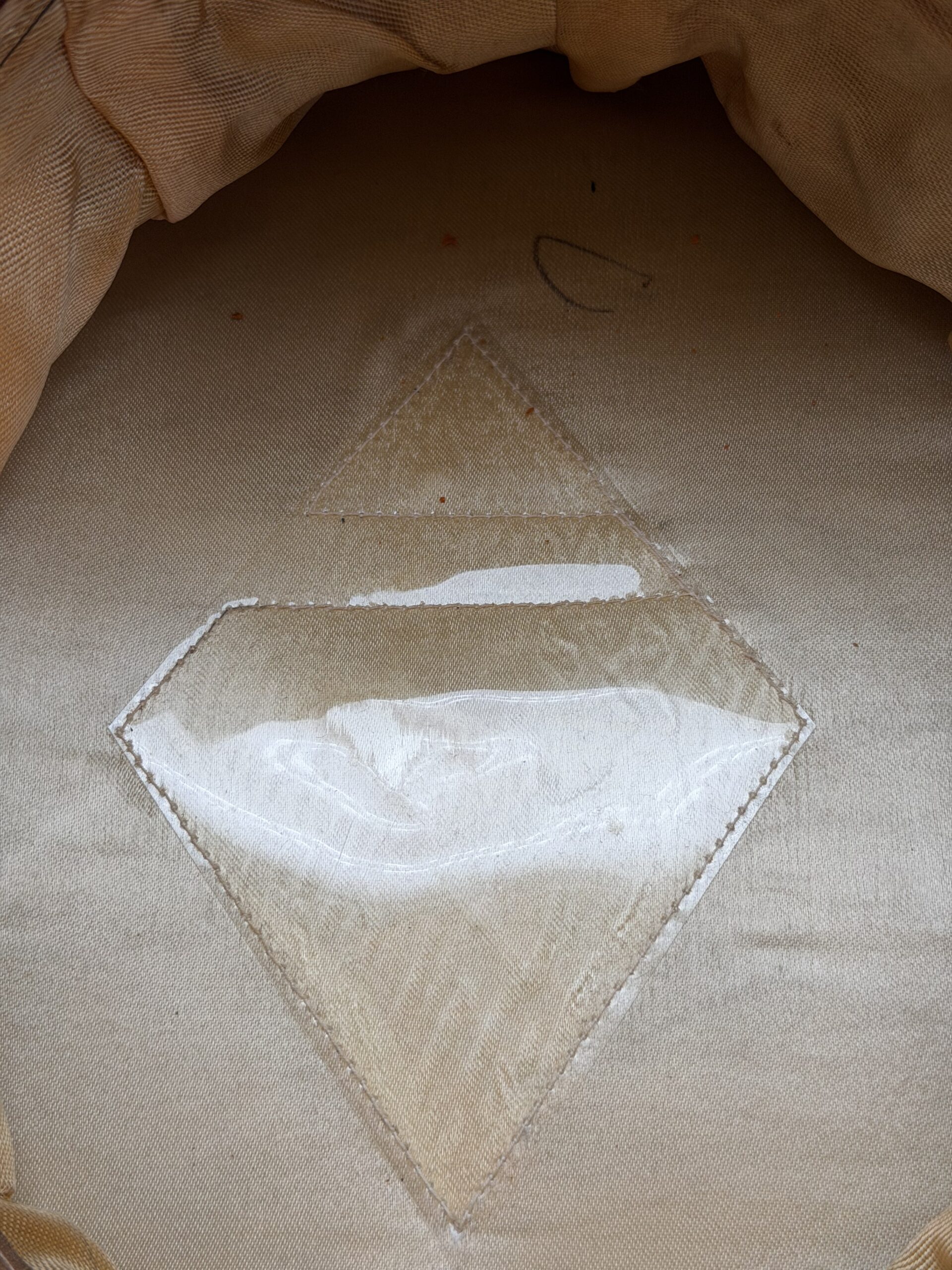
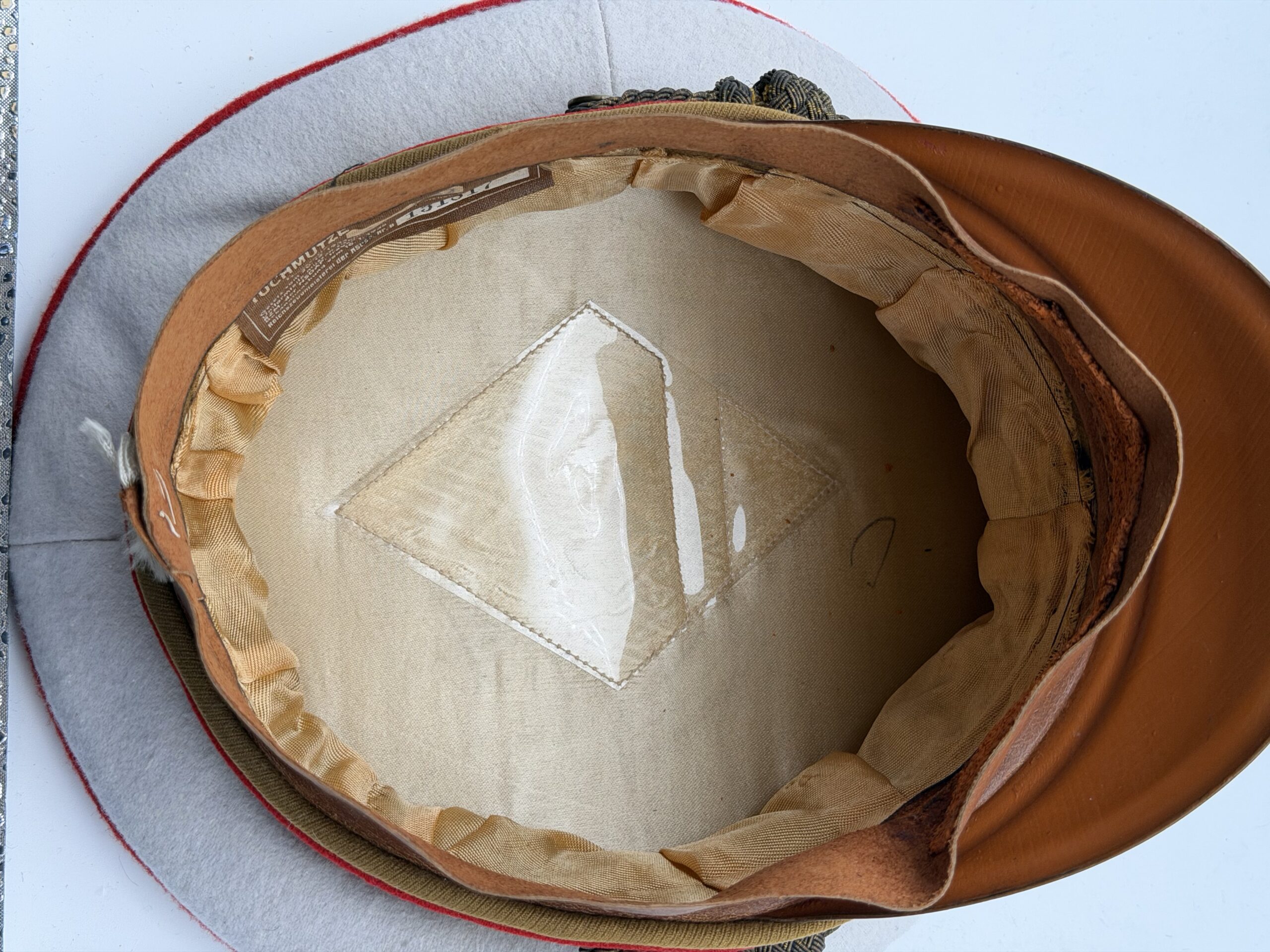
The cap contains a light tan rayon lining. The material remains largely intact and shows moderate discolouration, minor spotting and natural creasing.
A diamond-shaped stitch line marks the former position of a transparent celluloid sweat shield. The shield itself is now absent. Areas of pale residue remain within and around the stitched diamond, suggesting the loss or deterioration of the original transparent panel.
The brown leather sweatband displays natural drying, surface wear and partial separation. Wear is especially noticeable along the front section, where the leather contacted the wearer’s forehead. The damage should remain untreated unless a textile conservator recommends stabilisation.
The interior construction, folded rayon edges and stitching all contribute to the cap’s period appearance. Nevertheless, they should be assessed together rather than treated as isolated proof of originality.
An RZM cloth label survives beneath the leather sweatband. The label carries the RZM emblem, the designation “Tuchmütze”, a partially obscured manufacturer field and the clearly visible number 131817.
The printed German text refers to regulations dated 20 December 1934 and 16 January 1935. These notices concerned the marking of uniform components controlled through the Reichszeugmeisterei system.
The Reichszeugmeisterei supervised licensed production and distribution of NSDAP uniforms, equipment and insignia. Comparable Political Leader caps also retain RZM labels beneath their sweatbands.
The label shows wear where it has contacted the sweatband and lining. Its manufacturer number can no longer be read with confidence. Therefore, the cap should not be attributed to a specific maker without further evidence.
Political Leaders formed the uniformed administrative structure of the NSDAP. They operated across four principal organisational levels: Ortsgruppenleitung, Kreisleitung, Gauleitung and Reichsleitung.
The Gauleitung directed Party administration across a regional Gau. Its officials supervised district and local organisations while also supporting propaganda, mobilisation and political control.
The red piping on this NSDAP Gauleitung visor cap visually placed the wearer within that regional structure. By comparison, light blue represented the local Ortsgruppenleitung level, while other colours identified Kreisleitung and Reichsleitung personnel.
The 1943 Organisationsbuch der NSDAP provides a primary period reference for the organisation’s uniforms, insignia and administrative structure. The surviving volume has been digitised through the United States Holocaust Memorial Museum collection.
The white crown remains structurally sound and retains its intended saddle profile. It shows light dust, embedded surface dirt and mild age discolouration. The red piping remains bright and complete.
The brown velvet band has moderate surface compression but no obvious major loss. The bullion wreath remains complete and retains strong definition. The enamelled cockade also appears intact.
The chin cord has heavily oxidised to a dark brown colour. In addition, the visor shows fine scratches and small pressure marks. The leather sweatband has dried, worn and separated in places. Finally, the original celluloid sweat shield is missing.
These condition issues reflect the cap’s age and should not be cosmetically restored. Cleaning the white crown or polishing the metallic insignia could remove original surface material and reduce historical integrity.
Based on the supplied photographs, the cap body, textile construction, interior lining, sweatband wear, RZM label and embroidered wreath appear consistent with period manufacture.
The cap is therefore considered a likely original NSDAP Gauleitung visor cap. However, photographic examination cannot provide an absolute guarantee. Direct inspection should confirm the reverse of the eagle, its attachment prongs, the construction beneath the bullion wreath and the protected sections of the chin cord.
The cap should not be attributed to a named Gauleiter or senior official without documentary provenance. Gauleitung piping identifies the administrative echelon, but it does not establish the wearer’s precise rank or identity.
This NSDAP Gauleitung visor cap represents an unusually elaborate white summer-pattern Political Leader’s cap. Its red piping identifies Gau-level service, while its hand-embroidered metallic oak-leaf wreath demonstrates deluxe private-purchase workmanship.
The survival of the enamelled cockade, gilt eagle and numbered RZM Tuchmütze label further strengthens its historical and collecting interest. Despite age-related interior wear, the cap remains visually impressive and substantially complete.
It should be preserved as material evidence of the uniform hierarchy, visual propaganda and administrative structure of the National Socialist dictatorship.
Explore related listings: Military Visor & Peaked Caps.