
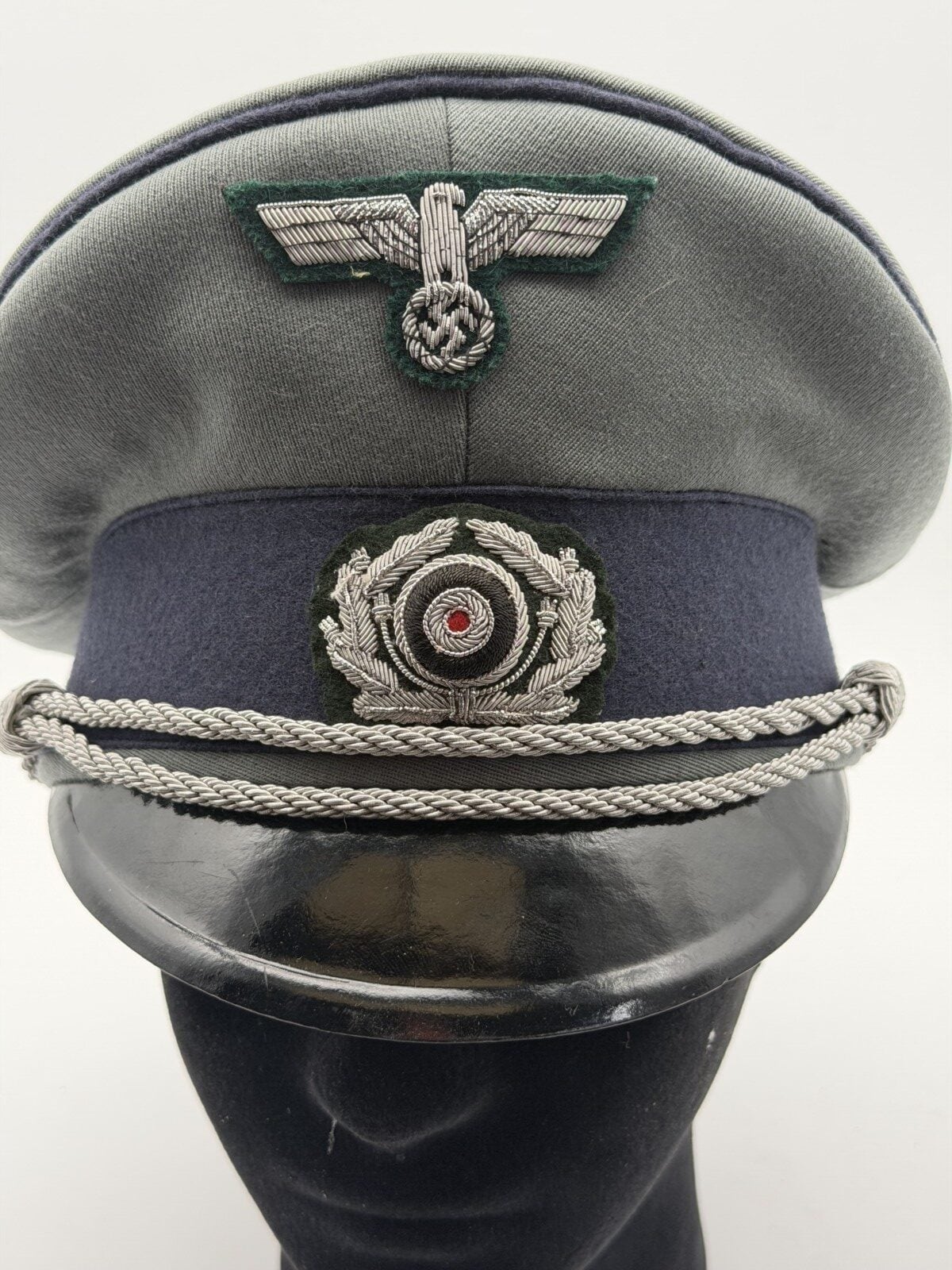
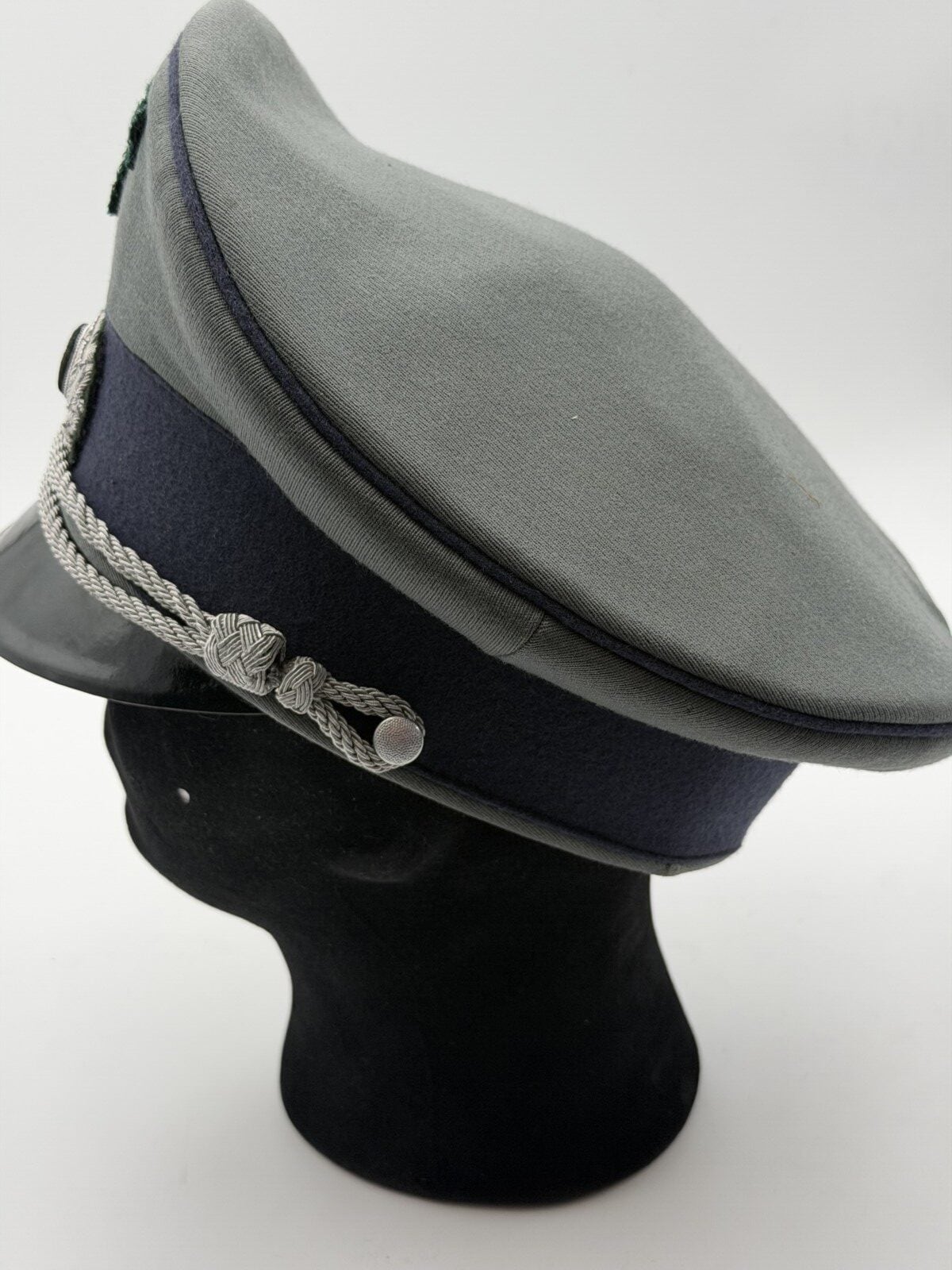
This Heer Medical Officer Visor Cap represents an especially attractive example of German Army officer headgear from the Second World War.
Its appearance immediately identifies it as an officer-quality Schirmmütze. Fine field-grey cloth forms the crown, while a dark bottle-green wool band surrounds the lower section.
€ 1.400
1 in stock
This Heer Medical Officer Visor Cap represents an especially attractive example of German Army officer headgear from the Second World War.
Its appearance immediately identifies it as an officer-quality Schirmmütze. Fine field-grey cloth forms the crown, while a dark bottle-green wool band surrounds the lower section.
Most importantly, blue piping follows the principal edges of the cap.
This Kornblumenblau, or cornflower-blue, Waffenfarbe identifies the medical branch of the Heer. Weitze likewise documents cornflower blue as the branch colour used by German Army medical personnel.
For comparison with another high-grade original Heer officer cap, see Nordmenn’s Double EREL Artillery Officer Visor Cap. Double EREL Artillery Officer Visor Cap – Nordmenn
Waffenfarbe formed an important part of German Army uniform identification.
Consequently, coloured piping could indicate the wearer’s branch without the need to examine additional insignia.
Medical personnel used Kornblumenblau. Therefore, the blue piping visible around this cap is an important identification feature rather than simply decorative trim. Weitze specifically identifies Kornblumenblau as the colour of the Sanitätstruppe.
Furthermore, documented original medical officer visor caps show the same basic arrangement of field-grey crown, dark centre band, blue piping and officer cords. Ratisbon’s has catalogued an original Heer Sanitätstruppe officer cap with blue branch piping and officer chin cords.
Ratisbon’s – Heer Sanitätstruppe Officer Visor Cap Reference
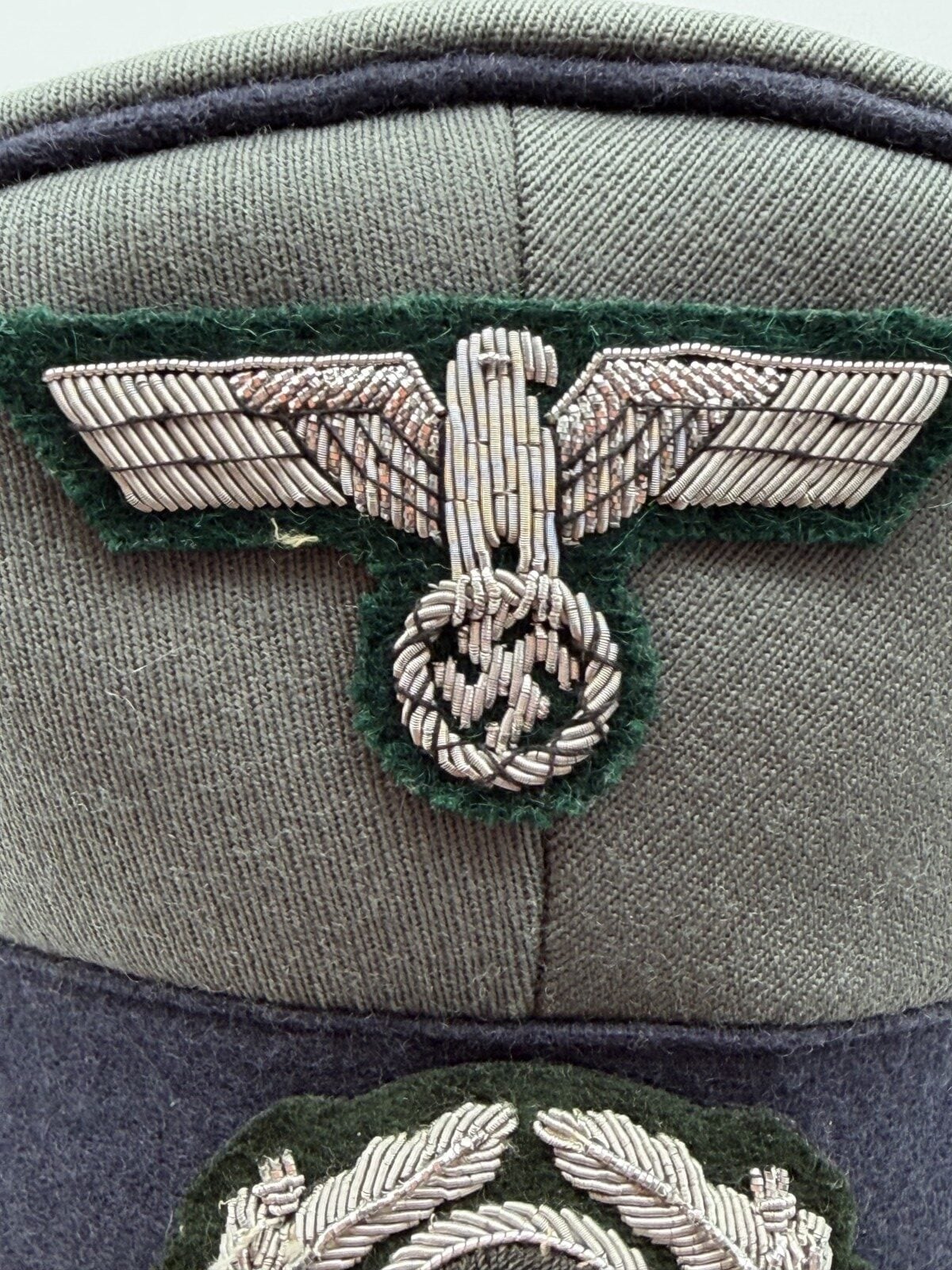
The crown carries an especially impressive officer-quality national eagle.
Rather than a conventional stamped metal device, this eagle uses hand-worked silver-coloured metal thread on a dark green cloth backing.
Individual feather groups remain clearly visible across both wings. Meanwhile, differing embroidery directions give the insignia the depth expected from quality hand work.
Closer examination also reveals gentle patination and small colour changes within the metallic strands.
Those variations enhance the appearance of age.
Importantly, the bullion should not be polished. Cleaning could remove original surface oxidation and valuable evidence of the insignia’s history.
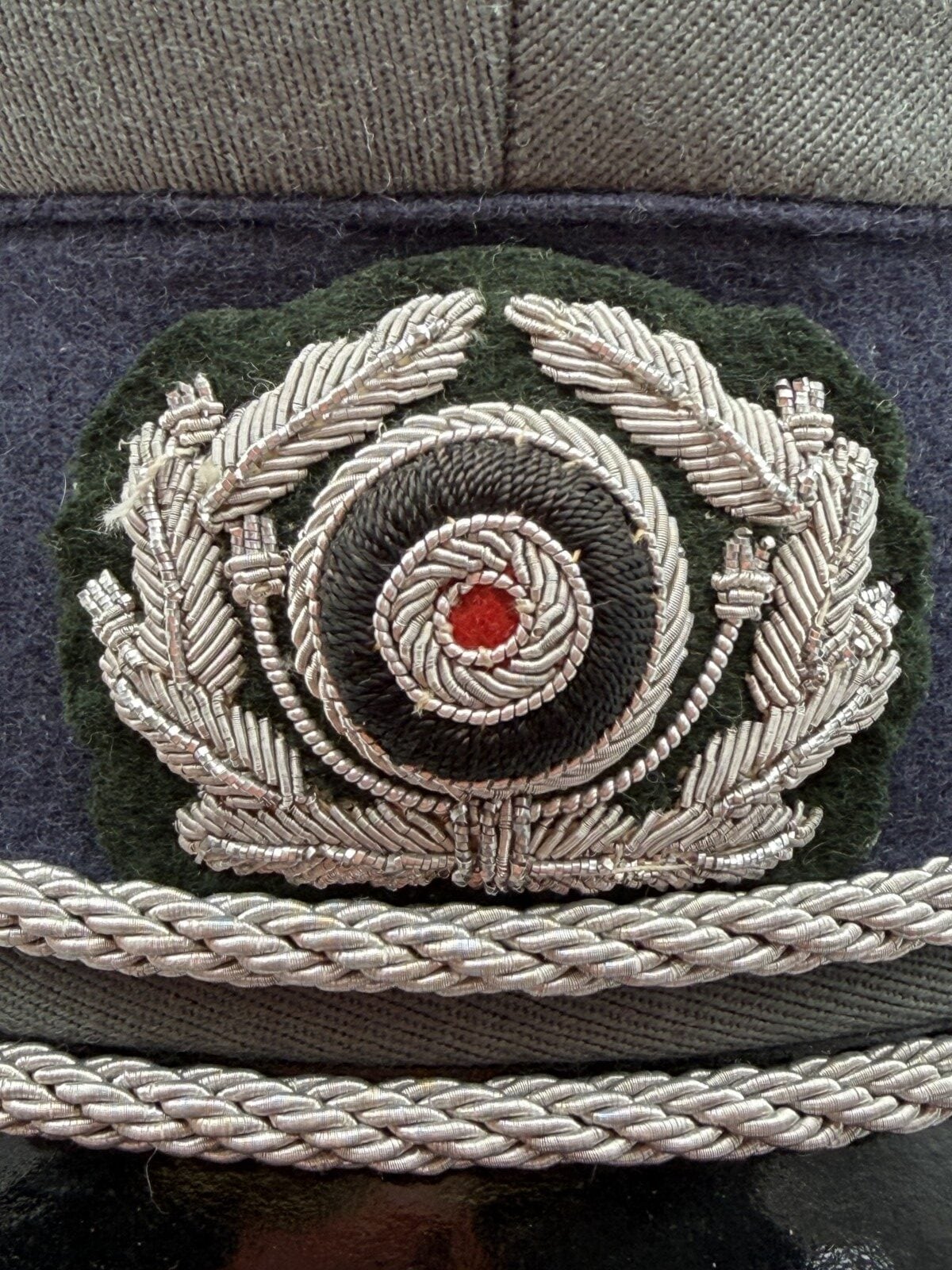
A matching hand-embroidered wreath sits centrally on the dark centre band.
Silver metal thread forms the oak leaves, acorns and lower binding.
At its centre remains the national cockade with black, white and red elements.
The construction of this wreath complements the eagle extremely well. Moreover, both pieces display comparable ageing, which gives the cap a coherent overall appearance.
Fine officer-grade bullion insignia substantially increases the visual appeal of this Heer Medical Officer Visor Capcompared with examples carrying ordinary stamped aluminium devices.
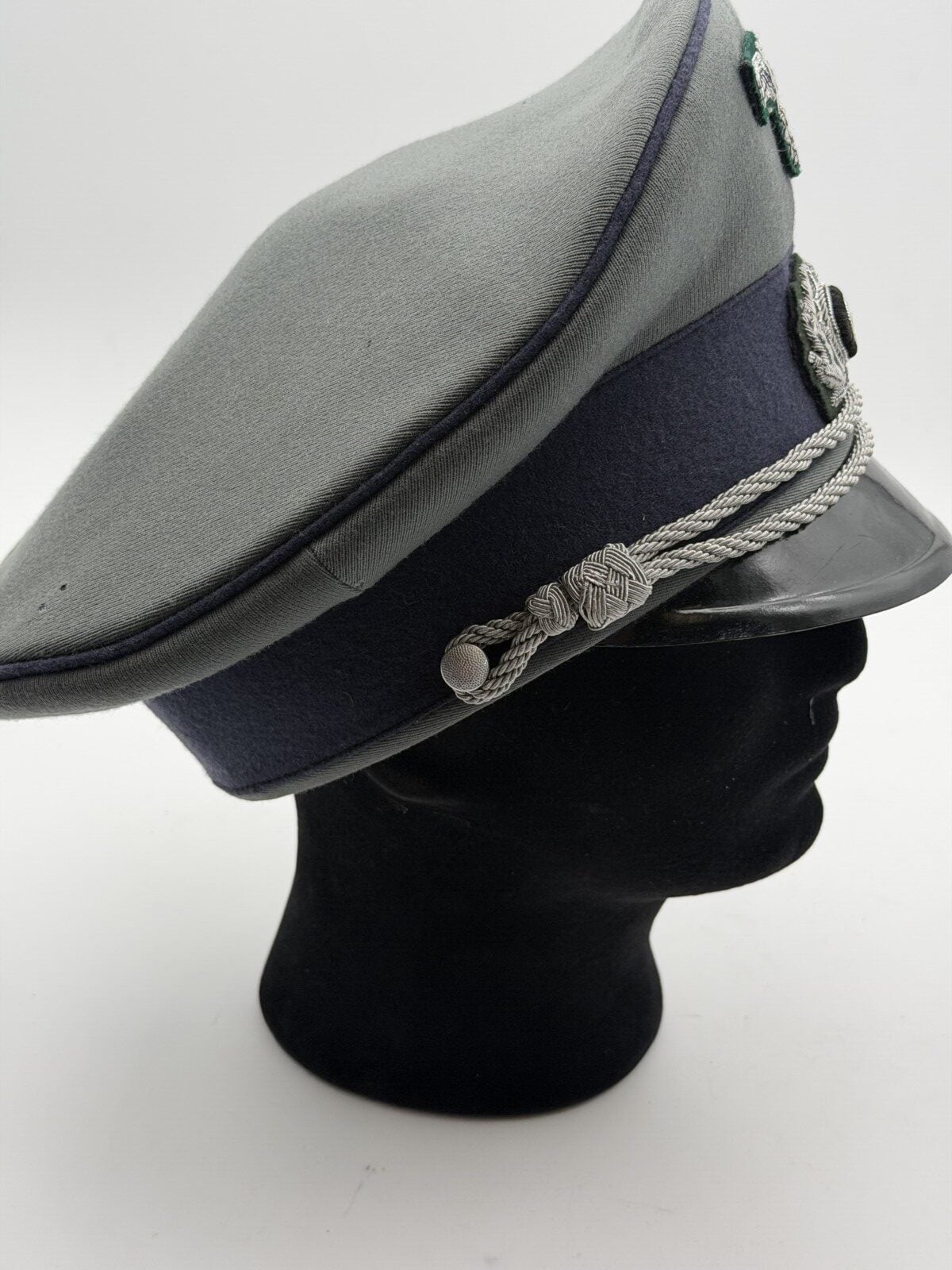
Silver-coloured officer cords extend across the front above the visor.
Decorative slides remain positioned towards each side, while textured officer buttons secure the cords to the cap.
This feature is entirely appropriate for commissioned Heer officer headgear.
By contrast, enlisted and many NCO configurations used a leather chinstrap rather than silver officer cords.
Therefore, the cords form another important component of the cap’s officer identification.
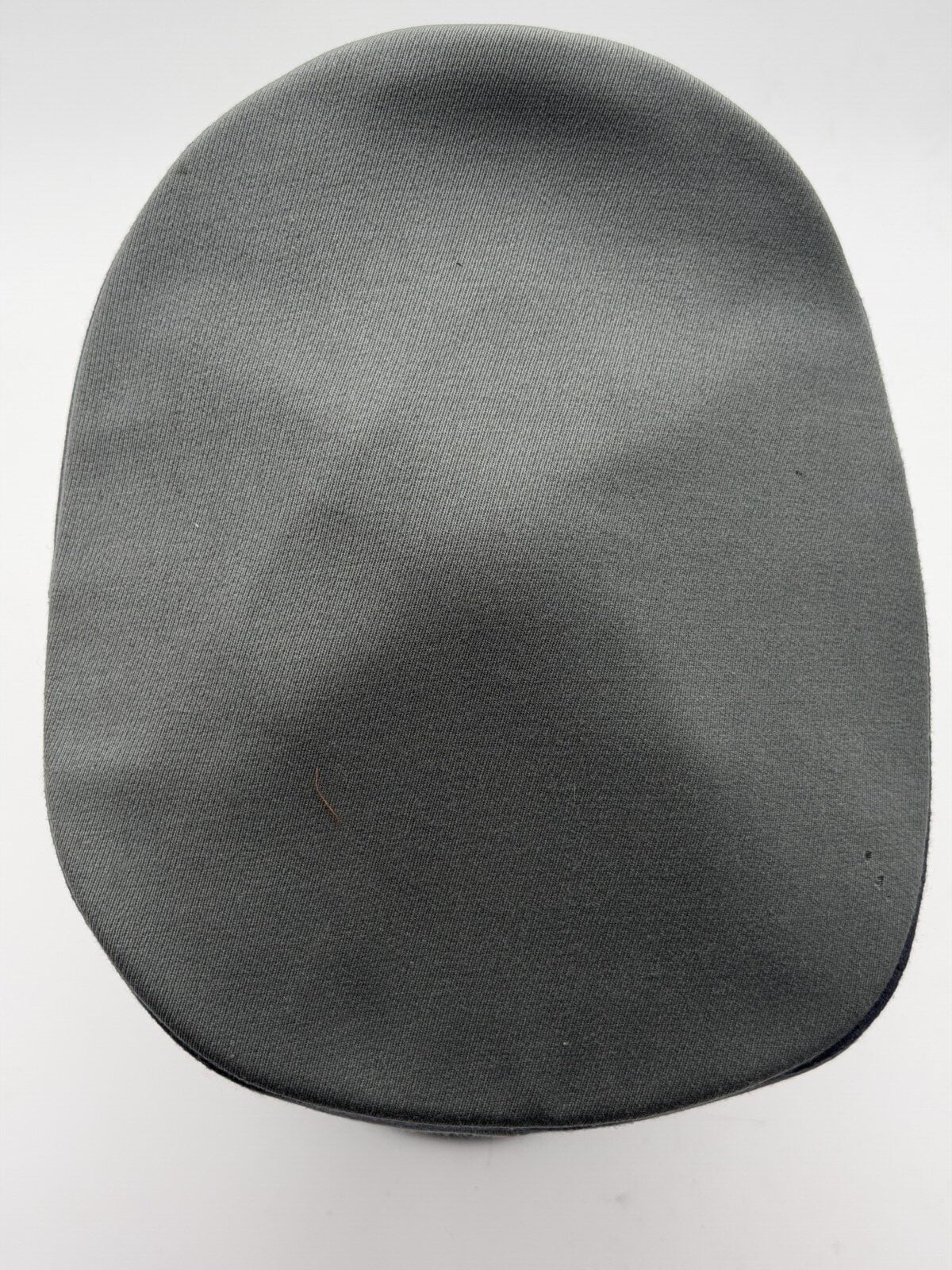
The upper body consists of finely woven field-grey material.
Its quality suggests a privately purchased officer cap rather than standard enlisted-issue construction.
The crown retains an excellent saddle profile and shows relatively little distortion.
Furthermore, the panel seams remain clearly defined.
Only limited age-related marks appear across the cloth, while the overall colour remains remarkably strong.
A deep bottle-green wool band surrounds the lower portion of the crown.
Depending on lighting, this material can appear very dark blue-green or almost black.
Nevertheless, the construction corresponds with the established Heer officer Schirmmütze format.
The contrast between field-grey cloth, dark green band and cornflower-blue piping gives the cap its distinctive medical-service appearance.
Collectors can compare the general construction with Nordmenn’s Original Heer Generalmajor Parade Visor Cap.
Original Heer Generalmajor Parade Visor Cap – Nordmenn
The black visor remains exceptionally attractive.
Its upper surface retains a strong glossy finish despite normal age and handling marks.
At the same time, the visor sits correctly within the body of the cap and retains an appealing shape.
Nothing suggests aggressive modern refinishing from the photographs provided.
Consequently, I would leave the visor completely untouched.
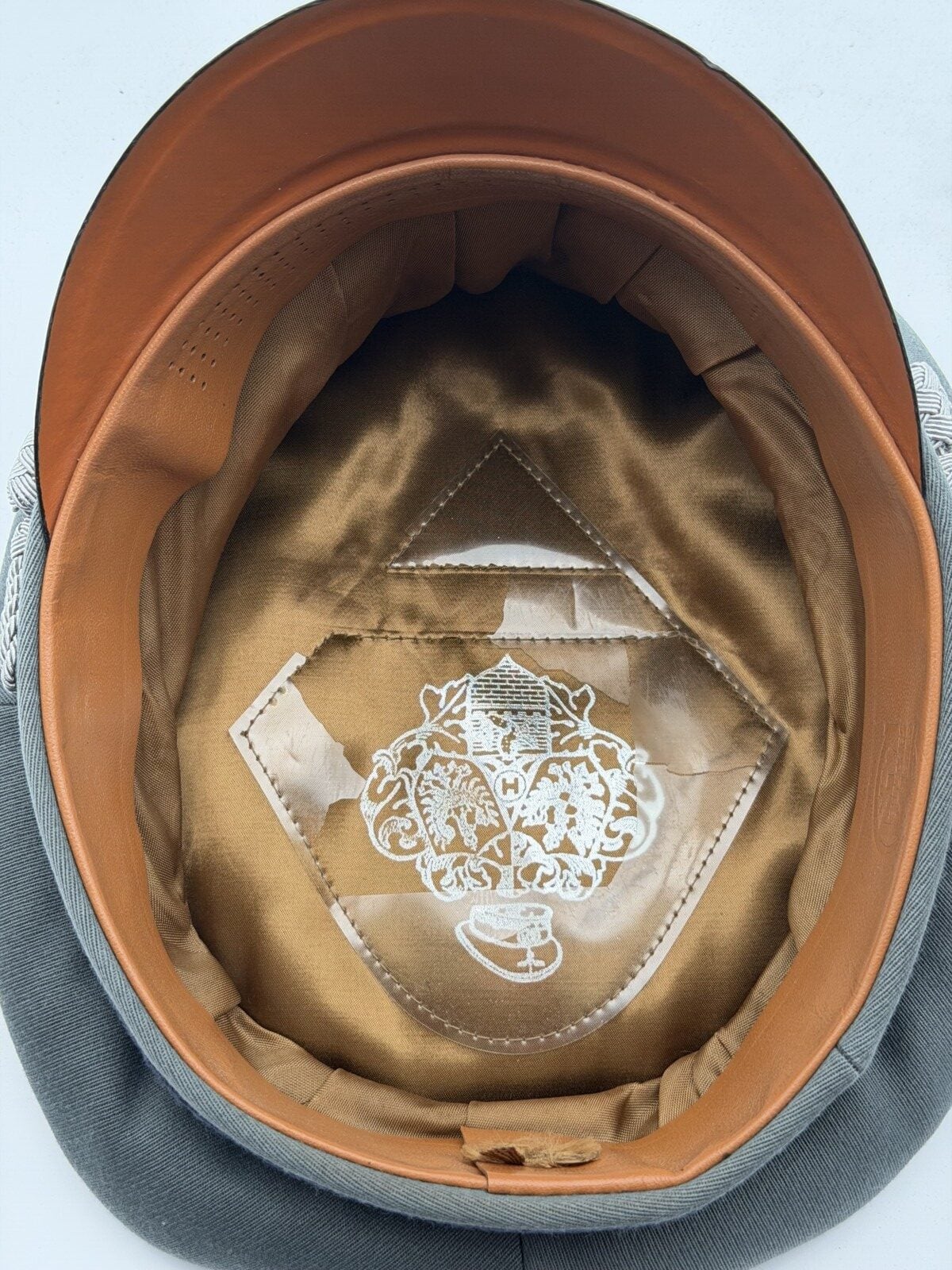
Inside the cap survives an attractive golden-brown rayon or artificial-silk lining.
A tan leather sweatband surrounds the interior.
Ventilation perforations remain clearly visible across part of the leather, while natural age and use appear throughout the construction.
The combination is typical of superior privately purchased officer headgear.
In addition, the interior has not been unnecessarily restored or cosmetically improved.
That point matters because original interior construction often provides valuable evidence when assessing wartime headgear.
The crown lining retains substantial remnants of its original transparent celluloid sweat shield.
Age has caused portions of this material to fracture and disappear.
However, the original stitched outline remains intact.
Part of a manufacturer’s trademark also survives beneath the damaged celluloid.
At present, I would describe the cap as:
Maker marked, with the surviving trademark presently unidentified.
I would not attribute it to EREL, Peküro, Clemens Wagner, Josef Huber or another manufacturer until the remaining device can be identified conclusively.
Based upon the photographs supplied, this Heer Medical Officer Visor Cap presents as a very convincing period example.
The field-grey material, dark centre band, cornflower-blue piping, officer cords and interior construction work together correctly.
Moreover, the ageing of the hand-embroidered eagle and wreath appears compatible with the rest of the cap.
The damaged celluloid sweat shield also shows natural deterioration rather than cosmetic artificial ageing.
I see no obvious feature in these photographs that would lead me to classify the complete cap as a modern reproduction.
Nevertheless, physical inspection always provides the strongest confirmation. UV examination, inspection beneath the sweatband and photographs of the reverse of both bullion insignia would provide further supporting evidence.
The Sanitätstruppe provided medical support throughout the German Army.
Medical personnel served with divisional medical companies, hospitals, field medical installations and numerous specialist formations.
Their distinctive Waffenfarbe remained cornflower blue.
Therefore, medical officer headgear forms a recognisable specialist category within Heer collecting.
For research into individual Wehrmacht officers, the German Federal Archives – Bundesarchiv retains military personnel material, including records concerning officers and medical officers.
Bundesarchiv – German Military Personnel Research
Overall condition is excellent for an original wartime officer visor cap.
The field-grey crown retains a strong profile.
Likewise, the blue piping remains substantially complete and clearly identifiable.
Both bullion insignia retain excellent definition with attractive natural tarnishing.
The officer cords also remain complete.
Meanwhile, the glossy visor presents extremely well.
The principal deterioration concerns the interior celluloid sweat diamond, where age-related cracking and losses are evident.
That damage should remain untouched because restoration would remove original material.
Medical officer visor caps appear much less frequently than infantry or artillery examples.
Furthermore, this cap has the added advantage of matching hand-embroidered bullion eagle and wreath insignia.
Its strong exterior condition increases desirability again.
Consequently, I would regard it as a superior Heer medical headgear example suitable for an advanced German Army uniform collection.
A second useful internal comparison is Nordmenn’s Heinrich Stümpfl White Summer Uniform and Named General’s Cap, which illustrates another form of privately purchased Heer officer headgear.
Heinrich Stümpfl White Summer Uniform & Named General’s Cap – Nordmenn