
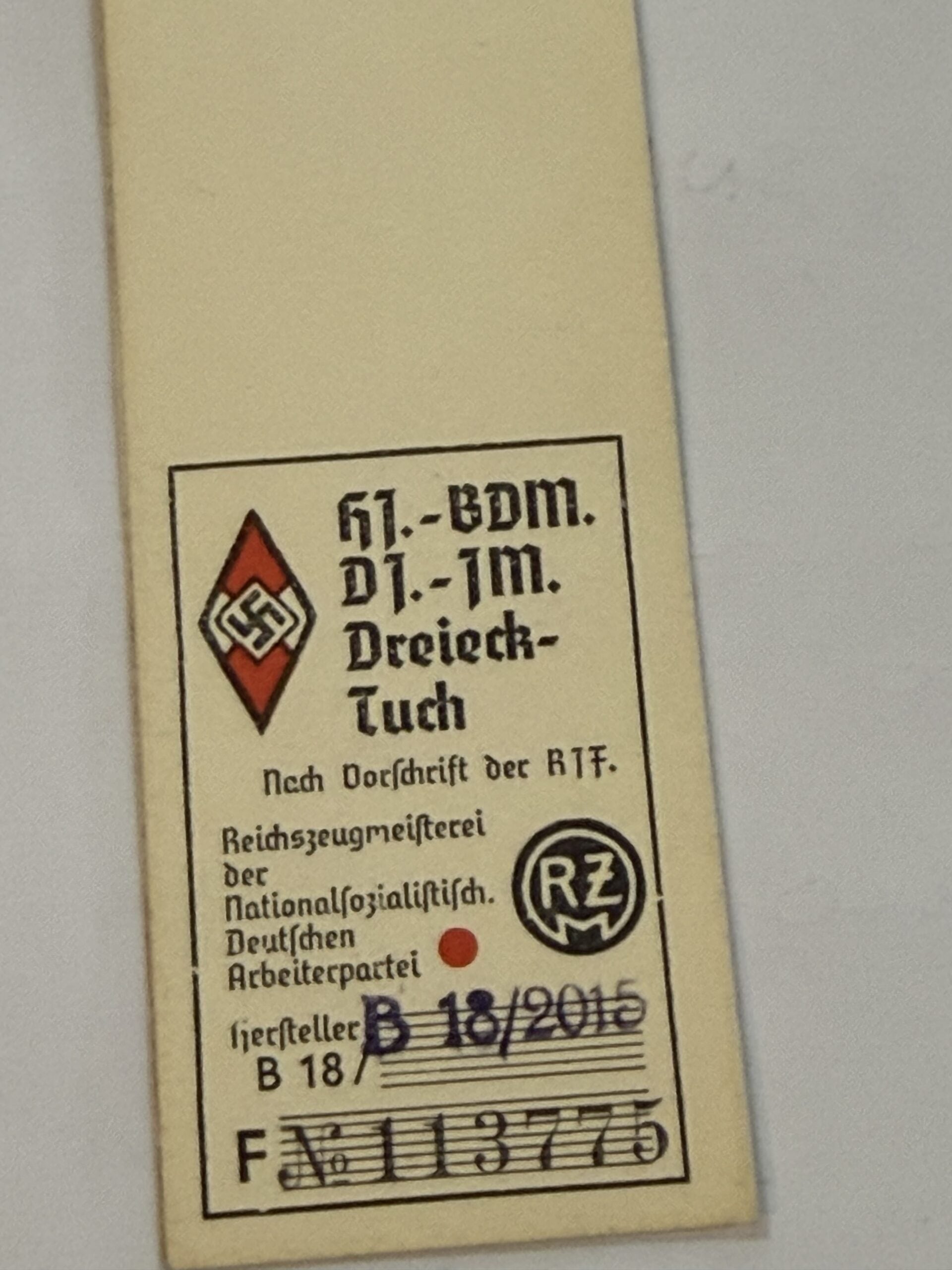
This Original Third Reich RZM BDM JM Dreiecktuch Label is an exceptionally scarce surviving example of an official Reichszeugmeisterei (RZM) garment label intended for the Bund Deutscher Mädel (BDM) and Jungmädel (JM) triangular neckerchief (Dreiecktuch). Unlike the more commonly encountered labels for shirts or skirts, labels for the BDM/JM neckerchief survive only rarely because they were normally removed with the garment or discarded through wear.
€ 70
2 in stock
This Original Third Reich RZM BDM JM Dreiecktuch Label is an exceptionally scarce surviving example of an official Reichszeugmeisterei (RZM) garment label intended for the Bund Deutscher Mädel (BDM) and Jungmädel (JM) triangular neckerchief (Dreiecktuch). Unlike the more commonly encountered labels for shirts or skirts, labels for the BDM/JM neckerchief survive only rarely because they were normally removed with the garment or discarded through wear.
This example remains in outstanding unused condition and retains its original colour printing, manufacturer’s licence code, inspection number and full paper extension. As a result, it represents an important museum reference piece illustrating the official quality-control system used by the Reichszeugmeisterei for Hitler Youth female uniform components.
The Bund Deutscher Mädel (BDM) formed the girls’ division of the Hitler Youth, while younger members belonged to the Jungmädelbund (JM). Uniform clothing was tightly regulated and manufactured according to specifications issued by the Reichsjugendführung (RJF).
One of the most recognisable items of the female youth uniform was the Dreiecktuch, or triangular neckerchief. Worn folded around the neck and secured by a leather slide or knot, it formed an essential part of both BDM and Jungmädel dress.
Following the Uniform Law of 20 December 1934, all authorised Party uniform items had to be produced by licensed manufacturers operating under the supervision of the Reichszeugmeisterei (RZM). Each approved garment carried an official inspection label confirming compliance with Party regulations. This label represents one of those original inspection tags.
The label is printed on cream-coloured paper and features:
The label survives complete with its original uncut paper extension, an increasingly uncommon feature.
The label is printed on high-quality cream paper consistent with official RZM paper labels used during the late 1930s and early 1940s.
The paper exhibits:
Its condition suggests it remained unused and protected from prolonged exposure to light.
The printing demonstrates characteristics consistent with original period production.
Notable features include:
The coloured BDM diamond remains especially well preserved, with no obvious colour bleeding.
The typography matches documented examples of RZM paper labels.
Particularly convincing are:
These details are difficult to reproduce accurately and are consistent with authentic period manufacture.
The label carries:
Hersteller: B 18/2015
with an earlier entry struck through and updated to B 18/.
Such manuscript or overprinted amendments are encountered on original RZM labels when licence details were revised or simplified during production. The alteration appears period in execution and is not unusual for original factory-issued labels.
The inspection designation:
F Nr. 11377
formed part of the Reichszeugmeisterei quality-control system.
Rather than indicating garment size, it identified the production inspection sequence associated with the approved manufacture of the neckerchief.
Its typography and layout conform to authenticated wartime examples.
Based upon the supplied photographs, the label displays all principal characteristics expected of an authentic Third Reich RZM paper garment label.
Positive observations include:
Nothing visible suggests post-war manufacture.
Original paper labels for BDM/JM Dreiecktücher are considerably scarcer than labels for shirts, skirts or jackets.
Most neckerchiefs were heavily worn, and detached labels were usually discarded during manufacture or tailoring. Complete unused examples are therefore uncommon and are increasingly sought after by:
This label is an important surviving document of the Reichszeugmeisterei’s control over Hitler Youth uniform production.
It records:
For museum collections, such labels provide valuable comparative material when assessing the originality of complete BDM neckerchiefs and associated uniform groupings.
Based upon the supplied photographs:
Opinion based upon photographs only
This label displays all of the major characteristics associated with authentic wartime RZM paper labels issued for BDM/JM triangular neckerchiefs.
No visible feature raises concern regarding originality.
98–99% probability of authenticity
The quality of the printing, paper stock, typography and period manufacturer amendment strongly supports originality. A microscopic examination would be appropriate for formal museum accessioning, but nothing in the photographs suggests modern manufacture.
Explore related listings: Uniform Accessories & Belts.
The Dreiecktuch was the regulation triangular neckerchief worn by members of the Bund Deutscher Mädel and Jungmädel as part of their official uniform.
Most surviving BDM labels are woven textile examples for shirts or skirts. Paper labels for neckerchiefs are encountered much less frequently, especially with their original paper extension intact.
The B 18 designation identifies a licensed RZM manufacturer approved to produce official youth organisation uniform components. The amended code reflects period administrative practice rather than later alteration.
| Attribute | Details |
|---|---|
| Item | Original RZM BDM/JM Dreiecktuch Label |
| Organisation | Hitler Youth / Bund Deutscher Mädel / Jungmädel |
| Uniform Component | Dreiecktuch (Triangular Neckerchief) |
| Period | Third Reich, c. 1935–1945 |
| Material | Printed cream paper |
| Manufacturer Code | B 18/2015 (amended) |
| Inspection Number | F Nr. 11377 |
| Condition | Excellent unused |
| Authenticity | Original period example (photographic assessment) |