
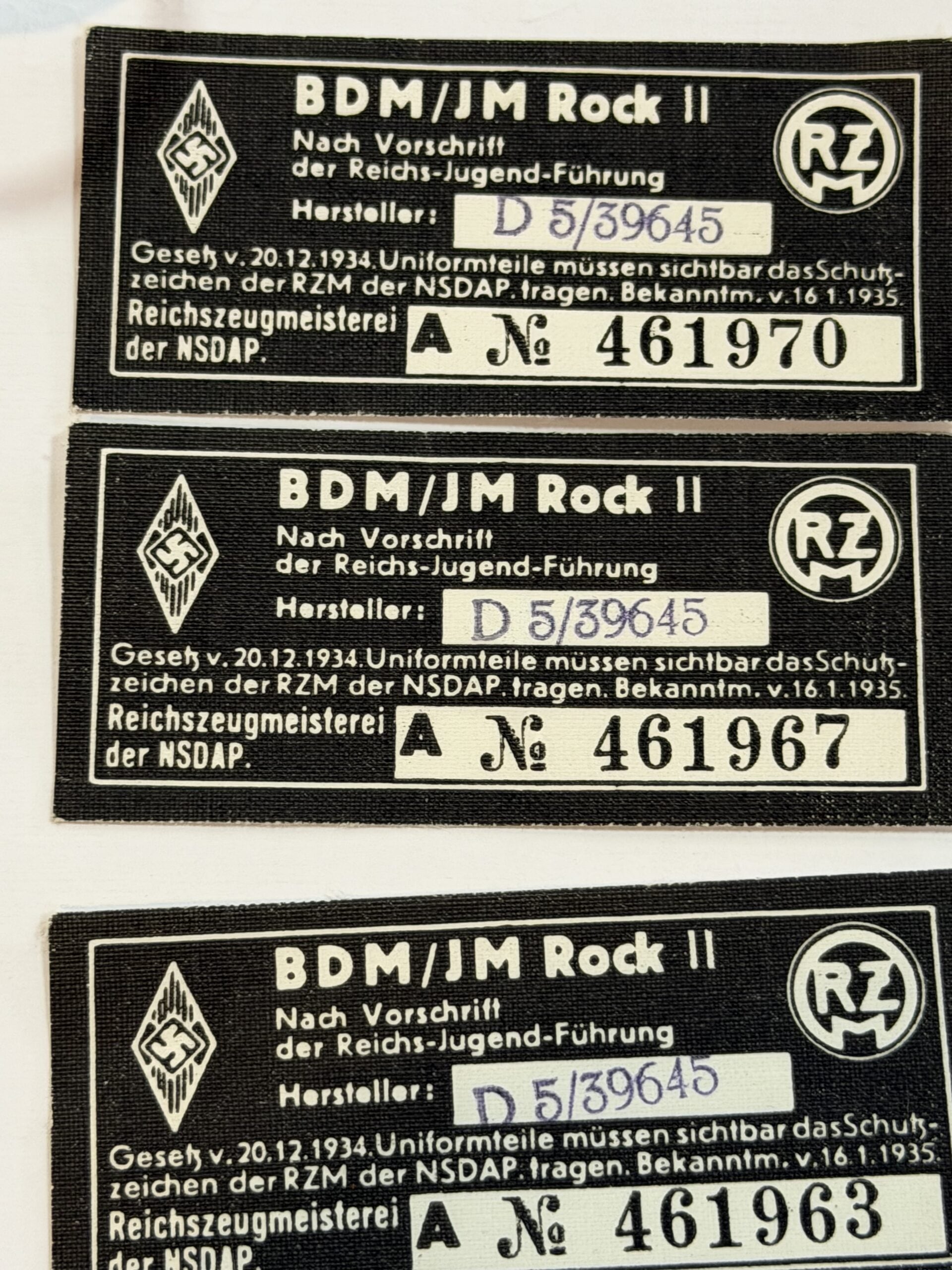
This exceptional group comprises three original Third Reich Reichszeugmeisterei (RZM) BDM/JM Rock II uniform labels, all preserved in unused condition and originating from the same production batch. Intended for insertion into officially manufactured Bund Deutscher Mädel (BDM) and Jungmädel (JM) uniform skirts (Rock II), these labels are rare survivors of the National Socialist clothing control system administered by the Reichszeugmeisterei.
€ 200
3 in stock
This exceptional group comprises three original Third Reich Reichszeugmeisterei (RZM) BDM/JM Rock II uniform labels, all preserved in unused condition and originating from the same production batch. Intended for insertion into officially manufactured Bund Deutscher Mädel (BDM) and Jungmädel (JM) uniform skirts (Rock II), these labels are rare survivors of the National Socialist clothing control system administered by the Reichszeugmeisterei.
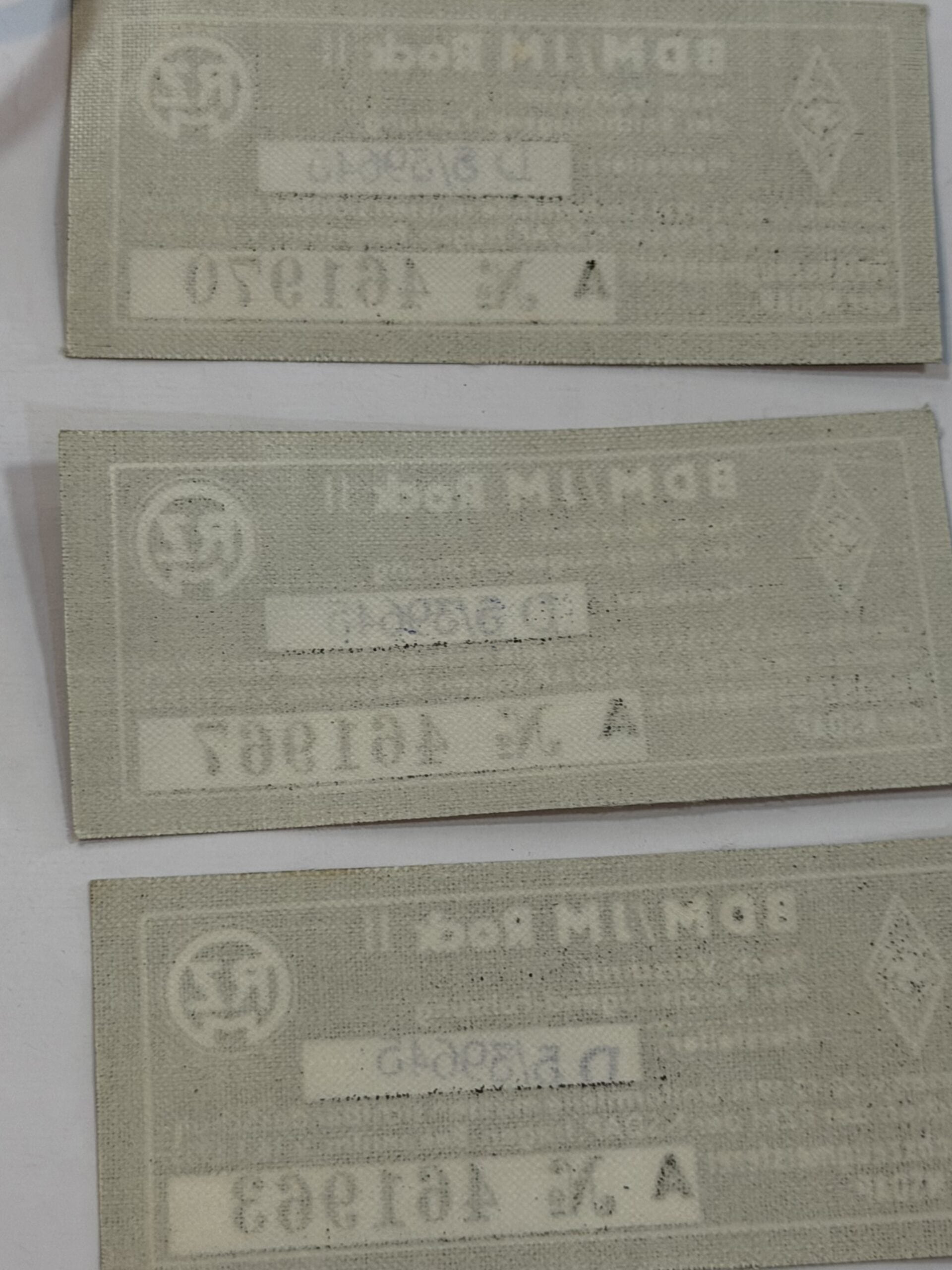
The labels retain their original manufacturer code, sequential inspection numbers and characteristic reverse print-through, making them outstanding museum reference examples for collectors, textile historians and institutions specialising in Third Reich uniform production.
The Bund Deutscher Mädel (BDM) served as the female branch of the Hitler Youth, while the Jungmädelbund (JM)was its junior section for girls between the ages of 10 and 14. Established to provide ideological education, physical training and community service, these organisations maintained highly regulated uniforms manufactured under strict Party supervision.
To ensure quality control and standardisation, the Reichszeugmeisterei (RZM) licensed approved manufacturers and required official labels to be sewn into garments. These labels confirmed that each item complied with the regulations issued by the Reichsjugendführung and the Uniform Law of 20 December 1934.
The designation “Rock II” refers to the standard regulation skirt pattern approved for wear by members of the BDM and Jungmädel.
This matching group consists of three original RZM BDM/JM Rock II labels, each printed in black on a tightly woven natural cotton foundation.
Each label displays:
Visible inspection numbers include:
The close numerical sequence strongly suggests manufacture during the same production run.
The labels are woven from fine natural cotton with a uniform plain weave consistent with authenticated wartime RZM textile labels.
The cloth exhibits:
The printing demonstrates numerous characteristics associated with authentic period manufacture.
Observed features include:
The quality is consistent across all three labels.
The reverse photographs reveal one of the strongest indicators of authenticity.
The printed design is faintly visible through the cotton weave, demonstrating natural ink penetration during the original screen-printing process.
This reverse strike-through is extremely difficult to reproduce accurately and is considered a key characteristic of genuine RZM textile labels.
The typography corresponds closely with documented originals.
Notable features include:
The inscription “Nach Vorschrift der Reichs-Jugend-Führung” is particularly well executed and conforms to known wartime examples.
Each label carries the manufacturer code:
D 5/39645
The RZM licensing system assigned coded identifiers to approved manufacturers rather than always printing company names. This allowed the Reichszeugmeisterei to regulate production and maintain uniform standards across the German textile industry.
The identical code on all three labels confirms production by the same licensed manufacturer.
The labels bear sequential inspection numbers:
Their close numerical relationship indicates they originated from a single inspection sequence or manufacturing batch. Such matched groups are considerably scarcer than isolated labels and are of particular interest to researchers studying wartime production practices.
Based upon the supplied photographs, all three labels display the principal characteristics expected from authentic wartime RZM production.
Positive indicators include:
No visible evidence suggests post-war reproduction.
Detached BDM/JM Rock II labels survive significantly less frequently than complete uniforms.
Matching groups from the same production run are particularly desirable because they document the manufacturing process and RZM inspection system.
They appeal to:
This group provides valuable evidence of the centralised control exercised by the Reichszeugmeisterei over Hitler Youth clothing production.
It illustrates:
As a comparative reference, these labels are especially useful when authenticating complete BDM and Jungmädel uniforms.
Based on the supplied photographs:
Opinion based upon photographs only
These labels display all major characteristics associated with authentic Third Reich RZM BDM/JM garment labels.
Nothing visible raises concern regarding originality.
98–99% probability of authenticity
The consistency of printing, weave, reverse strike-through and sequential numbering strongly supports originality. Physical examination under magnification would be appropriate for formal museum accessioning but is unlikely to alter this assessment.
Explore related listings: militaria catalogue.
“Rock II” refers to the approved regulation skirt pattern worn by members of the Bund Deutscher Mädel (BDM) and the Jungmädel (JM), produced according to Reichsjugendführung specifications.
This is the RZM licence code assigned to an authorised manufacturer. Such codes were used to identify approved producers without always printing the company’s commercial name.
Groups with sequential inspection numbers provide insight into wartime production batches and are especially valuable as museum reference material.
| Attribute | Details |
|---|---|
| Item | Original RZM BDM/JM Rock II Uniform Labels (Group of Three) |
| Organisation | Bund Deutscher Mädel / Jungmädel |
| Period | Third Reich, c. 1935–1945 |
| Material | Screen-printed woven cotton |
| Colour | Black with white printing |
| Manufacturer Code | D 5/39645 |
| Inspection Numbers | A Nr. 461963, 461967, 461970 |
| Condition | Excellent unused |
| Authenticity | Original period examples (photographic assessment) |