
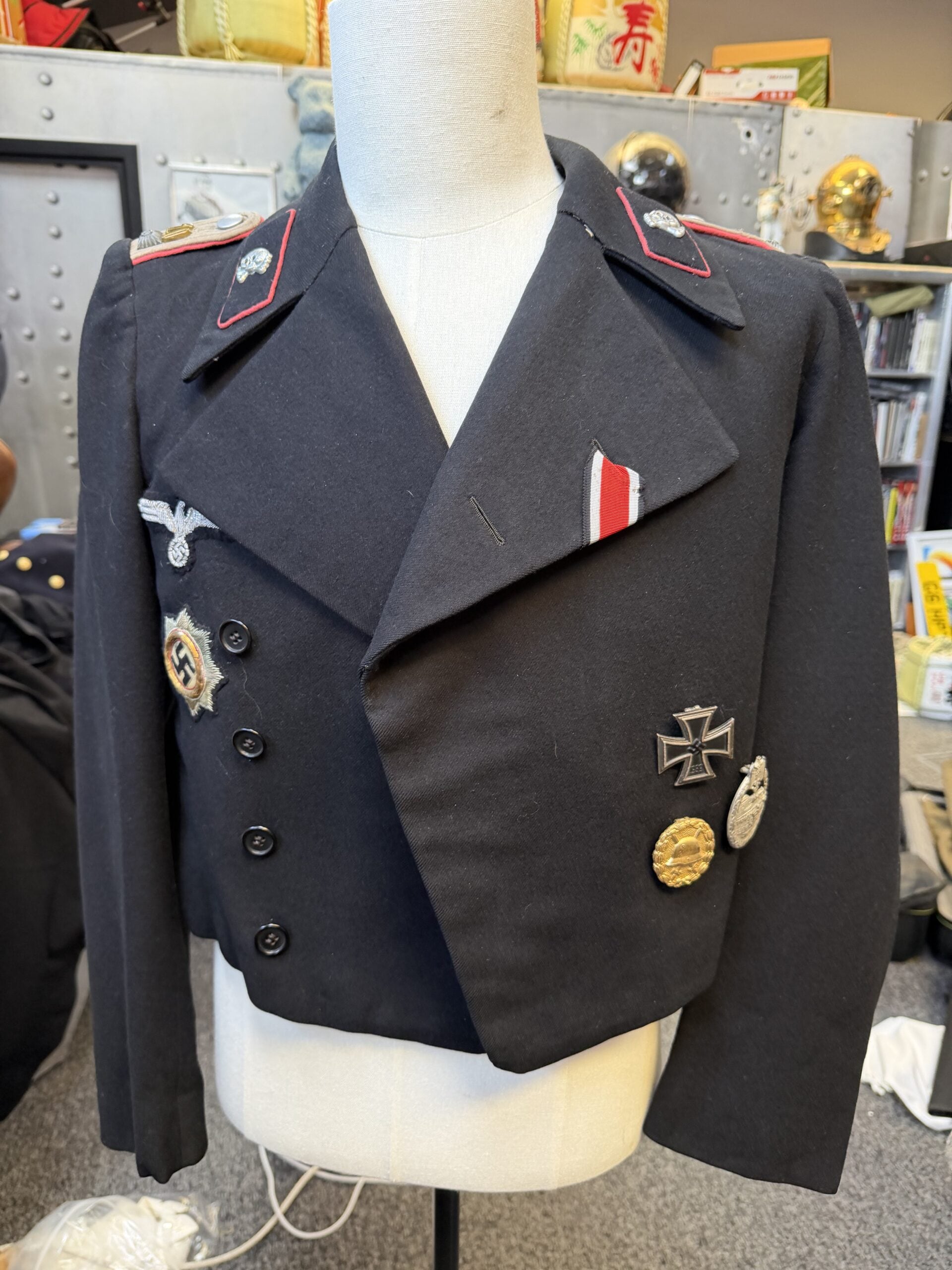
Exceptional original Panzer Regiment 10 Panzerjacke for an Oberleutnant of the German Army Panzertruppe. Tailored in black wool, the jacket retains rose-pink Waffenfarbe, Panzer Totenkopf collar insignia and officer shoulder boards carrying gilt numeral “10” cyphers.
An impressive combat award configuration includes a black-backed cloth German Cross in Gold, Iron Cross 1st Class 1939, Gold Wound Badge, Panzer Assault Badge in Silver and Iron Cross 2nd Class ribbon.
Research has identified Oberleutnant Knut Schumacher of 4./Panzer-Regiment 10, who received the German Cross in Gold on 3 November 1943, as a particularly important possible wearer. However, the jacket should not presently be attributed to Schumacher without documentary provenance.
€ 15.000
1 in stock
This Panzer Regiment 10 Panzerjacke represents an exceptionally desirable German armoured-force officer uniform from the Second World War.
Fine black wool forms the distinctive short wrap-over jacket associated with the Heer Panzertruppe. Rose-pink Waffenfarbe appears around the collar patches and beneath the shoulder boards.
Unlike an enlisted Panzerjacke, this example carries officer-grade insignia. Furthermore, the shoulder boards identify the wearer’s rank as Oberleutnant.
Most importantly, gilt metal numeral 10 cyphers connect the uniform with Panzer-Regiment 10.
Bundesarchiv records specifically identify Panzer-Regiment 10 with the 8. Panzer-Division. The archive also preserves the dedicated record BArch RH 39/637, titled Das Panzer-Regiment 10 im Frieden und im 2. Weltkrieg, 1937–1945.
Both shoulders carry officer boards constructed from silver braid over rose-pink Panzer Waffenfarbe.
A single rank pip corresponds to Oberleutnant.
Prominently mounted gilt numeral “10” cyphers identify Panzer-Regiment 10. Natural toning is visible on the metallic components, while the surrounding cloth shows compatible age.
The combination of rank and unit number becomes particularly significant when the German Cross recipient records are considered.
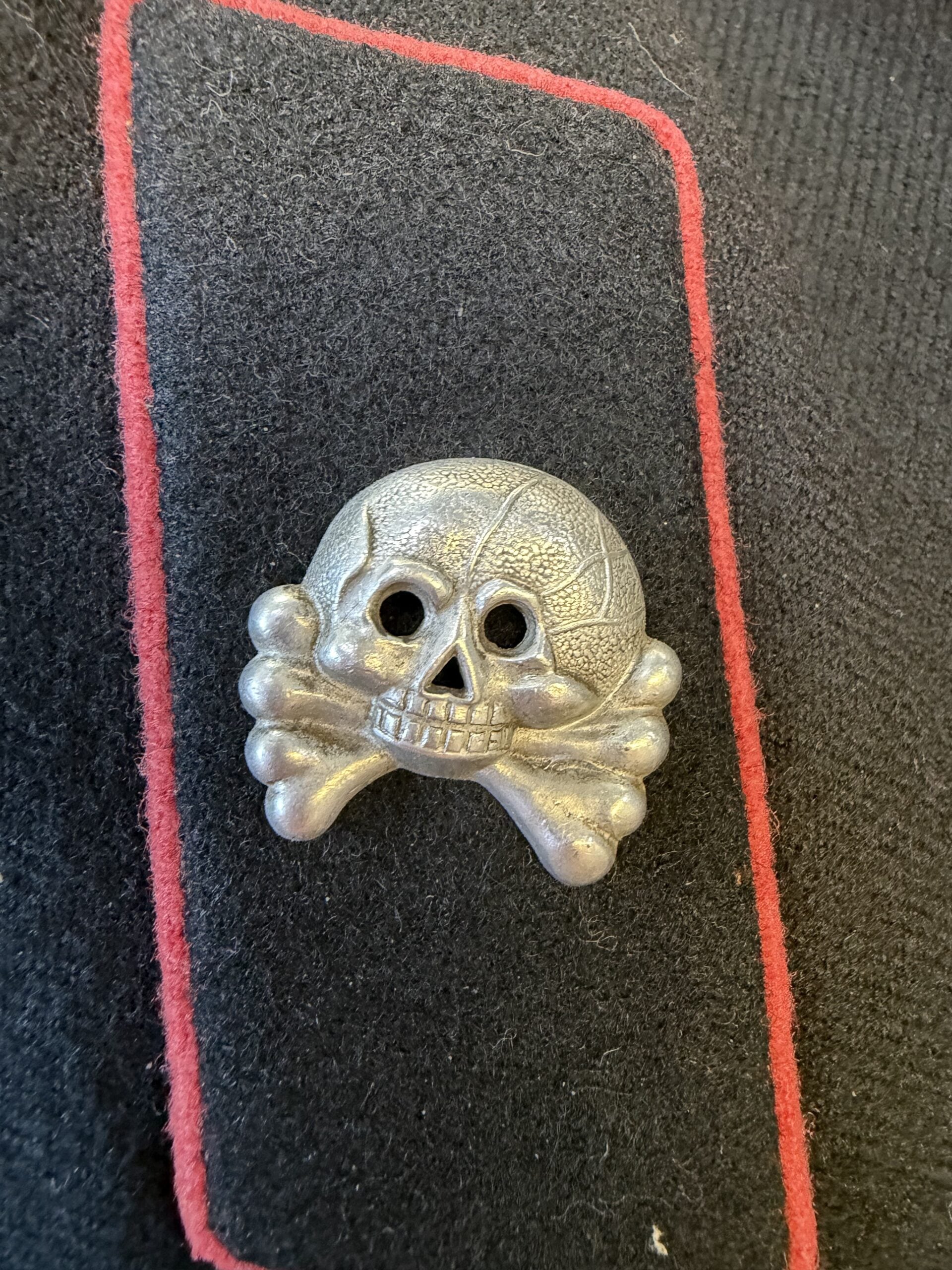
Black collar patches carry the traditional Panzer skull-and-crossbones insignia.
Rose-pink piping borders each patch. Although photographic lighting can cause this colour to appear stronger or more red, the configuration corresponds with Panzer branch insignia.
The metal Totenkopf devices show natural surface ageing, softened highlights and minor oxidation.
Close examination also reveals convincing integration between the collar patches and the underlying wool.
A high-quality Heer national eagle remains mounted on the right breast.
The silver-grey embroidery has naturally toned with age. Its construction and appearance complement the officer-quality insignia elsewhere on the garment.
Importantly, the eagle sits above one of the most significant features of the jacket: the cloth German Cross in Gold.
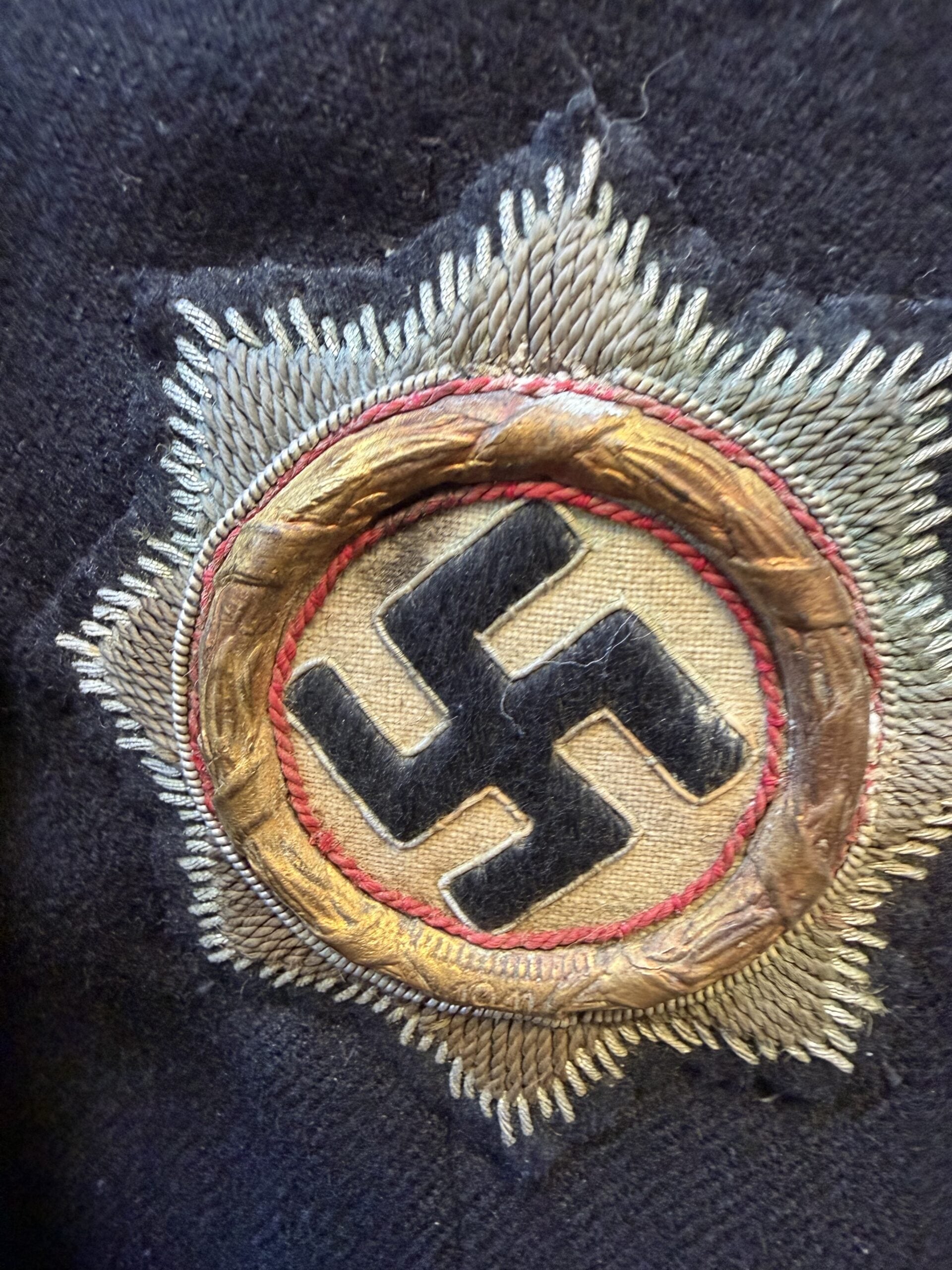
The right breast carries a highly desirable German Cross in Gold in cloth form.
Its black backing is particularly important because black-backed versions were intended for wear with Panzer uniforms.
The award displays the characteristic central swastika, contrasting field, red border, gilt wreath and radiating silver-grey star.
Cloth versions reduced the bulk associated with the large metal German Cross. Consequently, they were particularly practical for armoured crews operating within confined fighting compartments.
Current specialist examples confirm how desirable this variation has become. Helmut Weitze currently documents black Panzer versions at approximately €1,800 to €2,500 depending on construction and condition.
A cloth German Cross remaining attached to a decorated Panzer officer jacket carries considerably greater historical interest than an isolated example.
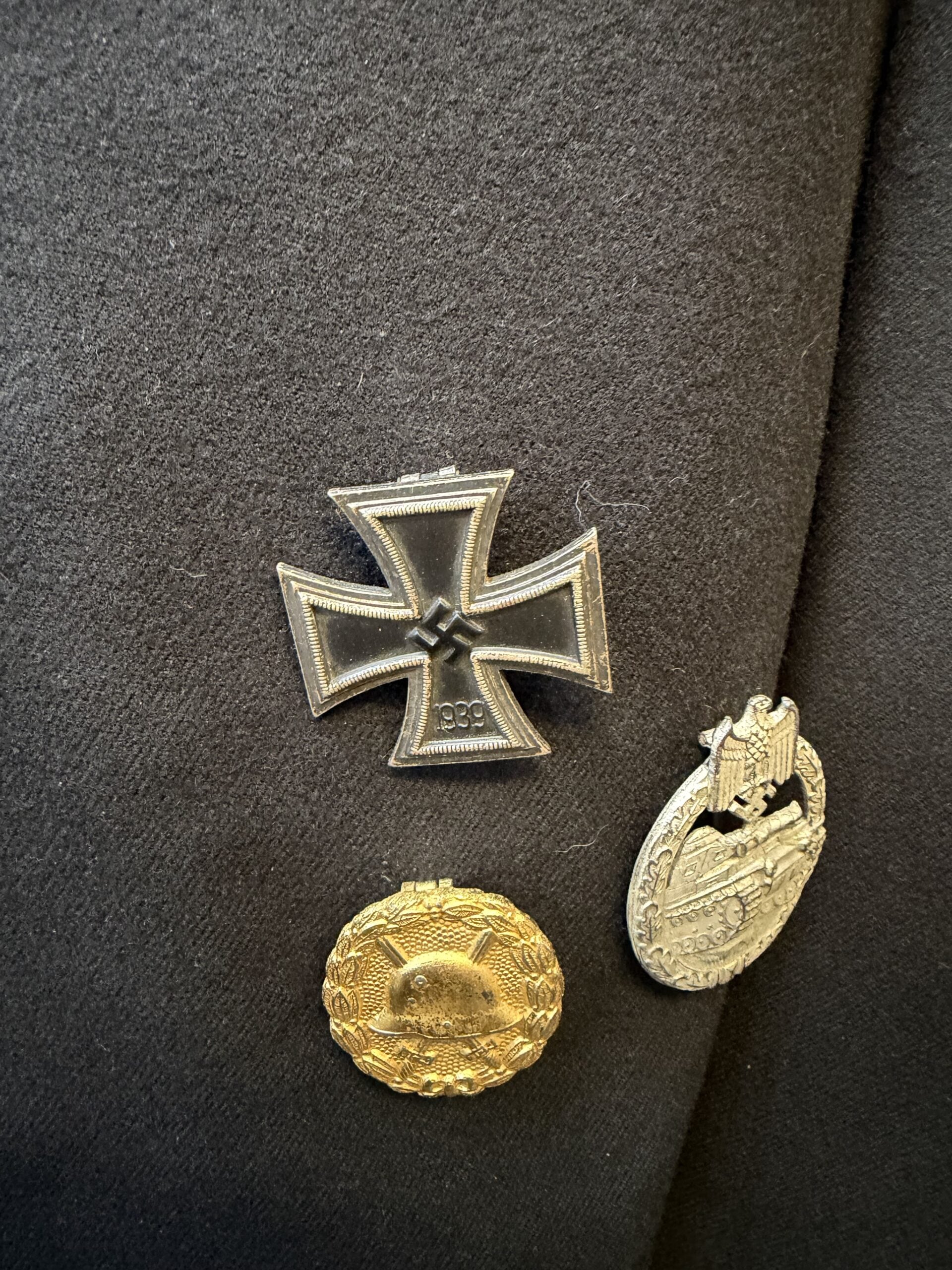
The left breast displays an Iron Cross 1st Class 1939.
Its blackened centre and silver-coloured frame remain clearly visible. The lower arm carries the date 1939.
Surface toning appears compatible with the remainder of the mounted decorations.
The presence of the Iron Cross 1st Class is also entirely logical alongside a German Cross in Gold recipient’s uniform.
Below the Iron Cross sits a 1939 Wound Badge in Gold.
The gold grade represented the highest regular class of the German wound decoration.
Its presence suggests either repeated wounds or wounds of considerable severity, although attribution to a particular wearer requires supporting award documentation.
The surviving finish shows age and wear appropriate to a decoration mounted on a wartime uniform.
A Panzer Assault Badge in Silver is mounted beside the other breast decorations.
Its oval wreath surrounds the familiar representation of a German tank beneath the national eagle.
This decoration was strongly associated with qualified Panzer crews and therefore fits the jacket’s branch and unit perfectly.
Together, the Panzer Assault Badge, Gold Wound Badge, Iron Cross and German Cross create an exceptionally strong armoured combat award group.
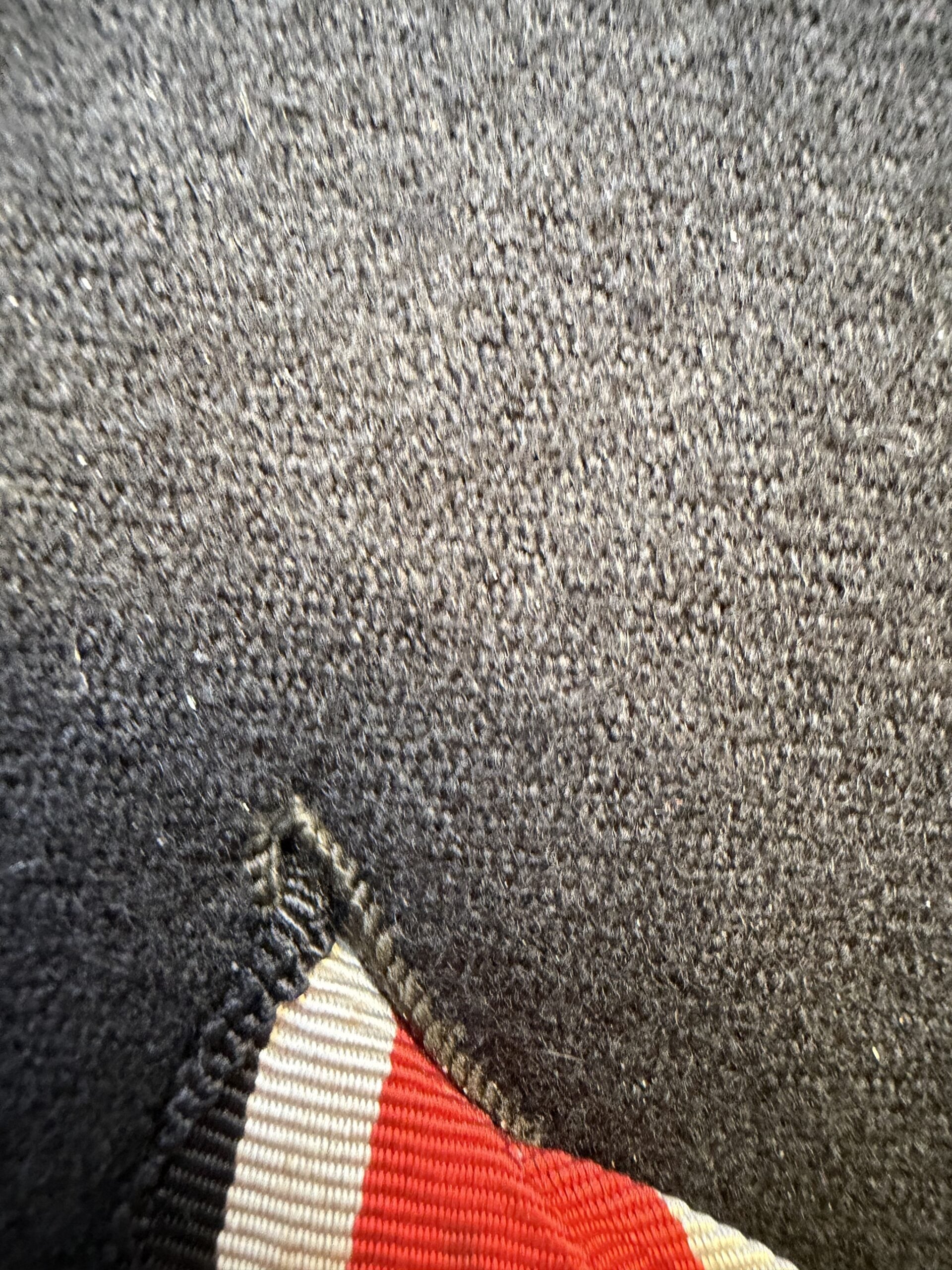
An Iron Cross 2nd Class ribbon appears through the lapel area.
Its black, white and red colouring remains visible.
Period photographs regularly show this form of ribbon wear on German uniforms. Its presence also complements the Iron Cross 1st Class mounted below.
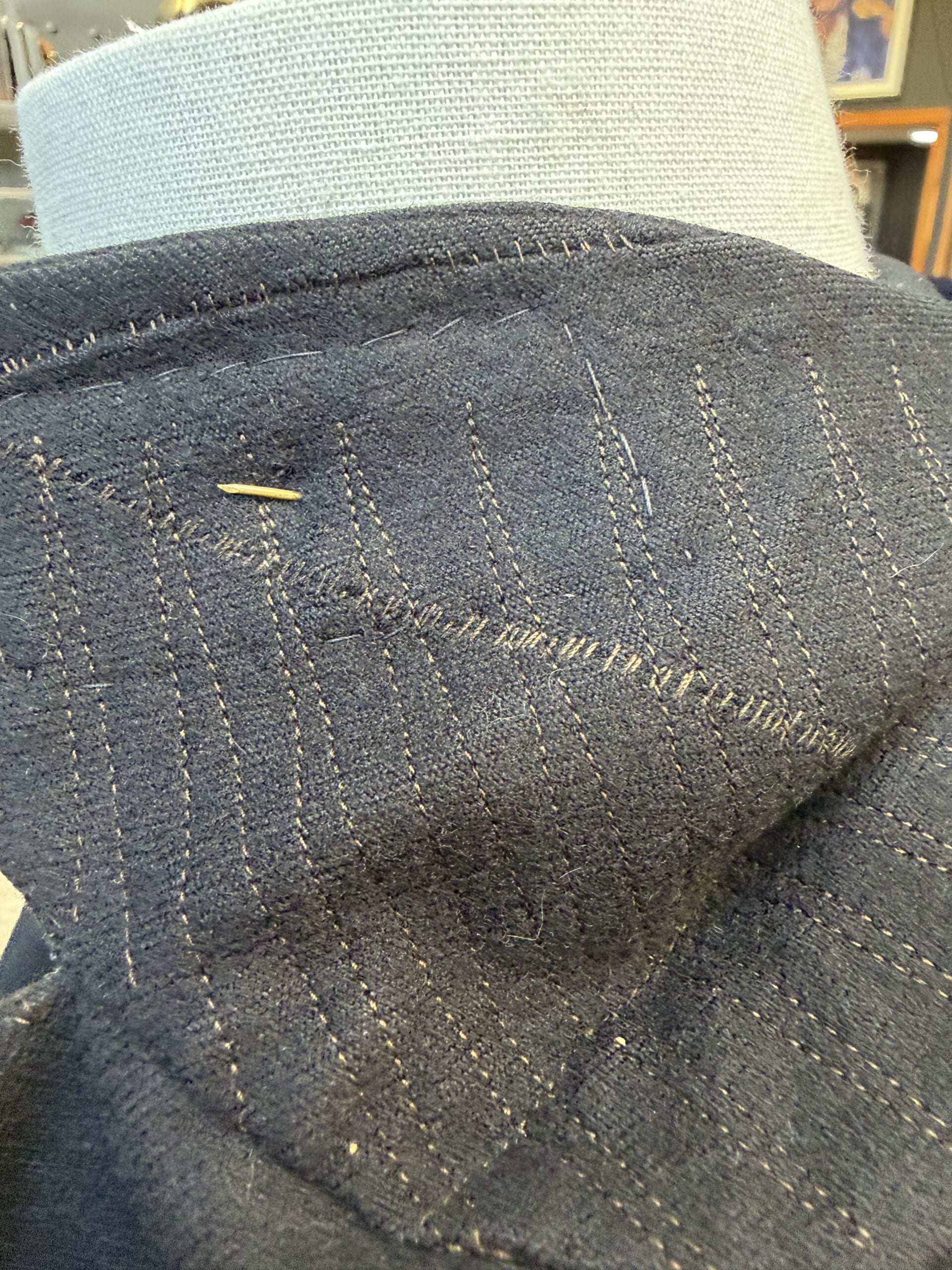
Detailed photographs of the inside reveal substantial period-style tailoring.
Numerous parallel reinforcement stitches run through the upper chest and shoulder areas. Hand finishing can also be seen around structural seams and the collar.
This internal work helped retain the sharply tailored upper body characteristic of privately produced officer Panzerjacken.
The thread now displays muted beige and grey colouring. Stitch tension also varies naturally in areas of hand finishing.
These details are encouraging when assessing the age and construction of the garment.
The jacket consists of dense black wool with a fine surface nap.
Minor fibres, dust and age marks remain visible throughout. Such characteristics give the fabric a convincing naturally aged appearance.
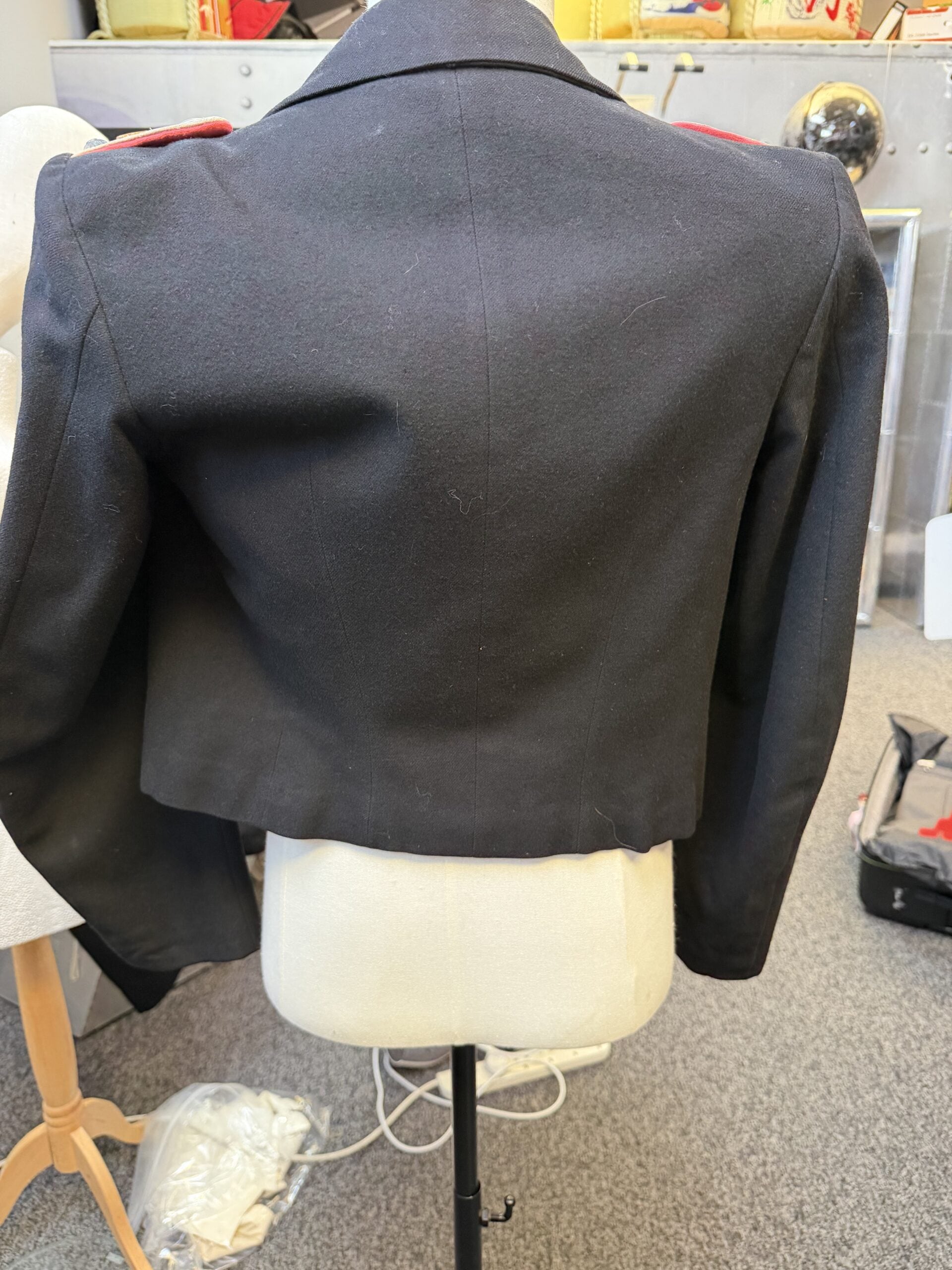
The back retains its short Panzer profile, central seam and shaped officer tailoring.
No major structural damage is apparent in the supplied photographs.
Several close photographs reveal useful evidence around the insignia and internal construction.
Threads show natural ageing rather than bright modern colour. Furthermore, wool fibres around several attachment points appear settled and compressed.
The cloth German Cross also exhibits age, deformation and surface wear consistent with prolonged attachment.
Nevertheless, photography alone cannot prove that every award has remained on the jacket continuously since wartime service.
A complete authentication should therefore include examination beneath each removable decoration as well as concealed stitching around the cloth insignia.
The most important development concerns Oberleutnant Knut Schumacher.
Published German Cross recipient research records:
Knut Schumacher – Oberleutnant – 4./Panzer-Regiment 10 – German Cross in Gold – 3 November 1943.
The underlying published source cited by the award research is Horst Scheibert’s Die Träger des Deutschen Kreuzes in Gold – Das Heer.
This is a remarkable correspondence with the surviving uniform.
The jacket itself shows an Oberleutnant’s rank.
Its shoulder boards carry numeral “10”.
The garment is unquestionably configured as a Panzer officer’s jacket.
Finally, a cloth German Cross in Gold is positioned on the right breast.
Consequently, Schumacher must be considered a serious possible wearer.
Knut Schumacher was born on 1 December 1918 in Berlin.
Genealogical documentation records him as the eldest son of Ernst August Johannes Friedrich Schumacher and Margot Pernet.
His father was a career German naval officer who ultimately held the rank of Konteradmiral.
A detailed biography of Ernst Schumacher independently records Knut’s birth on 1 December 1918. It also states that Knut ultimately reached the rank of Major in the Wehrmacht and was studying law by 1953.
Therefore, Knut’s military career evidently continued beyond his Oberleutnant rank of November 1943.
Knut Schumacher also belonged to a historically significant military family.
His mother, Margot Pernet, was the daughter of Margarete Pernet.
Margarete later married General Erich Ludendorff.
Accordingly, Knut Schumacher became Erich Ludendorff’s step-grandson through marriage, rather than his biological grandson. The family relationship is documented in surviving genealogical material.
This connection could prove useful because prominent family papers, photographic collections and correspondence may contain additional images of Knut.
The key documented entry records Schumacher as:
Schumacher, Knut
03.11.1943
Oberleutnant
4./Pz.Rgt. 10
This places him in 4. Kompanie, Panzer-Regiment 10, when his German Cross in Gold was formally awarded.
It provides three particularly important matches with the jacket:
Rank: Oberleutnant
Unit: Panzer-Regiment 10
Decoration: German Cross in Gold
That combination makes Schumacher much more significant than a general list of Panzer-Regiment 10 officers.
Not yet.
The evidence is certainly compelling enough to justify serious investigation. However, no visible name label, identity tag, written provenance or surviving document currently connects this exact jacket to Schumacher.
Furthermore, Panzer-Regiment 10 had other highly decorated officers.
Therefore, the correct catalogue description at present is:
“Panzer-Regiment 10 Oberleutnant Panzerjacke with German Cross in Gold – Knut Schumacher possible wearer.”
The wording “Knut Schumacher’s Panzerjacke” should not yet be used as a confirmed attribution.
A surviving personnel file or German Cross recommendation would be extremely important.
Ideally, Schumacher’s records should confirm that he also held the Iron Cross 1st Class, Gold Wound Badge and Panzer Assault Badge visible on this jacket.
A period photograph showing Schumacher wearing the same award combination would be even more significant.
Additional evidence could come from measurements, tailoring labels, written provenance or identifiable repairs visible both on the surviving jacket and in wartime photographs.
At present, no publicly accessible wartime photograph has been located that can be positively identified as Knut Schumacher of 4./Panzer-Regiment 10.
Numerous photographs appear in general internet searches for people named Knut Schumacher. However, none encountered during this research carries sufficient provenance or a reliable wartime caption connecting the man shown to:
Knut Schumacher
born 1 December 1918
4./Panzer-Regiment 10
German Cross in Gold 3 November 1943
For that reason, an unrelated photograph should not be added to this catalogue entry.
A falsely identified portrait would weaken rather than strengthen the historical attribution.
The most promising source is the Bundesarchiv.
Panzer-Regiment 10 records survive within Bundesarchiv holdings, including the dedicated regimental history catalogued as BArch RH 39/637.
Regimental albums, officer groups, German Cross presentation photographs and 8. Panzer-Division veterans’ publications should also be examined.
In particular, photographs captioned 4./Panzer-Regiment 10 during 1942–1944 could potentially contain Schumacher even where individual soldiers are not named.
A photograph showing an Oberleutnant wearing the German Cross in Gold would deserve very close comparison.
Based on the photographs supplied, the jacket presents numerous characteristics consistent with wartime manufacture.
The black wool construction, officer tailoring, Panzer Totenkopf collar patches, officer shoulder boards, numeral 10 cyphers and branch piping form a coherent Panzer-Regiment 10 configuration.
Likewise, the decorations form a believable Panzer officer combat group.
Ageing is visible throughout the cloth, threads, metallic insignia and awards.
The internal reinforcement stitching is particularly useful because it demonstrates the substantial construction expected in a privately tailored officer garment.
No obvious feature visible in the supplied photographs identifies the jacket body as a modern reproduction.
Nevertheless, a final museum-standard opinion should include direct examination of the jacket and the areas concealed beneath its awards.
Overall condition is very good to excellent for a wartime Panzer officer jacket.
The black wool remains deep in colour and retains much of its original surface.
Minor lint, fibres and small age marks are visible. These should not be aggressively removed.
Insignia display natural toning, while the decorations show varying degrees of surface wear.
The jacket remains extremely impressive when displayed.
Original Panzer officer jackets are considerably scarcer than enlisted examples.
An identifiable regiment further increases historical interest.
A German Cross in Gold adds another major level of rarity.
When that German Cross is the correct black-backed cloth version for Panzer wear, the uniform becomes especially desirable.
Finally, the documented existence of an Oberleutnant in Panzer-Regiment 10 who received the German Cross in Gold creates an unusually promising opportunity for named-wearer research.
For these reasons, this jacket should be considered a museum-grade Panzer uniform requiring continued archival investigation.
The correct value depends heavily upon confirmation that the insignia and awards are original and period-attached.
€12,500–€16,500
Explore related listings: Uniforms; Nordmenn Insignia and Shoulder Boards; Original Heer Panzer Beret.
Bundesarchiv / Deutsche Digitale Bibliothek – Panzer-Regiment 10:
Panzer-Regiment 10 – BArch RH 39/637
German Cross recipient research – Knut Schumacher:
8. Panzer-Division German Cross Recipient Records
Specialist comparison – Panzer Cloth German Cross in Gold:
Helmut Weitze Panzer German Cross in Gold
original-panzer-regiment-10-panzerjacke-german-cross-gold.jpg
This Panzer Regiment 10 Panzerjacke combines officer rank, identified regimental insignia and an exceptional combat award configuration.
The Oberleutnant shoulder boards carry the gilt numeral “10”, directly identifying Panzer-Regiment 10. Panzer Totenkopf collar insignia and rose-pink Waffenfarbe complete the branch identification.
More significantly, a cloth German Cross in Gold remains mounted on the right breast.
Research has identified Knut Schumacher, born 1 December 1918 in Berlin, as an Oberleutnant serving with 4./Panzer-Regiment 10 when he received the German Cross in Gold on 3 November 1943.
Consequently, Schumacher represents a particularly strong possible wearer.
No verified photograph or documentary link currently permits a definite attribution. Therefore, the jacket should remain catalogued as a Panzer-Regiment 10 Oberleutnant Panzerjacke with Knut Schumacher noted as a possible wearer.
Further Bundesarchiv research into Schumacher’s personnel file, award history and German Cross recommendation could potentially transform this already exceptional uniform into a documented named-officer piece.