
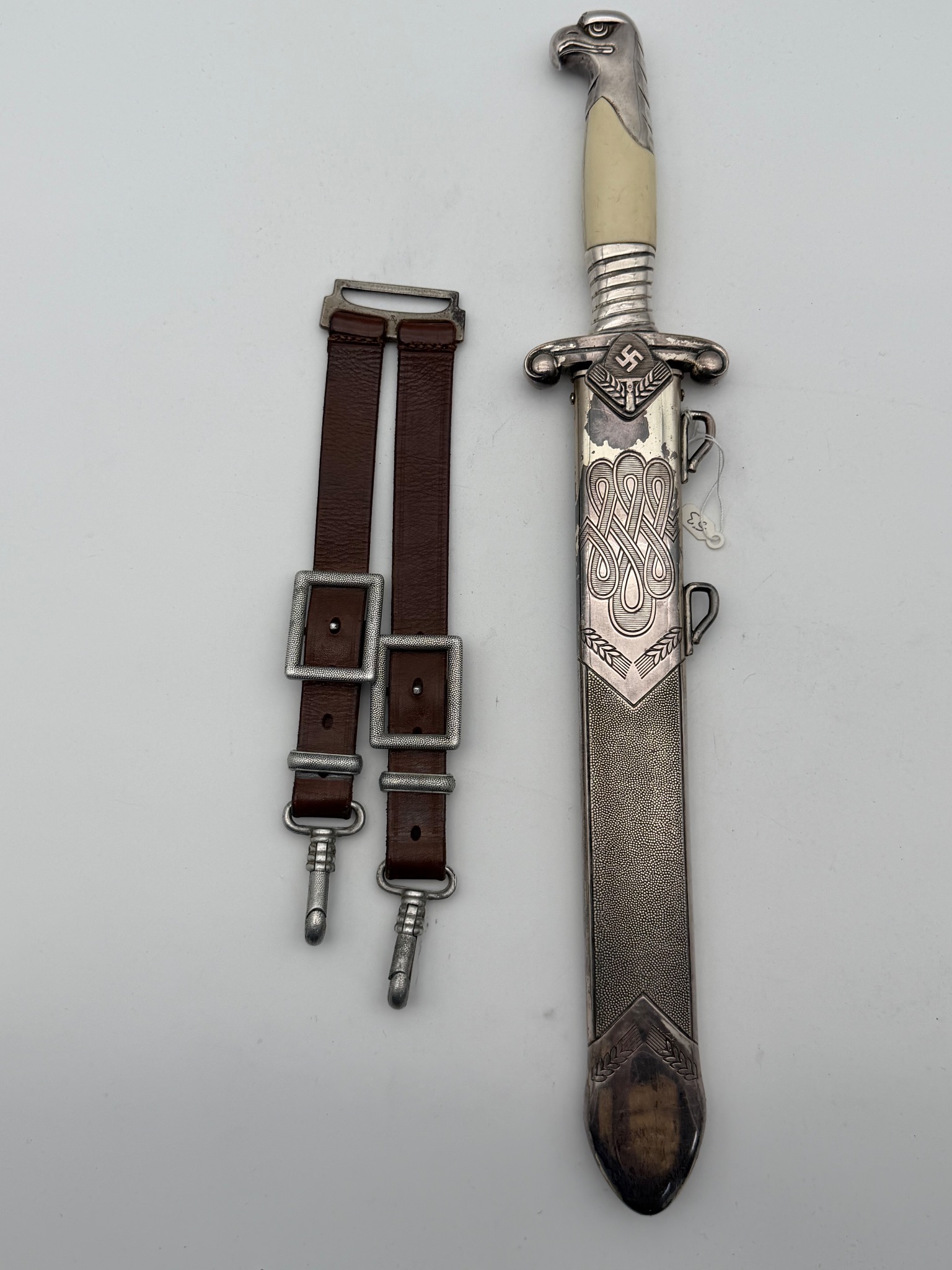
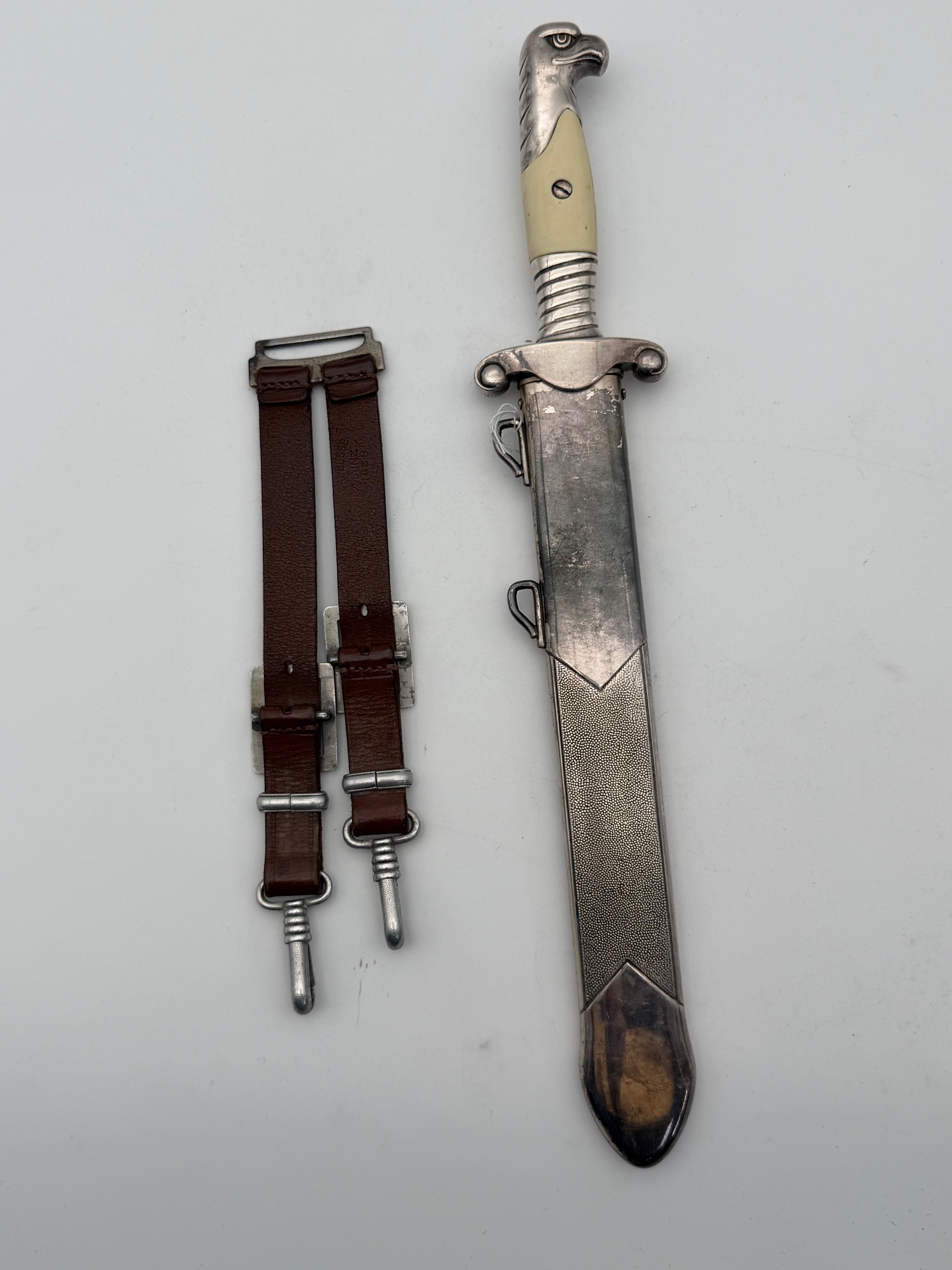
Rare RAD Leader’s Dagger Model 1937 complete with its elaborate silvered scabbard and brown leather double suspension hangers. This imposing Reichsarbeitsdienst officer’s dagger features the distinctive eagle-head pommel, ivory-coloured grip panels, RAD insignia, highly decorative scabbard and correct two-piece suspension system. The dagger presents with attractive period toning and strong original detail throughout. Complete RAD Leader dagger ensembles with their hangers are considerably harder to obtain than dagger-and-scabbard examples alone.
€ 4.995
1 in stock
Organisation: Reichsarbeitsdienst – RAD
Pattern: Model 1937 Leader’s / Officer’s Dagger
German designation: RAD Führerdolch / Führer-Hauer
Period: Third Reich, circa 1937–1942
Grip: Ivory-coloured grip panels
Pommel: Sculpted eagle-head form
Scabbard: Silvered decorated metal scabbard
Suspension: Original-pattern brown leather double hangers
Condition: Very good original appearance
Maker: To be confirmed from blade trademark
This RAD Leader’s Dagger Model 1937 represents one of the most distinctive official dress edged weapons associated with the Reichsarbeitsdienst.
Introduced for RAD leadership personnel, the Führerdolch combined elaborate symbolic decoration with unusually substantial construction.
Unlike the heavier enlisted-rank RAD hewer, the Leader pattern was intended principally as an insignia of office and rank. Consequently, its appearance was far more elaborate.
The present example is particularly desirable because the dagger survives with its correct scabbard and double brown leather suspension hangers.
Complete ensembles of this type are increasingly difficult to obtain.
The Reichsarbeitsdienst, normally abbreviated RAD, developed from the earlier voluntary labour-service movement.
During 1935, the Reich Labour Service became a compulsory state organisation following the Reichsarbeitsdienstgesetz.
Young men were organised into units engaged in agricultural, construction and public-works projects. At the same time, the organisation imposed political and paramilitary training.
The Bundesarchiv records the surviving central documentation of the Reichsarbeitsdienst primarily under BArch R 77.
Its archival description notes that the RAD developed from the state-supported voluntary labour service, became compulsory for male youth under the 1935 legislation and later performed increasingly military-related work during the Second World War.
For authoritative historical research:
Bundesarchiv / Archivportal-D – Reichsarbeitsdienst, BArch R 77
The distinctive Leader’s dagger appeared during the later 1930s.
It was intended for members of the RAD leadership establishment rather than ordinary Arbeitsmänner.
Collectors normally refer to this pattern as the:
RAD Führerdolch
RAD Leader’s Dagger
or
RAD Officer’s Dagger
Its dramatic design differs significantly from most Wehrmacht officer daggers.
Most immediately recognisable are the eagle-head pommel, pale grip panels and large symbolic crossguard.
Furthermore, the unusually elaborate scabbard gives the weapon an unmistakable appearance.
The upper grip terminates in an impressive sculpted eagle head.
Its hooked beak, prominent eye and feather detail remain clearly defined.
This feature is one of the principal identifiers of the RAD Leader pattern.
The surviving silver-coloured surface displays attractive natural age toning within the recessed areas.
Such toning provides contrast and enhances the sculptural quality of the fitting.
Minor surface marks are entirely consistent with handling and long-term storage.
Importantly, aggressive modern polishing is not evident from the supplied photographs.
The shaped grip incorporates pale ivory-coloured panels.
These provide a striking contrast against the silver-coloured metal fittings.
Original RAD Leader daggers are encountered with synthetic grip material intended to imitate ivory. More exceptional presentation versions could employ luxury materials.
The present grip displays a pleasing aged cream tone.
Both the colour and surface appearance complement the surrounding fittings.
A retaining screw is visible on the reverse.
The panels appear well fitted and remain highly presentable.
Mounted prominently within the grip is the RAD organisational device.
The emblem incorporates the characteristic spade-and-wheat symbolism closely associated with the Reich Labour Service.
Its contrasting darker finish remains clearly visible against the pale grip panel.
The device is firmly seated and shows appropriate age.
This is another important feature when assessing a genuine RAD Leader dagger because incorrect grip emblems are frequently encountered on reproductions and assembled pieces.
Beneath the main grip panels is a deeply ribbed silver-coloured section.
The horizontal ribs create a strong architectural transition between the grip and crossguard.
Natural patination remains visible between the grooves.
Raised areas show lighter wear.
This pattern of differential ageing is exactly the type of surface appearance collectors prefer to see on untouched period fittings.
The crossguard is among the dagger’s most distinctive components.
A large central RAD emblem dominates the front.
The organisation’s characteristic symbolism is incorporated into an angular shield-like device, while the crossguard arms extend outward to curled terminals.
The surviving relief remains crisp.
Edges and recessed areas retain natural toning.
Viewed together with the eagle-head pommel, the crossguard creates the unmistakable profile of the Model 1937 RAD Leader’s dagger.
The scabbard is one of the finest features of this example.
Its upper section displays elaborate engraved or relief decoration.
A complex interwoven geometric motif extends down the front, framed by decorative foliage and sharply defined borders.
The lower body incorporates a finely textured field.
A decorated lower chape completes the design.
This combination is considerably more ornate than the utilitarian scabbards associated with enlisted RAD edged weapons.
The silver-coloured surface retains an attractive aged appearance.
Some areas remain brighter while others display grey and darker toning.
This variation is visually convincing.
The lower chape displays particularly pronounced patina and wear.
Rather than detracting from the dagger, such evidence gives the scabbard a desirable untouched character.
I would strongly recommend leaving the existing finish exactly as it is.
Polishing would remove surface history and could materially reduce collector value.
Two suspension fittings are mounted along the scabbard.
These correspond with the two-strap officer hanger system supplied with the dagger.
Both remain present.
The rings exhibit age and oxidation consistent with the remainder of the scabbard fittings.
Their presence is important because missing or replaced suspension hardware can significantly affect both originality and value.
The accompanying suspension system considerably increases the desirability of this ensemble.
Two brown leather straps descend from a common upper fitting.
Each strap incorporates a large square adjustment buckle.
The buckles have finely textured surfaces and silver-coloured finishes.
Lower slides and suspension clips remain present.
Original RAD officer hangers are valuable accessories in their own right and are frequently missing from surviving daggers.
For comparison, specialist dealer Wittmann Antique Militaria currently lists an original set of RAD Officer straps at $895.
Wittmann Antique Militaria – RAD Officer Hangers
The brown leather remains attractively aged.
Natural creasing and darker areas are visible around the fittings.
Stitching remains clearly evident near the upper suspension section.
The square buckles retain their textured finish.
Meanwhile, the lower fittings display appropriate silver-grey age toning.
Nothing about the hanger set appears conspicuously new relative to the dagger.
That consistency is particularly important when assessing whether accessories have potentially remained together over a long period.
A major advantage of this piece is its completeness.
Many RAD Leader daggers currently survive as a dagger and scabbard only.
Original hangers were easily separated after 1945 and often became independent collector pieces.
Consequently, a dagger presented with a full suspension system offers substantially greater historical and display value.
The present group should therefore remain together.
Separating the hangers would reduce the integrity of the ensemble.
The blade is not visible in the photographs supplied for this catalogue entry.
For that reason, no manufacturer should yet be attributed.
Original RAD Leader daggers are known from established Solingen makers.
Correct examples normally display a manufacturer trademark near the ricasso, while the blade commonly carries the RAD motto:
or “Work ennobles.”
However, the precise manufacturer, blade finish and motto condition of this particular dagger should be recorded only after the blade itself has been photographed.
This is important for both accuracy and valuation.
A desirable maker combined with a strong original blade could increase the value further.
Based on the components visible in the supplied photographs, the dagger presents a strong period appearance.
Positive characteristics include:
Nothing visible in these photographs immediately suggests a crude modern reproduction.
Nevertheless, the blade must be examined before the dagger receives a final maker-specific authentication.
The manufacturer trademark, blade geometry, motto etching, tang assembly and internal fit provide important additional authentication points.
The overall condition is very good for an original period ensemble.
Grip panels remain intact and retain an attractive aged appearance.
Detail on the eagle pommel remains strong.
Likewise, the RAD emblem and crossguard retain good definition.
The scabbard appears straight and substantially complete.
Its decorative work remains clearly visible.
Natural surface wear, oxidation and patination are evident, especially on exposed fittings.
The suspension straps show age-related wear but remain visually impressive and apparently complete.
Such honest ageing contributes positively to the overall presentation.
This dagger should not be aggressively cleaned.
Avoid metal polish on the pommel, crossguard and scabbard.
Likewise, do not apply coloured leather polish to the hangers.
Original patina forms part of the historical surface.
The hanger straps should ideally be displayed without carrying the full weight of the dagger for prolonged periods.
Supporting the dagger separately will reduce stress on ageing leather.
Stable humidity and moderate temperatures will help preserve both the grip and suspension equipment.
RAD Leader daggers remain substantially scarcer than conventional Army or Luftwaffe officer daggers.
Their striking construction has made them highly sought after by collectors specialising in political and organisational edged weapons.
The complete hanger set gives this example additional appeal.
Moreover, the elaborate scabbard, eagle-head grip and unusual overall design make the dagger immediately recognisable even within a large edged-weapons collection.
It would fit naturally within:
The market value of a RAD Leader dagger depends heavily on originality, maker, blade condition, grip condition, scabbard finish and accessories.
Complete suspension systems command a substantial premium.
As a useful indicator, Wittmann Antique Militaria currently offers a pair of original RAD Officer straps for $895 on their own.
A recent British auction listing from 2025 described a circa-1937 RAD Leader dagger with associated scabbard as a rare Model 1937 Führer-Haumesser.
The Saleroom – RAD Leader dagger market reference
Auction estimates are normally below specialist dealer retail prices. Additionally, the present example has the important benefit of a complete double hanger system.
The principal surviving institutional records of the RAD are preserved as Bundesarchiv Bestand R 77.
Bundesarchiv / Archivportal-D – Reichsarbeitsdienst
The Bundesarchiv publication on Germany’s military and paramilitary structures discusses the 1935 Reichsarbeitsdienstgesetz and the compulsory labour-service system.
Bundesarchiv – Wehrmacht im Dritten Reich, Volume IV
A useful specialist reference for surviving original RAD suspension equipment.
Wittmann – Original RAD Officer Hangers
This RAD Leader’s Dagger Model 1937 with double hangers is an impressive example of one of the scarcer organisational dress daggers of the Third Reich period.
The eagle-head pommel remains sharply detailed.
Below it, the ivory-coloured grip panels and RAD emblem create the characteristic Leader pattern appearance.
The elaborate crossguard leads into an exceptionally decorative silvered scabbard incorporating complex geometric ornament, textured fields and two suspension points.
Most importantly, the dagger retains its complete brown leather double suspension hangers.
That accessory considerably enhances both historical completeness and market value.
The existing age toning and wear give the ensemble an attractive, honest appearance which should be preserved rather than restored.
Once the blade trademark and Arbeit adelt motto have been photographed and verified, the catalogue attribution can be completed with the precise manufacturer.
For an advanced collection of RAD militaria, German political edged weapons or rare Third Reich officer daggers, this is a highly desirable complete ensemble.