
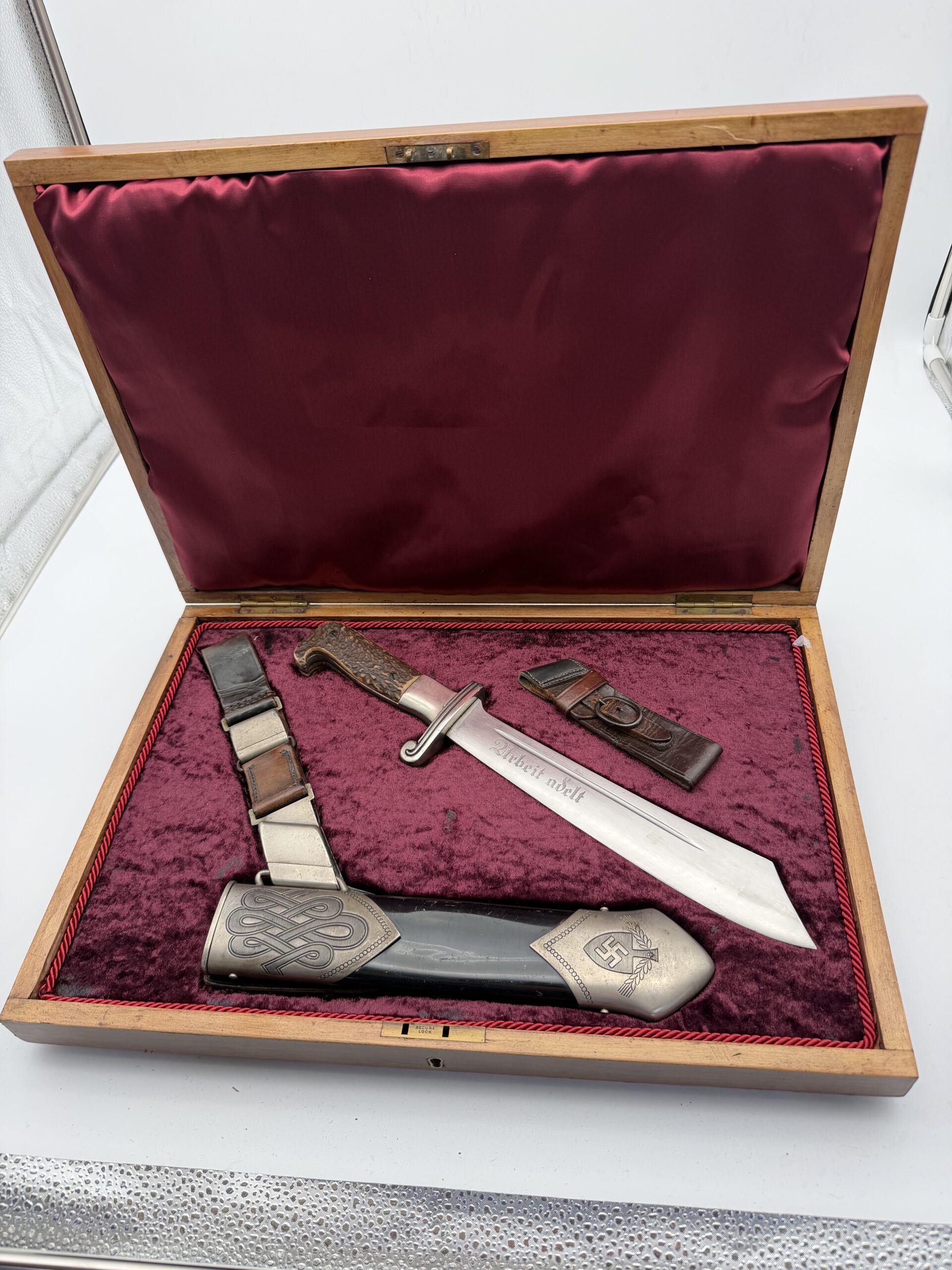
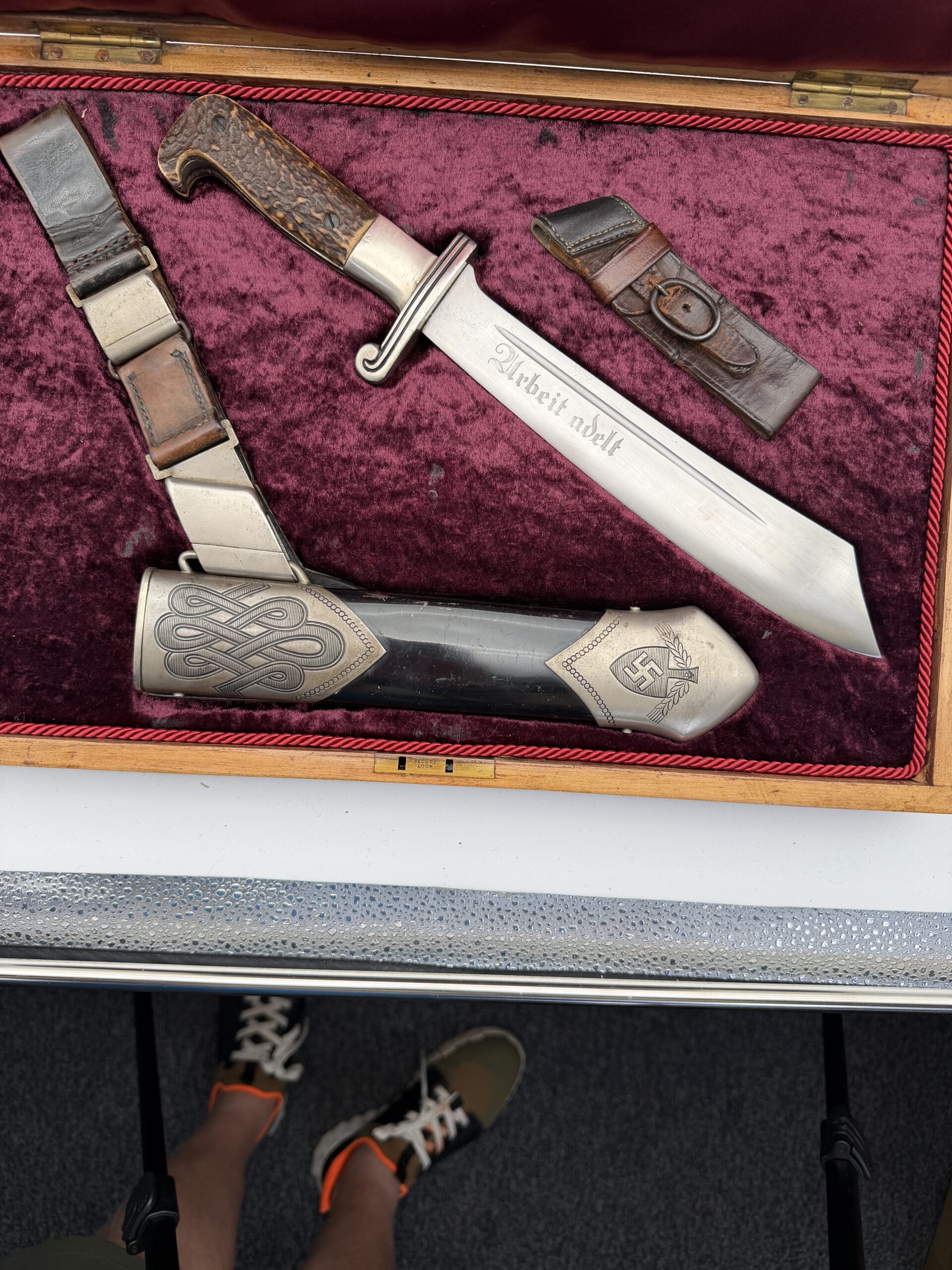
Rare early Carl Eickhorn M1934 RAD full-stag hewer with natural antler grip extending around the hooked pommel, etched “Arbeit adelt” blade, early Eickhorn squirrel trademark, RADJ acceptance mark and Ges. Gesch. marking. Complete with its decorated black RAD scabbard and two period leather hanger components. A scarce and highly desirable first-pattern variation with a specialist collector value of approximately €4,500.
€ 4.500
1 in stock
This exceptional Eickhorn RAD full-stag hewer is a scarce early-production variation of the Model 1934 Reichsarbeitsdienst hewer. Manufactured by Carl Eickhorn of Solingen, it retains the highly desirable full-stag grip construction associated with the earliest production period.
Most importantly, this example survives with two leather hanger components, rather than a single incomplete suspension. That degree of completeness substantially increases both collector interest and market value.
The combination of early full-stag construction, Carl Eickhorn manufacture, original decorated scabbard and two surviving hangers places this hewer well above the level of a standard M1934 RAD example.
Current specialist collector valuation: approximately €4,500.
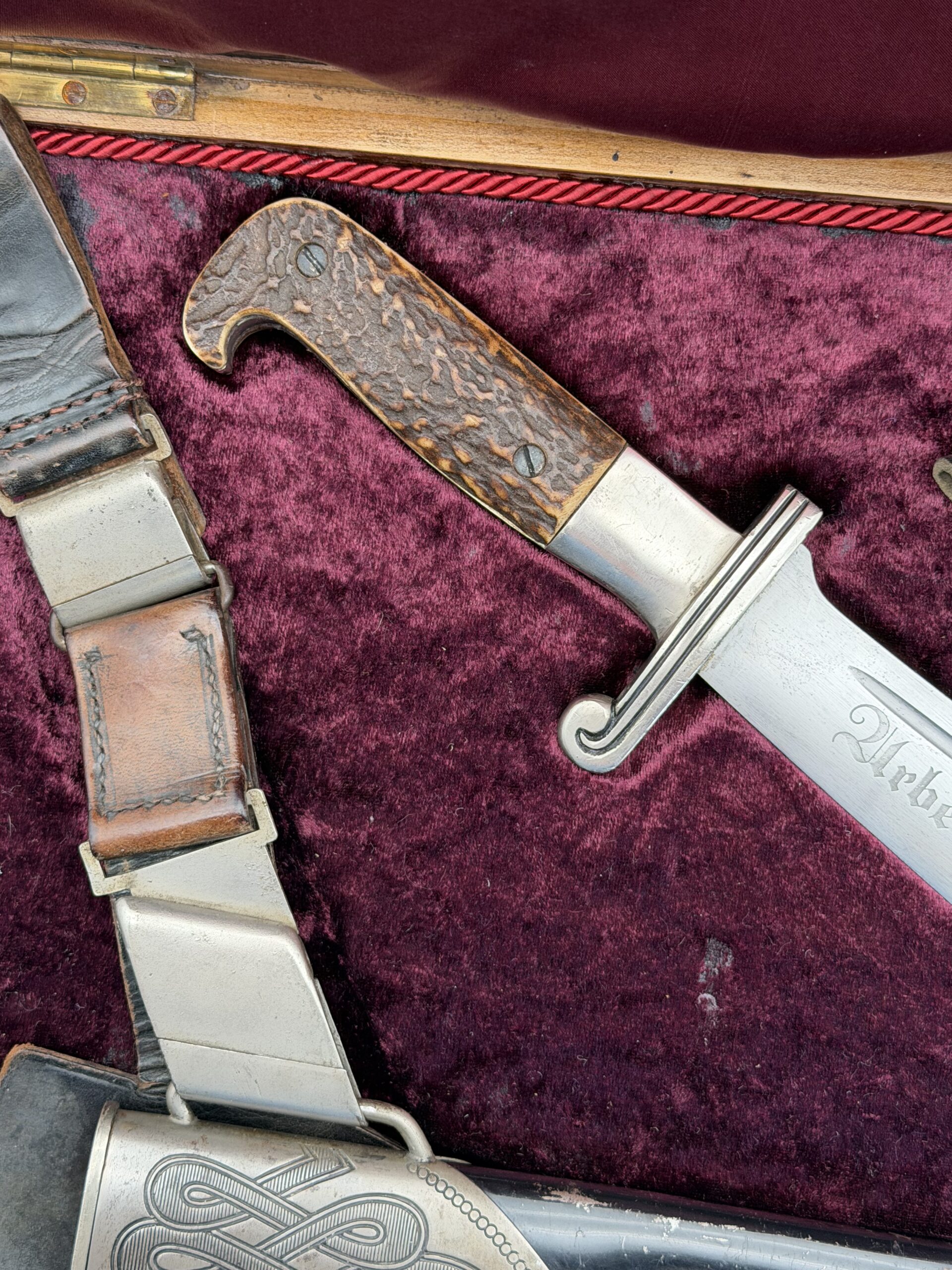
The defining feature is the remarkable natural stag grip.
Unlike later RAD hewers, the antler plates extend around the distinctive hooked pommel or beak. This difficult and expensive construction is associated with the earliest Eickhorn production.
Deep natural texture remains throughout the antler. Brown, ochre and darker tones run naturally through the surface, while age has settled convincingly into the deeper recesses.
Period slotted screws secure the grip plates. Both fittings sit correctly within the stag and display natural ageing.
Specialist references identify this full-stag configuration as one of the earliest and rarest Eickhorn M1934 variations.
A comparable full-stag example can be viewed in the Lakesidetrader archive.
Another documented example appears in the DG.DE RAD full-stag Eickhorn reference archive.
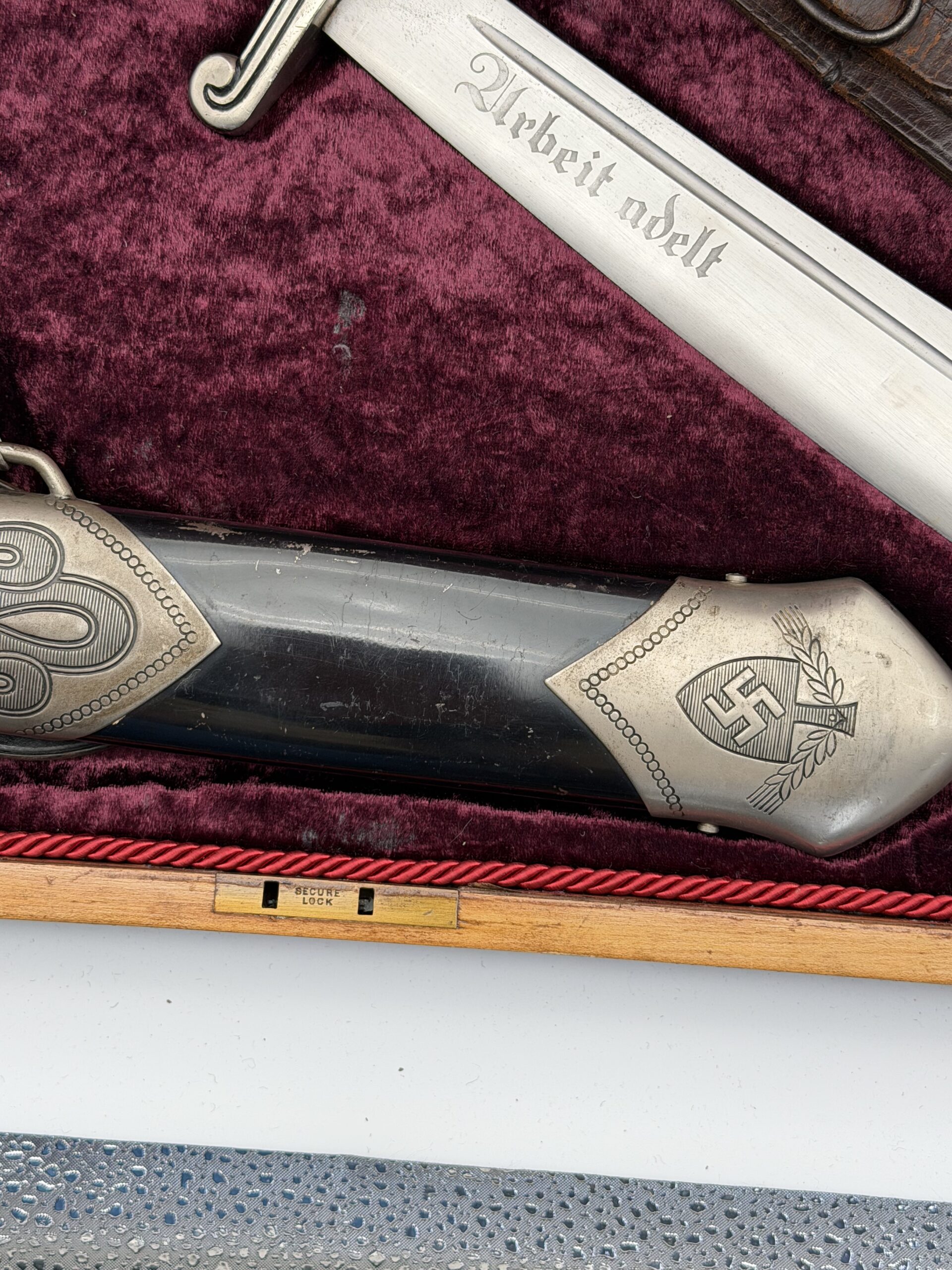
The imposing Bowie-style blade retains the famous RAD motto:
“Arbeit adelt”
Translated literally, the phrase means “Work ennobles.”
A long narrow fuller extends along the blade toward the clipped point. This distinctive profile gives the M1934 RAD hewer its unmistakable appearance.
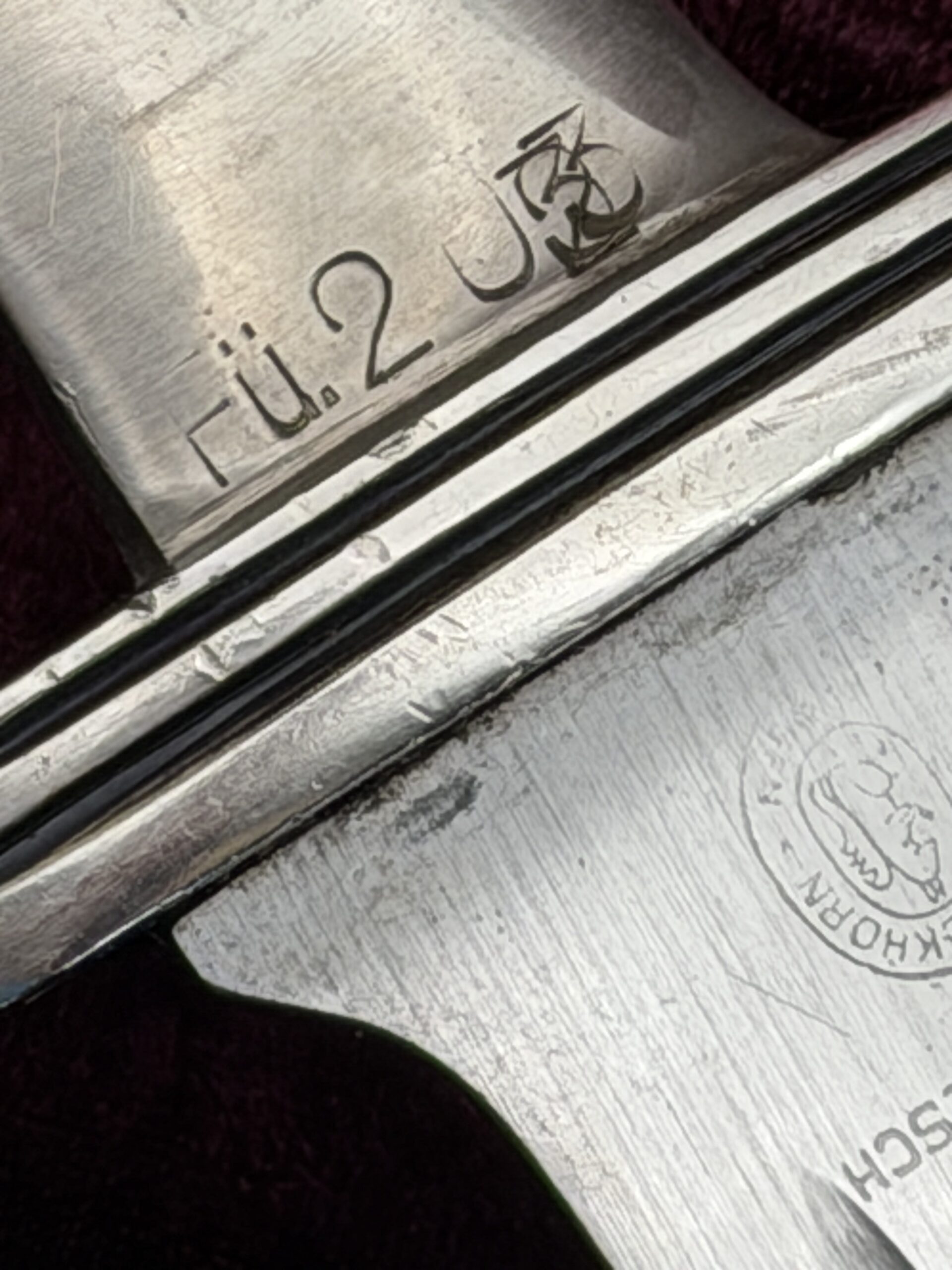
On the reverse ricasso, the blade carries the early Carl Eickhorn Solingen squirrel trademark.
Additional markings include:
Together, these features correspond with documented early Eickhorn RAD production.
The blade remains strong and impressive. Its motto retains excellent definition, while the maker and inspection marks remain clearly visible.
Some historical polishing or cleaning is evident under close examination. Consequently, the blade should not be described as untouched.
Nevertheless, the overall blade condition remains very attractive for an early RAD hewer.
Heavy early fittings surround the blade and grip.
The characteristic down-swept crossguard terminates in the distinctive curled quillon associated with the M1934 pattern.
Fine age-related surface marks remain visible on the bright metal. These are consistent with handling and historical cleaning rather than modern manufacture.
Importantly, the proportions, shaping and relationship between blade, guard and grip all correspond with known early Eickhorn production.
The substantial steel scabbard retains its black finish together with both large decorative metal mounts.
An elaborate interwoven design decorates the upper fitting. Fine engraved detailing remains clear and attractive.
At the lower end, the large chape carries the unmistakable RAD spade, swastika and wheat-ear emblem.
Beaded borders frame the decorative panels.
Surface wear and small losses to the black finish remain visible. However, these marks contribute to the authentic appearance of an item approaching ninety years old.
The scabbard fits the hewer correctly and presents extremely well.
A particularly important feature of this set is the presence of two period leather hanger components.
Original RAD hewer suspension equipment is frequently missing because the hangers were separated from the weapon after 1945. Finding an early Eickhorn full-stag hewer with both surviving suspension pieces is therefore considerably more desirable.
The main hanger incorporates substantial leather construction, stitched reinforcement and heavy metal attachment fittings.
A second leather suspension component accompanies the set.
Natural ageing, surface wear, creasing and patination are visible throughout the leather. The appearance corresponds well with long-term period use and storage.
Together, the two hangers materially increase the completeness, rarity and collector value of this Eickhorn RAD full-stag hewer.
A further engraved marking appears close to the guard beneath the grip.
The visible characters appear to include:
“Ü.2” or “U.2”
An intertwined symbol or monogram sits alongside the characters.
Early RAD hewers are known with property, issue and organisational markings. However, this particular inscription has not yet been conclusively identified.
For that reason, no unsupported unit attribution has been made.
Further archival research may eventually connect the marking to a particular RAD formation, depot or original owner.
If such an identification were established, it could add another important layer of provenance.
The Reichsarbeitsdienst, or RAD, developed into one of the major organisations of the National Socialist state.
The organisation provided compulsory labour service and combined physical work with military-style discipline, uniforms and ceremonial traditions.
Further historical information can be found through the Deutsches Historisches Museum history of the Reichsarbeitsdienst.
Introduced in 1934, the RAD hewer became one of the most recognisable edged weapons of the Third Reich period.
Its heavy blade reflected the appearance of a traditional working tool. At the same time, elaborate decoration transformed the hewer into a distinctive organisational sidearm.
Early examples display particularly substantial construction.
Carl Eickhorn became one of the most respected manufacturers of German military and political edged weapons. Therefore, surviving early Eickhorn RAD hewers have always attracted strong specialist interest.
Standard RAD hewers are encountered regularly on the collector market.
The full-stag Eickhorn version is different.
Here, the antler extends around the hooked pommel rather than terminating below a conventional metal pommel section.
Manufacturing this form required considerably more shaping and hand fitting.
As production developed, the complicated full-stag arrangement was abandoned in favour of the more familiar later configuration.
Consequently, surviving full-stag examples represent an important early stage in the evolution of the M1934 RAD hewer.
The construction of this example is strongly consistent with an original early Carl Eickhorn M1934 RAD hewer.
Important positive features include:
No single feature should authenticate an edged weapon on its own. However, the combined construction details form a highly convincing and consistent early Eickhorn package.
Overall condition is very good for an early M1934 RAD hewer.
The stag grip remains particularly attractive.
Metal fittings show appropriate age, handling marks and evidence of earlier polishing.
Blade surfaces retain the etched motto and maker markings clearly. Some historical cleaning is present, although the blade remains visually impressive.
The scabbard retains much of its black finish with expected scratches and small areas of loss.
Both leather suspension components show natural age, surface wear and patination.
Taken as a complete set, the hewer presents extremely well.
Several factors make this example particularly desirable.
First, the full-stag grip is substantially rarer than the conventional later pattern.
Second, Carl Eickhorn manufacture is highly sought after among advanced German edged-weapon collectors.
Third, the hewer retains its correct decorated scabbard.
Most importantly, two period hanger components remain with the weapon.
Finding all of these characteristics together is considerably more difficult than locating a standard RAD hewer.
This is therefore an advanced collector piece rather than an entry-level RAD example.
Ordinary RAD hewers must not be used as the sole valuation comparison for this example.
The early full-stag Eickhorn configuration carries a substantial rarity premium.
Furthermore, the survival of both hanger components adds significantly to the completeness and desirability of the set.
Comparable ordinary Eickhorn RAD hewers may trade considerably below this level. However, those examples usually lack either the scarce full-stag grip, complete early suspension equipment or both.
For the present example, taking account of its configuration, maker, scabbard and two hangers, the appropriate specialist collector valuation is:
That valuation reflects the complete rare configuration rather than the general market for standard RAD hewers.
Manufacturer: Carl Eickhorn, Solingen
Organisation: Reichsarbeitsdienst
Model: M1934 RAD Hewer
Variation: Rare early full-stag version
Blade motto: Arbeit adelt
Acceptance mark: RADJ
Additional marking: Ges. Gesch.
Scabbard: Original decorated black RAD pattern
Suspension: Two period leather hanger components
Condition: Very good collector condition
Rarity: Very scarce early variation
Collector valuation: €4,500
Explore related listings: RAD & TeNo Hewers.
Research the history of the organisation through the Deutsches Historisches Museum – Reichsarbeitsdienst.
Compare the construction with an archived Lakesidetrader full-stag Eickhorn RAD hewer.
A further early example can be studied in the DG.DE full-stag Eickhorn reference archive.
Historic auction comparisons can also be researched through the Ratisbon’s Militaria Price Guide.