
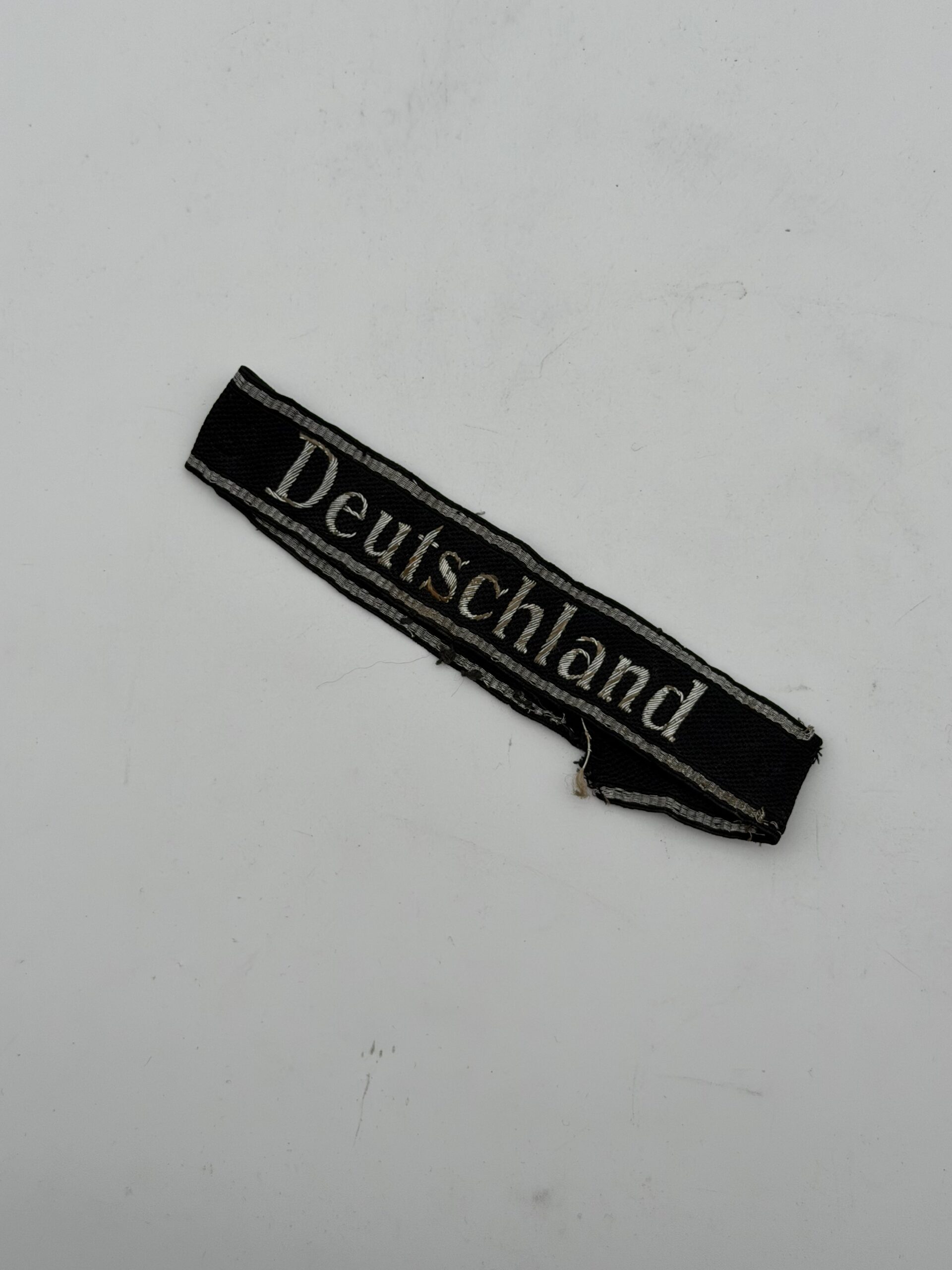
This SS Deutschland officer cuff title represents an impressive officer-grade example associated with one of the oldest armed SS formations.
€ 2.400
1 in stock
This SS Deutschland officer cuff title represents an impressive officer-grade example associated with one of the oldest armed SS formations.
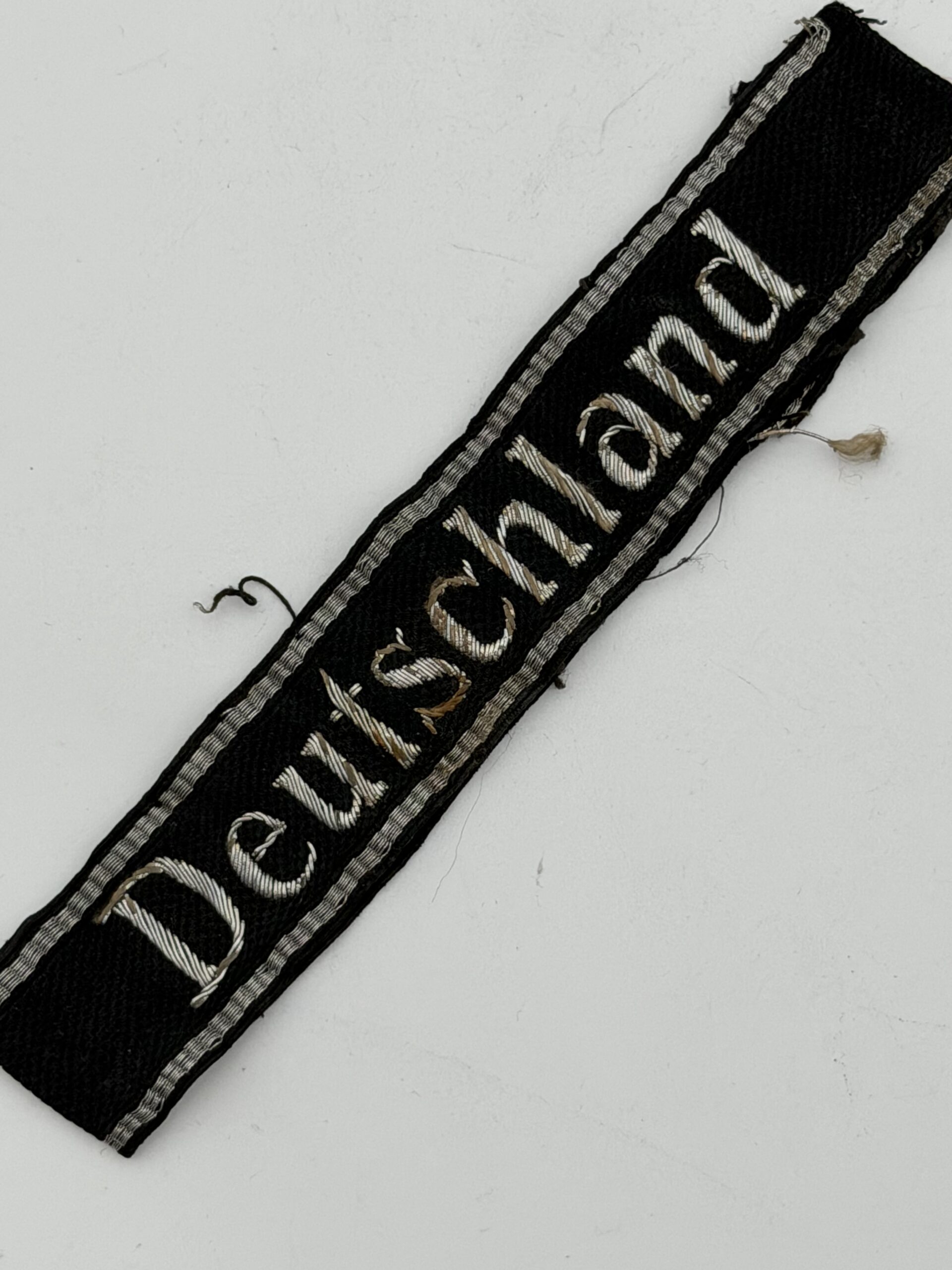
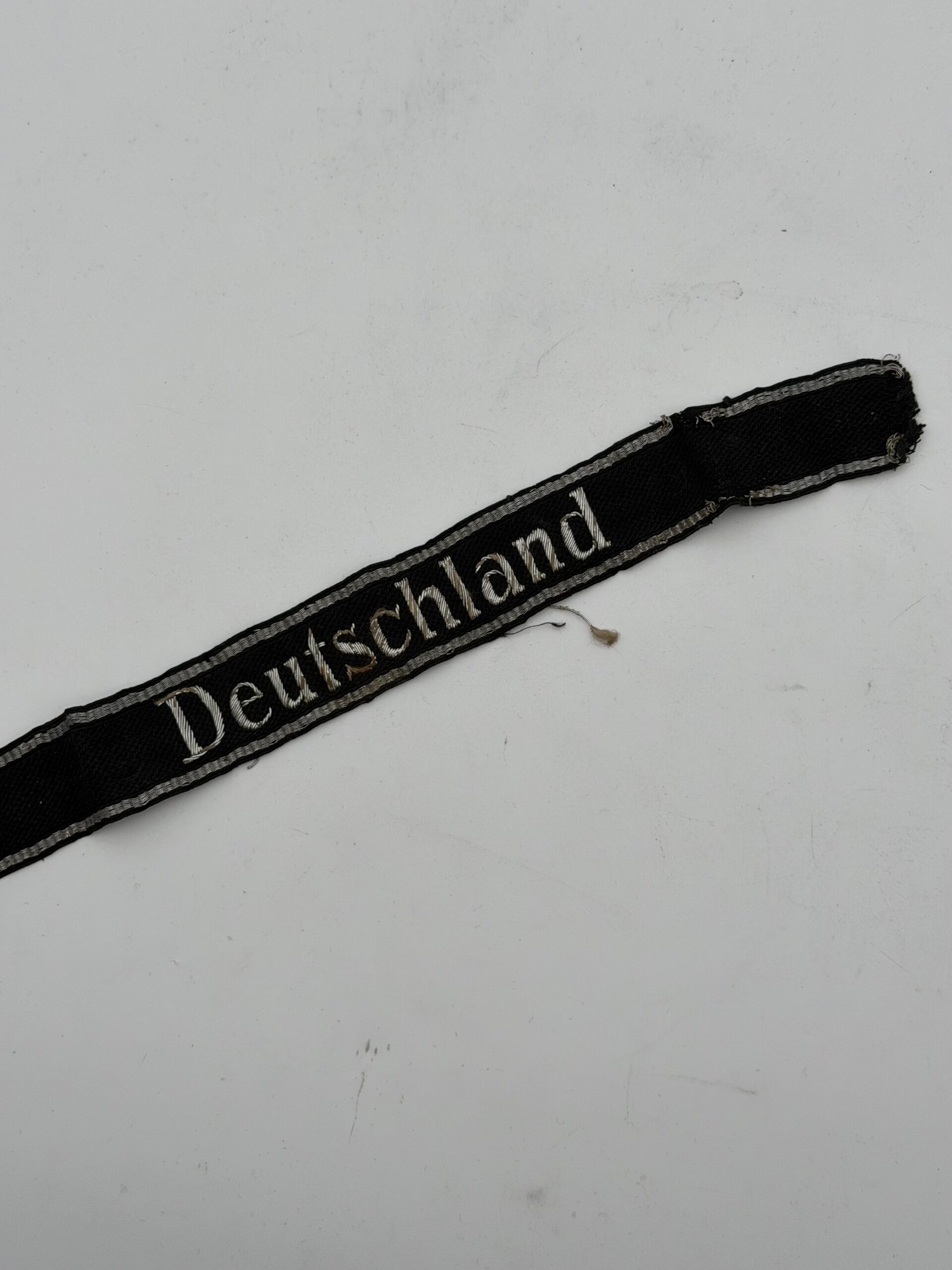
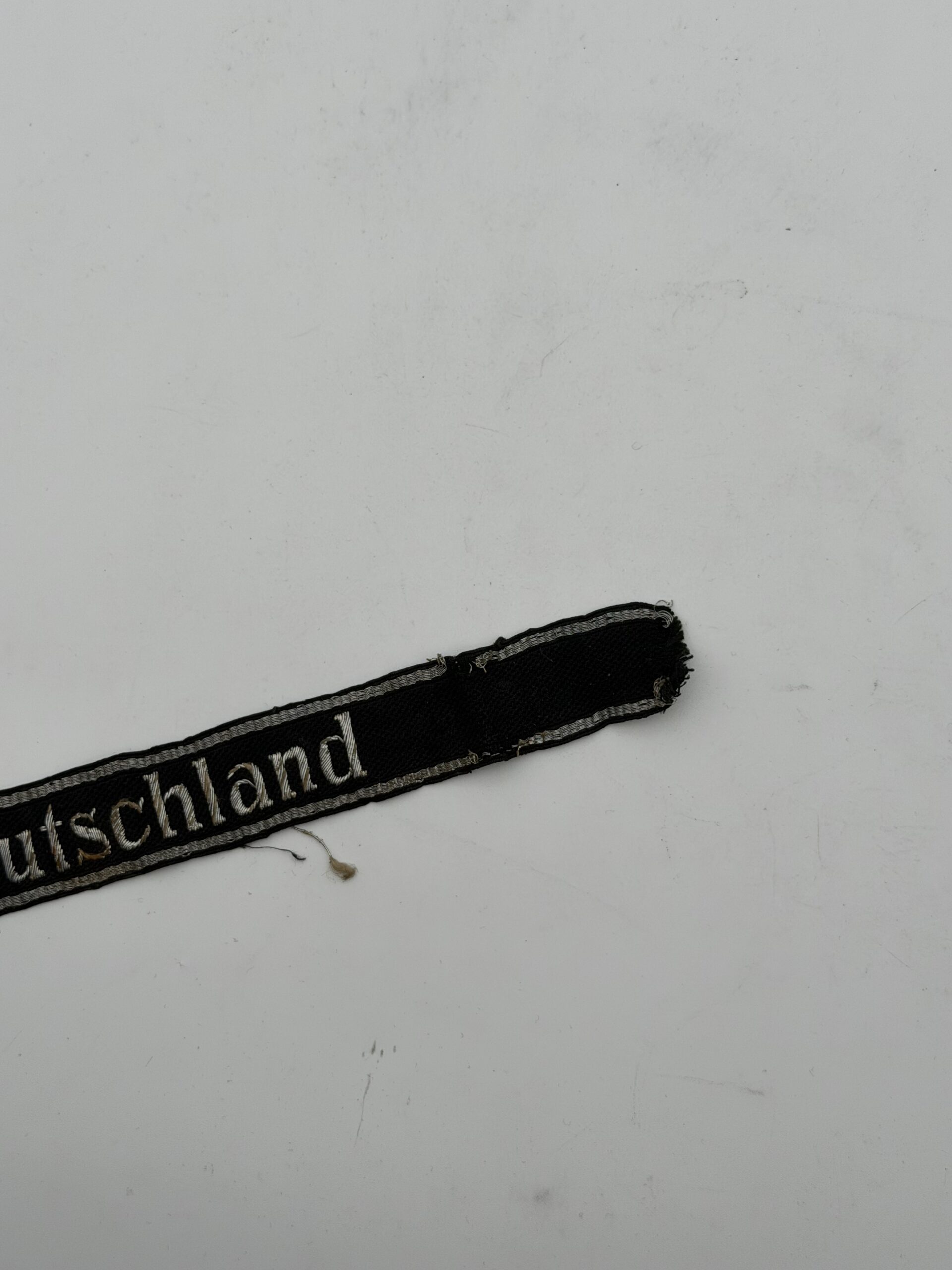
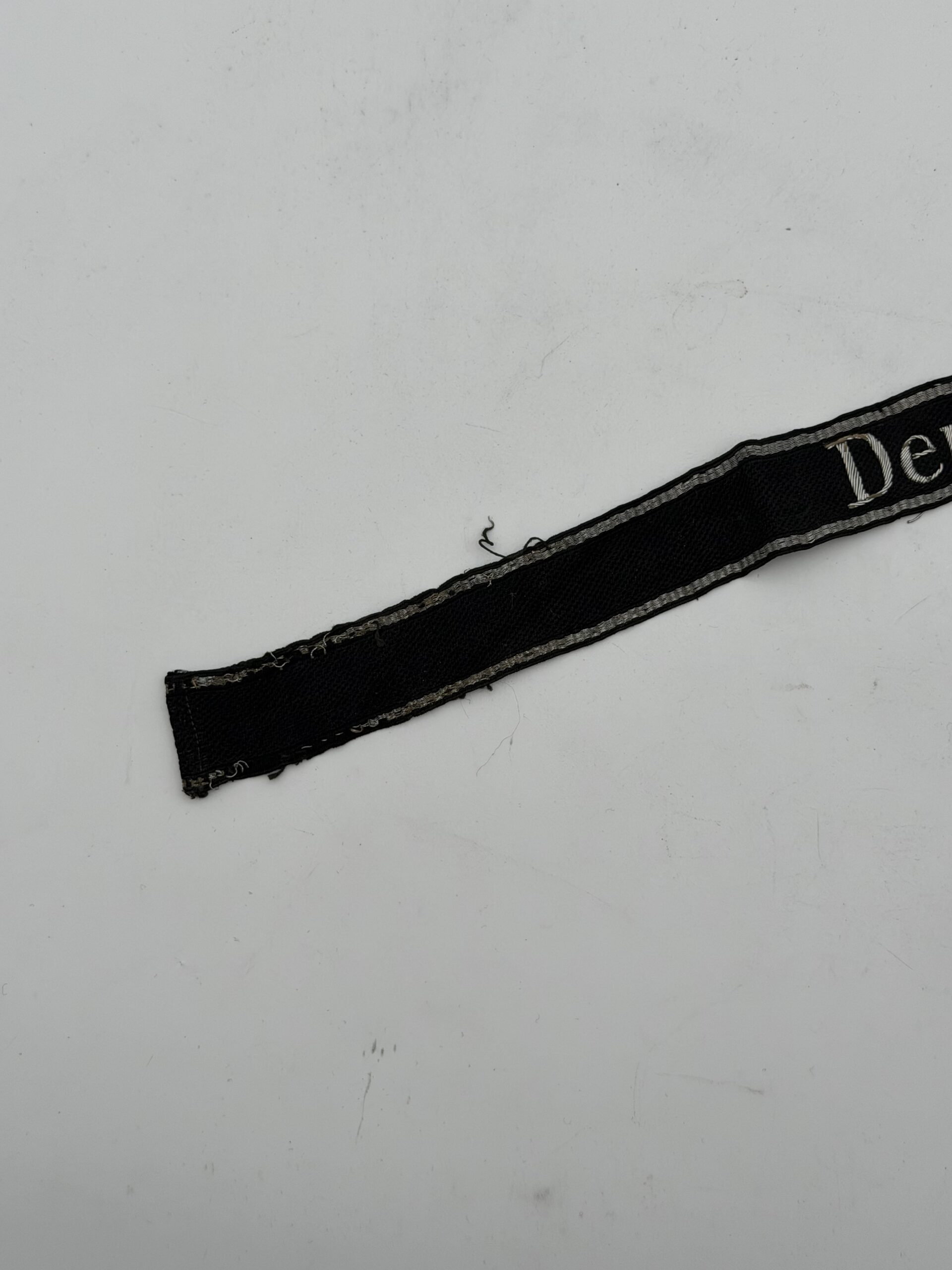
The maker constructed the band from a dense black woven textile and added silver/aluminium metallic borders along both horizontal edges. Across the centre, the embroiderer worked the word “Deutschland” individually in bright metal thread.
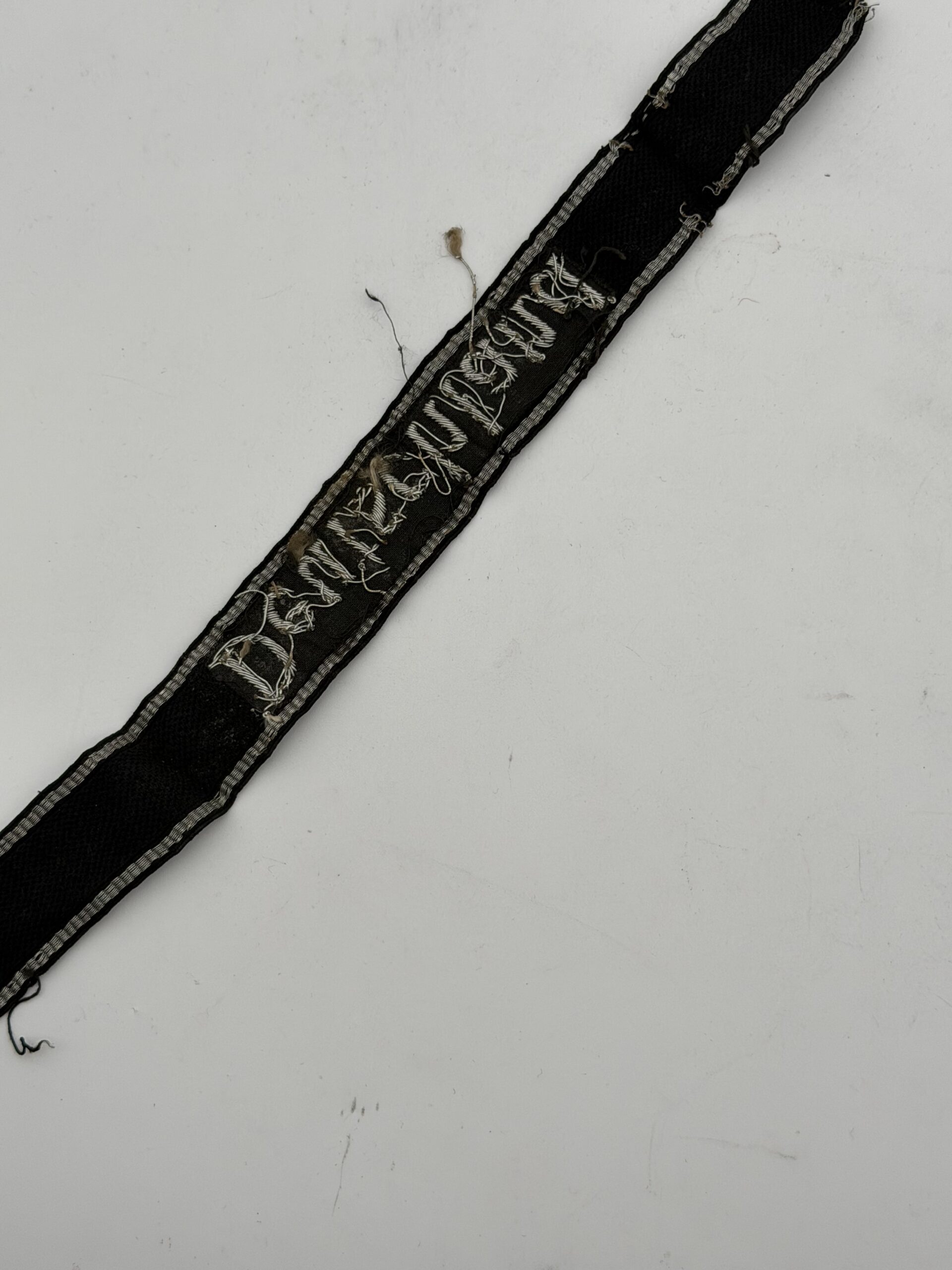
Unlike machine-embroidered enlisted versions, the lettering shows the depth, irregularity and complex reverse thread structure expected from genuine hand embroidery.
Most importantly, this example retains clear evidence of period uniform attachment and subsequent removal.
Original sewing threads, folded sections, fraying, edge wear and disturbance around the metallic borders remain visible. These characteristics give the cuff title strong historical character and distinguish it from an unissued collector example.
Collectors can compare this piece with material in our SS Cuff Titles, Waffen-SS Uniforms, Hand-Embroidered Third Reich Insignia, Third Reich Textile Insignia and Museum Collection categories.
The “Deutschland” formation developed from the early SS-Verfügungstruppe, the militarised branch of the SS that preceded the Waffen-SS.
The Bundesarchiv identifies the SS-Standarte “Deutschland,” later SS-Regiment “Deutschland,” under collection RS 24. Surviving archival records confirm its place among the principal formations of the SS-Verfügungstruppe.
At the outbreak of the Second World War, the SS-Verfügungstruppe included the Standarten or regiments “Deutschland,” “Germania” and “Der Führer.” After the Polish campaign, the SS combined these formations into a divisional structure.
On 1 April 1940, the three Standarten formed the SS-Verfügungs-Division. This formation later developed into the division known as “Das Reich.” The “Deutschland” regiment remained an important component throughout these organisational changes.
Eventually, the regiment received the designation SS-Panzergrenadier-Regiment 3 “Deutschland.”
Therefore, this cuff title represents a regimental distinction rather than the later divisional “Das Reich” title.
The present cuff title carries the word:
Deutschland
in conventional Latin lettering rather than the earlier Gothic script.
Period “Deutschland” cuff titles originally used Gothic lettering. Specialist reference research records a change to Latin script in December 1939, creating an important distinction between early and later examples.
This specimen combines Latin lettering with traditional hand-worked metal-thread embroidery.
That combination makes it particularly interesting.
Hand embroidery dominated higher-grade officer cuff-title production during the earlier period. Around 1939–1940, manufacturers increasingly adopted machine-woven flatwire construction because it reduced labour and production costs. Consequently, a hand-embroidered Latin-script example fits an important transitional phase in SS cuff-title manufacture.
The SS Deutschland officer cuff title displays unmistakable hand-worked construction.
The front shows raised silver/aluminium-wire letters with individual changes in thread direction. Each letter possesses depth and a slightly individual character that machine production would not reproduce in the same way.
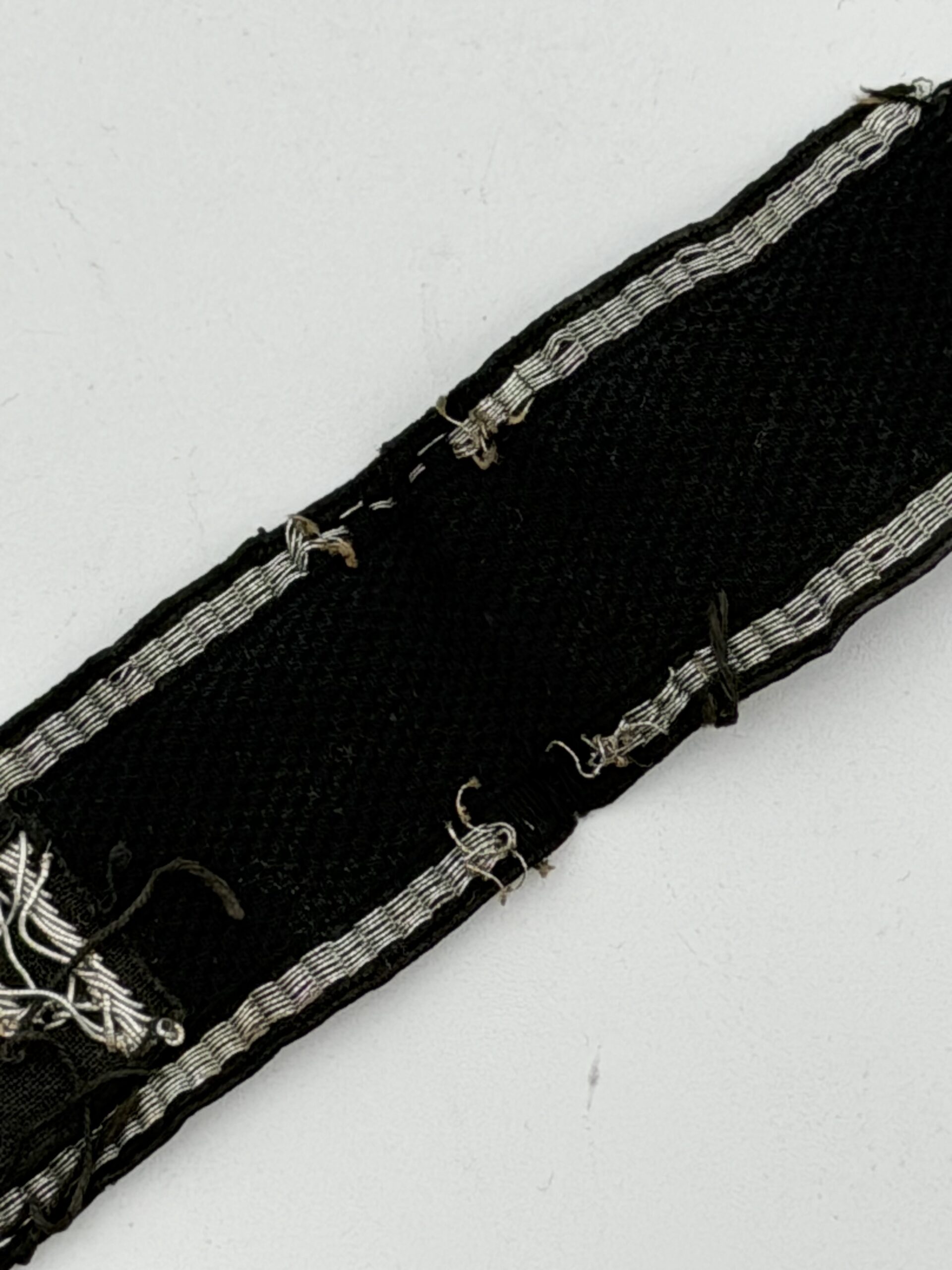
The reverse provides even stronger evidence.
Numerous metallic working threads cross behind the lettering. Individual securing stitches, turns, loops and thread ends remain visible.
Rather than presenting a neat mechanically produced reverse, the embroidery displays the complex working structure expected from hand manufacture.
This is an important authentication characteristic.
Close inspection also reveals natural variation in the metallic thread. Some areas remain bright silver, while others show subdued grey, champagne and brownish age toning.
Such irregular ageing adds considerably more credibility than a perfectly uniform modern finish.
Both horizontal edges carry the distinctive silver/aluminium metallic border associated with higher-quality SS cuff titles.
The border consists of multiple fine metallic strands arranged into repeating rectangular segments.
Several areas retain excellent definition. Elsewhere, prolonged wear and removal from the tunic have disturbed individual strands.
This variation appears natural.
The metallic edge has not aged identically across the entire cuff title. Instead, exposed sections display more wear than protected areas, exactly as one would expect from an insignia that spent part of its life attached to a uniform.
Condition provides one of the most attractive features of this cuff title.
The photographs show numerous signs that a tailor once mounted it to a tunic.
Surviving features include:
These details strongly support genuine period wear and subsequent uniform removal.
This is therefore not an unissued cuff title.
Instead, it represents an authentic service-used example with genuine historical character.
Collectors often describe pieces of this type as “tunic removed” or “uniform removed.”
The black woven ground remains strong overall and retains excellent colour.
Silver/aluminium lettering remains complete and highly legible. However, several parts show age toning, small areas of surface oxidation and thread disturbance.
The metallic border displays wear and minor losses in places.
Loose original threads remain present.
One end shows clear fraying and evidence of removal, while other sections retain old sewing material associated with previous mounting.
Importantly, the cuff title has not undergone modern restoration.
Its age, wear and removal evidence remain exposed and easy to study.
For a serious historical collection, this untouched state offers considerably more interest than an aggressively cleaned or artificially restored example.
The supplied photographs show a strong group of features consistent with period manufacture:
No single feature should authenticate an SS cuff title by itself.
However, the combination of construction, thread behaviour, textile wear and reverse embroidery shown here presents a convincing period profile.
A final hands-on examination should include UV testing, fibre inspection under magnification and comparison against established originals.
That distinction matters for both historical cataloguing and valuation.
The Waffen-SS developed from earlier armed SS formations, including the SS-Verfügungstruppe.
The Bundesarchiv describes the SS-Verfügungstruppe as militarily armed formations of the NSDAP and confirms that Germany reorganised these units into the Waffen-SS around the beginning of the war. It preserves surviving Waffen-SS organisational records primarily between Berlin and the Bundesarchiv-Militärarchiv in Freiburg.
The United States Holocaust Memorial Museum also documents the wider history of the Waffen-SS. Waffen-SS formations participated in major military campaigns while members and units also participated in mass shootings, anti-partisan atrocities, concentration-camp activities and other war crimes.
Responsible museum cataloguing should place this insignia within that complete historical framework.
An enlisted “Deutschland” cuff title remains collectible, but the officer version occupies a distinctly higher level.
Specialist references identify hand-embroidered aluminium-wire versions specifically with officer wear. Later officer examples also appeared in machine-woven flatwire construction.
The present example carries the additional appeal of genuine uniform use.
Rather than surviving as unused stock, it retains evidence of having formed part of an actual uniform.
That feature gives it significant display and research value.
This SS Deutschland officer cuff title offers something that an unused example cannot provide: visible evidence of its former life on a uniform.
The surviving sewing threads and compressed edges create an important physical record of attachment.
Meanwhile, the reverse reveals the embroiderer’s construction technique with unusual clarity.
Age toning across the metallic thread has developed naturally and unevenly. Equally, small areas of border deterioration correspond with the general level of use.
For an advanced collection, these features make the cuff title an excellent study piece as well as an attractive display object.
This SS Deutschland officer cuff title represents a rare and historically important example of Waffen-SS regimental insignia.
The Latin-script inscription dates the design to the wartime pattern, while the traditional hand-worked metal-thread construction places it within the higher-quality officer category.
Its exposed reverse provides excellent evidence of individual embroidery technique.
Furthermore, original attachment threads, edge wear, metallic toning and fraying clearly document previous uniform use.
Rather than detracting from the piece, this honest tunic-removed condition gives it strong historical character.
For an advanced SS textile collection, regimental insignia display or museum study collection, this cuff title offers an excellent combination of rarity, construction detail and genuine period wear.
Explore related listings: Cuff Titles & Armbands.
Bundesarchiv – SS-Verfügungstruppe and Waffen-SS Records
Bundesarchiv – SS-Standarte Deutschland, RS 24
USHMM – History of the Waffen-SS
MedalBook – SS Deutschland Cuff Title Construction Reference
Helmut Weitze – Deutschland Officer Cuff Title Market Comparison
Ratisbon’s – Deutschland Officer Cuff Title Auction Record