
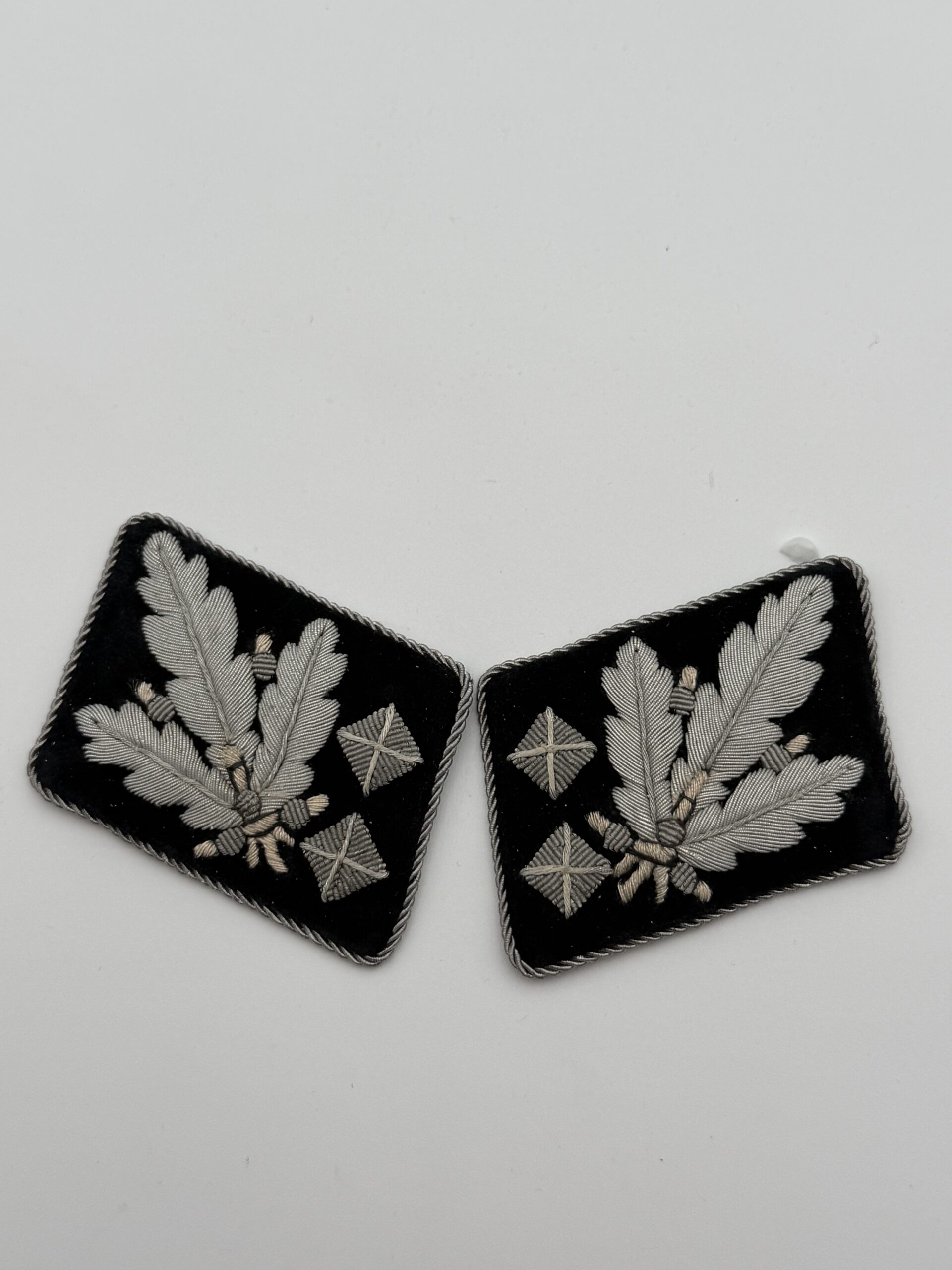
This exceptional matching pair of SS-Obergruppenführer collar tabs represents one of the highest general-officer ranks within the SS hierarchy. Introduced as part of the revised general-officer insignia system from 1942, each tab carries the distinctive three-leaf oak spray together with two rank pips.
€ 7.500
1 in stock
This exceptional matching pair of SS-Obergruppenführer collar tabs represents one of the highest general-officer ranks within the SS hierarchy. Introduced as part of the revised general-officer insignia system from 1942, each tab carries the distinctive three-leaf oak spray together with two rank pips.
The pair displays very fine hand embroidery in silver-coloured metal thread on a deep black velvet ground. Twisted silver officer’s cord finishes the outer edges. Moreover, one tab retains an exceptionally important period RZM paper label on the reverse.
The overall construction, embroidery technique, materials and reverse finish correspond closely with documented period examples. Consequently, this pair represents an unusually complete example of senior SS rank insignia.
The insignia identifies the wearer as an SS-Obergruppenführer.
The post-1942 SS general-officer system used three oak leaves as the basic general-rank device. Additional pips then differentiated the senior grades. On this pair, the three oak leaves and two square pips identify SS-Obergruppenführer.
A surviving pair held by the Imperial War Museums provides an important institutional comparison for SS-Obergruppenführer collar insignia. The IWM describes its example as a facing pair of black collar patches with silver edging and an oak-leaf device.
These are rank collar tabs rather than divisional insignia. Therefore, no particular Waffen-SS division can be assigned from the tabs alone. A senior officer could hold the SS-Obergruppenführer rank while serving within the Waffen-SS, Allgemeine-SS, police leadership or one of the principal SS administrative organisations.
The rank of SS-Obergruppenführer stood near the summit of the SS hierarchy. Depending upon an individual’s appointment, a holder might also use a corresponding title such as General der Waffen-SS or General der Polizei.
From 1942, the SS revised its general-officer collar insignia. The later pattern used a three-oak-leaf arrangement with an increasing number of pips for the successive general ranks. A current Helmut Weitze reference pair is likewise catalogued as the pattern from 1942 onwards and uses hand-embroidered metal thread on black velvet.
The SS itself developed from a Nazi Party bodyguard organisation into a vast security, police, military and administrative apparatus. It controlled major parts of the German police system and concentration-camp network and played a central role in the persecution and murder carried out by the Nazi regime. The United States Holocaust Memorial Museumprovides extensive historical documentation concerning the organisation and its role in the Holocaust.
This historical context is essential when cataloguing surviving SS material. Such insignia should be understood as material evidence of the organisational hierarchy and uniform culture of a regime responsible for systematic persecution, war crimes and genocide.
Both SS-Obergruppenführer collar tabs appear to form an original matching left-and-right pair.
Each tab uses a black velvet face over a stiff internal foundation. The velvet provides the characteristic dense, matt background required for senior officer insignia.
The oak-leaf devices show sophisticated hand workmanship. Fine metal threads form the individual leaves, while changes in thread direction create the veins and three-dimensional appearance. The embroiderer separately defined the stems, acorns and smaller elements.
Two square rank pips appear beside the oak-leaf spray on each tab. These are also executed in metal thread rather than being simple stamped-metal additions.
A tightly twisted silver-coloured cord surrounds each tab. The cord follows the perimeter cleanly and creates the formal officer-grade finish associated with high-ranking SS insignia.
The construction closely resembles documented 1942-pattern examples. Weitze’s current comparative pair is likewise described as hand-embroidered metal thread work on black velvet.
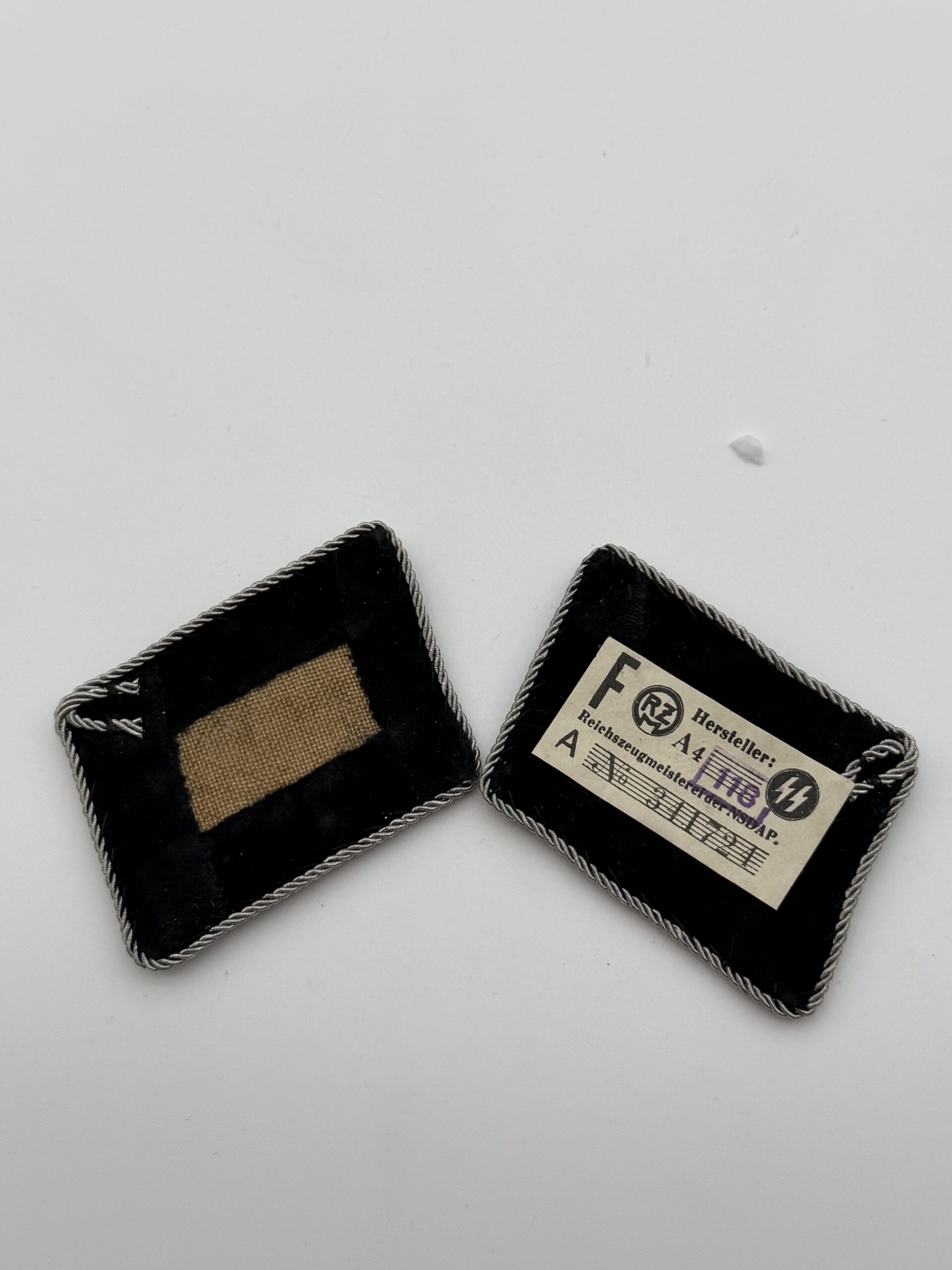
The reverses provide particularly valuable evidence.
The black velvet folds neatly around the rigid internal foundations. This method creates the characteristic tailored reverse appearance expected on quality officer collar tabs.
One tab exposes a rectangular section of tan woven foundation material. The second retains an original-style Reichszeugmeisterei der NSDAP paper label.
The surviving label incorporates the RZM emblem, the wording Reichszeugmeisterei der NSDAP, an SS device and the manufacturer’s classification. Close examination of the supplied photograph indicates the manufacturer marking A4/176.
The label also carries period control markings applied across the printed lines. Its slightly aged paper colour, printing, ink application and integration with the reverse construction are all visually compatible with period manufacture.
The RZM label significantly increases both the research value and collector interest of the pair. However, the number should not be expanded to a named manufacturer without confirmation from a reliable surviving RZM manufacturer’s directory.
Collectors interested in comparable labelled insignia can also view this RZM-labelled SS collar tab within the Nordmenn Militaria collection.
On the basis of the photographs supplied, the pair displays strong characteristics of original period manufacture.
Several features support this assessment. First, the embroidery shows the irregular precision expected from skilled hand work rather than identical machine repetition. Second, individual metal threads follow the contours of the oak leaves naturally.
Furthermore, the square rank pips show appropriate hand-worked construction. The black velvet also has a convincing pile and surface character.
The perimeter cord appears correctly integrated into the tabs rather than artificially aged after assembly. Likewise, the reverse construction shows the folds, foundation materials and finishing expected from traditionally made collar insignia.
Most importantly, the RZM label appears naturally associated with the tab rather than newly attached. Nevertheless, an RZM label should always form only one part of an authentication assessment because labels themselves have also been reproduced.
Modern reproductions of senior SS collar tabs exist and some employ genuine-style hand embroidery. Therefore, authentication must rely on the complete construction rather than one isolated feature.
Taken together, the embroidery, velvet, bullion work, rank-pip construction, edging, reverse manufacture and surviving RZM label form a highly convincing and internally consistent group of features.
From the photographs currently available, there are no obvious construction features that would cause this pair to be rejected as a reproduction.
The pair survives in exceptionally fine condition.
The black velvet remains deep and uniform, while the silver-coloured embroidery retains excellent definition. The oak leaves show virtually all of their original detail.
Likewise, the twisted perimeter cord remains complete and well seated. No significant moth damage, tearing or material loss is visible in the supplied photographs.
The reverses also remain remarkably clean. Most notably, the survival of the delicate RZM paper label adds considerably to the historical integrity of the set.
The tabs appear either unissued or only very lightly handled. However, without documented provenance confirming issue status, they should conservatively be described as being in near-mint condition rather than definitively unissued.
Original SS general-officer insignia is considerably scarcer than ordinary enlisted or junior-officer SS collar insignia. The potential pool of wearers was very small, while surviving matched pairs are scarcer still.
A complete facing pair at the SS-Obergruppenführer level therefore occupies a significantly different collecting category from standard Waffen-SS rank tabs.
The additional survival of an RZM manufacturer’s label makes the present set particularly desirable for the study of period production and RZM-controlled insignia.
For related material, see the Nordmenn Militaria SS Items collection and the wider Uniforms and Insignia section.
Helmut Weitze currently offers a period 1942-pattern SS-Obergruppenführer matching pair at €6,500. That example is described as lightly worn and condition 2+.
View the Weitze comparative example.
The present pair appears substantially cleaner from the available photographs. In addition, it retains the important RZM paper manufacturer’s label. Those factors justify a premium over a comparable worn pair, provided physical inspection confirms the photographic assessment.
Estimated collector market range: €7,500–€9,500
For a specialist international audience, a higher asking price approaching €9,500 would also be defensible because of the condition and surviving RZM label. However, €8,500 provides a strong balance between rarity, condition and the current €6,500 dealer comparison.
A documented provenance to a named SS-Obergruppenführer would change the valuation substantially. Without such provenance, the pair should be valued for its rank, construction, condition and surviving RZM documentation rather than attributed to any particular individual.
Object: Matching pair of SS general-officer collar tabs
Rank: SS-Obergruppenführer
Pattern: Post-1942
Period: Third Reich, circa 1942–1945
Organisation: SS / potentially Allgemeine-SS, Waffen-SS or associated senior SS command
Material: Black velvet, metal-thread embroidery, textile foundation and twisted officer cord
Design: Three oak leaves with two rank pips on each tab
Construction: Hand embroidered
Reverse: Black textile backing over stiff foundation
RZM label: Present on one tab
Manufacturer code: RZM A4/176, as presently read from the photograph
Condition: Near mint / exceptionally well preserved
Rarity: Very rare
Recommended retail: €8,500
The principal significance of these SS-Obergruppenführer collar tabs lies in the combination of rank, craftsmanship and preservation. The detailed hand embroidery represents some of the most elaborate textile insignia produced for the SS uniform system.
Moreover, the matched construction and surviving RZM manufacturer’s label make this pair particularly useful as a reference example. Unlike divisional collar insignia, these tabs identify the wearer’s senior rank rather than a particular formation.
Accordingly, this is an exceptionally strong example for an advanced SS insignia collection or a museum display examining the material culture and hierarchy of the Nazi state.