
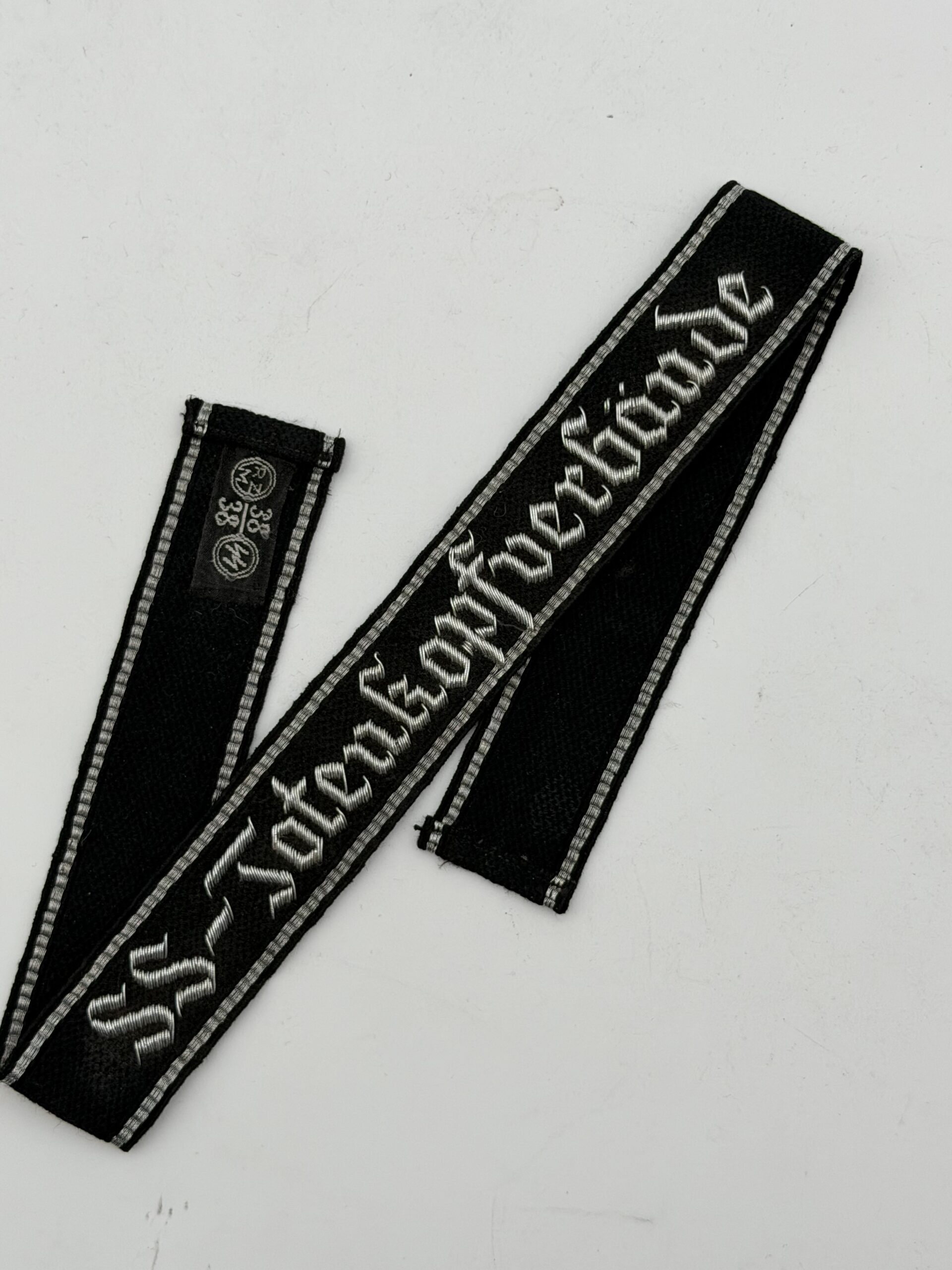
Exceptionally rare original SS Totenkopfverbände cuff title produced in the high-quality officer or Führer pattern. The full-length black cuff band carries the Gothic inscription “SS-Totenkopfverbände”, individually worked in bright silver-aluminium metal thread and bordered along both edges with matching silver-aluminium woven stripes.
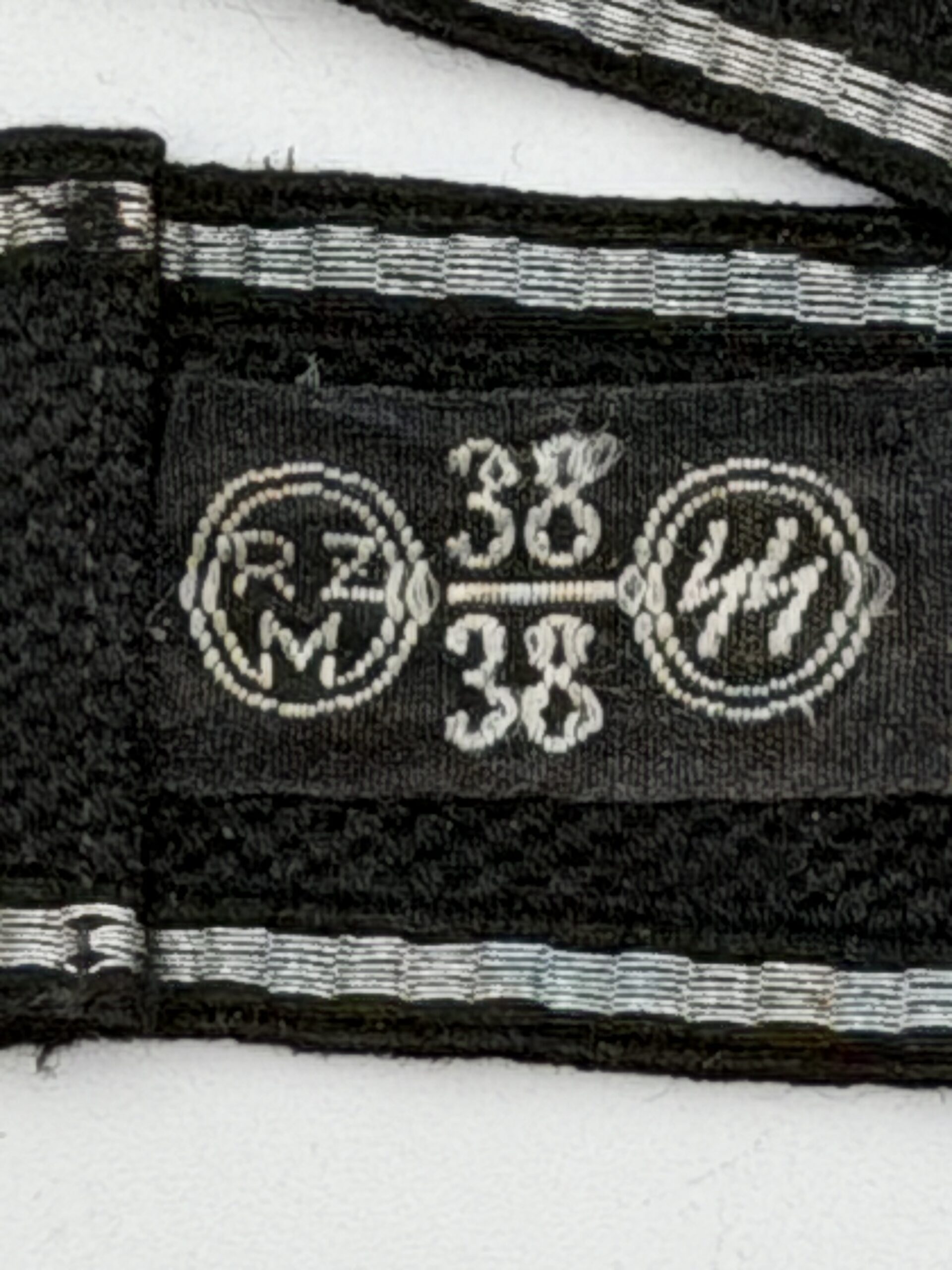
Most importantly, this example remains full length and unshortened. It also retains its original black woven RZM/SS manufacturer’s label marked 38/38, an important feature rarely encountered on surviving examples.
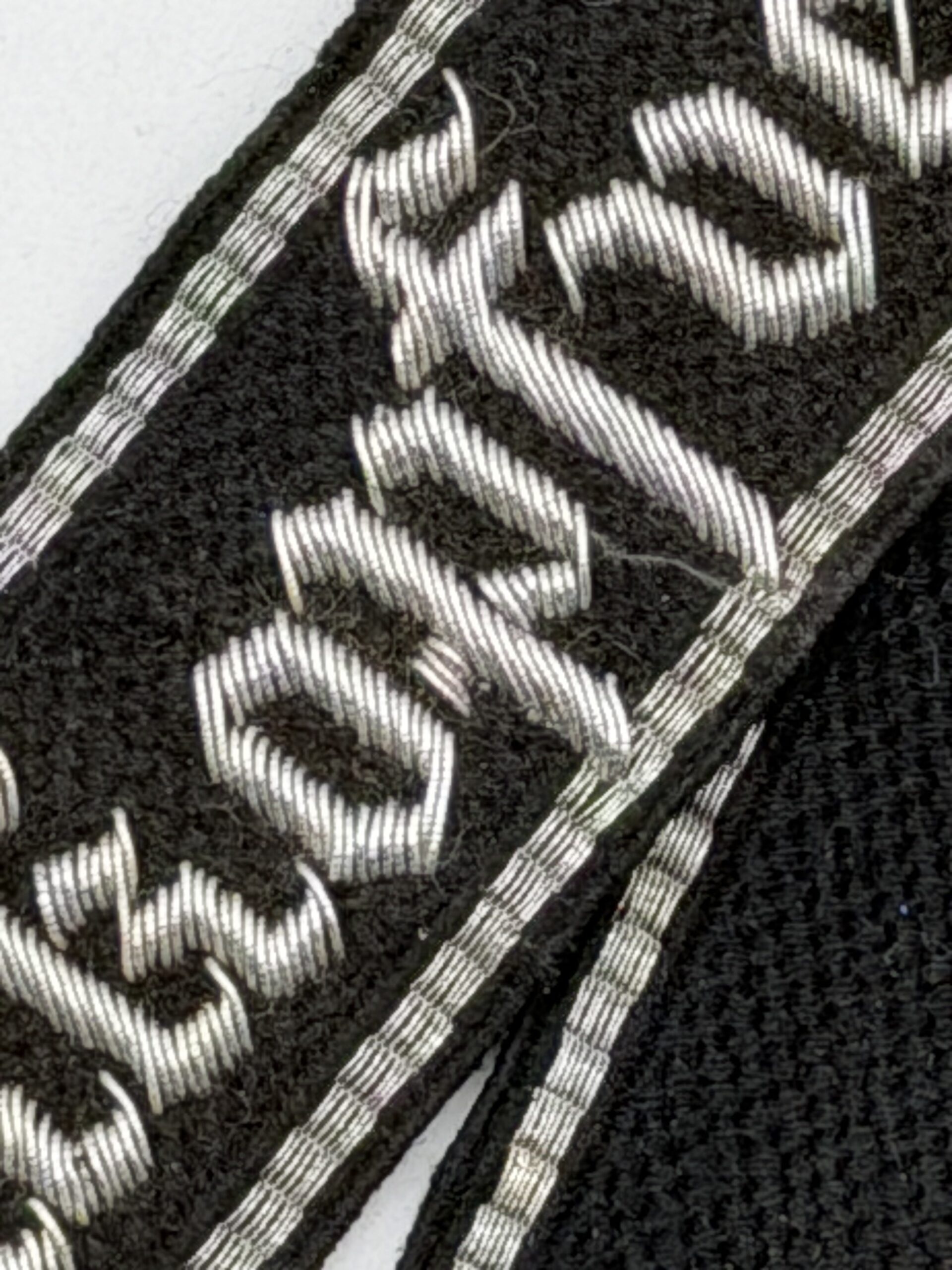
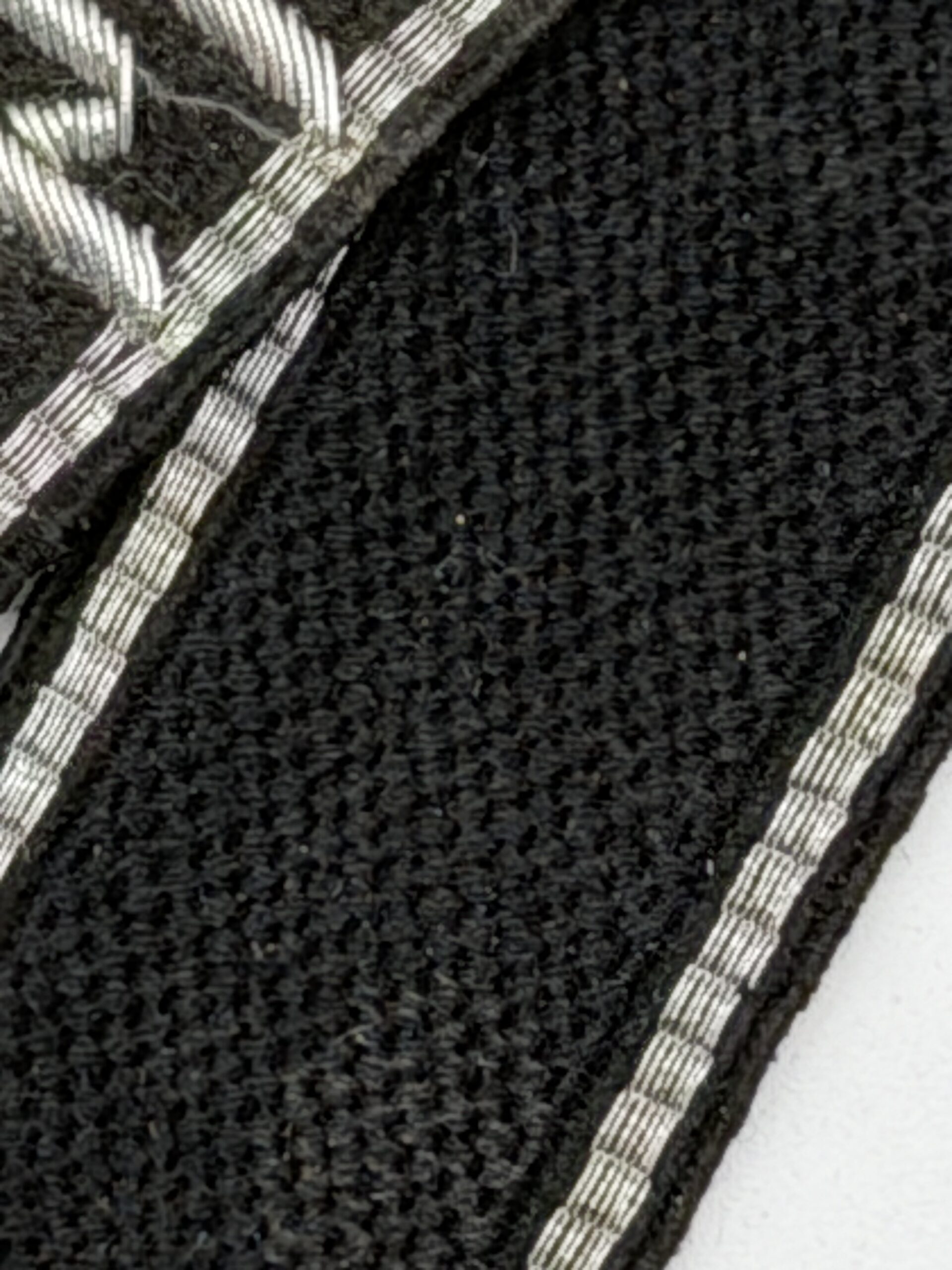
The photographs show superbly defined metal-thread lettering, correct period Gothic typography, original woven borders and factory-finished construction. No obvious evidence of significant restoration can be seen.
This is an exceptionally important example of one of the rarest pre-war SS officer cuff-title patterns and represents a genuine museum-level textile artefact
€ 17.500
1 in stock
The SS Totenkopfverbände cuff title belongs to a highly specialised group of insignia associated with the SS-Totenkopfverbände, usually abbreviated SS-TV.
The organisation developed from the SS guard formations used within the Nazi concentration-camp system. In 1935 the formations were known as SS-Wachverbände. During 1936 they became the SS-Totenkopfverbände, or SS Death’s-Head Units.
The United States Holocaust Memorial Museum records that the SS-Totenkopfverbände guarded and administered concentration camps. Consequently, surviving SS-TV insignia must be understood within that historical context rather than simply as conventional military unit insignia.
By the later 1930s, the organisation included several Totenkopfstandarten together with an inspection and administrative structure.
A surviving Bundesarchiv organisational listing dated July 1939 records the Inspektion der SS-Totenkopfverbände at Oranienburg as well as the principal Totenkopfstandarten “Oberbayern,” “Brandenburg,” “Thüringen” and “Ostmark.”
Therefore, the present cuff title belongs to an especially significant phase in the institutional development of the SS before the Second World War.
The generic “SS-Totenkopfverbände” inscription should not be confused with cuff titles carrying individual Standarte names such as “Oberbayern,” “Brandenburg” or “Thüringen.”
Specialist references record that a general cuff title for SS-TV personnel was proposed during the mid-1930s. An early design used a different script before the Gothic-lettered pattern was adopted.
The recognised Gothic form subsequently identified officers serving with staff elements of the SS-Totenkopfstandarten.
MedalBook specifically identifies this SS-Totenkopfverbände cuff title as an officer version and records that it was worn by officers serving on the staffs of SS-Totenkopfstandarten.
A documented full-length hand-embroidered example in the Ulric of England collection is likewise described as an officer cuff title introduced for wear from 1937 and used by officers serving on SS-TV staffs. That example measured 49 cm and carried an original woven RZM/SS label.
The quality of this SS Totenkopfverbände cuff title is immediately apparent.
Instead of ordinary cotton or rayon machine embroidery, the Gothic inscription has been created from silver-aluminium metal thread. Each section of the lettering displays numerous narrow parallel lines within the metallic surface.
Close examination of the enlarged photographs reveals the individual placement of the aluminium material.
The raised lettering produces considerable three-dimensional depth. Furthermore, changes in thread direction follow the shape of individual Gothic characters.
Visible characteristics include:
The resulting construction is substantially more elaborate than standard enlisted or NCO cuff-title manufacture.
The central inscription is one of the strongest features of the piece.
The title reads:
SS-Totenkopfverbände
Early SS cuff titles frequently employed Gothic lettering. This typography gives the cuff title its characteristic pre-war appearance.
Each letter has been carefully formed rather than produced as part of a modern computer-controlled embroidery sequence.
Magnification reveals small natural variations in the positioning and direction of the aluminium metal thread. Such irregularity is desirable on genuinely hand-worked insignia.
At the same time, the spacing remains remarkably consistent.
The long inscription required substantially more embroidery than a short Standarte title such as “Thüringen” or “Oberbayern.” Consequently, surviving high-quality examples were expensive insignia to manufacture even during the period.
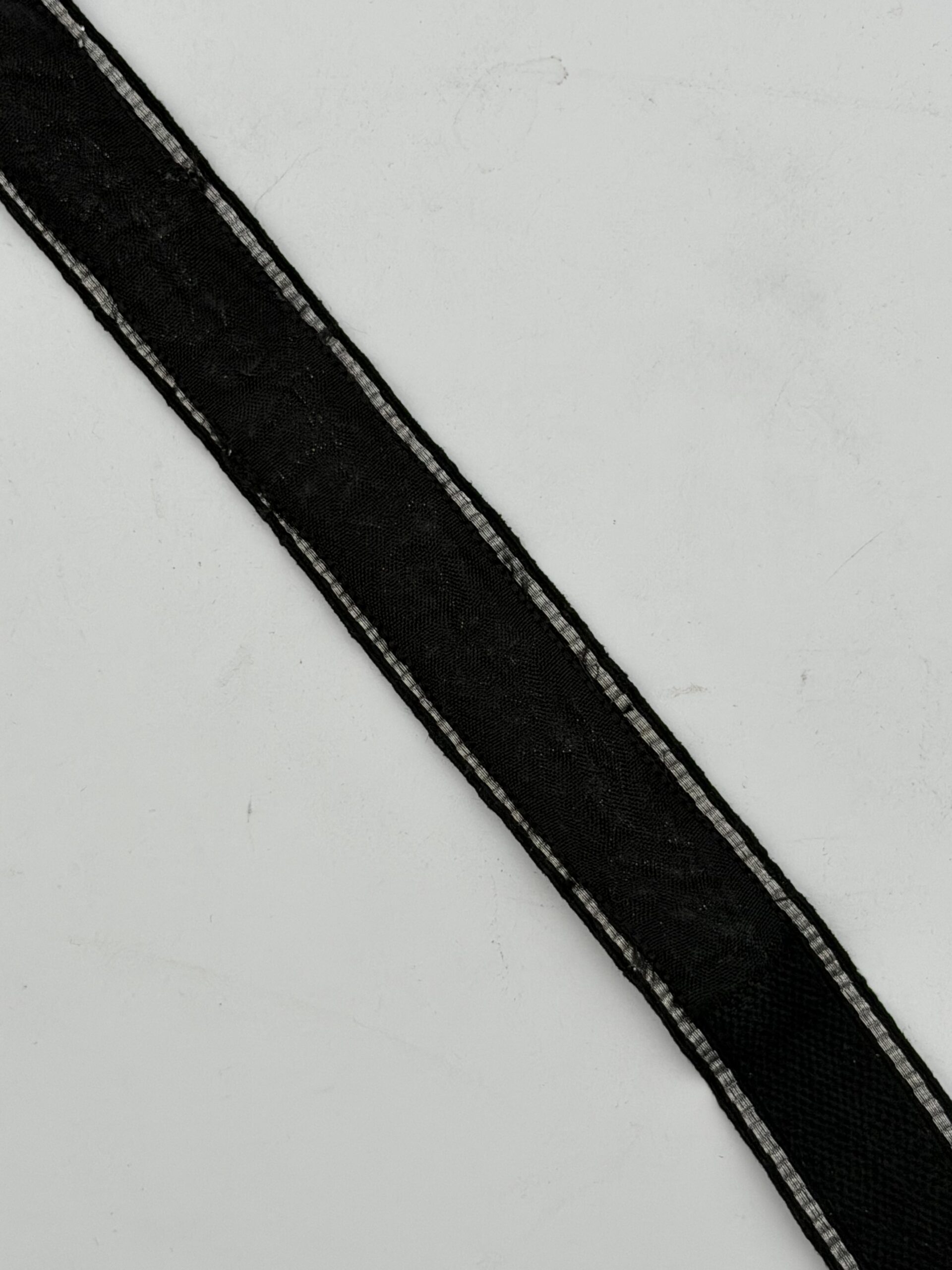
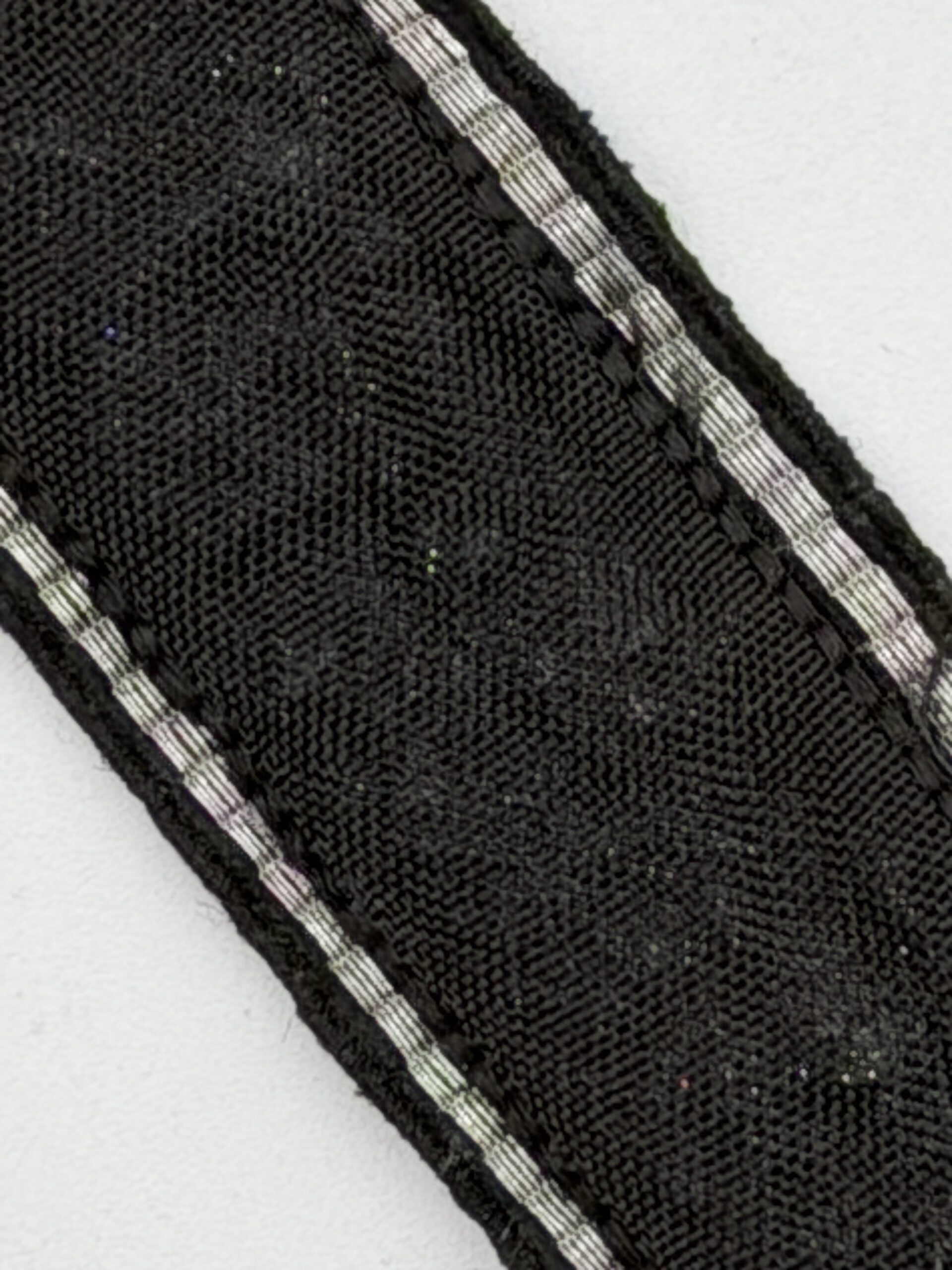
Both longitudinal edges retain their original metallic borders.
The border construction consists of multiple fine silver-aluminium strands incorporated into a repeating woven pattern.
These borders remain exceptionally complete.
Under magnification, each metallic section shows the fine parallel structure expected from period metal-thread production. Additionally, the borders display minor natural tonal variation rather than an unnaturally uniform modern finish.
Comparable officer-quality SS-TV cuff titles also use silver-aluminium borders surrounding black cuff-title cloth.
A current Helmut Weitze example for the Totenkopfstandarte “Thüringen,” for example, is described as an RZM metal-thread, hand-embroidered officer version produced at full length.
The present SS-Totenkopfverbände staff title is considerably rarer than that individual Standarte pattern.
An especially important feature is the surviving full length.
Numerous original SS cuff titles were shortened when sewn onto tunic sleeves. Others were cut during removal at the end of the war.
This example has avoided that damage.
Both extended sections of the black band remain present, while the original metallic borders continue along the full cuff title.
No significant shortening can be seen in the supplied photographs.
The factory-finished configuration is especially valuable because it allows the cuff title’s original dimensions and construction method to be studied without relying upon reconstruction.
Full-length SS officer cuff titles naturally command a substantial premium over shortened examples.
The reverse retains a particularly desirable black woven RZM/SS manufacturer’s label.
Visible features include:
The label can therefore be catalogued accurately as:
RZM/SS woven label marked 38/38.
Period RZM/SS woven labels normally placed a manufacturer’s identification above the final two digits of the production year. Accordingly, the visible configuration is consistent with a 1938 manufacture format.
However, assigning a specific factory name solely from the number should be avoided until that manufacturer’s code has been confirmed from an appropriate contemporary RZM directory.
This conservative treatment prevents the catalogue from making an unsupported maker attribution.
The Reichszeugmeisterei controlled production and distribution of NSDAP and affiliated organisational equipment, including regulated SS insignia.
Consequently, correctly constructed RZM/SS labels provide useful evidence when assessing original textile insignia.
Nevertheless, the label should never be considered proof of authenticity on its own.
Instead, authentication depends upon the complete combination of materials, typography, construction, reverse weave, metallic thread, borders, finishing and age.
On the present SS Totenkopfverbände cuff title, those features can be examined together.
The intact label is therefore especially valuable because it survives alongside an apparently complete cuff title rather than as an isolated component.
The supplied high-resolution photographs show numerous characteristics consistent with original period manufacture.
Particularly positive features include the hand-worked aluminium lettering and the structure of the surrounding black cloth.
Moreover, the Gothic typography corresponds closely with documented original officer examples.
The metallic borders also exhibit convincing period construction.
Additional positive observations include:
Nothing visible within the supplied photographs immediately contradicts period manufacture.
For an artefact of this value, final authentication should nevertheless include direct microscopic examination, ultraviolet testing and comparison of the woven label with indisputable reference examples.
The condition is exceptionally strong for an original full-length example.
The black foundation remains deep in colour and structurally sound. Meanwhile, the silver-aluminium inscription retains excellent brilliance and definition.
Only light age-related toning appears across parts of the metallic thread.
The borders remain substantially complete.
Likewise, the woven RZM/SS label retains clear detail and remains securely associated with the cuff title.
Most significantly, the piece has not been shortened.
No major moth loss, structural tear or restoration is apparent from the supplied photographs.
Overall preservation can therefore be described as:
Excellent original collector condition, full length, retaining original RZM/SS woven label.
This cuff title is considerably more important than an ordinary divisional Waffen-SS title.
The wording “SS-Totenkopfverbände” links the artefact directly to the administrative and staff structure of the SS Death’s-Head Units during the pre-war period.
The United States Holocaust Memorial Museum documents that these units commanded, administered and guarded Nazi concentration camps. As a result, this insignia represents physical evidence connected with the institutional history of the concentration-camp system.
Museum interpretation should therefore retain this context.
Such material has legitimate historical value precisely because surviving objects can help document the organisations, hierarchy, uniforms and administrative mechanisms involved in Nazi persecution.
The exact SS Totenkopfverbände cuff title ranks among the most difficult SS officer cuff titles to obtain.
Ulric of England describes its documented hand-embroidered example as “Exceptionally Rare” and assigns it the highest 10/10 rarity rating within its comparative SS cuff-title scale. Their example was also full length and retained its woven RZM/SS label.
This rating is significant because many far more familiar Waffen-SS cuff titles survive in considerably larger numbers.
Standard unit titles were required for thousands of personnel.
In contrast, this particular pattern served a much smaller officer/staff population.
Consequently, very few examples appear on the international market.
One of the strongest recent market references appeared in the Dave Delich Collection at Hermann Historica.
Lot 1160 consisted of an officer cuff title for SS-TV staff personnel.
That example featured:
It sold in November 2024 for €38,000.
That extraordinary result should not simply be applied directly to every surviving example. The Dave Delich provenance provided a substantial premium, and construction differed from the present hand-embroidered form.
Nevertheless, the result demonstrates the extraordinary demand for genuine full-length officer SS-Totenkopfverbände staff cuff titles.
Named Totenkopfstandarte cuff titles provide a lower market reference but are not direct equivalents.
Helmut Weitze currently lists full-length hand-embroidered officer examples of “Thüringen” around €2,500–€3,000.
Those pieces identify a particular Standarte.
The present generic SS-Totenkopfverbände staff cuff title occupies a substantially different rarity class.
MedalBook gives an estimated value of approximately $3,000 for a generic officer SS-TV cuff title, although that guide does not adequately reflect the exceptional €38,000 Dave Delich auction result or the premium attached to documented full-length labelled examples.
Therefore, modern specialist retail valuation requires a wider assessment than simply applying older generic price-guide figures.
This valuation takes account of:
At €15,000, the cuff title remains substantially below the exceptional provenance-driven Hermann Historica result while correctly positioning it above considerably more common Totenkopfstandarte, Waffen-SS regimental and SS administrative cuff titles.
Collectors researching this SS Totenkopfverbände cuff title should also view the Nordmenn Cuff Titles and Armbands collection.
For a directly related Totenkopfstandarte example, compare the Original SS-Totenkopfverbände “Thüringen” BeVo cuff title.
Further high-grade administrative SS insignia can be compared with the Original SS RuS-Hauptamt metal-embroidered cuff title and the Original SS-Hauptamt officer cuff title with RZM label.
The wider range of original SS material can be viewed within the Nordmenn SS Items collection.
For historical context regarding the organisation itself, consult the United States Holocaust Memorial Museum – SS and the Camp System.
The Bundesarchiv publication documenting the July 1939 SS-TV organisational structure provides an important German archival reference.
For technical cuff-title comparison, see the MedalBook SS-TV officer cuff-title reference.
A documented full-length hand-embroidered comparison appears in the Ulric of England SS-Totenkopfverbände cuff-title archive.
Finally, the exceptional 2024 market result can be studied through the Hermann Historica Dave Delich Collection auction record.
| Attribute | Details |
|---|---|
| Item | SS-Totenkopfverbände officer cuff title |
| Organisation | SS-Totenkopfverbände |
| Grade | Officer / Führer |
| Period | Third Reich, pre-war |
| Approximate dating | Late 1930s |
| Inscription | SS-Totenkopfverbände |
| Script | Gothic |
| Foundation | Black woven textile |
| Lettering | Silver-aluminium metal thread |
| Manufacture | Hand-embroidered officer quality |
| Borders | Silver-aluminium woven borders |
| Length | Full original length – unshortened |
| Ends | Original factory-finished construction |
| RZM label | Present |
| Label type | Black woven RZM/SS |
| Label marking | 38/38 |
| Condition | Excellent |
| Restoration | None apparent from photographs |
| Rarity | Extremely rare |
This is not the standard “Totenkopf” divisional cuff title.
Neither is it a cuff title for one individual Totenkopfstandarte.
The full inscription “SS-Totenkopfverbände” identifies the specialist officer/staff pattern.
That distinction is essential when valuing the piece.
A comparison based solely on “Thüringen,” “Oberbayern” or ordinary Waffen-SS Totenkopf cuff titles will result in a substantial undervaluation.
Full length, officer manufacture and the surviving 38/38 RZM/SS woven label make this example especially desirable.
The construction visible in the supplied photographs is consistent with recognised original officer examples. The metal-thread embroidery, Gothic lettering, woven borders, full-length construction and surviving RZM/SS label all provide positive indicators.
No. The elaborate silver-aluminium metal-thread construction corresponds with an officer or Führer-quality version.
The Gothic inscription reads “SS-Totenkopfverbände.”
No. This is an earlier SS-Totenkopfverbände staff-related pattern rather than the standard later divisional Totenkopf cuff title.
Yes. The supplied photographs show the complete extended cuff-title band rather than a shortened sleeve-removed section.
Yes. A black woven RZM/SS label survives at one end.
The visible woven identification reads 38/38, positioned between the RZM and SS symbols.
The format is compatible with the RZM system used on SS woven labels. However, a specific company should not be named until manufacturer code 38 has been verified against an authoritative period RZM directory.
Extremely rare. A documented specialist example has received a maximum 10/10 rarity rating, while an officer staff example from the Dave Delich Collection realised €38,000 in 2024.