
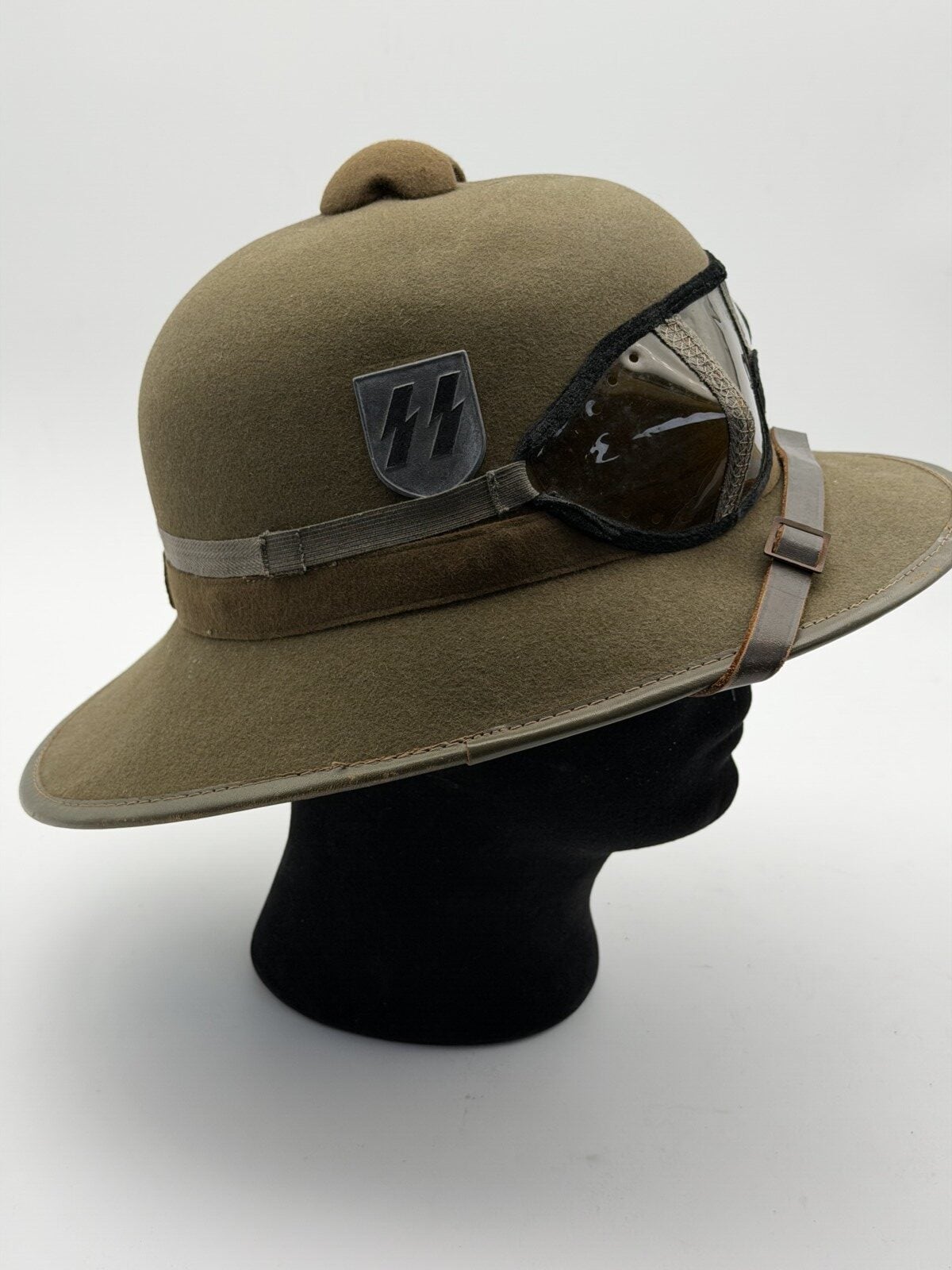
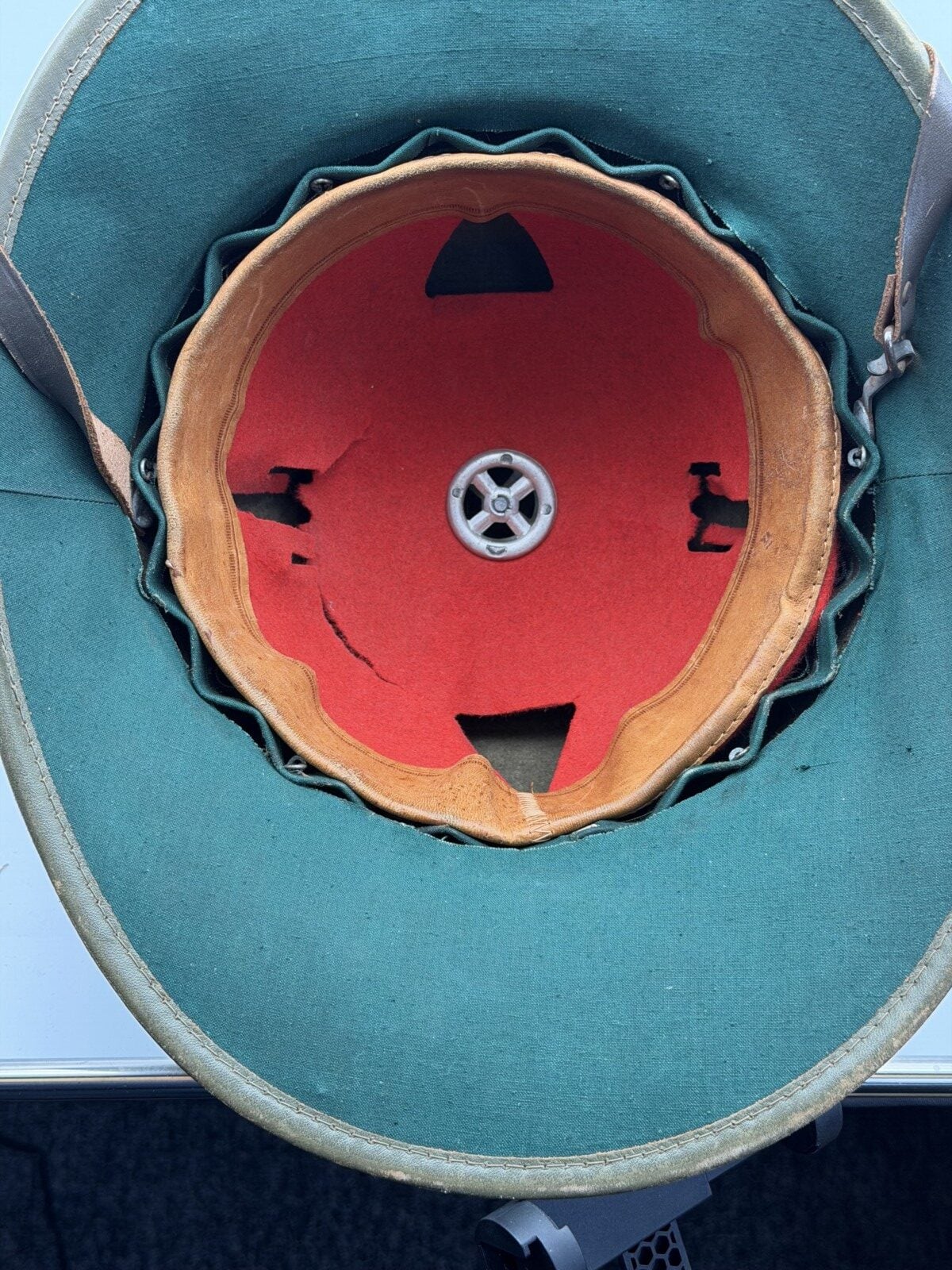
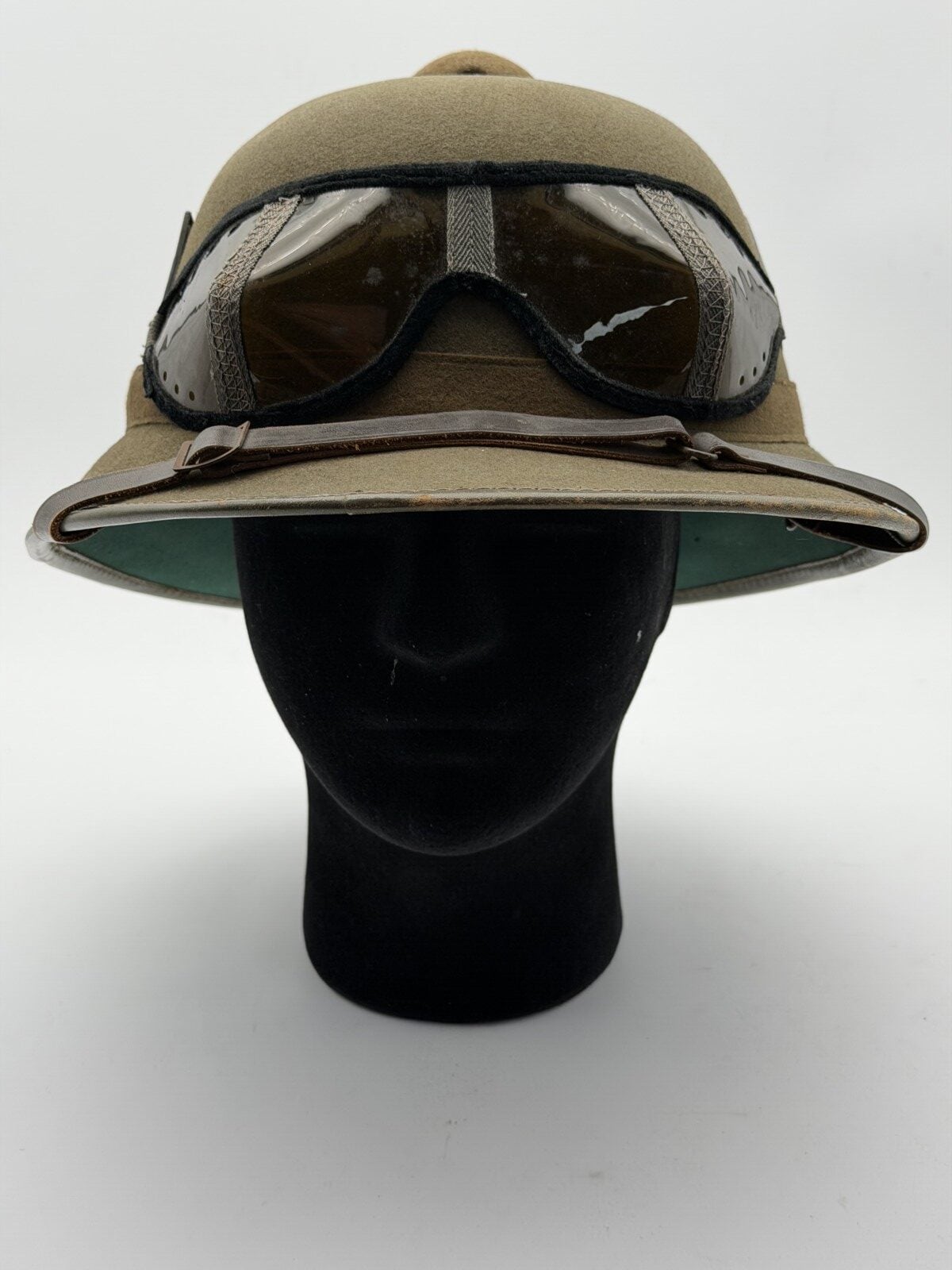
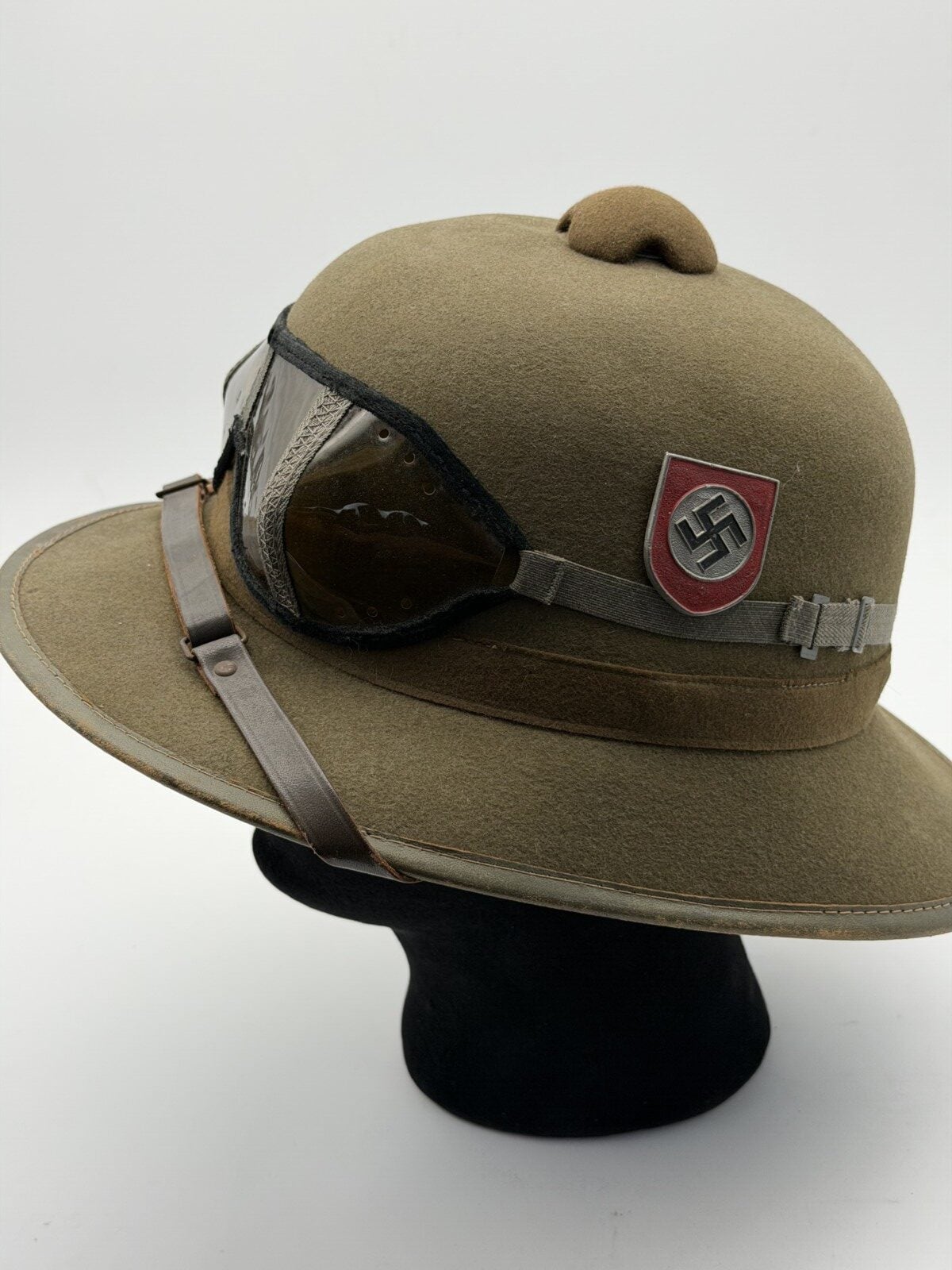
Exceptionally rare original-style Waffen-SS second-pattern tropical pith helmet, constructed with an olive-brown felt-covered body, broad sun brim, green underside, red felt interior, tan leather sweatband and original-style brown chinstrap.
The helmet retains both distinctive Waffen-SS side shields comprising the SS runic emblem and opposite red swastika national shield. A highly attractive pair of tinted Augenschützer 42-type tropical eye protectors accompanies the helmet and displays the characteristic celluloid panels, ventilated sides and black velvet edging.
The helmet body shows convincing period construction throughout, while reverse examination of the extremely valuable SS shields is recommended before giving an unconditional originality guarantee.
€ 4.495
1 in stock
This exceptionally scarce Waffen-SS Tropical Pith Helmet represents the felt-covered second pattern of German tropical sun helmet produced during the Second World War.
Its olive-brown felt exterior remains remarkably complete and retains the distinctive broad brim, crown ventilation dome, leather edging and original-style chinstrap associated with this pattern.
Most importantly, the helmet carries the distinctive Waffen-SS metal identification shields rather than the far more frequently encountered Heer insignia.
A pair of tinted period-pattern Augenschützer 42 eye protectors accompanies the helmet and creates an impressive complete tropical headgear display.
The helmet body displays the characteristic construction associated with the second-pattern Tropenhelm.
Earlier German tropical helmets used a shaped cork body covered with cotton twill. Subsequently, manufacturers simplified construction by introducing a felt-covered pattern.
Helmut Weitze describes the second version as having a pressed core covered in olive felt, with a blue-green underside to the brim and a red felt-lined interior. Production belongs principally to the 1942 period.
All of those principal characteristics appear on the example offered here.
Fine olive-brown felt covers the external crown and broad brim.
A matching felt-covered ventilation dome sits prominently at the crown.
Meanwhile, narrow leather edging protects the outer circumference.
The shape remains excellent despite natural wartime and storage wear.
Turning the helmet over reveals one of the strongest construction features.
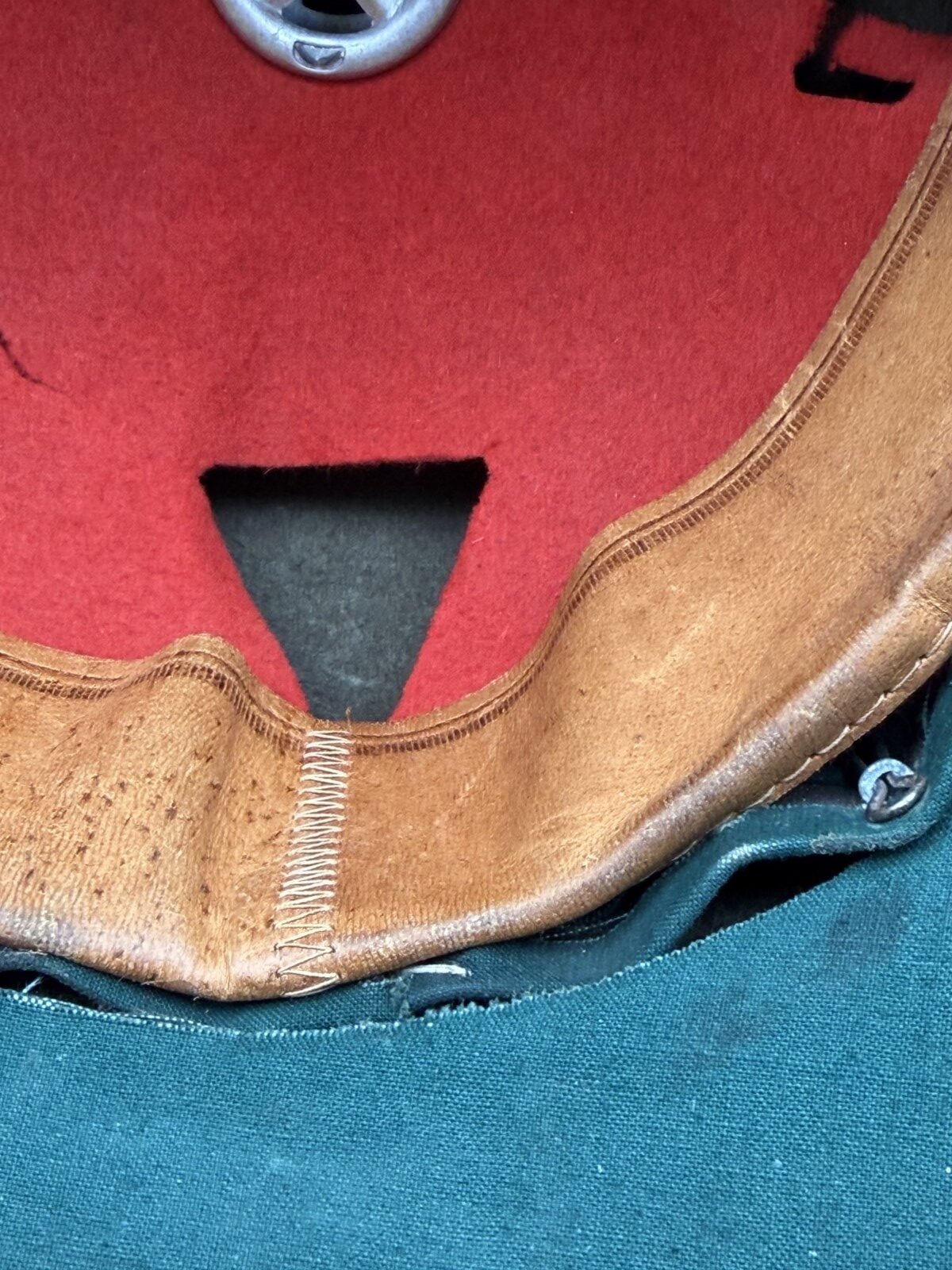
Deep blue-green material completely covers the underside of the broad brim.
This colour is characteristic of surviving second-pattern tropical helmets.
The contrast between the olive exterior and darker green underside also appears on independently documented wartime examples. Weitze records the same combination on original German second-pattern Tropenhelme.
Consequently, the Waffen-SS Tropical Pith Helmet displays precisely the type of layered construction expected from an original period shell.
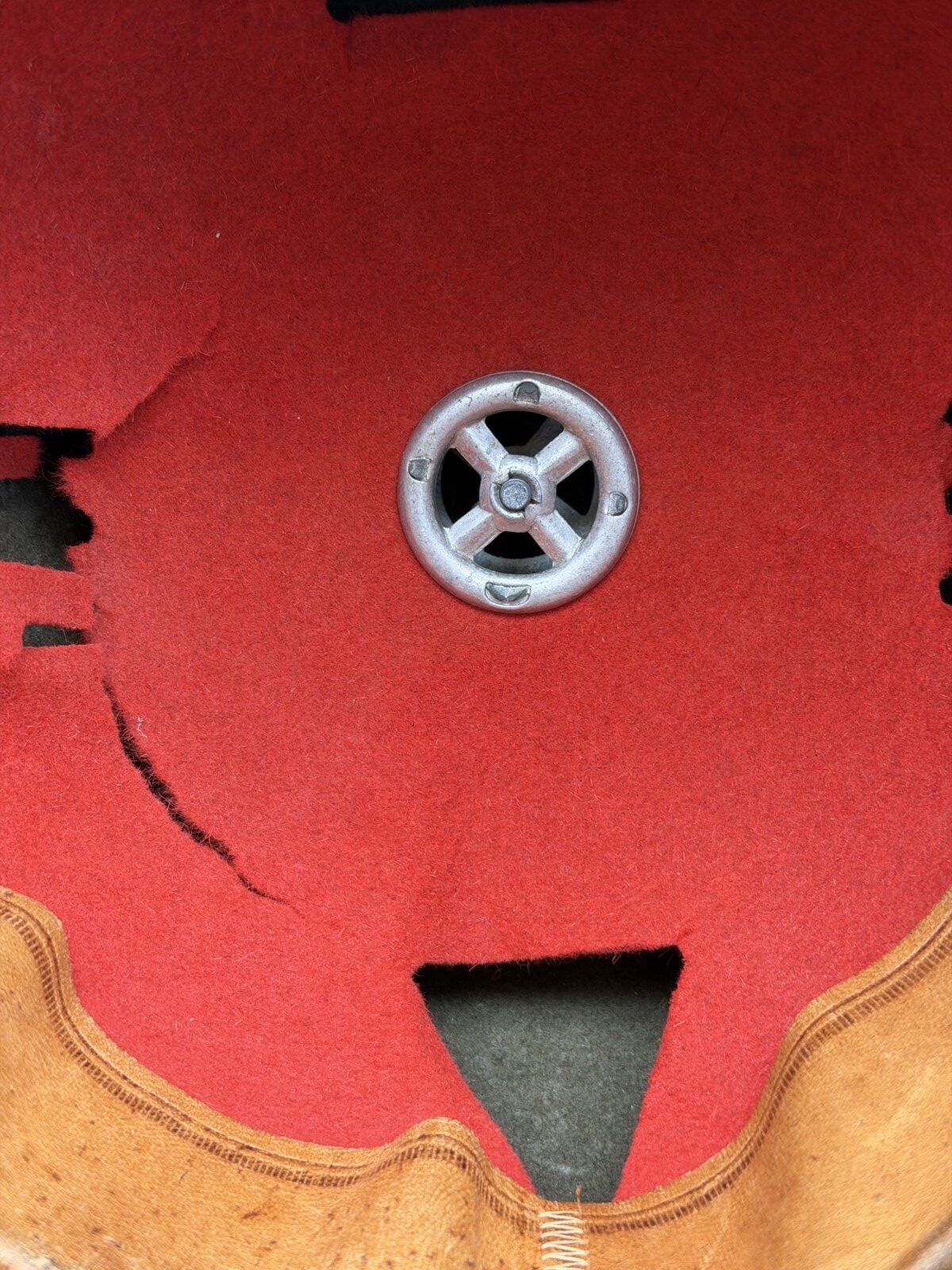
Inside the crown is a striking red felt liner.
Purpose-made ventilation apertures surround the interior.
At the centre sits the circular metal ventilation assembly, which remains complete.
The broad tan leather sweatband runs around the wearer’s head and shows genuine darkening, spotting and flexibility from age.
Importantly, the rear join remains closed with period-style stitching.
No maker, size or date stamp is visible in the photographs supplied.
Such information frequently appears on the reverse of the sweatband, so I would inspect beneath it carefully without forcing or excessively bending the aged leather.
A visible 1942 date or recognised manufacturer mark would materially improve the catalogue entry.
The Waffen-SS-specific runic shield appears on the side of the helmet.
Its shield-shaped body carries the familiar paired SS runes.
Surface finish has naturally darkened with age.
Furthermore, the shield has not been aggressively polished or repainted.
The placement corresponds with documented period Waffen-SS tropical helmets.
Gettysburg Museum’s original first-pattern Waffen-SS Tropenhelm likewise retains the runic shield on one side and the red swastika shield on the opposite side.
The same insignia arrangement continued on suitable later tropical helmets.
Nevertheless, these fittings demand particularly careful authentication.
Mounted to the opposite side is the red national shield.
A black swastika appears centrally against the circular field.
The surrounding red enamel or painted surface retains good colour while showing natural age and handling.
Together, the two shields immediately distinguish this helmet from standard Heer, Luftwaffe and Kriegsmarine tropical examples.
Ratisbon’s has documented several Waffen-SS Tropenhelme retaining the same paired shield configuration, including a particularly fine 1942 example.
On this Waffen-SS Tropical Pith Helmet, the visible obverse characteristics are encouraging.
However, the backs remain critical.
Original Waffen-SS tropical shields are scarce enough that reproductions have become a major problem.
Helmut Weitze currently offers an unquestionably original pair manufactured in Feinzink and marked J.F.S. 43. Each carries three reverse attachment prongs. That pair alone is currently priced at €2,500.
Not every genuine shield carries J.F.S. 43 markings.
Ratisbon’s has also catalogued authentic aluminium examples and other period zinc forms.
Therefore, absence of J.F.S. markings would not condemn this helmet.
What I specifically want to see is the reverse shape, material, prong configuration, evidence of long-term compression against the felt and whether any unused extra holes exist beneath either shield.
If both shields show correct period construction and appear to have occupied their present holes for many decades, my confidence in the complete helmet increases considerably.
A brown leather chinstrap remains fitted.
Rather than hanging beneath the helmet, it is positioned across the upper surface of the brim.
Period photographs show tropical helmet chinstraps worn and stored in this manner.
A small metal adjustment buckle remains present.
Age toning along the leather edges corresponds nicely with the condition of the outer brim.
The strap should remain untreated because modern leather dressing may noticeably alter both colour and surface.
An especially attractive feature is the pair of tinted goggles positioned around the crown.
Their construction closely matches the Augenschützer 42.
These lightweight protective glasses appeared during 1942 and existed in tinted and clear forms.
The tinted version provided protection from intense sunlight, while similar clear examples primarily protected the eyes from dust.
Documented originals use flexible celluloid panels joined with field-grey woven textile, ventilated side sections and a black velvet comfort border.
Your goggles display those same distinctive features.
The broad tinted panels remain present.
Grey woven connectors separate the lens sections.
Rows of small ventilation holes appear at the sides.
Black textile edging surrounds the face opening.
Consequently, the goggles are very convincing in pattern.
I would describe them as period Augenschützer 42-type tinted goggles pending close examination of the elastic, stitching and any manufacturer or issue markings.
One tinted panel displays a visible crack or split.
I would make no attempt to glue or flatten it.
Original celluloid becomes increasingly brittle with age.
Adhesives can also permanently cloud the surface and substantially reduce collector value.
The damage should therefore be described as honest age-related deterioration.
For the Waffen-SS Tropical Pith Helmet, the goggles add significant display appeal even though the lens damage prevents them from being considered mint.
German tropical sun helmets were introduced for personnel operating under hot climatic conditions.
The second felt-covered pattern simplified manufacture when compared with the earlier cotton-covered cork version.
Waffen-SS helmets remained far scarcer than ordinary Heer tropical helmets.
MedalBook notes that only limited numbers of Waffen-SS tropical helmets were issued and that surviving examples bearing both SS shields are particularly scarce.
I would avoid describing this as an “SS Afrika Korps helmet.”
That phrase is historically misleading because the famous Deutsches Afrikakorps belonged to the Wehrmacht.
A more defensible catalogue designation is:
Waffen-SS Second-Pattern Tropical Pith Helmet / Tropenhelm, circa 1942–43.
Such helmets are better associated broadly with Waffen-SS tropical equipment intended for warm-weather and southern European theatres.
The helmet body itself gives me considerable confidence.
Correct felt construction appears throughout.
Likewise, the green underside, red interior, ventilation arrangement, broad sweatband, chinstrap and crown profile correspond closely with documented wartime second-pattern helmets.
Age distribution also looks coherent.
Felt shows different deterioration from leather.
Metal components carry separate oxidation.
The interior demonstrates wear not replicated uniformly across the exterior.
Overall, the Waffen-SS Tropical Pith Helmet is a strong candidate for a genuine period second-pattern Tropenhelm.
The remaining authentication issue is principally the pair of SS shields.
Because these are responsible for a very large proportion of the helmet’s market value, I would inspect their reverses before advertising the piece as guaranteed Waffen-SS original throughout.
Overall condition is very good original age-used condition.
The felt body remains unusually clean and structurally strong.
Its broad brim has retained excellent form.
Leather edging remains largely complete.
Both shields retain strong visual detail.
Red interior felt continues to display excellent colour.
The sweatband remains intact with expected age staining.
Original-style chinstrap hardware is present.
Meanwhile, the Augenschützer goggles remain impressive despite cracking to one tinted lens.
Nothing should be polished, recoloured or aggressively cleaned.
Complete Waffen-SS tropical helmets rarely appear on the market.
Ratisbon’s sold a very good 1942 Waffen-SS example for €2,085 including premium in 2020. Another double-shield Waffen-SS helmet achieved €2,230 in 2019.
A damaged example with a replaced swastika shield brought only €1,005 in 2023, illustrating how heavily originality of the shields affects value.
Current dealer pricing gives a different indication of today’s replacement cost.
Helmut Weitze is asking €2,500 for the two original J.F.S. 43 Waffen-SS tropical shields alone.
That comparison demonstrates why an untouched complete helmet with confirmed original shields deserves a substantial premium over the older auction results.
For a Waffen-SS Tropical Pith Helmet in this condition, accompanied by convincing period-pattern goggles, I would presently recommend:
A reasonable specialist-retail range would be approximately €3,750–€5,000, depending principally upon the reverse authentication of the two shields.
If the shields prove to be a correctly marked matched period set with untouched three-prong mounting and no additional holes, I would have no difficulty moving the retail figure toward €4,995.
Explore related listings: Helmets; Original Waffen-SS Artillery Crusher Cap | Feldmütze; Original SS Officer White Summer Visor Cap | Allgemeine-SS; Nordmenn Uniforms and Headgear Collection.
For a direct authentic Waffen-SS comparison, Ratisbon’s documents a 1942 example with original aluminium shields, manufacturer marking and original chinstrap. Ratisbon’s – Waffen-SS Tropical Pith Helmet 1942
For the exceptionally important shield comparison, Weitze currently illustrates a genuine J.F.S. 43 pair and explicitly discusses the problem of reproductions. Helmut Weitze – Original Waffen-SS Tropenhelm Shields
For the second-pattern helmet construction, Weitze provides a useful reference showing the felt exterior, green under-brim and red interior. Helmut Weitze – Second Pattern Tropenhelm Construction
For the accompanying goggles, the Gettysburg Museum reference documents original tinted Augenschützer 42 construction in detail. Gettysburg Museum – Original Augenschützer 42 Goggles