
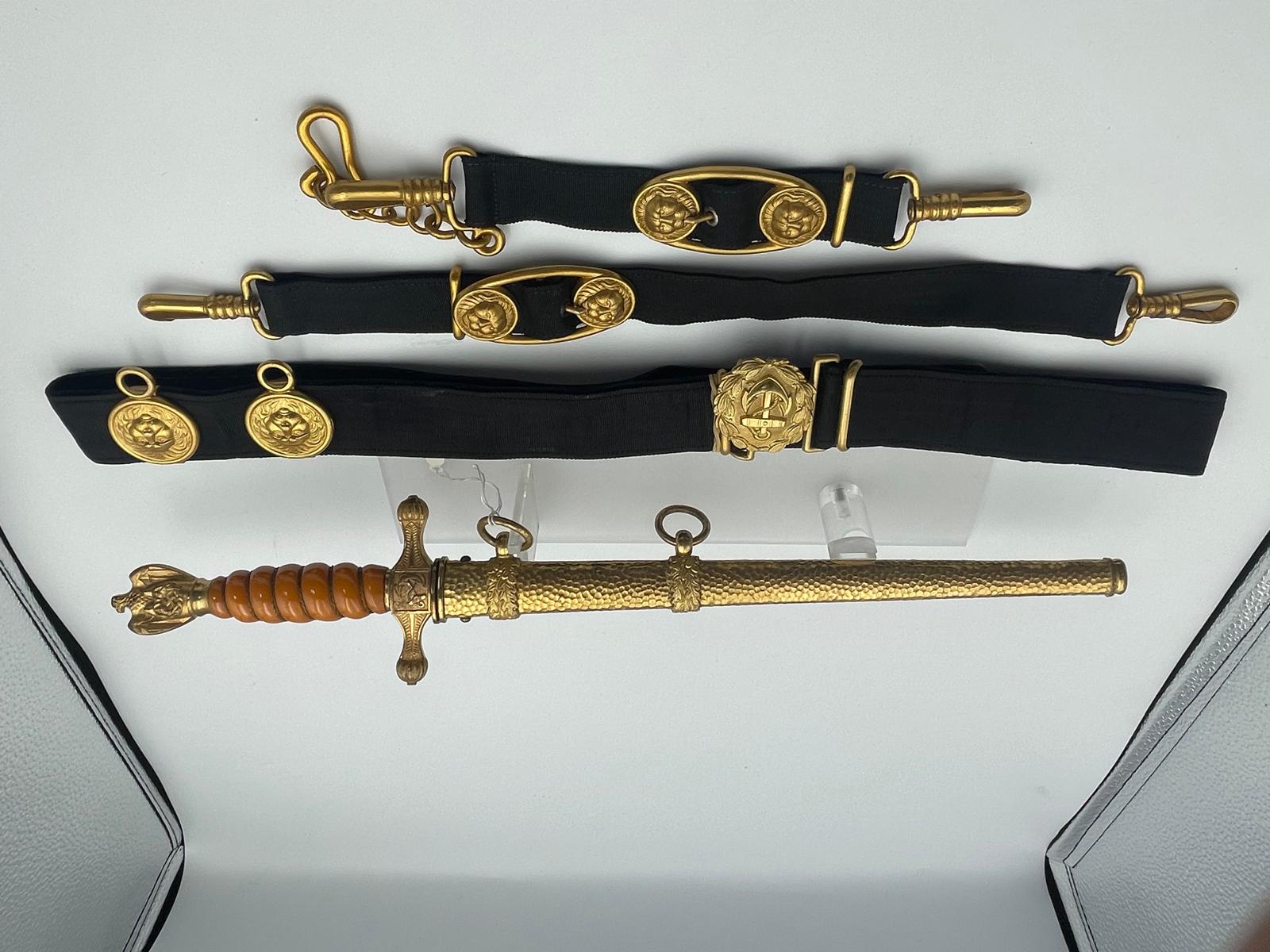
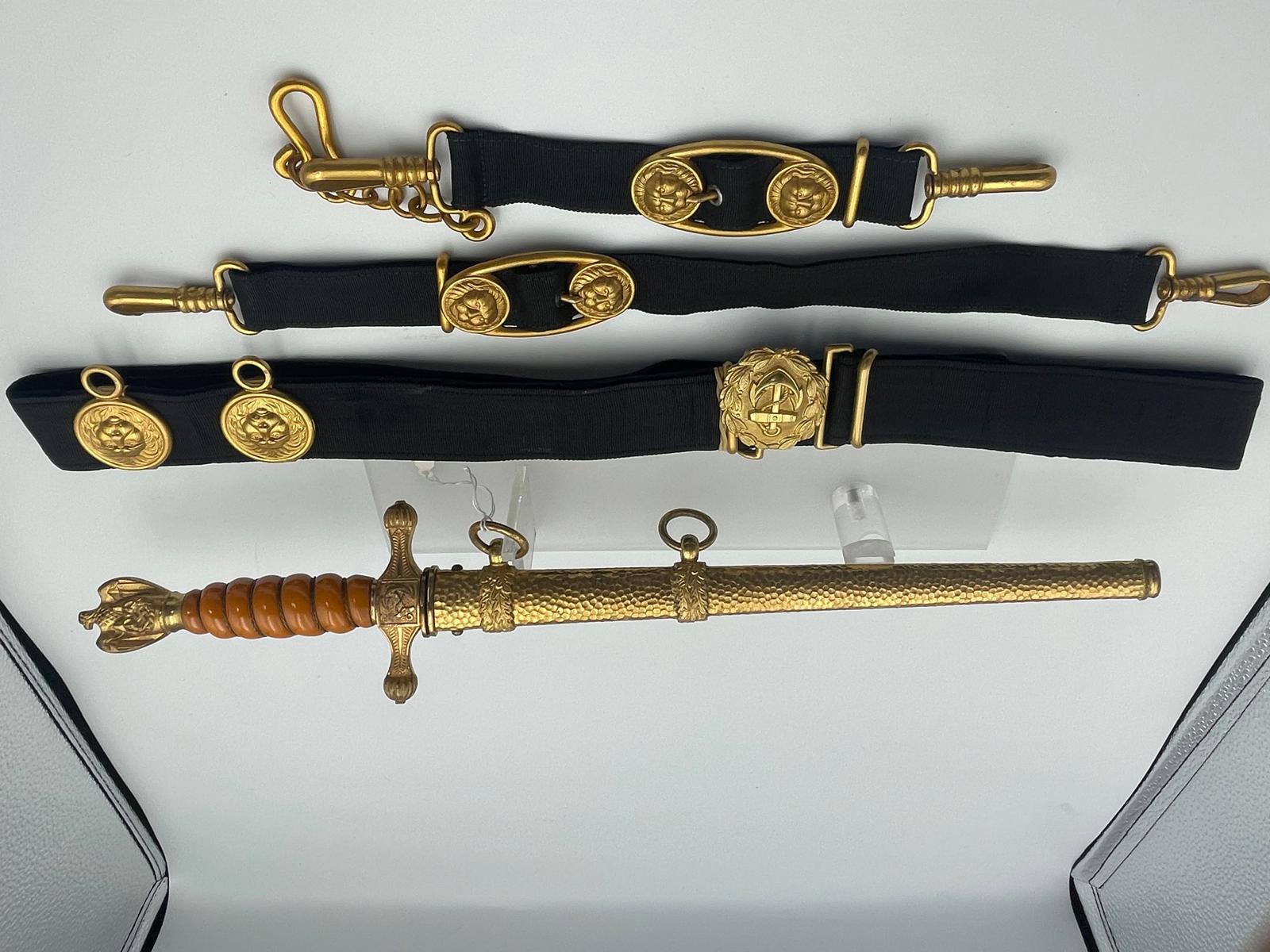
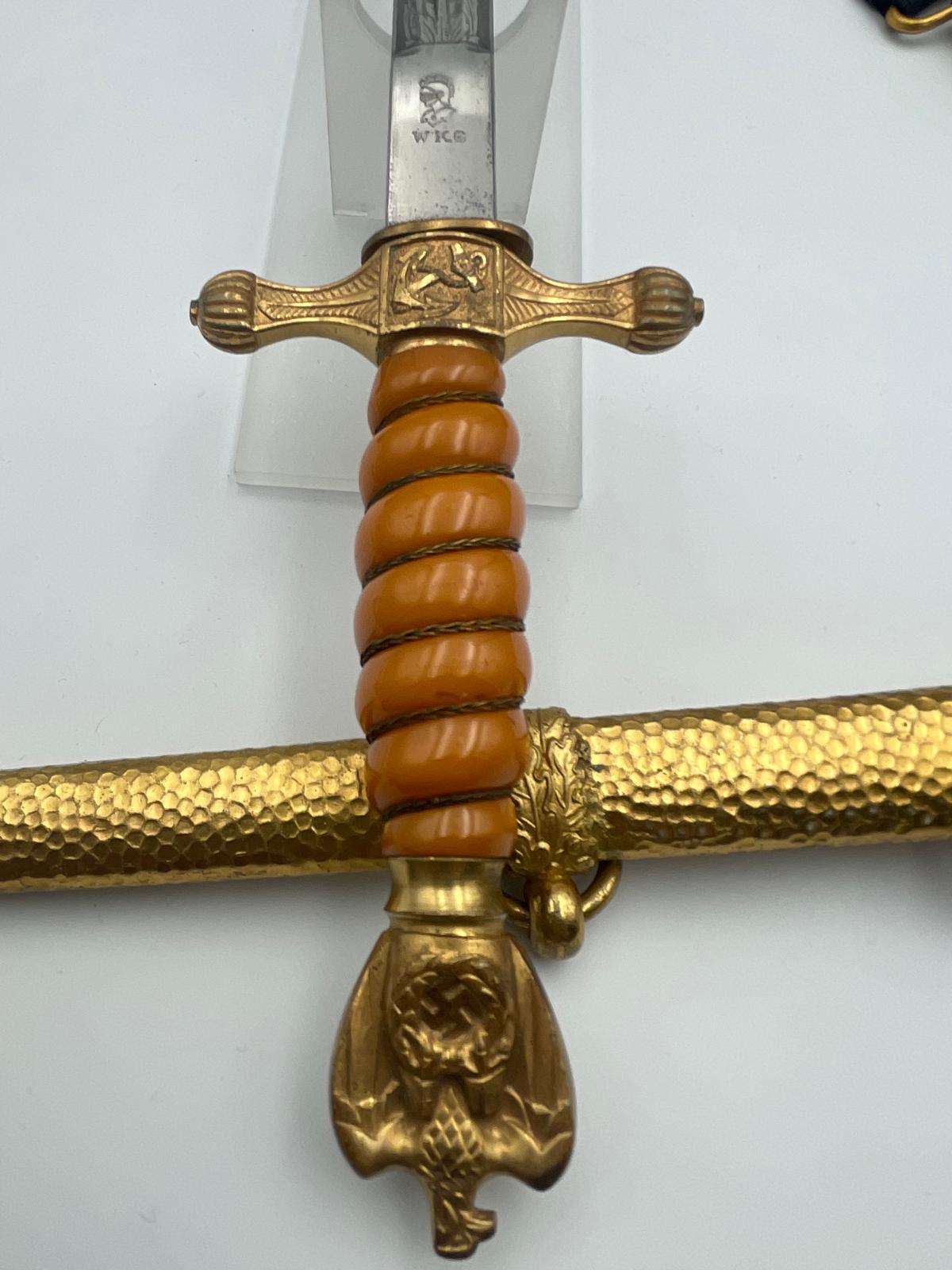
An outstanding and unusually complete WKC Kriegsmarine Officer Dagger ensemble comprising a Model 1938 naval officer’s dagger, hammered gilt-brass scabbard, matching-style two-piece lion-head suspension hangers and scarce black moiré Kriegsmarine officer’s dress belt.
The dagger features a highly desirable deep orange grip with intact twisted wire, richly gilded naval fittings and a beautifully preserved double-sided etched blade. Moreover, the ricasso carries the unmistakable WKC knight’s helmet trademark, identifying Weyersberg, Kirschbaum & Cie of Solingen.
Particularly noteworthy is the survival of the complete naval suspension equipment. The black dress belt retains its gilt anchor-and-rope buckle and two lion-head suspension medallions, while both dagger hangers retain their gilt lion-head adjusters and clips.
€ 3.495
1 in stock
The WKC Kriegsmarine Officer Dagger represents one of the most elegant edged weapons worn by officers of the German Navy during the Second World War.
Introduced in its familiar eagle-pommel configuration in 1938, the naval officer’s dagger combined traditional maritime symbolism with elaborate Solingen craftsmanship.
This example displays the classic features expected from a high-quality WKC production:
Current specialist references likewise document WKC examples with orange grips, maritime etched blades and hammered scabbards. Ratisbon’s records an almost identical basic configuration, while Helmut Weitze currently lists comparable WKC naval daggers in several grades.
One of the most attractive features is the rich orange-coloured grip.
Collectors traditionally place a premium on strongly coloured orange or pumpkin-toned naval grips because they create a striking contrast against the gilt fittings.
The grip on this dagger appears extremely well preserved.
Its moulded spiral form remains sharply defined, while the twisted metallic wire follows each groove correctly. Importantly, no major loss or serious cracking can be seen in the supplied photographs.
Above the grip sits the imposing Kriegsmarine eagle pommel.
Fine feather detail remains visible across the eagle, and substantial original-looking gilt finish survives throughout the hilt.
The Model 1938 eagle pommel provides the immediate identification point for the later Kriegsmarine officer’s dagger.
A detailed national eagle forms the upper terminal of the hilt.
Despite normal mellowing of the finish, the feathering remains crisp. Furthermore, the overall colour of the pommel corresponds convincingly with the crossguard and scabbard fittings.
Natural tonal variation across the recesses gives the fitting considerably more character than a recently polished example.
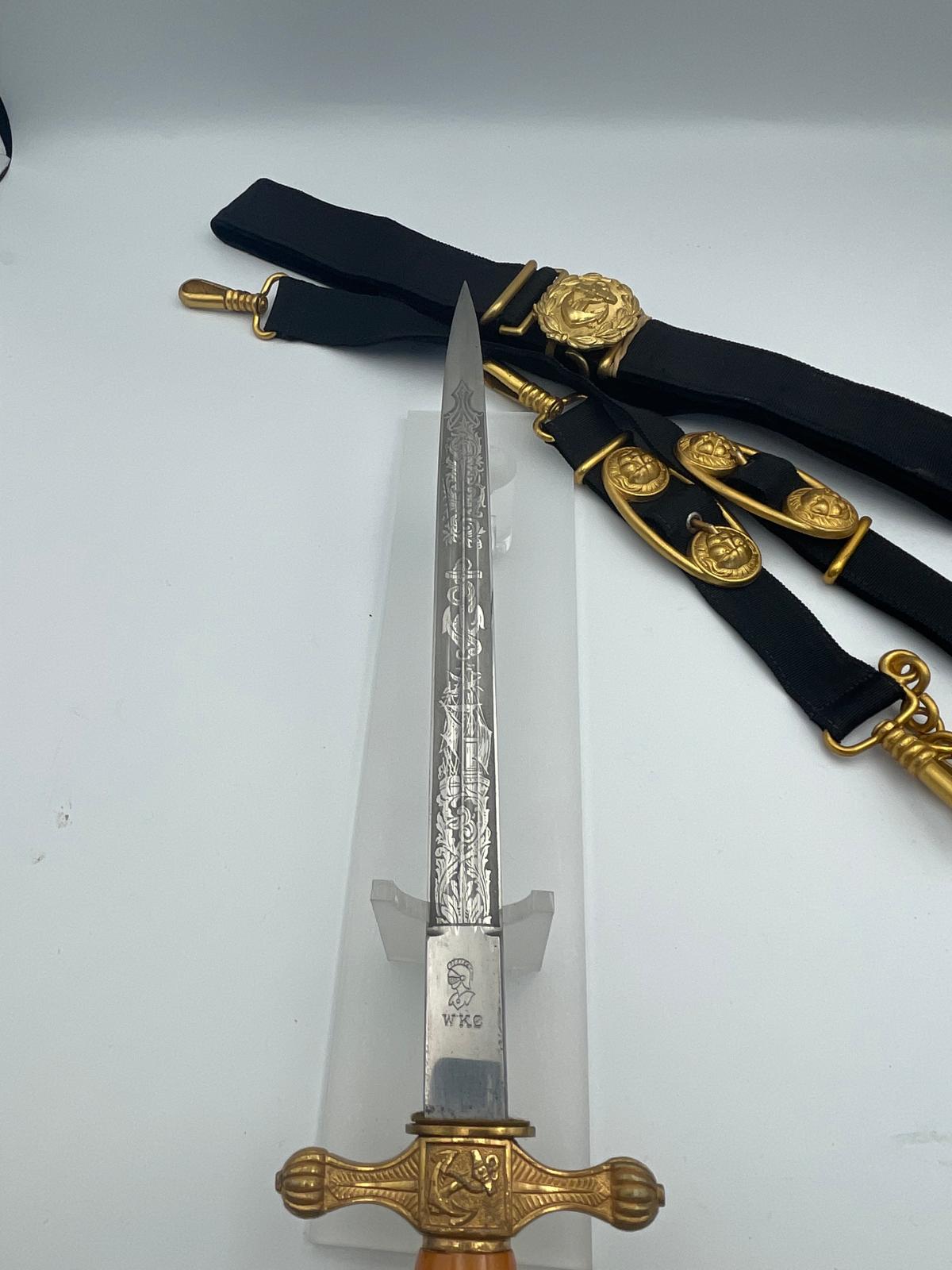
The gilt crossguard incorporates the traditional naval fouled-anchor motif at its centre.
Fluted rounded terminals extend to either side, while decorative linear treatment follows the arms of the guard.
The original scabbard release mechanism is positioned adjacent to the guard.
Again, the construction and detail visible here correspond well with documented WKC-produced Kriegsmarine officer daggers.
The blade carries the familiar:
WKC
beneath the company’s knight’s helmet trademark.
WKC stands for Weyersberg, Kirschbaum & Cie., Solingen, one of the major German edged-weapon manufacturers.
The knight’s helmet trademark is particularly associated with WKC swords and daggers and is clearly visible on the ricasso of this example.
Specialist references document the same mark on original Model 1938 Kriegsmarine daggers. Contemporary collector-market examples also show the trademark in this position on genuine WKC naval blades.
The strong, clearly struck logo on the present blade is therefore an important authentication feature.
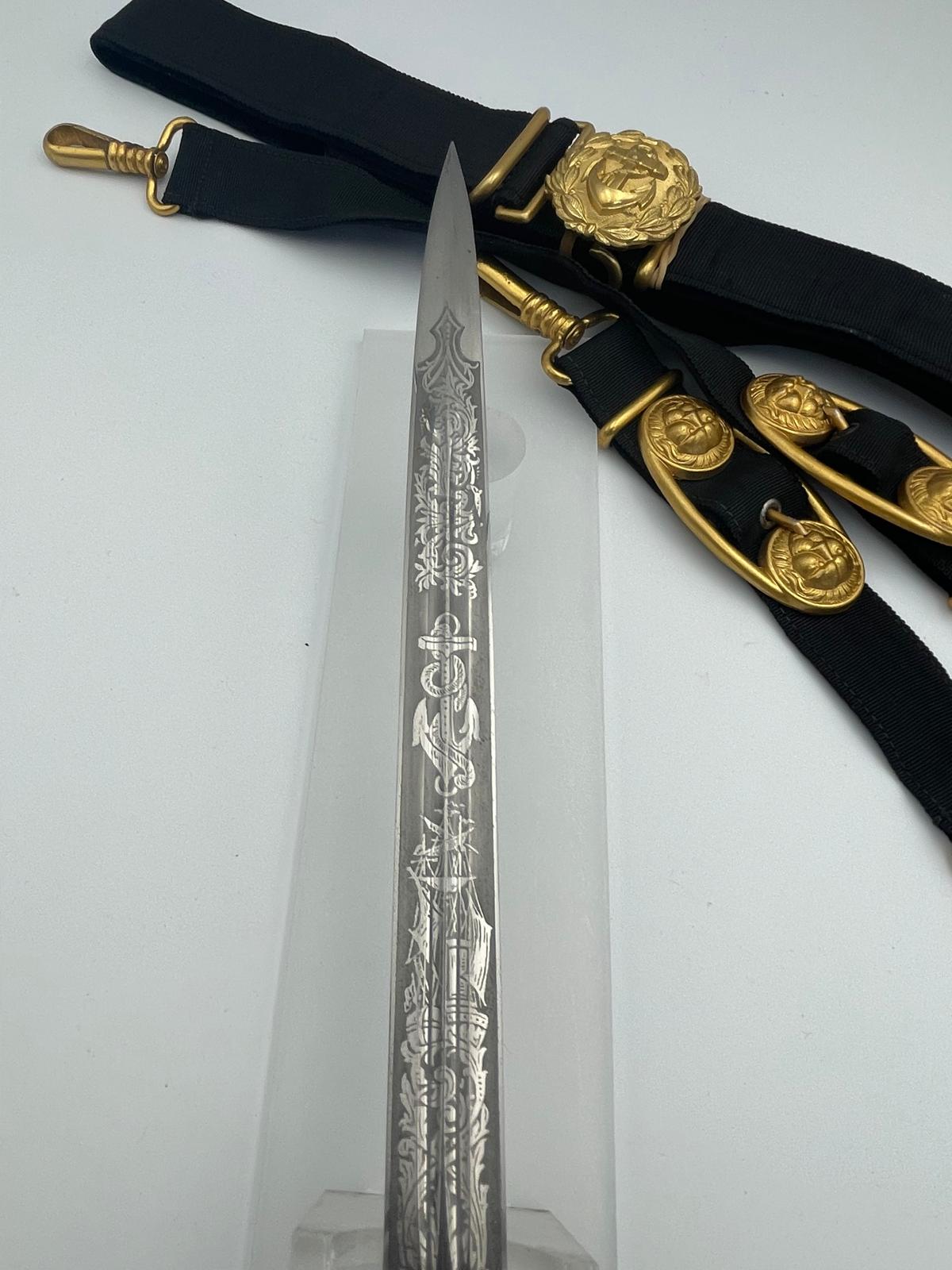
The blade is especially impressive.
A long double-edged naval blade terminates in the characteristic spear point. Extensive acid-etched decoration runs through the central panels.
Visible maritime decoration includes scrolling foliage and naval themes associated with Kriegsmarine officer blades.
Most importantly, the etching remains bright and sharply defined against the polished blade.
Fine manufacturing and scabbard runner marks can be seen when examined closely. Nevertheless, the blade remains substantially cleaner than many surviving service-worn examples.
WKC offered naval blades with several recognised decorative patterns, including fouled-anchor and sailing-ship treatments. Current dealer examples confirm strongly etched WKC blades of precisely this general form.
Another important feature is the hammered scabbard.
Instead of the common lightning-bolt pattern, the brass body carries a dense hand-worked or impressed hammered surface.
This finish gives the scabbard a considerably richer appearance.
Two oak-leaf decorated suspension bands divide the body, each retaining its suspension ring. At the bottom, a simple gilt terminal completes the design.
Substantial gilding remains visible throughout.
Helmut Weitze currently lists a WKC dagger with a dark orange grip, etched blade and hammered scabbard at €1,350 where the example shows greater wear and includes a portepee and hanger. Another particularly fine personalised WKC example with hammered scabbard and extensive remaining gilding is currently listed at €2,500.
Those comparisons underline the desirability of the hammered WKC configuration.
The ensemble includes both regulation-style naval dagger suspension straps.
Black ribbed or moiré textile forms the principal body of each hanger.
Decorative gilt fittings include the characteristic lion-head adjustment buckles. Each strap also terminates in the appropriate gilt suspension fitting.
The lion-head pattern is a recognised Kriegsmarine officer feature.
Period sets are documented with black moiré straps, gilt clips and large lion-head buckles. Specialist examples confirm precisely this construction.
Both the short and long suspension straps accompany this dagger.
Consequently, the ensemble presents correctly when displayed with the complete naval belt.
Perhaps the most unusual component is the accompanying Kriegsmarine officer’s black dress belt.
The broad black moiré belt carries an elaborate gilt naval buckle featuring a fouled anchor surrounded by a decorative wreath.
Two separately mounted gilt lion-head medallions remain positioned along the belt.
Each lion-head device incorporates the ring necessary for attaching the dagger hangers.
This arrangement is historically documented.
An archived auction description of a complete naval officer ensemble specifically records a matching black moiré dress belt fitted with two lion-head suspension devices and an anchor-and-rope buckle, together with the associated lion-head dagger hangers.
That comparison is especially valuable because it corresponds remarkably closely with the equipment shown in these photographs.
Most surviving Kriegsmarine officer daggers appear today without their original wearing equipment.
Hangers remain collectible in their own right.
Complete dress belts are considerably harder to locate.
Finding:
dagger + scabbard + short hanger + long hanger + officer’s dress belt
creates a much more impressive ensemble than an isolated naval dagger.
Additionally, the gilt finishes across the accessories produce an exceptionally coherent display.
Unless documentary provenance confirms that every component remained together with one officer since the wartime period, I would describe the ensemble as a complete period Kriegsmarine officer dagger and dress-belt set rather than claiming an undocumented single-owner association.
That wording remains both accurate and commercially strong.
Overall condition: Excellent collector condition.
The photographs indicate:
Minor age toning and light wear remain visible on the gilded surfaces.
These small traces should not be removed. Excessive polishing would reduce both the historical character and collector desirability of the ensemble.
From the supplied photographs, the dagger itself displays a highly convincing group of period features.
The WKC maker mark corresponds with recognised originals. Equally, the orange grip, crossguard configuration, eagle pommel, etched blade and hammered scabbard all fit documented WKC Kriegsmarine production.
The suspension hangers also display recognised naval construction.
Most significantly, the unusual dress belt configuration finds direct historical comparison in auction documentation describing the black moiré belt, two lion-head suspension fittings and anchor-and-rope buckle.
On photographic examination, I see no obvious feature that would cause me to reject the ensemble as reproduction material.
A definitive high-value authentication should nevertheless include hands-on inspection of:
Those checks could potentially identify manufacturers of the suspension equipment as well.
Standard Kriegsmarine officer daggers remain obtainable.
However, the present set moves well beyond a normal example because it combines several premium characteristics:
WKC manufacture
Deep orange grip
Excellent etched blade
Hammered gilt scabbard
Complete pair of lion-head hangers
Kriegsmarine officer dress belt
The complete dress arrangement is the decisive feature.
A current Weitze standard WKC dagger with hammered scabbard, hanger and worn portepee is offered at €1,350. A high-condition personalised hammered WKC example reaches €2,500, while a deluxe naval dagger accompanied by suspension equipment and belt strap is currently offered at €3,850.
Accordingly, this set belongs in a substantially higher category than an isolated €1,000–€1,500 naval dagger.
Based on current specialist dealer comparisons and the unusual completeness of the wearing equipment:
| Market Level | Estimated Value |
|---|---|
| Auction estimate | €2,400–€2,800 |
| Collector-to-collector | €2,750–€3,150 |
| Specialist dealer retail | €3,250–€3,750 |
I would therefore list this ensemble at:
That figure gives proper value to the scarce dress belt and complete lion-head hanger arrangement without pricing it at the level of genuine hand-chased or Damascus-bladed deluxe naval daggers.
| Attribute | Description |
| Item | Kriegsmarine Officer Dagger Ensemble |
| Model | M1938 / Second Model |
| Manufacturer | Weyersberg, Kirschbaum & Cie. |
| Maker Mark | Knight’s helmet over WKC |
| Location | Solingen |
| Organisation | Kriegsmarine |
| Period | 1938–1945 |
| Grip | Deep orange synthetic/celluloid-type material |
| Grip Wire | Twisted metallic wire |
| Pommel | Gilt national eagle |
| Crossguard | Fouled-anchor naval pattern |
| Blade | Double-edged, double-sided decorative etching |
| Scabbard | Hammered gilt brass |
| Suspension Bands | Oak-leaf decorated |
| Hangers | Two-piece black naval officer pattern |
| Hanger Fittings | Gilt lion-head buckles and clips |
| Dress Belt | Black moiré |
| Belt Buckle | Gilt anchor-and-rope design |
| Belt Fittings | Two gilt lion-head suspension medallions |
| Condition | Excellent collector condition |
Few Kriegsmarine officer daggers display as impressively as a complete dress ensemble.
The orange WKC grip immediately attracts attention, while the hammered gilt scabbard provides the premium appearance associated with better-quality naval pieces.
More importantly, both lion-head hangers and the officer’s belt remain present.
The belt transforms the group from an attractive dagger into a substantially more complete example of the actual dress equipment worn by a Kriegsmarine officer.
For an advanced naval collection, mannequin display or museum-standard edged-weapon collection, this is a particularly desirable combination.
Explore related listings: Kriegsmarine Daggers; Nordmenn Militaria collection.
Ratisbon’s documents an original WKC Kriegsmarine officer dagger with orange grip and hammered scabbard, making it an excellent direct construction comparison.
Ratisbon’s WKC Kriegsmarine Officer Dagger Reference
Helmut Weitze’s current Kriegsmarine edged-weapons inventory provides useful market and construction comparisons for WKC orange-grip daggers, hammered scabbards and complete suspension equipment.
Helmut Weitze Kriegsmarine Edged Weapons
The photographed construction is consistent with recognised original WKC Model 1938 Kriegsmarine officer daggers. Positive features include the WKC knight’s helmet trademark, orange grip, naval crossguard, etched blade and hammered brass scabbard.
Weyersberg, Kirschbaum & Cie. of Solingen, commonly abbreviated to WKC, manufactured the dagger.
The ricasso carries a knight’s helmet above the letters WKC, a recognised Weyersberg, Kirschbaum & Cie. trademark.
Orange and deep pumpkin-coloured grips are particularly attractive Kriegsmarine variants and receive considerable collector interest when undamaged.
The dagger has the desirable hammered gilt-brass scabbard rather than the more commonly encountered lightning-pattern surface.
Yes. Both the short and long black naval suspension hangers are present, complete with gilt lion-head adjustment fittings.
Yes. The ensemble includes the broad black dress belt with gilt naval buckle and two lion-head suspension fittings.
Complete Kriegsmarine officer dress belts are substantially less common than loose daggers. The surviving belt allows the entire suspension arrangement to be displayed as originally intended.
No portepee is shown in the supplied photographs. Therefore, this catalogue entry deliberately does not claim that one is included.