
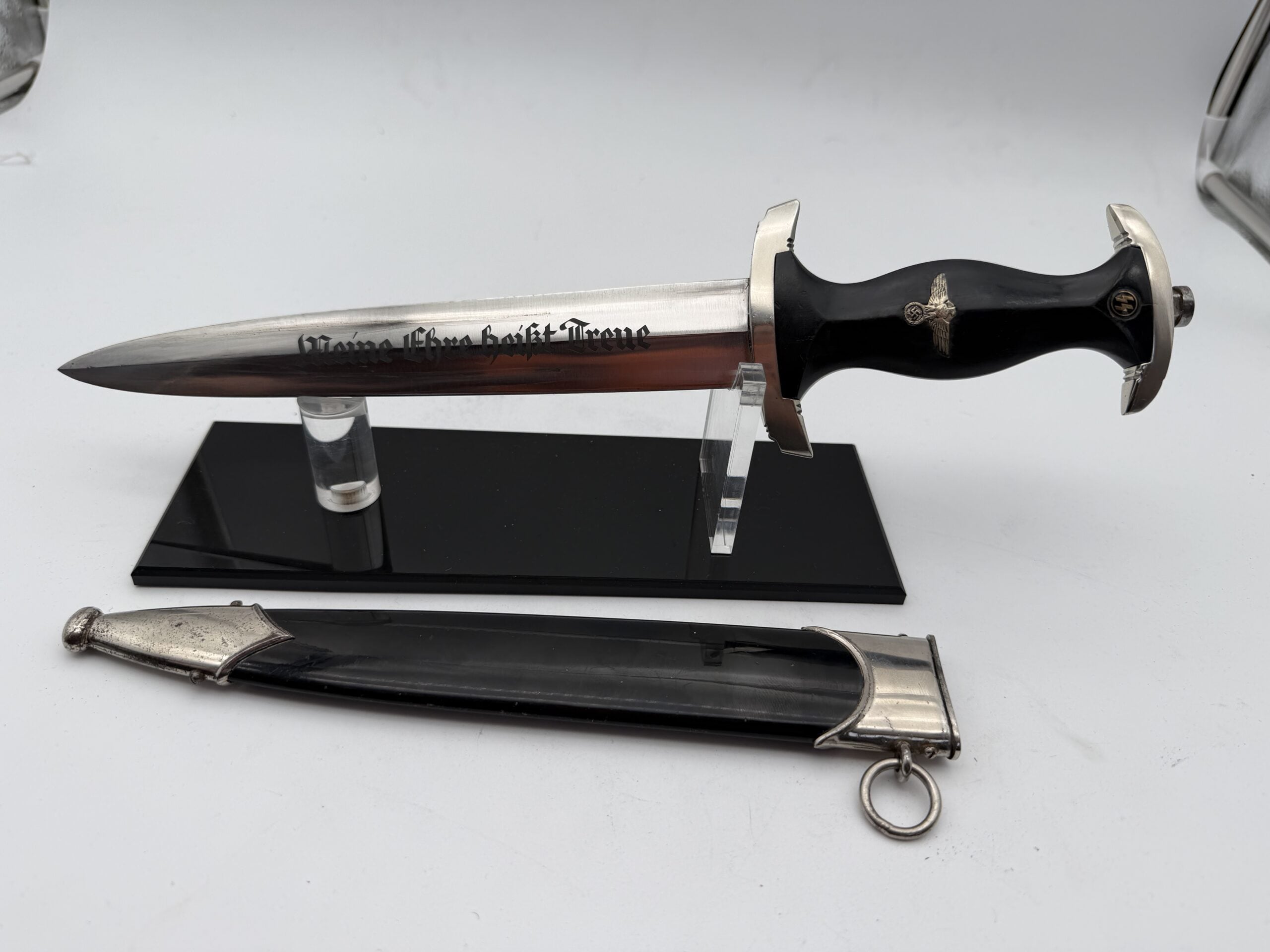
This Early Eickhorn SS Dagger is a well-presented example of the Model 1933 SS-Dienstdolch. Carl Eickhorn of Solingen manufactured the dagger during the early production period, most probably between 1933 and 1935. Its characteristic black grip, nickel fittings, SS insignia and black scabbard distinguish it from the closely related brown SA dagger.
€ 4.950
1 in stock
This Early Eickhorn SS Dagger is a well-presented example of the Model 1933 SS-Dienstdolch. Carl Eickhorn of Solingen manufactured the dagger during the early production period, most probably between 1933 and 1935. Its characteristic black grip, nickel fittings, SS insignia and black scabbard distinguish it from the closely related brown SA dagger.
Most importantly, the obverse blade carries the deeply etched SS motto:
Meine Ehre heißt Treue
“My Honour Is Loyalty”
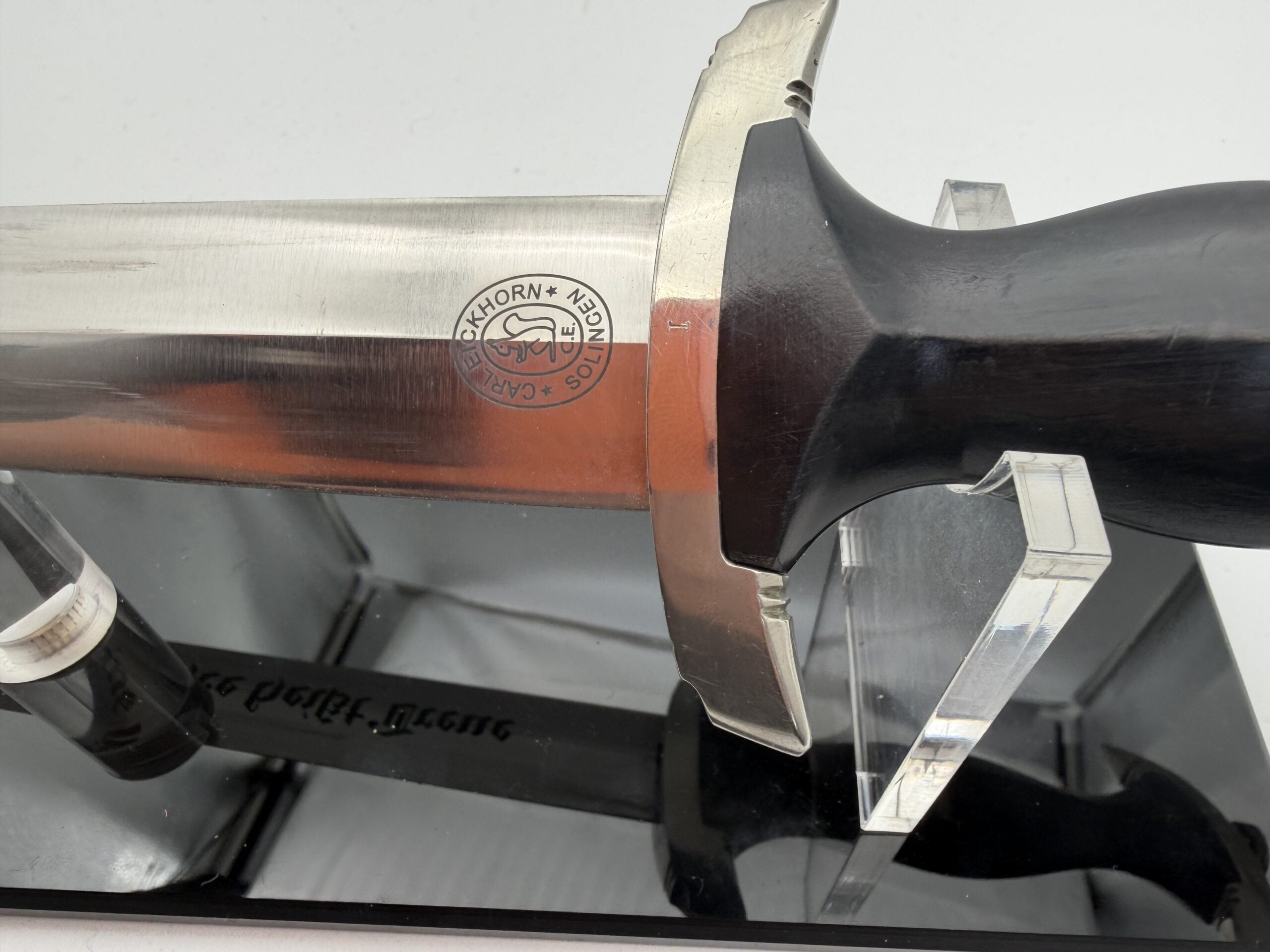
The reverse ricasso bears Carl Eickhorn’s early squirrel trademark within its circular or double-oval surround. This pre-RZM maker’s device is an important dating feature. Specialist references generally associate this form of the Eickhorn trademark with production between approximately 1933 and 1935.
The SS introduced its service dagger in December 1933. Members acquired and wore it as an official component of SS dress rather than as a practical fighting knife. The design drew inspiration from the traditional Swiss Holbein dagger, with a broad double-edged blade, waisted wooden grip and curved upper and lower guards. Early examples became available during the opening months of 1934.
Although the dagger holds considerable significance within edged-weapon collecting, it also represents the political culture of the National Socialist dictatorship. The SS developed from a small Nazi Party bodyguard into an organisation that controlled policing, intelligence and the concentration-camp system. It played a central role in persecution, mass murder and the Holocaust. The United States Holocaust Memorial Museum’s history of the SS provides essential institutional context.
Consequently, this object should be preserved and described as material evidence of dictatorship, political violence and ideological indoctrination. Its inclusion in a collection does not imply endorsement of the organisation that used it.
The double-edged steel blade retains a pronounced central ridge and a strong spear point. Fine transverse manufacturing grain remains visible across much of the surface. In addition, the blade shows minor longitudinal runner marks and light signs of handling.
The motto remains dark, sharp and legible. Its Gothic lettering reads Meine Ehre heißt Treue. The etching displays strong contrast against the polished blade surface.
On the reverse, the Carl Eickhorn Solingen squirrel trademark appears close to the lower guard. Eickhorn had longstanding associations with Solingen’s edged-weapon industry, while the squirrel served as the company’s recognised trademark. The early maker logo adds considerably to the dagger’s collector interest.
The blade remains visually impressive. However, close inspection under angled natural light should establish whether the cross-graining remains entirely factory-applied or whether the blade received careful later cleaning.
The fitted black wooden grip has the distinctive waisted profile associated with the Model 1933 SS dagger. Its polished surface displays light handling marks and minor age-related surface irregularities. Nevertheless, it remains visually strong and appears free from major losses in the supplied photographs.
An enamelled SS runic roundel sits near the pommel. Below it, a national eagle and wreath device occupies the centre of the grip. Both emblems appear firmly seated. Their precise originality, pin configuration and untouched installation should still be confirmed through magnified examination.
The black grip provides the clearest visual distinction between the SS dagger and the brown-gripped SA version. Collectors seeking comparative material may also examine this original SS Model 1933 dagger grip in the Nordmenn Militaria collection.
The upper and lower guards display the characteristic sweeping form of early Model 1933 fittings. Their bright surfaces show scattered marks, fine scratches and light oxidation. These traces remain consistent with handling and storage over an extended period.
Early SS daggers normally used solid nickel or nickel-silver grip fittings. Later production increasingly relied upon plated base-metal components. Therefore, confirming the composition of these guards with a non-invasive magnet test and specialist examination would help support the proposed early date.
The tang nut projects noticeably from the upper guard. This may simply result from grip shrinkage. However, it can also indicate earlier disassembly. A hands-on inspection should check the nut, tang threads, internal guard markings and grip fit before the dagger receives an unconditional “untouched” designation.
The steel scabbard retains a black surface finish with contrasting bright metal mounts. The throat fitting carries the suspension ring required for attachment to a leather hanger. No hanger accompanies the dagger in the photographs.
The scabbard body shows evident age and use. Most notably, a broad longitudinal depression or crease runs along part of its surface. There are also scattered scratches, finish disturbance and pressure marks. The lower ball displays wear but remains substantially intact.
The scabbard fittings carry small retaining screws. These should be inspected for matching age, undisturbed slots and correct thread engagement. Moreover, examination of the scabbard throat and internal runners may establish whether the scabbard has remained with this blade throughout its service life.
Despite the visible damage, the black scabbard gives the Early Eickhorn SS Dagger a complete and visually coherent appearance.
Carl Eickhorn ranked among Solingen’s largest and most prolific edged-weapon manufacturers. The company supplied military, political and civil organisations with daggers, swords and bayonets. During the Third Reich period, Eickhorn used several versions of its squirrel trademark before adopting RZM contract markings on regulated political weapons.
The early trademark on this dagger predates the later RZM 941/38 SS and RZM 941/39 SS markings found on subsequent Eickhorn SS daggers. A 1938 Eickhorn SS dagger offered by Weitze, for example, carries both the RZM contract designation and the later Eickhorn mark.
For additional reference material, see German Daggers of World War II, Volume 1 and the wider Nordmenn Militaria edged-weapons collection.
Blade: Very good visual condition. Strong motto and maker mark remain present. Fine cross-graining is visible, together with runner marks and possible light cleaning.
Grip: Good overall appearance. Minor marks and surface irregularities are present. No major grip loss can be seen.
Insignia: Both the SS roundel and eagle remain installed. Magnified examination is recommended.
Fittings: Bright, with light scratching and age-related wear. The projecting tang nut deserves further inspection.
Scabbard: Complete, although it has a prominent longitudinal depression, surface wear and scattered marks.
Hanger: Not present.
Overall photographic grade: Approximately very good, subject to physical authentication and confirmation that the major components are period-matched.
The visible construction, motto, black grip, inset insignia, early Eickhorn trademark and general Model 1933 configuration are consistent with an early-production SS service dagger.
However, photographs alone cannot confirm:
Therefore, the safest catalogue wording is “original early-pattern Carl Eickhorn SS Model 1933 dagger, subject to hands-on confirmation of complete originality and component matching.”
No individual SS number or documented ownership is visible in the supplied photographs. Therefore, the dagger should not be attributed to a named member without documentary evidence.
If an SS membership number appears beneath the lower crossguard, the Bundesarchiv guide to surviving SS recordsprovides the correct starting point for archival research. The Bundesarchiv preserves substantial SS personnel and administrative material, although survival and accessibility vary.
Current comparisons show a wide range. A later RZM-marked Eickhorn M33 with a hanger sold through Ratisbon’s for €2,675 in June 2024. An early removed-Röhm Eickhorn example realised €4,110 in March 2024. Meanwhile, a near-mint Eickhorn example with a vertical hanger achieved €8,095 in November 2023. A specialist American dealer has also listed an early Eickhorn SS dagger at US$5,500.
This Early Eickhorn SS Dagger combines the major characteristics sought in an early Model 1933 example. It has a black wooden grip, inset SS insignia, nickel-style fittings, a clear motto blade and an early Carl Eickhorn squirrel trademark.
Furthermore, the blade presents particularly well. The damaged scabbard records genuine use and imperfect preservation rather than destroying the dagger’s overall display quality. Subject to physical authentication, it represents a desirable early Eickhorn example suitable for an advanced collection of German political edged weapons.