
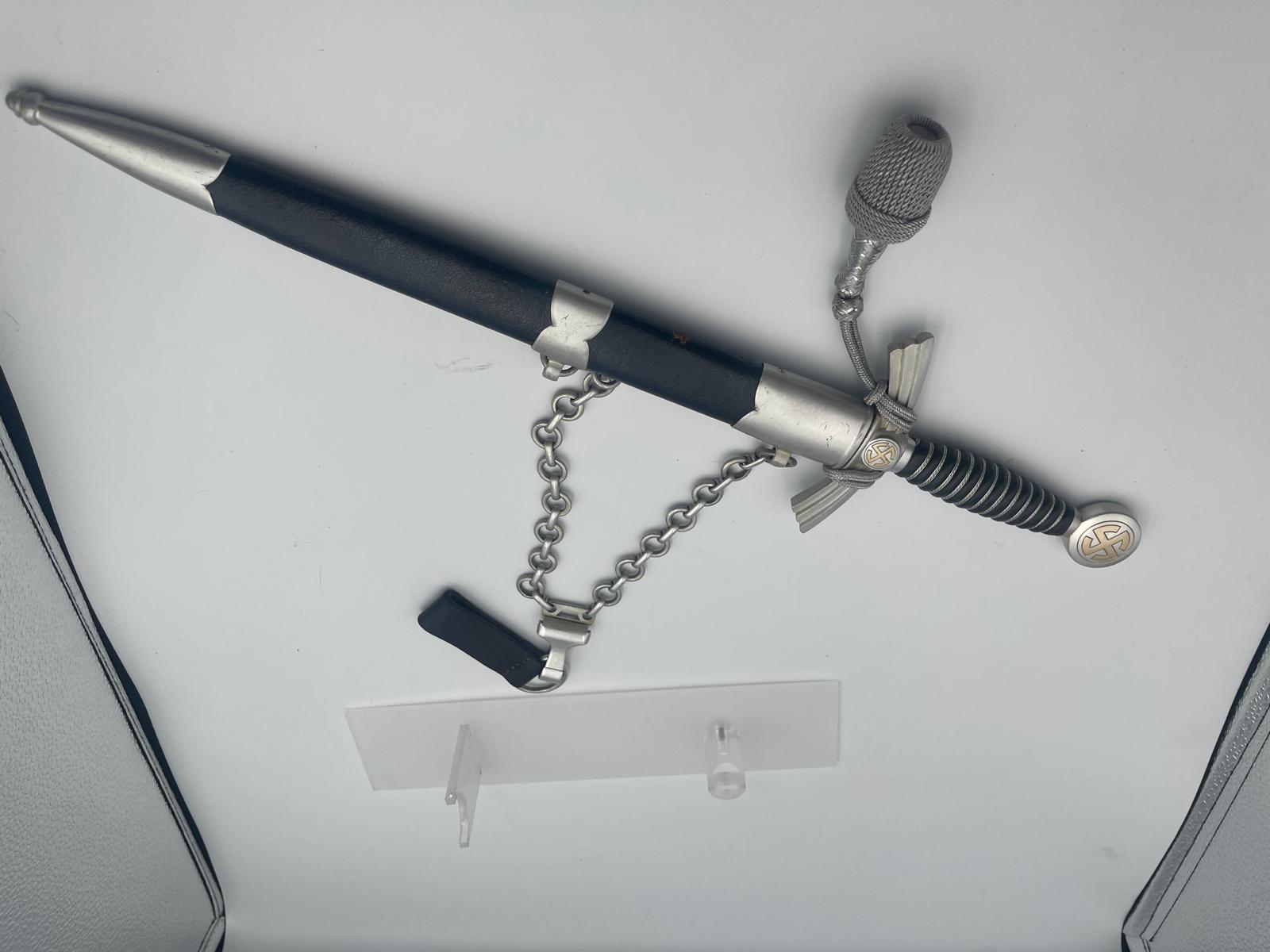
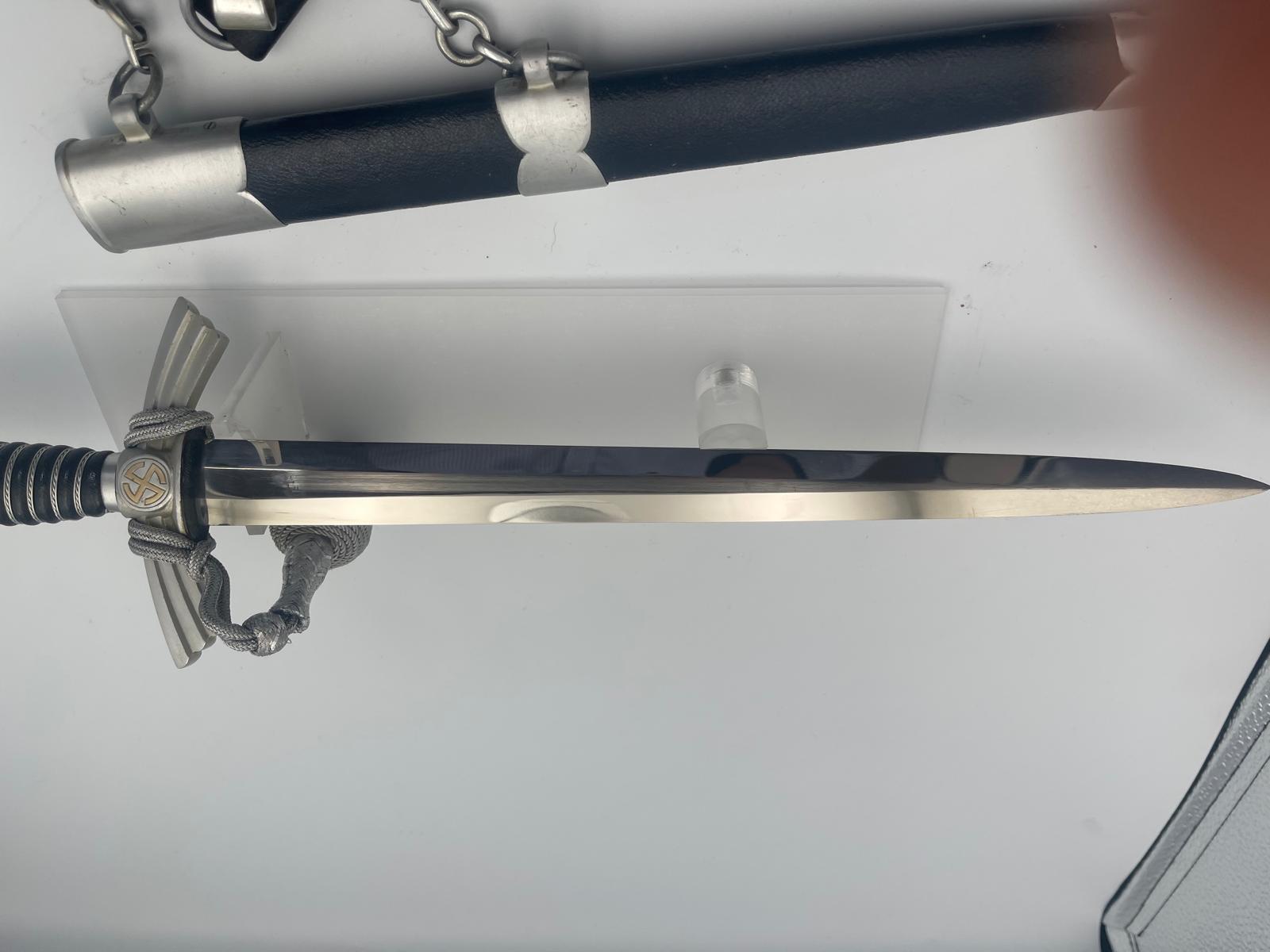
A superb original First Model Luftwaffe Officer Dagger M1935 by SMF Solingen, complete with its dark blue leather-covered scabbard, original dual-chain suspension and silver officer’s portepee.
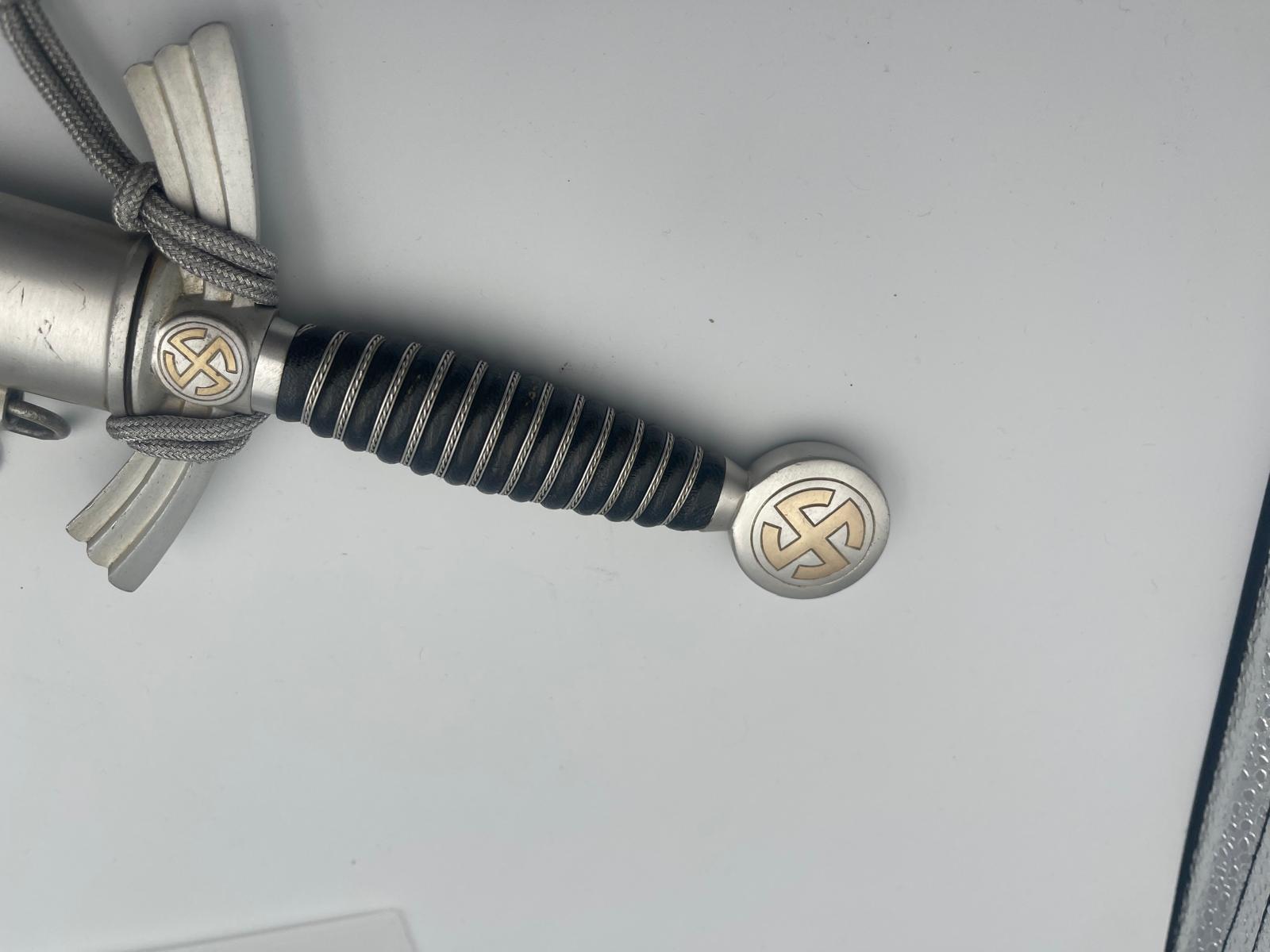
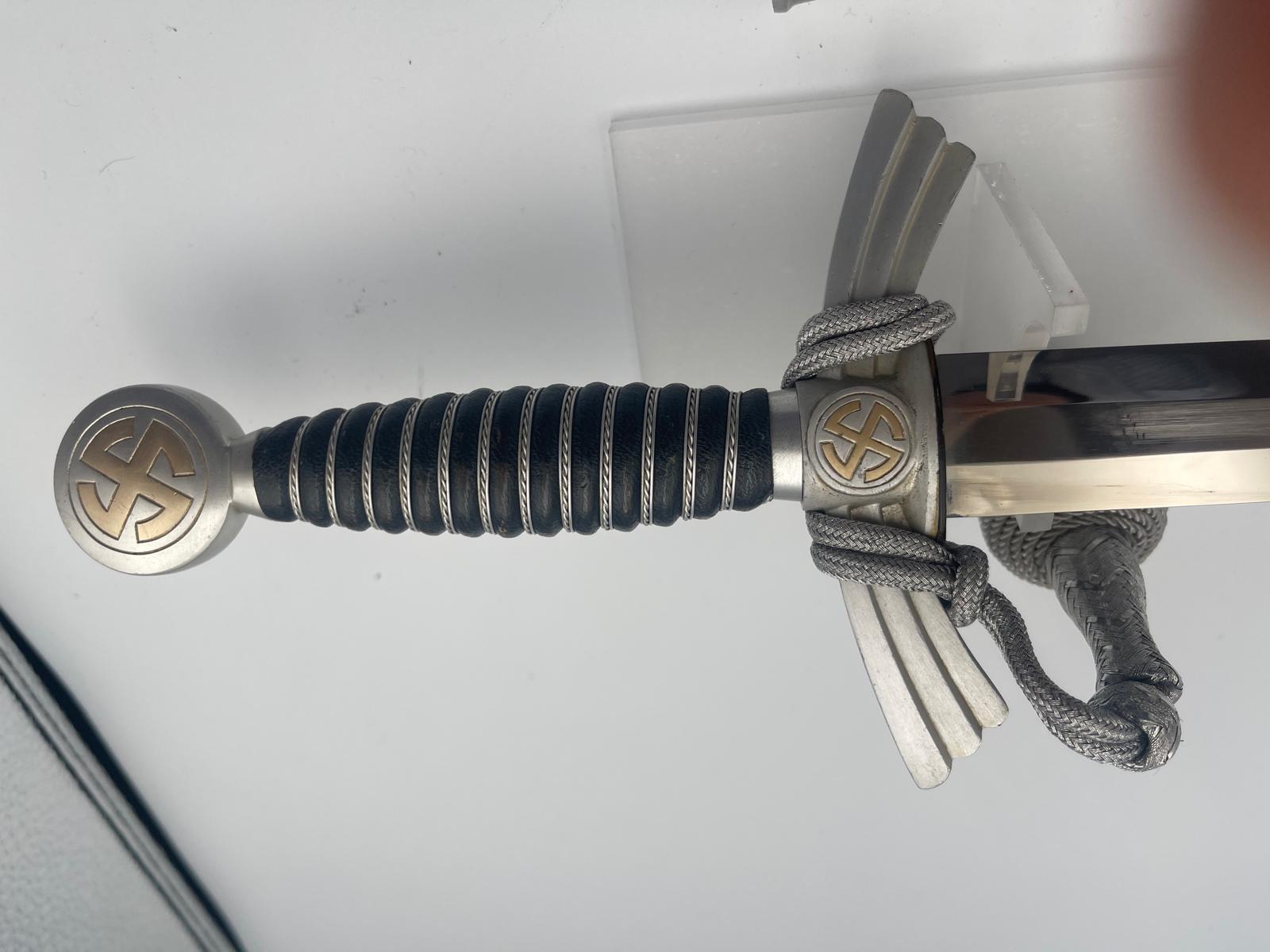
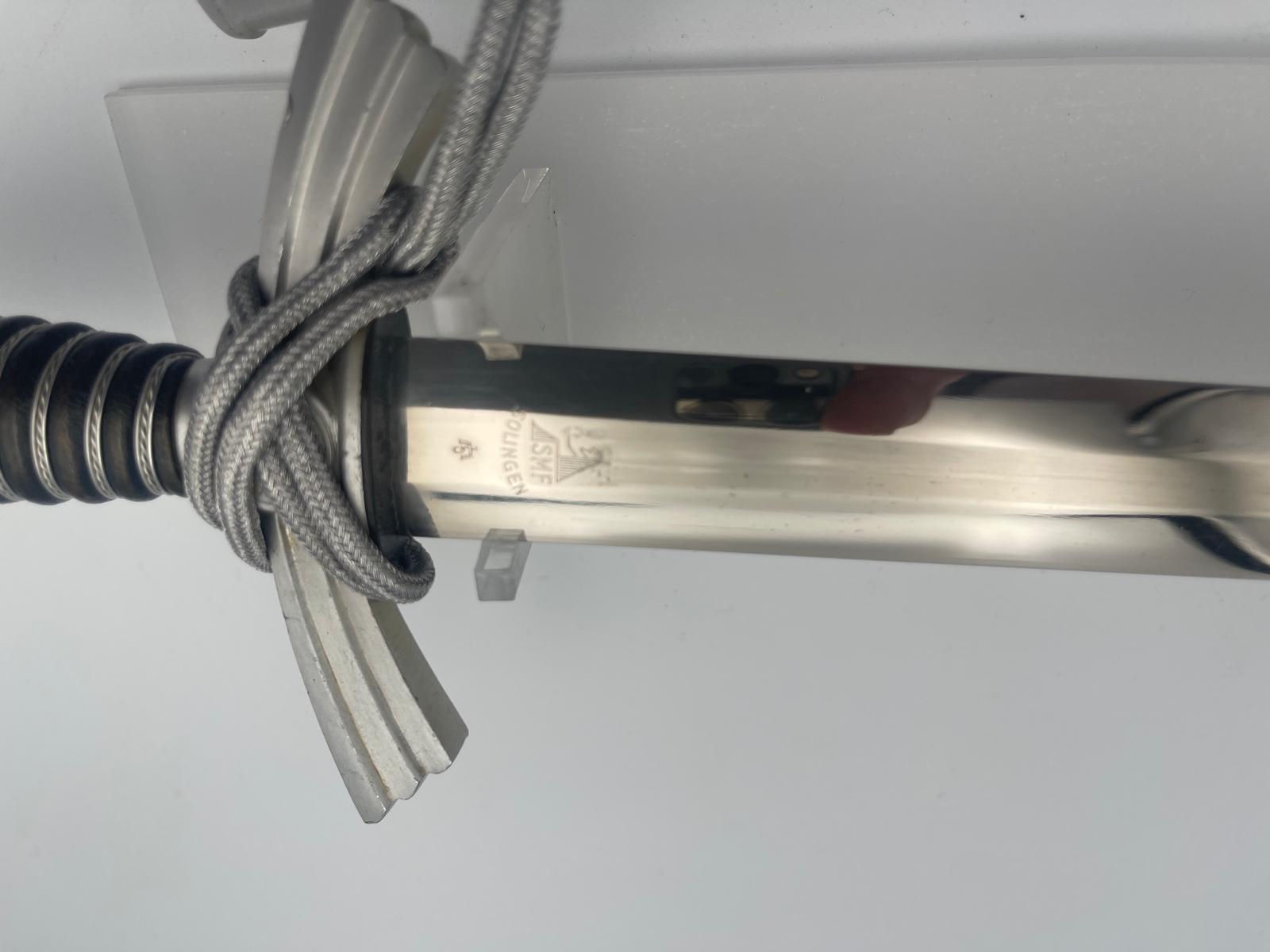
The bright double-edged blade carries the distinctive SMF seated-king trademark over SOLINGEN. Dark blue leather covers the grip, while the original wire winding remains intact. Both the pommel and crossguard retain their characteristic gilt-toned sunwheel swastika medallions.
Introduced during the formative period of the Luftwaffe and replaced by the Second Model dagger in 1937, the M1935 Fliegerdolch or Borddolch is considerably scarcer than the later Luftwaffe officer’s dagger.
€ 1.795
This impressive First Model Luftwaffe Officer Dagger represents the distinctive early edged weapon adopted during the formation of Germany’s newly established Luftwaffe.
Collectors commonly describe this model as the:
Fliegerdolch
or
Borddolch
The design developed directly from earlier German aviation organisation daggers. However, the Luftwaffe version became an official military sidearm after the establishment of the new air force in 1935.
Its appearance differs completely from the familiar Second Model Luftwaffe dagger introduced in 1937.
Dark blue leather, silver-coloured fittings, gilt sunwheel emblems and a chain suspension immediately identify this early pattern.
The blade carries the highly recognisable:
trademark beneath the firm’s characteristic seated-king device.
SMF is associated with Solinger Metallwarenfabrik Stöcker & Co. of Solingen, an established German edged-weapon producer.
The company manufactured several aviation-related edged weapons. These included early DLV and NSFK pieces together with Luftwaffe daggers.
A small period inspection or acceptance marking is also visible near the maker’s trademark in the supplied photographs.
The seated-king SMF logo is well documented on surviving First Model Luftwaffe daggers. Specialist auction references likewise record SMF examples with the same maker mark.
The blade is particularly attractive.
A long central ridge divides the polished double-edged blade and continues towards the spear-shaped point.
Both sides retain substantial original brightness.
Only light runner marks and minor handling traces remain visible. Therefore, the blade presents considerably better than many M1935 examples encountered today.
The maker’s mark remains crisp and clearly legible.
Most importantly, the blade has not suffered the heavy corrosion, excessive polishing or major sharpening frequently encountered on surviving First Model Luftwaffe daggers.
Its excellent presentation substantially increases the collector appeal of this example.
The grip retains its original dark blue leather covering.
Age and handling have deepened the colour considerably. Under some lighting, the leather consequently appears almost black.
Nevertheless, dark Luftwaffe blue is the correct description.
The shaped grip remains wrapped with its characteristic spiral metallic wire.
That winding appears complete and evenly positioned.
Natural compression and slight surface ageing can be seen in the leather. However, there are no visually distracting areas of major loss in the supplied photographs.
This is an important feature because damaged leather and missing wire frequently reduce the value of First Model daggers.
The circular pommel displays one of the defining features of the M1935 dagger.
At its centre sits the early sunwheel swastika medallion.
A warm gilt or brass-toned finish remains visible within the emblem. Meanwhile, the surrounding silver-coloured pommel has developed an attractive subdued patina.
The contrast between the silver fitting and gold-coloured sunwheel gives the early Luftwaffe dagger its unmistakable appearance.
Later Second Model Luftwaffe daggers abandoned this pommel design entirely.
A second sunwheel swastika appears at the centre of the characteristic swept-wing crossguard.
The guard extends outward in broad stepped wings.
Its geometric design reflects the styling inherited from earlier German aviation organisations.
Again, the warm gilt centre contrasts strongly with the silver-coloured metal surrounding it.
Surface wear remains limited.
Furthermore, the contours of the guard remain crisp and well defined.
First Model Luftwaffe daggers occur in more than one construction period.
Early examples generally used heavier nickel or nickel-silver fittings.
Later production moved increasingly towards polished aluminium.
Helmut Weitze notes that nickel or silver fittings were used on the early pattern before aluminium became established around 1936.
The fittings on this SMF example have the appearance of the lighter aluminium production associated with the later First Model period.
Consequently, a date around:
is entirely plausible.
The matching scabbard retains the characteristic M1935 construction.
Dark blue leather covers the central body.
As with the grip, ageing has darkened the leather considerably.
Silver-coloured mounts protect the throat, suspension areas and lower tip.
The scabbard remains particularly attractive because the leather covering is substantially complete.
Only modest age and handling traces are visible.
The lower fitting terminates in the characteristic rounded finial.
This combination corresponds closely with documented First Model Luftwaffe daggers preserved in museum and specialist collections. An example photographed at the Glomdalsmuseet likewise retains the blue leather scabbard, chain suspension and portepee.
Especially desirable is the original early dual-chain hanger.
Two chain sections connect the suspension fittings on the scabbard with the upper belt attachment.
This arrangement is a defining characteristic of the M1935 dagger.
By contrast, the later M1937 Luftwaffe dagger normally used textile suspension straps rather than this early chain system.
Original chain sets frequently became separated from their daggers after the war.
Therefore, the survival of the correct chain considerably improves the completeness and value of the present example.
Weitze specifically documents the First Model as having the early chain suspension system.
The dagger also retains its silver-coloured officer’s portepee.
It remains tied around the crossguard and grip in the traditional manner.
The knot displays a tightly woven crown with braided cord and flat hanging straps.
Its silver-grey colour fits the overall Luftwaffe presentation extremely well.
Complete First Model daggers retaining both their chain hanger and portepee are more desirable than incomplete examples.
Consequently, these surviving accessories add significantly to the display quality of this ensemble.
The Luftwaffe officially emerged as an independent German armed service during 1935.
Soon afterwards, the modified aviation dagger became part of its uniform system.
The M1935 design had developed from the earlier DLV dagger. As a result, it retained the blue leather, winged guard and sunwheel symbolism associated with Germany’s early aviation organisations.
The First Model was authorised for Luftwaffe officers. Additionally, qualified enlisted personnel and NCOs holding valid pilot licences could wear the dagger.
Period photographs confirm that qualified aircrew wore the early dagger with Luftwaffe uniform.
The model remained in service for only a relatively short period.
On 15 July 1937, the familiar Second Model Luftwaffe Officer’s Dagger replaced it.
Therefore, the First Model represents a particularly interesting 1935–1937 transitional period in Luftwaffe history.
The two Luftwaffe dagger patterns are easy to distinguish.
The First Model Luftwaffe Officer Dagger uses:
The Second Model M1937 uses:
Consequently, the M1935 is immediately recognisable as the earlier Luftwaffe pattern.
The M1935 Luftwaffe dagger did not appear in isolation.
Its design evolved from edged weapons used by the Deutscher Luftsportverband, or DLV.
The DLV played an important part in aviation training before the Luftwaffe emerged openly in 1935.
Several manufacturers subsequently produced both DLV-related edged weapons and Luftwaffe daggers.
SMF was among those firms.
For comparison, Nordmenn Militaria also holds an original SMF Solingen DLV / NSFK Fliegermesser. Its maker mark and aviation heritage provide a useful internal comparison with the present Luftwaffe dagger.
The photographs show a highly coherent First Model Luftwaffe Officer Dagger.
Positive characteristics include:
The blade, hilt and scabbard also display a coherent level of preservation.
No obvious modern reproduction feature immediately stands out in the supplied photographs.
Accordingly, the ensemble is strongly consistent with an original period SMF-manufactured First Model Luftwaffe dagger.
As always with a high-value edged weapon, final confirmation can include examination of the internal tang, scabbard throat, assembly points and chain hardware.
Overall condition is very good to excellent collector condition.
The blade remains bright and attractive.
Moreover, the tip retains a strong original profile.
Dark blue grip leather survives exceptionally well. The metallic winding also remains complete.
The sunwheel medallions retain strong contrasting colour.
Likewise, the scabbard covering remains substantially intact.
Silver-coloured fittings show only normal age-related toning and light handling marks.
Finally, the complete chain hanger and portepee make this a particularly attractive display example.
No aggressive cleaning is recommended.
The existing patina should remain untouched.
The M1935 First Model dagger is significantly less common than the later M1937 Luftwaffe dagger.
Its production period lasted only around two years.
Moreover, complete examples can be difficult to find because chains, grip wire and leather coverings were easily damaged or lost.
This example combines several important features:
SMF Solingen manufacture
excellent blade
complete grip wire
strong dark blue leather
gilt sunwheel medallions
matching leather scabbard
original chain suspension
and
officer’s portepee
Together, these qualities place it above an average incomplete First Model example.
A current Nordmenn Gebrüder Heller First Model Luftwaffe Dagger M1935 with chain suspension is offered at €1,695.
Helmut Weitze has offered a comparable First Model Höller example at €1,250, while a more worn Paul Weyersberg example is offered at €950.
The present SMF example benefits from its very attractive blade, complete wire, intact blue leather, chain suspension and surviving portepee.
Item: Luftwaffe Officer’s Dagger
Model: First Model / M1935
Collector names: Fliegerdolch / Borddolch
Manufacturer: SMF, Solingen
Maker: Solinger Metallwarenfabrik Stöcker & Co.
Trademark: Seated king over SMF SOLINGEN
Period: Circa 1936–1937
Blade: Bright double-edged steel
Grip: Dark blue leather-covered wood core
Grip winding: Metallic spiral wire
Pommel: Silver-coloured with gilt sunwheel swastika
Crossguard: Winged First Model pattern with gilt sunwheel
Scabbard: Dark blue leather-covered body
Suspension: Original dual-chain hanger
Portepee: Present
Condition: Very good to excellent
Rarity: Scarce complete early Luftwaffe pattern
Short ID: LW-M35-SMF-01
Price: €1,795
Explore related listings: Luftwaffe Daggers; SMF Solingen DLV NSFK Fliegermesser; Gebrüder Heller First Model Luftwaffe Dagger M1935.
Weitze documents the First Model’s blue leather construction, chain suspension and sunwheel insignia:
Helmut Weitze – First Model Luftwaffe Borddolch
A museum-photographed M1935 dagger with scabbard, hanger and portepee provides an excellent historical comparison:
Glomdalsmuseet First Model Luftwaffe Dagger
It is the First Model Luftwaffe Officer Dagger M1935, commonly called the Fliegerdolch or Borddolch.
The blade carries the distinctive SMF SOLINGEN seated-king trademark associated with Solinger Metallwarenfabrik Stöcker & Co.
The Luftwaffe used this pattern primarily between 1935 and 1937. The Second Model replaced it in July 1937.
No. The original leather is very dark Luftwaffe blue. Age has deepened the colour until it appears almost black under some lighting.
They are the characteristic sunwheel swastika medallions used on the pommel and crossguard of the First Model.
Yes. The dual-chain suspension is one of the defining features of the M1935 pattern.
Yes. Complete daggers retaining their scabbard, chain suspension and portepee are generally more desirable than incomplete examples.
No. The M1937 Second Model uses a flying-eagle crossguard, light-coloured grip and pebbled metal scabbard.
