
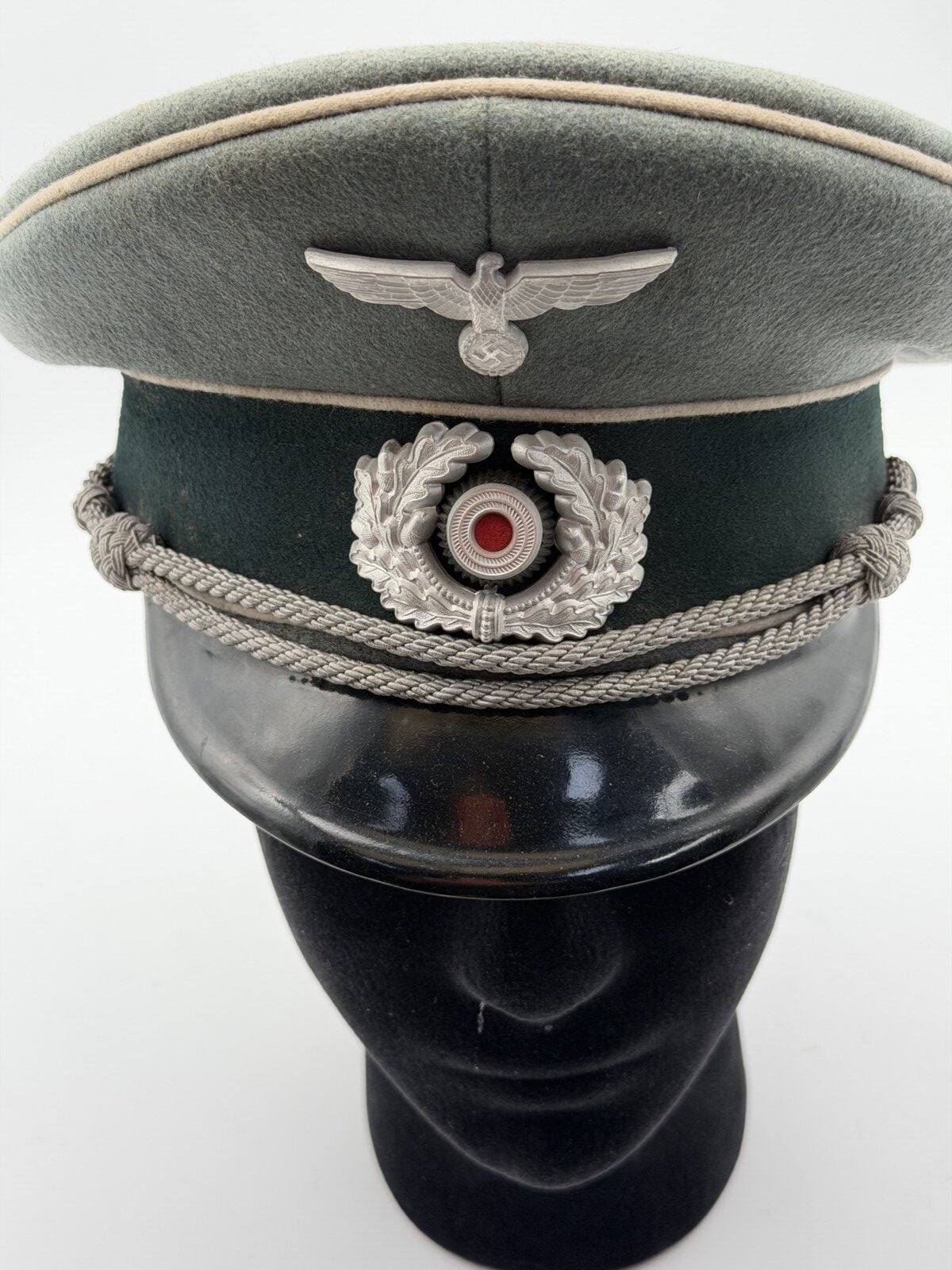
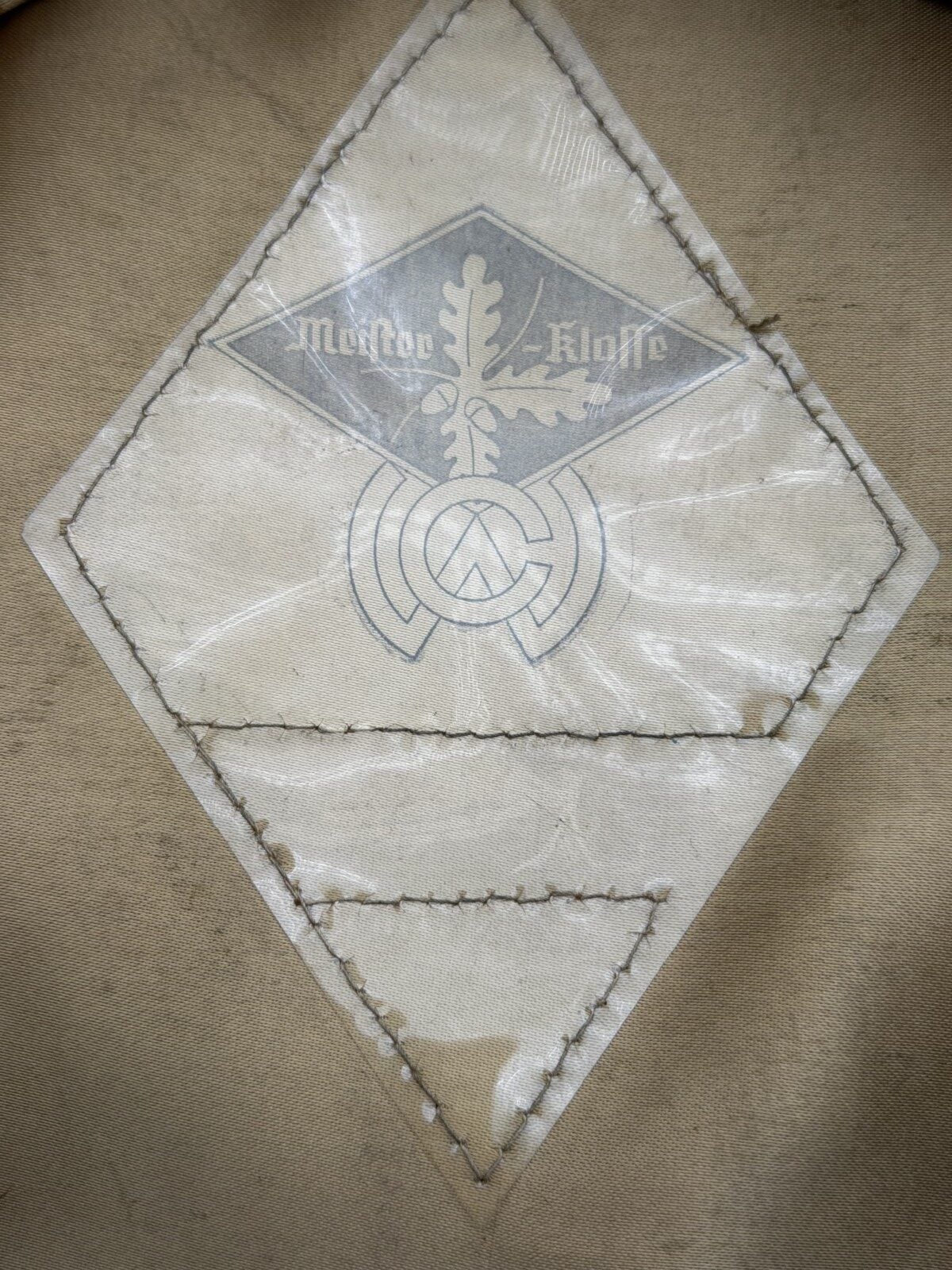
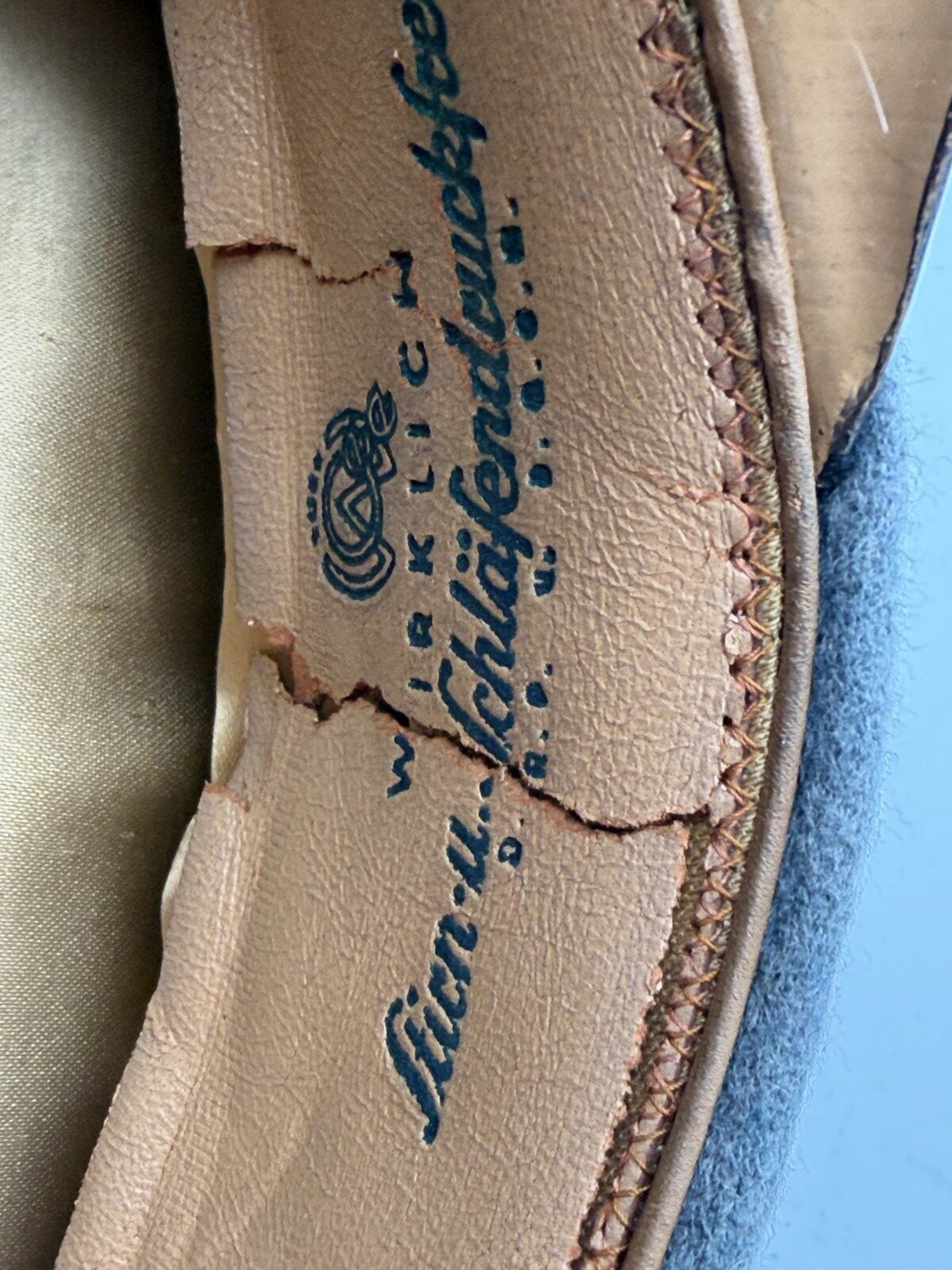
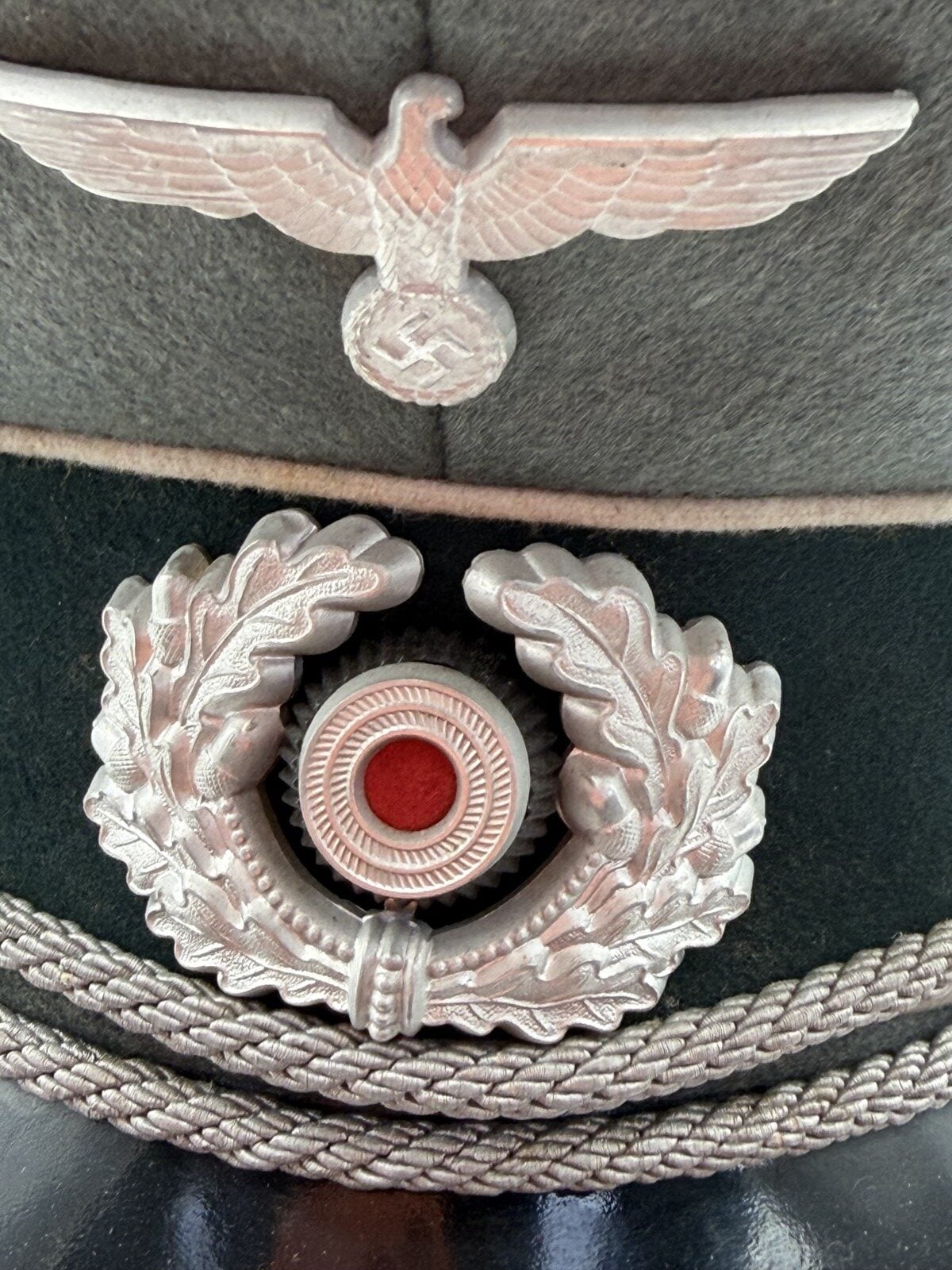
Original Wehrmacht Heer Infantry Officer Visor Cap manufactured by Clemens Wagner. Constructed from fine field-grey officer-quality wool with dark bottle-green centre band, aged white Infantry Waffenfarbe and silver officer chin cords. The cap retains period Heer insignia, golden-brown interior lining, celluloid sweat diamond with Clemens Wagner Meister-Klasse CW branding and the characteristic “Wirklich Stirn- u. Schläfendruckfrei” marked sweatband. A particularly attractive private-purchase Infantry officer Schirmmütze with excellent display presence.
€ 895
1 in stock
This Heer Infantry Officer Visor Cap is a fine original private-purchase German Army officer’s Schirmmütze manufactured by Clemens Wagner. Its high-quality field-grey wool body, dark bottle-green centre band and white Waffenfarbe piping identify it with the Heer Infantry branch.
Importantly, the piping is white rather than pink. Age and exposure have mellowed the original white wool into an attractive cream or ivory tone, which is frequently encountered on surviving wartime Infantry headgear.
Documented Heer Infantry officer caps use white Waffenfarbe around the crown and on both edges of the centre band. A surviving Clemens Wagner Infantry officer cap displays precisely this field-grey, dark-green and white-piped configuration.
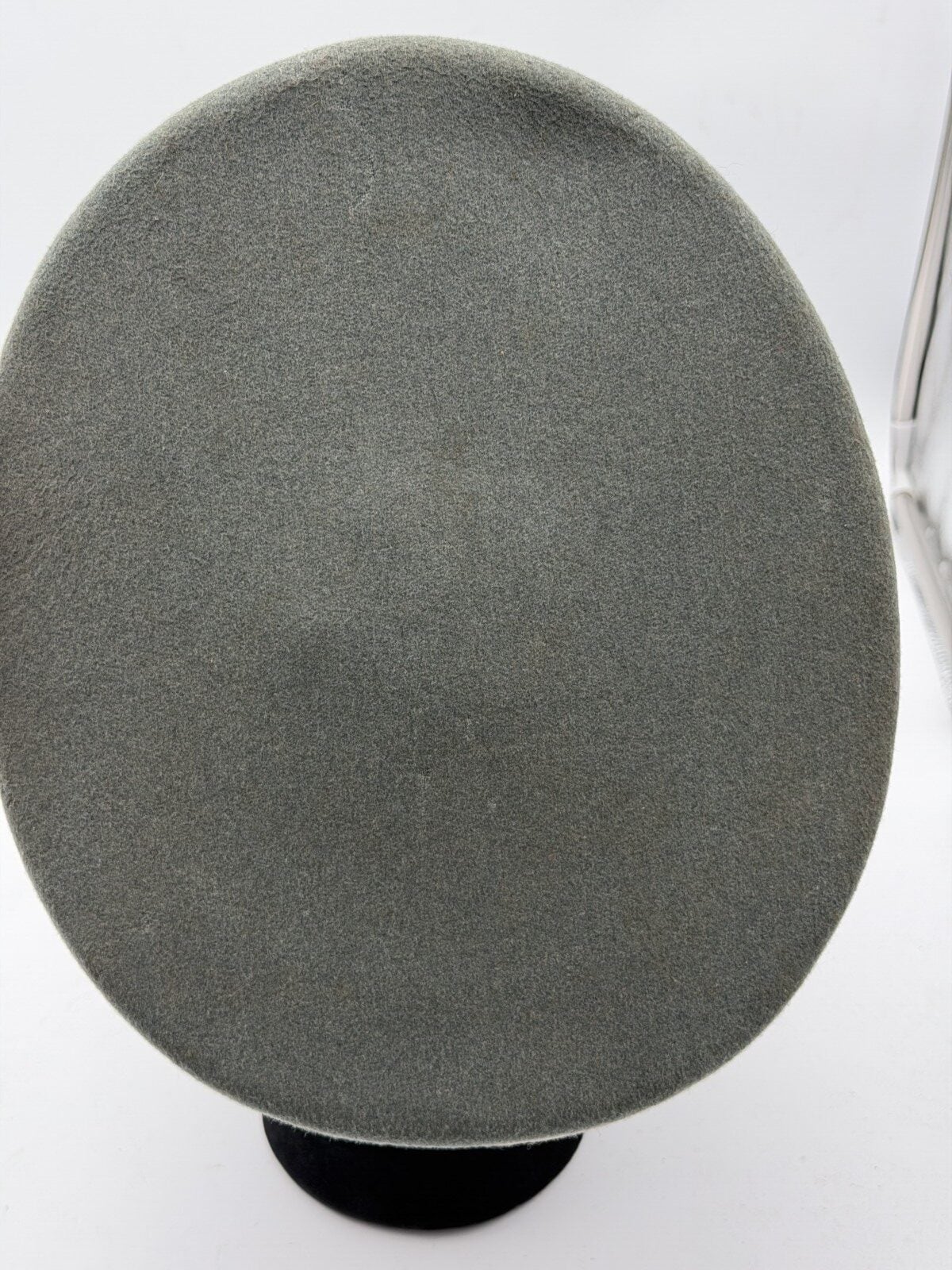
The crown uses finely finished field-grey officer-quality wool with a close, even nap.
Its shape remains excellent. Moreover, the cap has retained the desirable high-fronted saddle profile associated with privately purchased officer headgear.
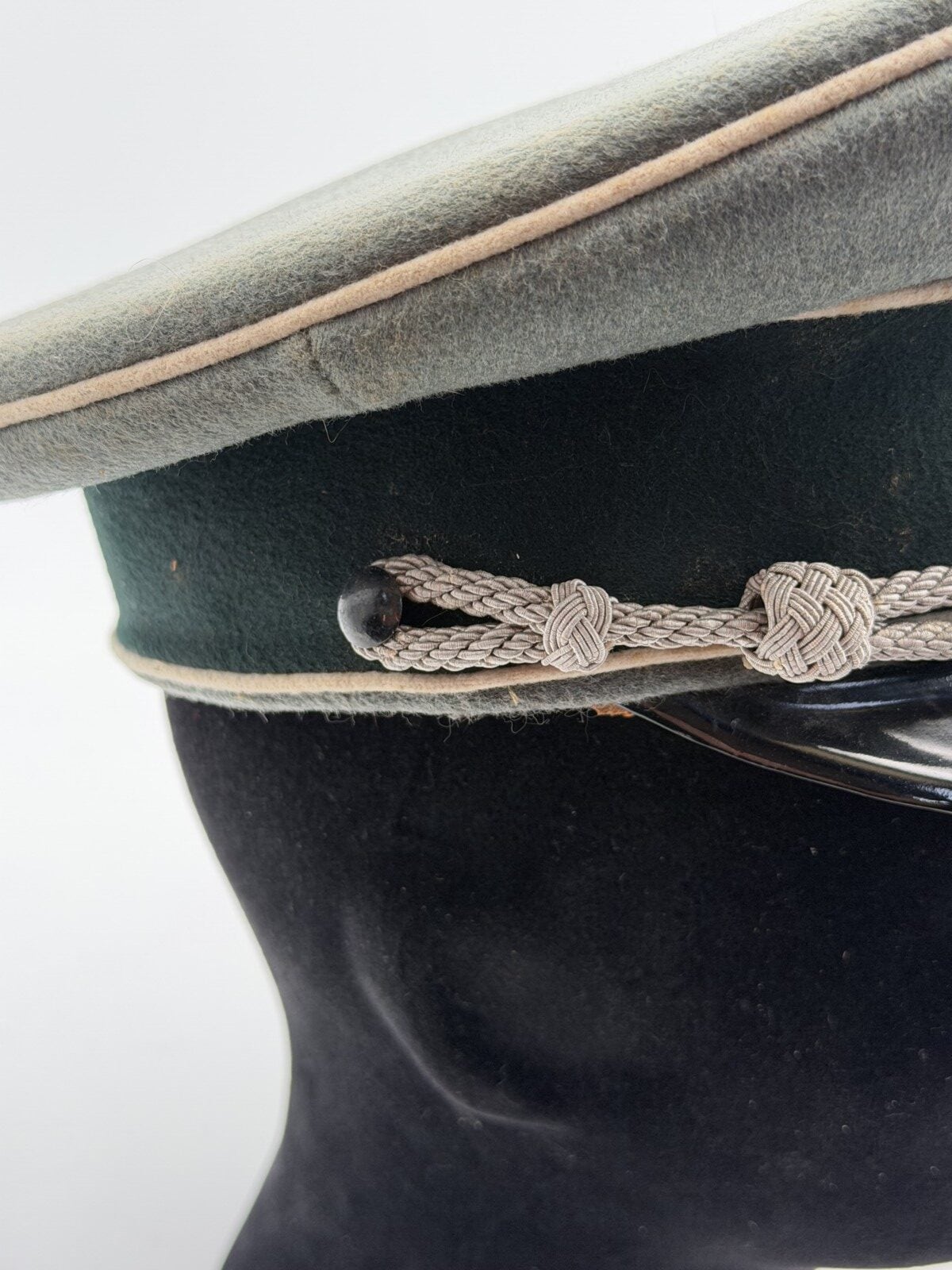
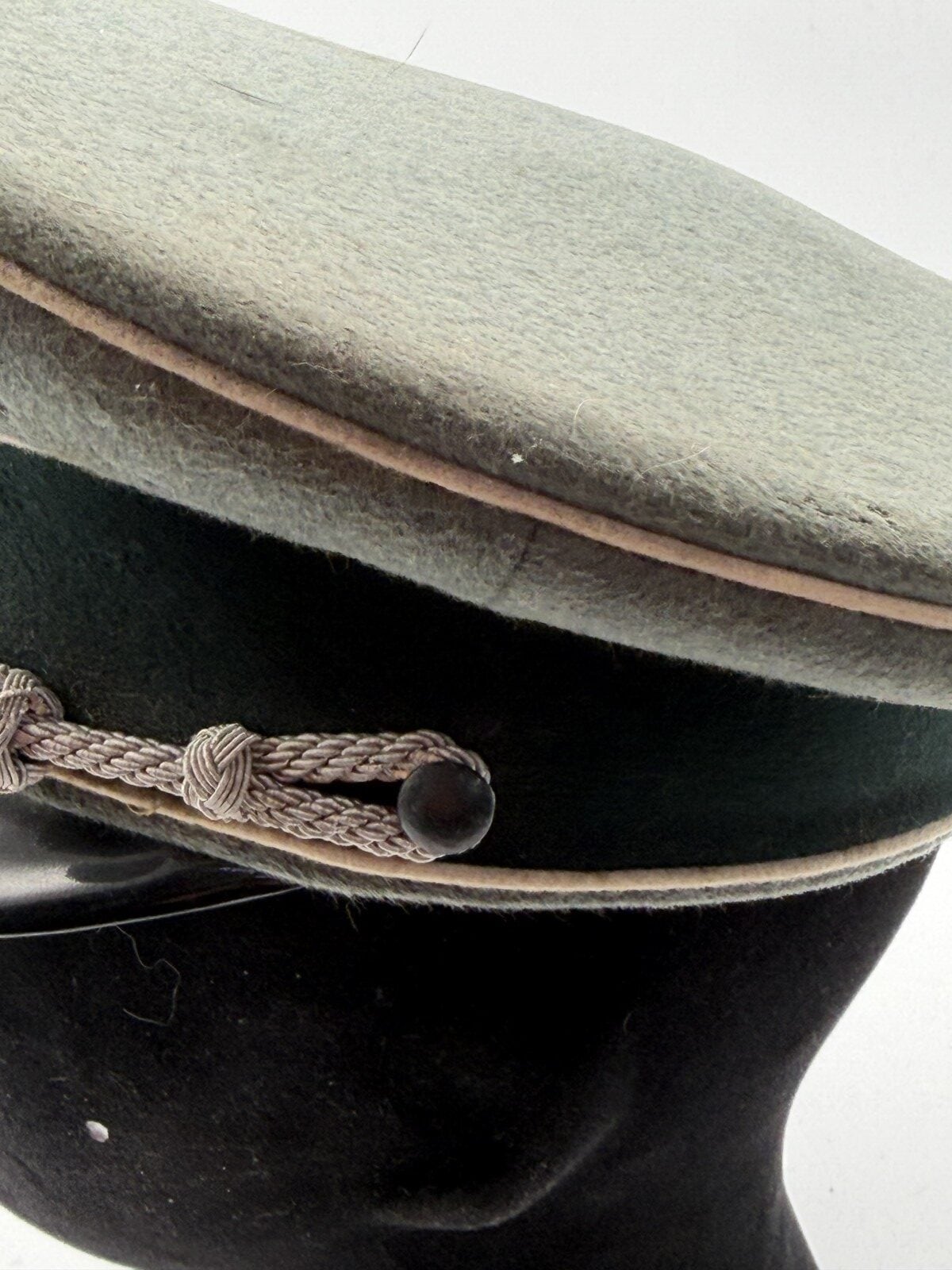
A dark bottle-green wool band surrounds the lower section. White Infantry piping contrasts against both the crown and centre band.
Silver-coloured officer chin cords run across the front. These are secured at each side by appropriate officer-pattern buttons.
Unlike enlisted and NCO caps, which generally carried a black leather chinstrap, the silver cord arrangement immediately identifies this as commissioned officer headgear.
The branch piping is one of the most important identifying features of this Heer Infantry Officer Visor Cap.
White Waffenfarbe represented the Infantry and Motorised Infantry branches. Period examples can range today from bright white through cream, ivory or slightly beige tones depending upon age, storage and exposure.
Therefore, the slightly aged colour visible here is entirely compatible with originally white piping.
A separately documented Clemens Wagner Infantry officer cap is specifically described with Weiß — white — piping as the Infantry branch colour.
A silver-coloured Heer national eagle sits prominently on the crown.
Below it remains the characteristic open oak-leaf wreath surrounding the national cockade. The red centre of the cockade is still particularly strong.
The insignia display natural surface ageing and subdued patination. Their appearance complements the condition of the cap rather than looking newly installed or artificially aged.
From the photographs, the eagle and wreath appear period-correct. However, until the backs and securing prongs are examined, I would avoid claiming that they have unquestionably remained factory fitted since manufacture.
The interior provides particularly strong evidence for the manufacturer’s attribution.
The cap retains its golden-brown rayon lining together with a substantial portion of the original transparent celluloid sweat diamond.
Under the diamond appears the distinctive Clemens Wagner CW trademark together with the Meister-Klasse quality designation.
Clemens Wagner was a well-established producer of high-quality military and civilian headwear. Surviving wartime examples are known with the same CW branding, and authenticated Heer Infantry officer caps by the manufacturer are documented.
The sweatband is another particularly interesting feature.
It carries the period manufacturer’s wording:
“Wirklich Stirn- u. Schläfendruckfrei”
This refers to the construction designed to reduce pressure against the forehead and temples.
Such branding is consistent with premium private-purchase headgear. More importantly, the ageing of the sweatband, stitching, lining and celluloid appears coherent throughout.
The sweatband has become fragile and displays several splits. Nevertheless, this should be regarded as honest age-related deterioration rather than something that should be cosmetically repaired.
I would strongly recommend leaving the sweatband untouched.
Several aspects visible in the photographs support the wartime attribution:
Taken together, these characteristics produce a highly coherent cap.
On the photographs supplied, I would assess this Heer Infantry Officer Visor Cap as a convincing original wartime private-purchase officer’s cap manufactured by Clemens Wagner.
The exterior construction corresponds well with known Infantry examples. Equally important, the interior branding and construction characteristics support the same conclusion.
A documented Clemens Wagner Infantry officer cap is recorded with white Infantry piping, field-grey wool, dark-green band and correct officer cords. Another surviving named Infantry officer cap by the same maker shows essentially the same premium exterior arrangement.
I see no obvious feature in the supplied photographs that would cause me to reject the cap as a modern reproduction.
For a final component-by-component examination, I would still like to inspect photographs of:
Externally, the cap remains in very good condition.
The crown has retained an excellent shape, while the field-grey cloth remains attractive and relatively clean. The bottle-green band remains strong in colour.
White Infantry piping survives substantially intact, although age has softened it to a cream tone.
The chin cords remain complete and display natural oxidation and ageing.
Internally, the lining and maker diamond survive well. The principal weakness is the fragile sweatband, which shows cracking and splitting.
This deterioration lowers the technical condition grade slightly but adds nothing suspicious from an authentication standpoint.
Privately purchased officer Schirmmützen were manufactured to a noticeably higher standard than many issue examples.
Officers could select finer cloth, improved linings and more elaborate internal construction from specialist hat makers. Consequently, recognised manufacturers such as Clemens Wagner produced caps with distinctive quality markings and proprietary design features.
White Waffenfarbe was associated with the Infantry branch, making the combination of white piping and silver officer cords immediately recognisable.
Several factors make this example particularly desirable:
Original named or clearly maker-marked officer caps normally attract greater interest than anonymous examples because the construction can be compared with documented examples.
Ratisbon’s has sold Clemens Wagner Heer officer caps, including an Artillery officer example in September 2025 for €625, while earlier high-grade Wagner examples have achieved stronger figures depending upon condition, insignia and branch.
A used Clemens Wagner Infantry officer cap recorded through Milivault sold at approximately €599, although that example showed significant wear and damage.
Explore related listings: Military Visor & Peaked Caps; Nordmenn Uniforms & Headgear; Original Heer Medical Officer Visor Cap | WWII.
Clemens Wagner Infantry Officer Cap Reference
For manufacturer and market comparison, Ratisbon’s also maintains records of original Clemens Wagner Heer officer caps.