
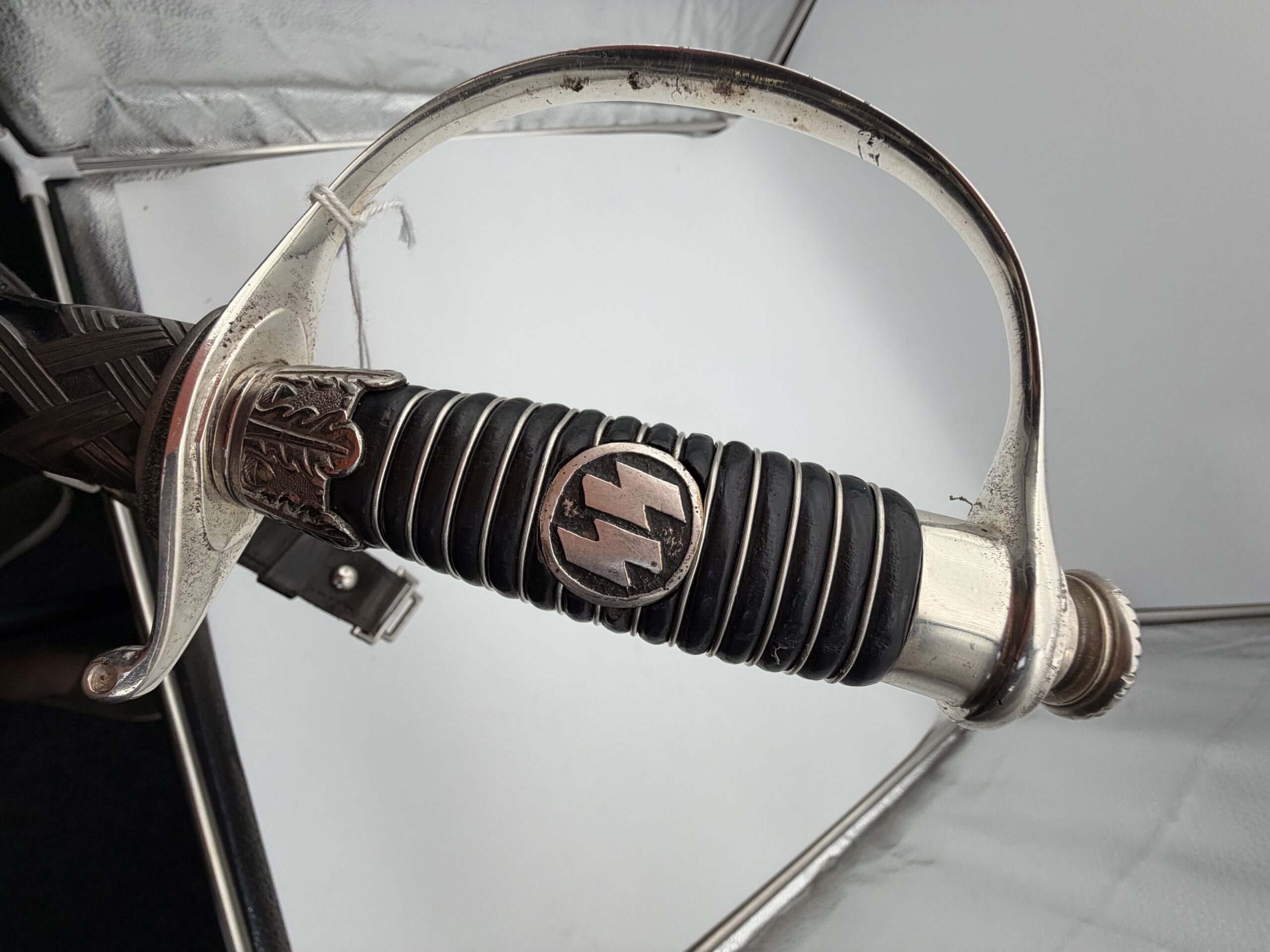
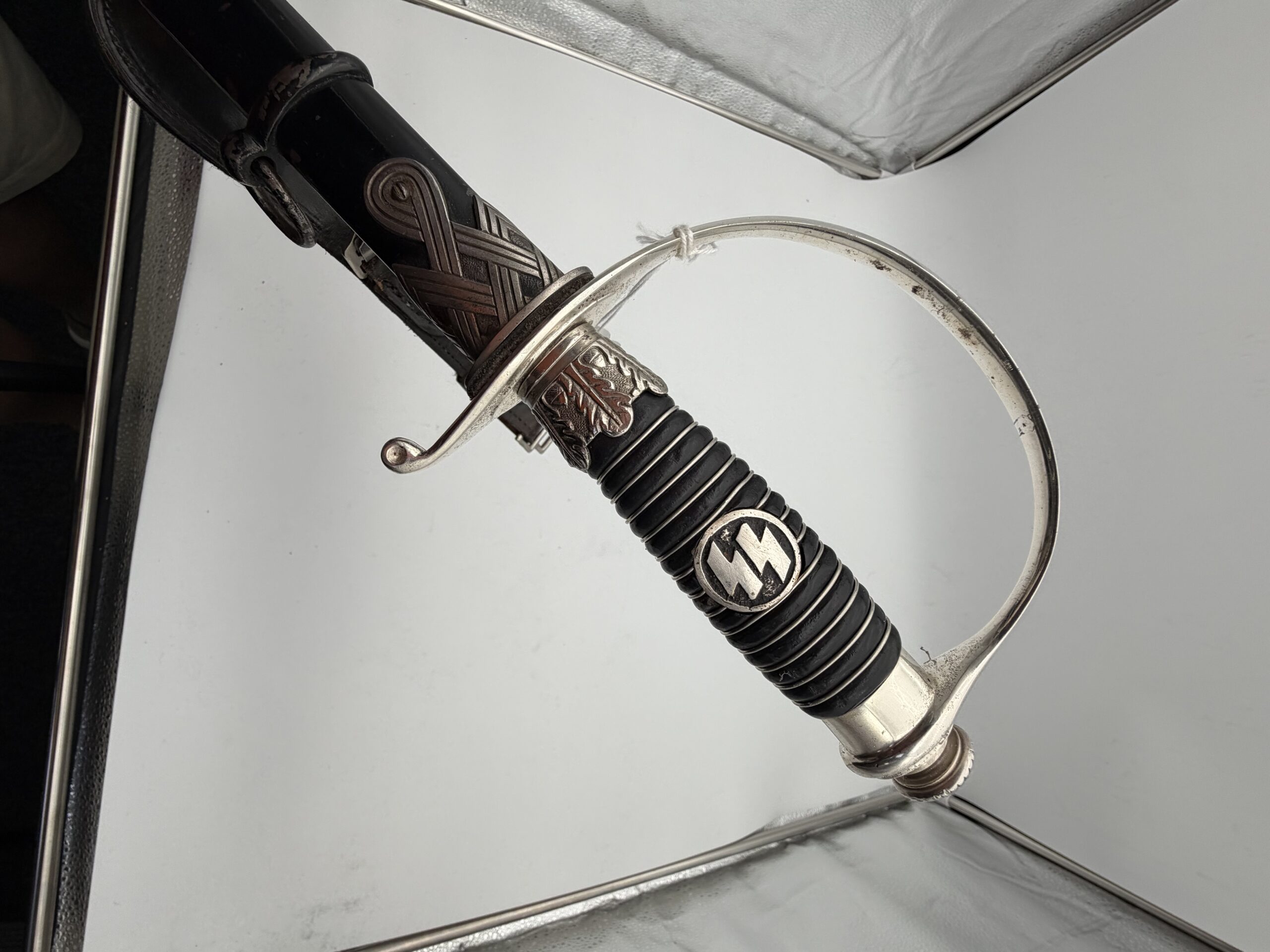
An exceptionally rare original Dachau SS Führerdegen, produced in the distinctive later stainless-steel configuration associated with SS sword production and assembly at Dachau.
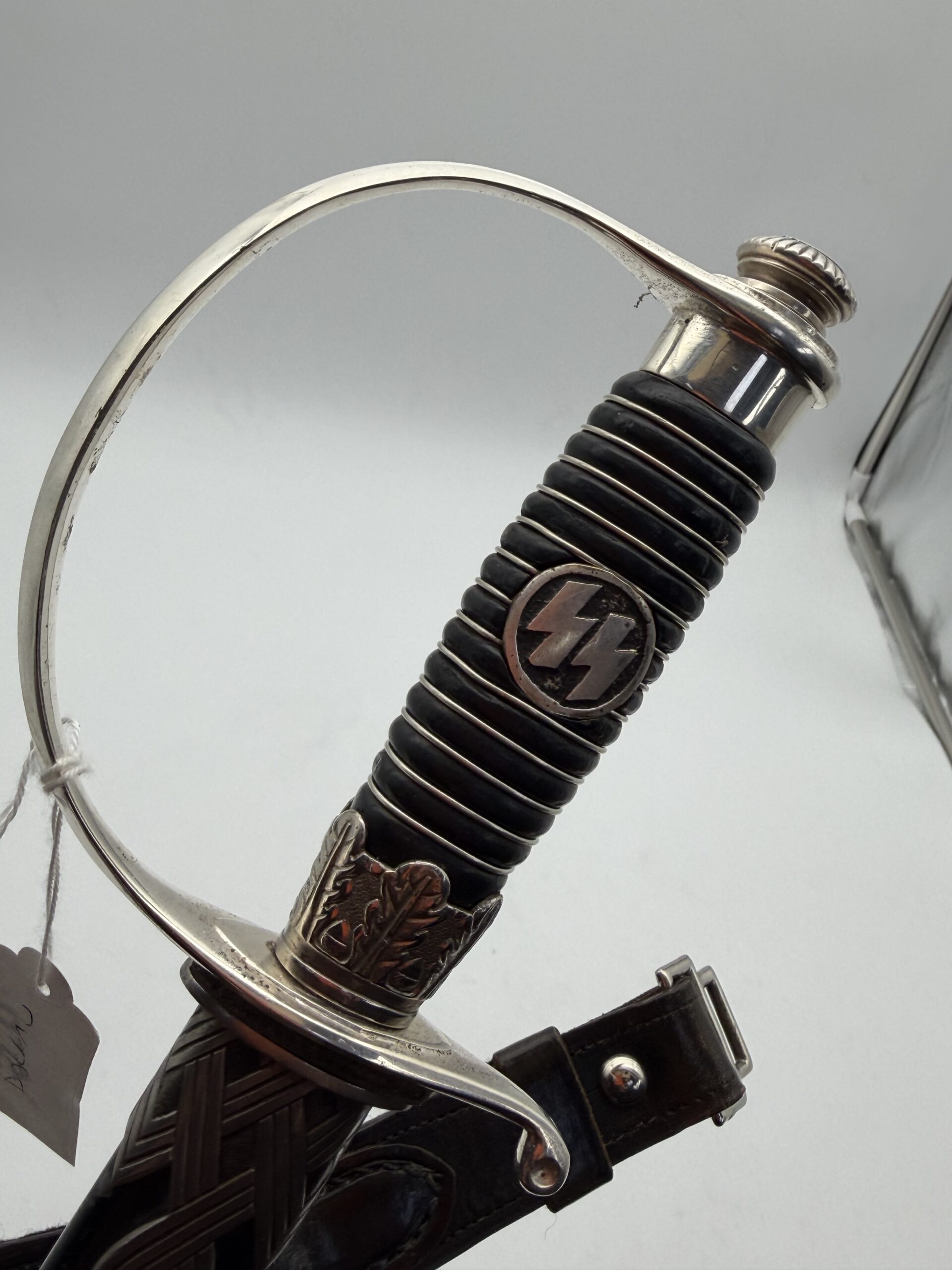
The sword features bright stainless or rostfrei-type hilt fittings, a black ribbed officer grip with silver wire winding, inset SS runic medallion, traditional oak-leaf ferrule and elegant D-shaped guard.
Its original black lacquered steel scabbard retains the silver-coloured Wotan knot throat fitting and SS runic inspection marking. Most importantly, the sword remains complete with an original silver-and-black SS Führerdegen portepee.
The combination of Dachau-pattern stainless construction, officer configuration, original scabbard and surviving SS portepee makes this an exceptionally desirable late-production SS sword.
€ 7.995
1 in stock
Professor Karl Diebitsch designed the distinctive SS sword during the mid-1930s.
Earlier examples relied heavily on Solingen manufacturers such as Peter Daniel Krebs. Later production and assembly became associated with the SS technical workshops at Dachau.
The present sword displays the characteristic bright stainless-steel style fittings associated by advanced collectors with these later Dachau examples.
Unlike nickel-plated fittings, the polished metal retains its colour through the material itself rather than depending entirely upon a thin plated surface.
Consequently, genuine stainless examples often survive with particularly attractive hilt surfaces.
This sword is an SS Führerdegen for an officer, rather than an SS Unterführerdegen.
Several features establish that identification immediately.
The black grip retains multiple silver-coloured wire windings.
Additionally, a circular SS rune medallion sits prominently within the grip.
The correct officer configuration therefore includes:
By contrast, an SS Unterführerdegen normally lacks the officer grip wire and moves the SS rune emblem to the pommel.
That distinction is essential when identifying and valuing this sword.
The most important construction feature is the bright white-metal hilt.
Later SS swords associated with Dachau are well known among specialist collectors for the use of stainless or rostfrei-type fittings.
Collector research concerning Paul Müller and the SS technical sword workshop at Dachau records the transition from earlier nickel-plated components toward stainless fittings.
Specialist discussions also note that later Dachau swords can display stainless pommel components, guards and scabbard furniture rather than the plated surfaces associated with earlier production.
The present sword displays precisely this bright, highly corrosion-resistant appearance.
Paul Müller was an experienced Solingen swordsmith who became associated with the SS sword workshop at Dachau during 1939.
Period correspondence discussed in specialist research records his contract to teach swordsmithing and the manufacture of prestigious blades within the SS technical establishment.
Importantly, Müller had previous experience working with stainless steel.
His wartime SS correspondence also mentions earlier experimentation with stainless material.
The exact extent to which every component of later “Dachau” swords was actually produced inside the Dachau workshop remains debated.
For this reason, the most accurate description is:
rather than claiming that every individual component was forged personally by Paul Müller.
The history becomes particularly interesting because Dachau swords did not necessarily contain blades produced entirely on site.
A documented sword recovered from the Dachau supply depot after liberation used a Peter Daniel Krebs Solingen bladecombined with Dachau-associated fittings.
That example also featured a thin Dachau-style scabbard and stainless Wotan knot throat mount.
Therefore, the presence of a Solingen-made blade does not automatically exclude Dachau assembly.
This evidence helps explain the variation seen among surviving original SS swords.
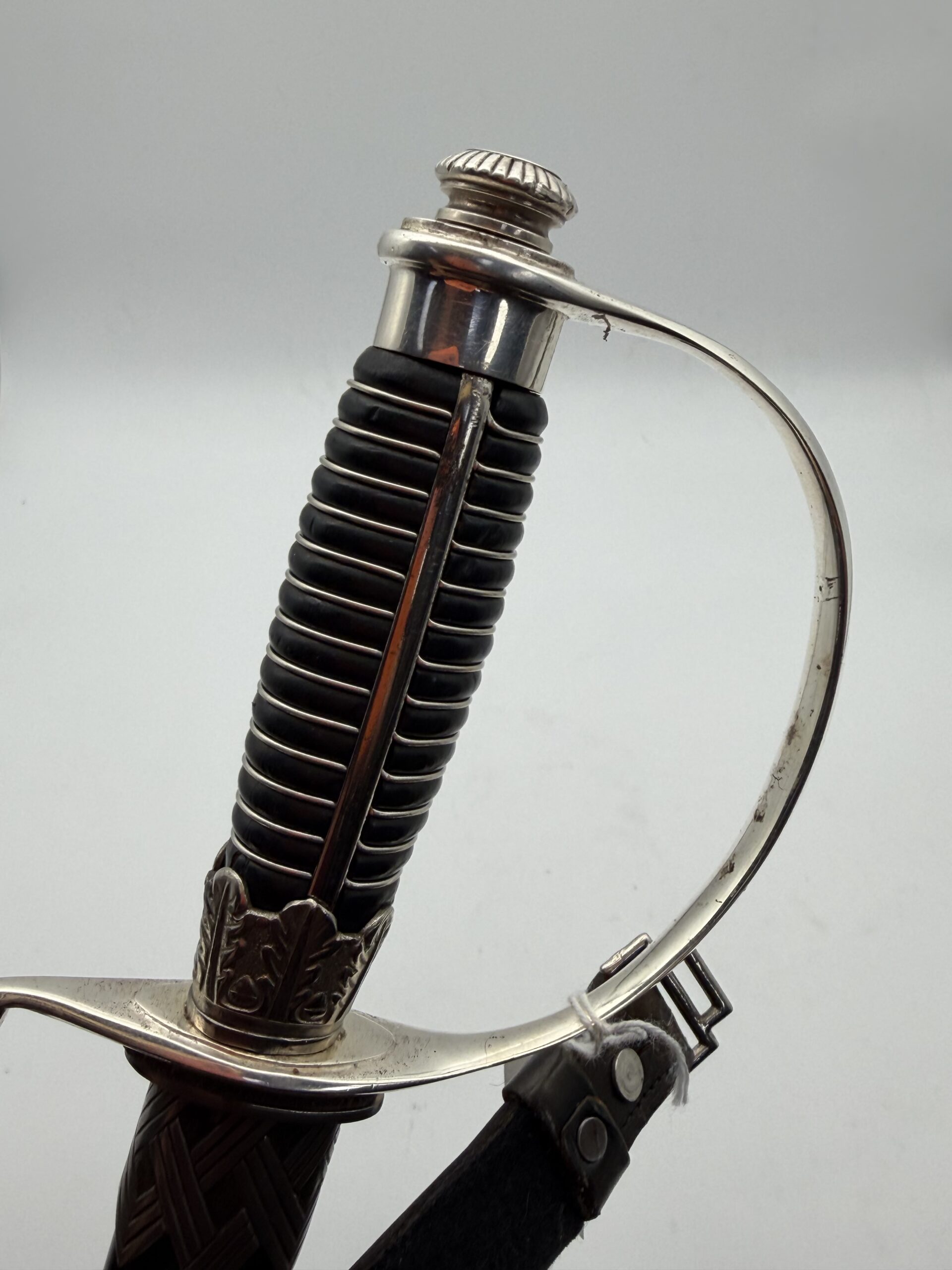
The officer’s D-guard remains particularly attractive.
Its bright finish has survived extremely well.
Small areas of age toning and handling wear remain visible. However, the guard has not developed the extensive flaking associated with degraded nickel plating.
That preservation supports the stainless-steel interpretation.
The guard begins beneath the pommel and sweeps forward before meeting the crossguard.
A rounded quillon finishes the opposite end.
The restrained shape typifies the Diebitsch SS sword design.
The grip consists of black ribbed material over the internal core.
Deep horizontal ribs run from the lower ferrule toward the pommel.
Multiple silver-coloured wire strands follow the grooves.
The contrast between polished white metal and deep black grip material creates the classic SS Führerdegen appearance.
Moreover, the grip remains in excellent overall condition.
Only small age-related traces appear within individual grooves.
A circular rune medallion sits centrally in the grip.
The black field carries the familiar twin SS Sig runes in raised silver-coloured metal.
Natural age darkening remains within the recesses.
Meanwhile, the rune surfaces retain brighter highlights.
The medallion also sits correctly within the grip rather than appearing superficially attached.
Its location confirms the officer configuration.
The lower grip ferrule carries deeply modelled oak-leaf ornament.
Oak leaves formed an important decorative theme throughout SS symbolism and appear repeatedly on Führerdegen fittings.
Here, the individual leaves retain strong definition.
Darkened recesses contrast with brighter raised surfaces.
Consequently, the ferrule displays excellent depth without appearing artificially polished.
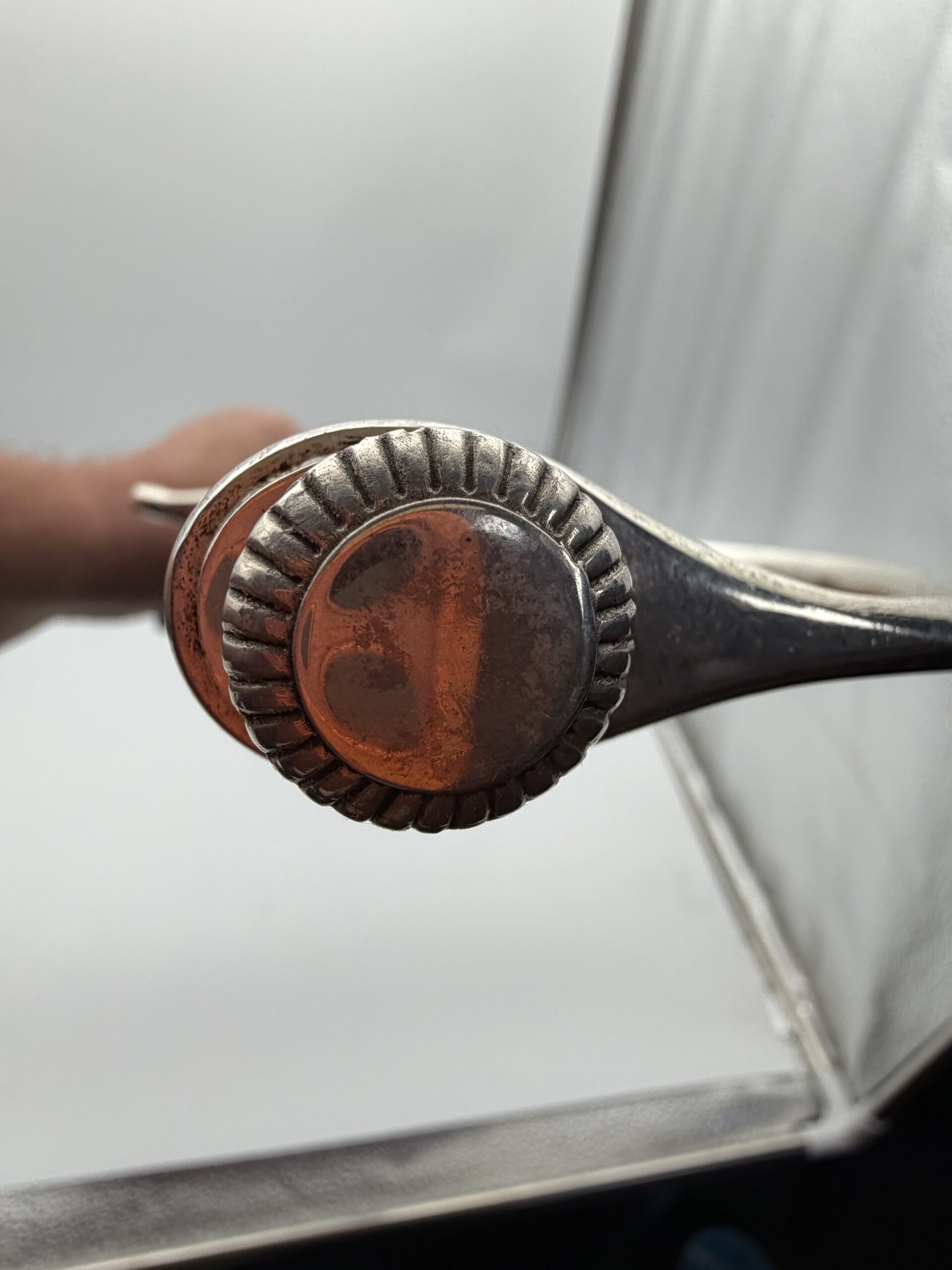
The pommel uses the restrained stepped form associated with SS officer swords.
A ribbed circular top cap completes the hilt.
The stainless or white-metal finish remains particularly strong.
Importantly, the pommel does not carry the large external runic device used on the Unterführer version.
Instead, the officer’s runes remain within the grip medallion.
The upper scabbard mount displays the famous Wotan knot or Germanic interlace design.
Silver-coloured strips form an intricate geometric pattern over the black background.
This decorative arrangement became one of the most recognisable features of SS sword scabbards.
The fitting remains extremely crisp.
Moreover, the metal displays natural age while retaining excellent definition.
A comparable Wotan knot throat is specifically recorded on documented Dachau-associated SS swords.
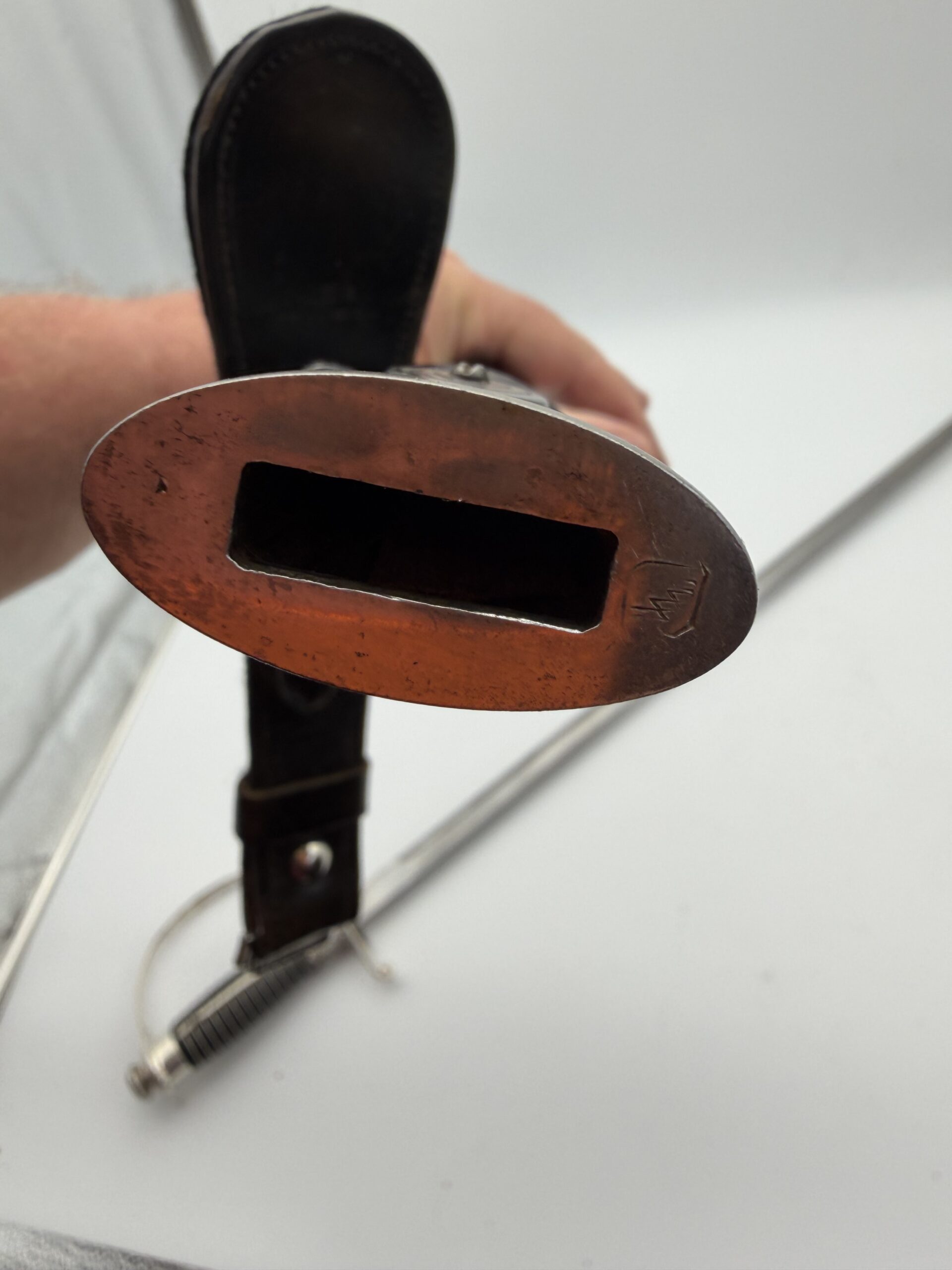
The underside of the scabbard throat carries an important SS runic mark within an octagonal cartouche.
This inspection or Kulturzeichen-style marking provides another useful period characteristic.
The stamp remains sharply defined within the metal.
Its placement and wear appear coherent with the rest of the fitting.
Not every surviving Dachau sword displays identical inspection marks.
Therefore, the mark should be recorded as an individual feature rather than used as the sole test of Dachau manufacture.
The sword retains its full-length black steel scabbard.
Much of the original dark finish remains.
The body appears straight and retains the correct suspension ring.
Its dimensions also provide the elegant, relatively slender appearance associated with SS degens.
Specialist research repeatedly identifies thinner scabbard bodies with Dachau-related production.
The combination of black lacquer and stainless furniture creates an especially attractive presentation.
The sword remains complete with an original-style silver-and-black SS Führerdegen portepee.
This accessory is extremely important.
Silver/aluminium metallic thread forms the principal strap.
Twin black stripes run through the weave.
The characteristic enclosed tassel also incorporates alternating black and silver elements.
Original SS Führerdegen portepees are valuable collectibles in their own right.
Helmut Weitze currently lists genuine examples between approximately €1,400 and €1,550, depending upon condition and surviving labels.
Therefore, the survival of the correct portepee adds materially to the value of this complete sword.
Many SS swords encountered today have lost their original knot.
Others carry incorrect Heer, Luftwaffe or reproduction examples.
The present ensemble avoids that problem.
Its silver-and-black portepee visually and technically corresponds with the SS officer pattern.
The complete combination is therefore considerably more desirable than a sword and scabbard alone.
For preservation purposes, the knot should remain tied exactly as found.
Early Peter Daniel Krebs examples are generally regarded as the classic first production form.
Those swords frequently display nickel-plated fittings and SS inspection markings.
Later Dachau-associated swords developed visible construction differences.
Typical differences can include:
Early Krebs type
Later Dachau type
Consequently, both types are genuine SS swords.
However, they represent different stages in SS Führerdegen manufacture.
Some Dachau swords carry the famous:
mark associated with Paul Müller Dachau.
However, not every genuine Dachau-associated sword is PMD marked.
Collector surveys of surviving SS Führerdegen include three major categories:
A survey discussed among advanced collectors found these three groups to dominate surviving SS officer sword production.
Therefore, the absence of a PMD mark should never by itself condemn an otherwise correct Dachau sword.
The SS-Ehrendegen, officially known as the Ehrendegen des Reichsführers-SS, was introduced during the mid-1930s.
The officer sword became an important ceremonial distinction within the SS.
Recipients included officers of the SS-Verfügungstruppe, SS-Totenkopfverbände and graduates of the SS-Junkerschulen.
The design used a straight blade and restrained neo-Germanic styling.
A reference example of an early Krebs sword illustrates the classic black grip, runic medallion, Wotan knot scabbard fitting and white-metal hilt.
This Dachau SS Führerdegen should not be confused with the NCO sword.
The officer pattern has:
The Unterführer pattern generally has:
The present sword clearly belongs to the officer configuration.
The supplied photographs provide a highly coherent set of characteristics.
Positive features include:
Most importantly, nothing visible conflicts with the recognised late stainless Dachau family of SS swords.
The complete ensemble therefore presents strongly as an original Dachau-production or Dachau-assembled SS Führerdegen.
Overall condition is:
The stainless hilt retains exceptional brightness.
Grip construction remains complete.
Likewise, the SS rune medallion displays strong definition.
The Wotan knot throat remains crisp.
Meanwhile, the scabbard retains substantial original black finish.
The period portepee survives complete and highly presentable.
Only modest age and handling wear appear across the ensemble.
No aggressive polishing or restoration is recommended.
All original SS Führerdegen are scarce.
However, a correct Dachau stainless-steel officer sword belongs to a particularly desirable subgroup.
PMD and late Dachau swords appear far less frequently than ordinary German officer sabres.
Additionally, a complete original portepee increases both rarity and collector appeal.
Advanced collectors actively distinguish these swords by production generation, fittings, grip construction, blade type and scabbard details.
The present ensemble offers an especially strong combination of those characteristics.
Current collector discussion places genuine SS officer swords around the US$7,000 level before allowing for exceptional condition or valuable accessories.
Original SS Führerdegen portepees currently command approximately €750–€1,550 depending on condition.
The present example benefits from:
Accordingly, it deserves a premium over an average SS sword.
A reasonable specialist range is approximately:
Direct named provenance or documented recovery from the Dachau SS supply depot could move the value higher.
Item: SS ceremonial officer sword
Correct designation: SS-Führerdegen / Ehrendegen des Reichsführers-SS
Production type: Dachau stainless-steel variation
Organisation: Schutzstaffel / SS
Period: Late 1930s–early 1940s
Production association: Dachau SS technical sword workshops
Hilt: Stainless / rostfrei-type white metal
Guard: D-shaped officer pattern
Grip: Black ribbed
Grip wire: Silver-coloured officer winding
Grip insignia: Inset SS rune medallion
Ferrule: Oak-leaf decorated
Scabbard: Black lacquered steel
Upper fitting: Wotan knot / Germanic interlace pattern
Inspection marking: SS runes in octagonal cartouche
Portepee: Original silver-and-black SS Führerdegen type
Condition: Excellent / museum-quality
Rarity: Extremely rare production variant
Short ID: SS-DACHAU-ROSTFREI-01
Recommended retail: €8,995
Explore related listings: Military Swords; Nordmenn Militaria Collection; Original Der Führer BeVo Flatwire Cuff Title; Original SS-Obergruppenführer Collar Tabs – 1942 Pattern with RZM Label.
Dachau SS Führerdegen production research
Specialist Dachau SS Ehrendegen Research
This detailed discussion examines PMD markings, stainless fittings, thin Dachau scabbards and the surviving documentation surrounding Paul Müller.
A documented sword recovered from the Dachau supply depot used a Krebs blade with Dachau-style stainless fittings and thin scabbard construction.
Helmut Weitze Original SS Führerdegen Portepee
This provides a useful direct comparison for the original silver-and-black knot.
It is a later SS officer sword associated with the SS technical sword workshops and assembly facilities at Dachau.
Yes.
The silver-wire grip and inset SS rune medallion identify the officer configuration.
The later Dachau variation is associated with bright stainless or rostfrei-type fittings rather than relying entirely upon conventional nickel plating.
No.
Paul Müller directed swordsmithing work at Dachau, but surviving Dachau-associated swords can contain components supplied by other manufacturers.
Yes.
A documented sword recovered directly from the Dachau supply depot carried a Peter Daniel Krebs blade combined with Dachau-associated fittings.
No.
PMD-marked swords are an important group, but genuine later swords can also be unmarked or incorporate other supplied components.
It is the distinctive Germanic interlace design fitted to the upper scabbard mount.
It is an SS runic inspection or Kulturzeichen-type marking used on recognised SS sword fittings.
Yes.
A genuine SS officer portepee can currently command approximately €1,000 or more on its own, depending on condition.
No.
The officer grip wire and inset runic medallion establish it as an SS Führerdegen.
Original Dachau SS Führerdegen / Ehrendegen des Reichsführers-SS – Late Stainless Steel / Rostfrei Production Variation – Officer Pattern – Black Ribbed Grip with Silver Wire – Inset SS Rune Medallion – Stainless D-Guard – Oak-Leaf Ferrule – Original Black Lacquered Scabbard – Wotan Knot Upper Fitting – SS Runic Inspection Mark – Original Silver-and-Black SS Führerdegen Portepee – Excellent Museum-Quality Condition