
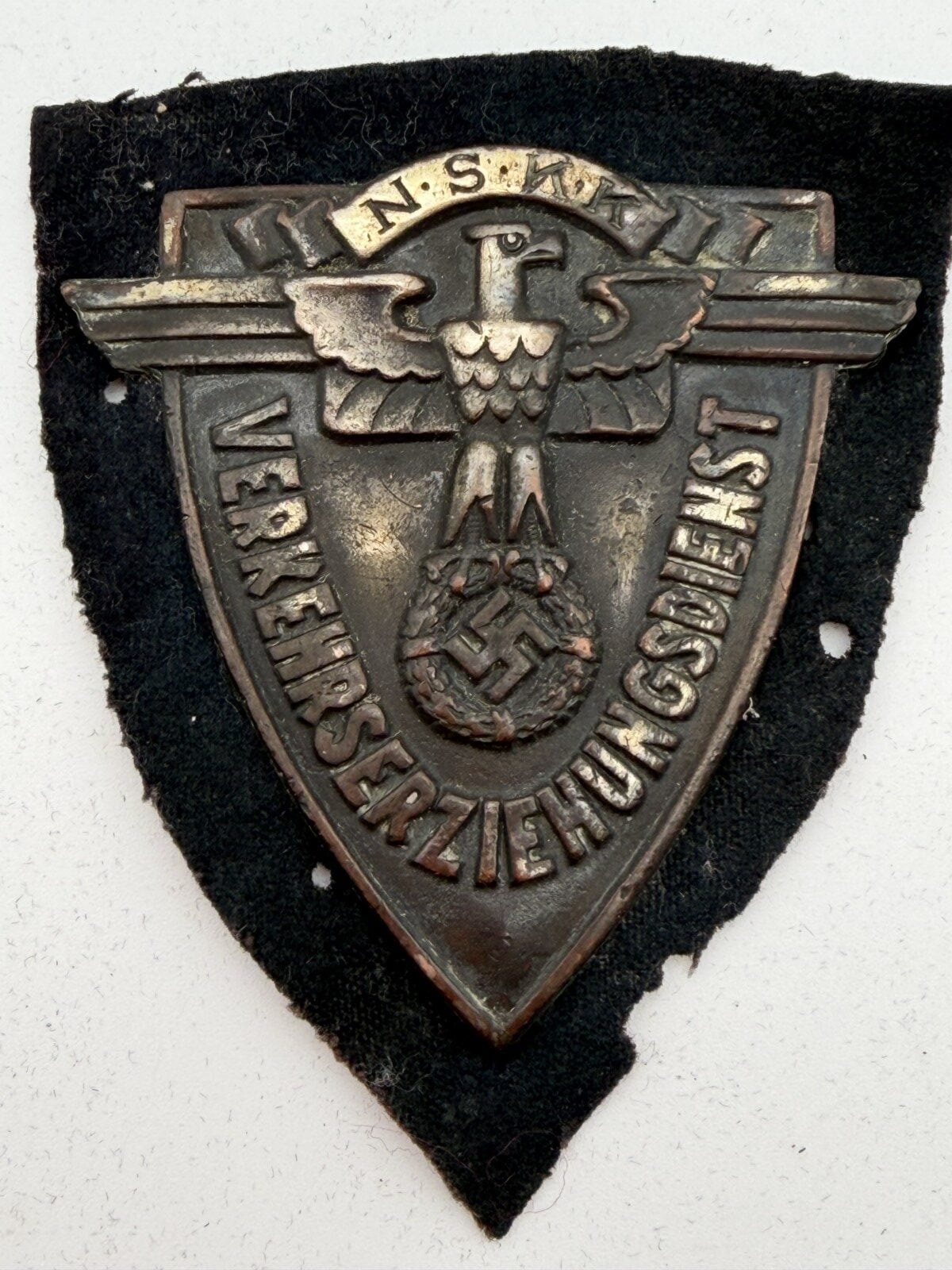
Original NSKK Verkehrserziehungsdienst Sleeve Shield in die-struck blackened metal, retaining its three fixing tabs and original black wool uniform backing. This scarce Traffic Education Service insignia displays honest service wear, natural patina and convincing period construction.
€ 250
1 in stock
This original NSKK Verkehrserziehungsdienst Sleeve Shield identified a member of the Nationalsozialistisches Kraftfahrkorps Traffic Education Service. The badge retains its dark metal finish, three integral fixing tabs and a section of period black wool uniform cloth.
Its large shield-shaped design features an NSKK eagle, the organisation’s initials and the full Verkehrserziehungsdienstdesignation. Honest surface wear has exposed the metal across several raised details. Meanwhile, the recessed areas retain much of their original dark finish.
Most importantly, the badge still rests on its black wool backing. The irregular cloth edges, old holes and general wear indicate removal from a uniform sleeve.
The German term Verkehrserziehungsdienst translates as Traffic Education Service. This specialist NSKK branch taught road discipline, instructed motorists and supported organised traffic control.
Traffic Education Service personnel attended busy road junctions, NSKK events and public gatherings. They also helped local authorities manage vehicles and pedestrians when large crowds created additional traffic problems.
After a qualifying period of satisfactory service, eligible personnel received this distinctive metal sleeve insignia. Therefore, the shield represented specialist training and duty rather than ordinary NSKK membership.
Members normally wore the badge on the upper right sleeve of the service tunic or greatcoat. During official traffic duties, they could also wear the corresponding NSKK Traffic Education Service gorget.
The NSKK Verkehrserziehungsdienst Sleeve Shield uses die-struck light-alloy construction. This manufacturing method created sharp lettering, clean outlines and well-defined raised details.
A large NSKK eagle dominates the upper half. Above its head, a curved panel displays the initials:
N.S.K.K.
The inscription “VERKEHRSERZIEHUNGSDIENST” follows the lower edge of the shield. Beneath the eagle, a smaller national emblem incorporates another eagle, wreath and swastika.
The design retains good definition despite genuine service wear. In particular, the letters remain clear and the main eagle still displays its individual wing sections and feather details.
A darkened finish originally covered the metal surface. Considerable amounts remain inside the recessed areas and around the lettering.
Regular handling and uniform wear gradually exposed the lighter metal along the raised border, eagle and inscription. This uneven surface creates a convincing period appearance. Furthermore, scratches and colour changes occur naturally across the whole shield rather than appearing artificially concentrated.
The badge also displays a mellow, untouched patina. Cleaning or polishing would remove useful evidence of age. Consequently, the shield should remain exactly as found.
The surviving black wool cloth significantly increases the collector interest of this example. Many comparable shields now exist as loose badges without any trace of their original uniform attachment.
Here, the metal insignia remains secured to a section of black wool. The cloth extends beyond the shield and follows its general outline. Several small holes, loose fibres and irregular edges provide evidence of genuine uniform removal.
Age has produced surface lint and minor textile wear. Nevertheless, the wool remains strong and continues to support the badge correctly.
The black material also matches the dark uniform cloth associated with the NSKK. Therefore, the surviving backing helps demonstrate how the shield originally appeared on a service uniform.
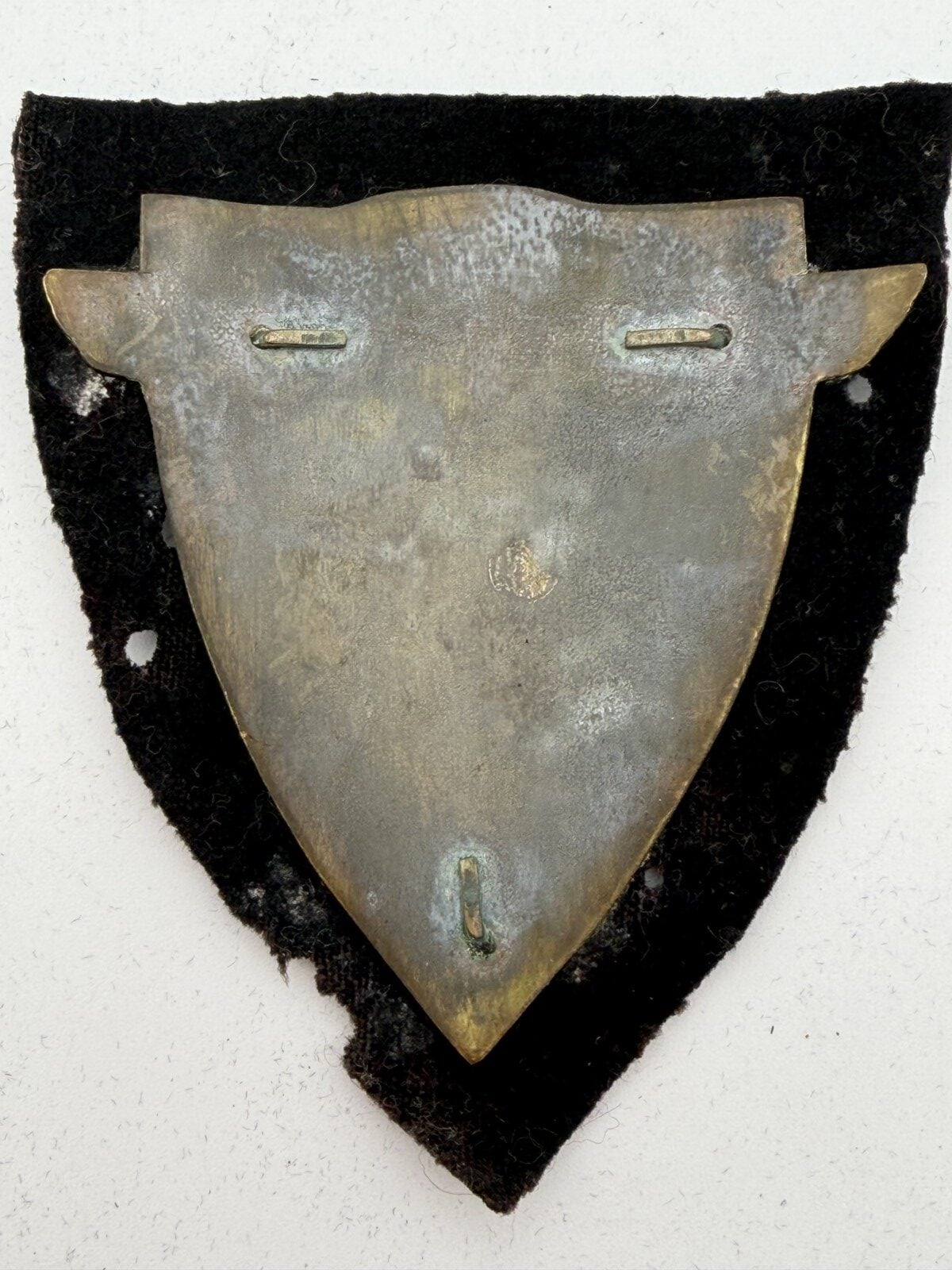
The reverse reveals a plain oxidised metal surface. Three integral tabs secure the shield to the cloth:
Each tab passes through the wool and folds flat against the reverse. This practical construction held the comparatively large shield securely against the sleeve.
A faint impression appears near the centre. However, the photographs do not show enough detail to identify a definite manufacturer. For that reason, the catalogue should describe the maker as unknown rather than assign an unsupported attribution.
The photographs show numerous features that support original pre-1945 manufacture:
Modern cast reproductions often show soft lettering, rough surfaces and poorly defined eagle details. In contrast, this shield retains crisp outlines and strong relief. Its reverse also lacks the porous texture commonly associated with cast copies.
Moreover, the metal and wool display compatible ageing. The tabs have remained in place long enough to create corresponding wear and oxidation around their openings.
Based on the supplied photographs, this NSKK Verkehrserziehungsdienst Sleeve Shield presents as an original wartime example in genuine uniform-removed condition.
The NSKK emerged from the earlier Nationalsozialistisches Automobilkorps during 1931. After separating from the SA in 1934, the organisation operated as an independent NSDAP formation under Adolf Hühnlein.
Its peacetime activities included driving instruction, vehicle maintenance, motorsport, road safety and technical education. The organisation also provided pre-military training for men who later entered motorised Wehrmacht units.
During the Second World War, NSKK personnel supported transport and logistical operations across German-controlled Europe. Drivers worked with the Wehrmacht, Luftwaffe and Organisation Todt. However, the Verkehrserziehungsdienst maintained a more specialised connection with road instruction and traffic management.
For another rare example of specialist NSKK insignia, see the NSKK Einsatzbereitschaft Führer Cuff Title. Collectors can also browse the wider Nordmenn Cuff Titles and Armbands collection.
Helmut Weitze illustrates a comparable NSKK Verkehrserziehungsdienst Sleeve Shield. Hiscoll also records an original light-alloy Verkehrserziehungsdienst arm shield. In addition, Regimentals confirms the right-sleeve position and three-point attachment system.
The shield remains in good, genuinely worn condition. Its recessed areas retain substantial dark finish, while the raised design shows expected rubbing.
All three attachment tabs remain intact. Likewise, the black wool backing survives in stable condition. Small holes, loose fibres and irregular cut edges reflect former uniform attachment and removal.
No significant cracks, broken fittings or destructive modern repairs appear in the photographs.
Overall condition: Very good original uniform-removed condition.
Comparable original examples currently show the following specialist retail prices:
The surviving uniform cloth adds interest and supports a stronger price than a loose shield. Genuine service wear prevents a mint-condition premium, although it also provides valuable evidence of actual uniform use.